Ryszard Kapuscinski
Books by this author (2)

Ebony
*The Shadow of the Sun* is a collection of notes from journeys across Africa spanning thirty years: from the independence of the continent to its more recent upheavals, such as the Rwandan genocide. The book encompasses both the nature of an essay and that of a memoir of lived experience, profoundly engaging for the author. A penniless reporter for an equally cash-strapped Warsaw daily, Kapuściński falls ill with tuberculosis and explains to the doctor that he cannot return home: “The dream of my life, working in Africa, would have vanished forever.” From this passion for travel and for Africa begins a journey across the continent: from Ghana on the west coast to the island of Zanzibar in the east, through Sub-Saharan and tropical Africa, all the way to the Horn of Africa and the Great Lakes. The reader skips along, and > everything blurs, overlaps, fades. (...) Often our memory is so saturated with names of localities, regions, and countries that we can no longer associate them with an image, a view, a landscape, an episode, or a face. (...) World unity, so difficult to achieve in practical reality, comes into being in our brains, in their layers of lost and confused memory . No differently from the superficial businessman who knows only the world's airports, fine restaurants, and luxury hotels, the inquisitive reporter risks his life to deliver the very same portrait: an Africa unchanged across time and space, and ever devoid of hope, because all corners of the vast continent are united “by the same misfortune, the same fate, and the same uncertainty.” To be sure, Kapuściński raises his voice loud and clear against “the international of predatory rabble,” just as he feels part of the “tormented life, the painful vegetating forever on the brink of death” of an oppressed and violated people, and for that reason perpetually in exile. Yet, after so many years on the road, the splendid concluding chapter, bearing the evocative and elusive title “In the Shade of a Tree, in Africa,” leaves us with a message of bitter resignation. Slavery, rapacious and cruel colonialism, the greed of ruling elites, desertification and environmental plunder, and the death and displacement of entire populations have destroyed the “shade of the tree” under which stories and traditions were once handed down: without this shade, the African > would lose every notion and even the memory of his yesterday, becoming people without a past, that is to say, nobody. Those men would lose everything that united them, scattering each on his own way, alone. Africa spans an area of 30.37 million square kilometers—large enough to contain the United States, China, India, Europe, and several other nations. It has 54 states and 1,500 languages. One cannot help but wonder why we persist in viewing Africa as a monolith, never attempting to grasp its diversity, and with it the changes and potential of this great continent. However well-meaning and observant, Kapuściński falls into the same Eurocentric and exoticizing trap that has long characterized relations between the West and Africa. From this, and not merely from the disjointed structure of the book (travel notes left as they were, without an overarching narrative), arises a sense of repetitiveness: each account seems identical to the last, personal encounters and singular stories rarely break through, while the critical assessments—agreeable though they may be—feel prepackaged. In *Orientalism* > Edward Said argued that the West sees the Orient as a mirror of itself: it seeks what it fantasizes the Orient to be (a cherished idea, sedimented across its history) without genuinely studying the peoples and cultures that make up the Orient of today; through this very same process, we view Africa: it is always *Heart of Darkness*", a land vibrant and fascinating, to be sure, but forever detached from modernity and consequently doomed to subjugation, to endure unspeakable suffering from which it cannot escape. Why read it? It is worth it for the final chapter.
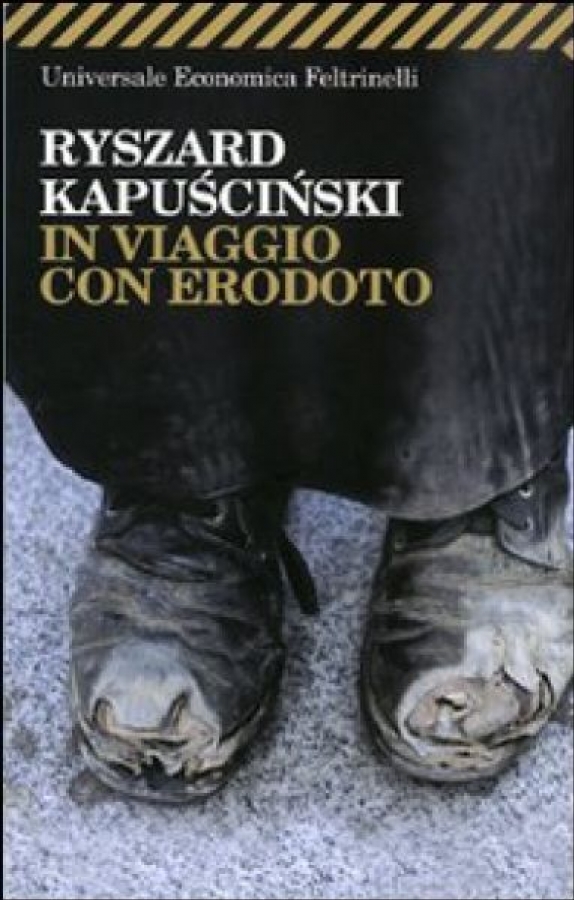
Travels with Herodotus
Kapuscinski is a great reporter who has written numerous travel books. In this case, he recounts how he became a reporter and describes some of his journeys to China, India, and Africa. Above all, however, he speaks of his great literary love, Herodotus. Whenever he travels, he carries Herodotus’s *Histories* with him. Kapuscinski’s travels are simultaneously real journeys and voyages into the world of Herodotus, to the point that it becomes difficult to distinguish present reality from that of Herodotus’s era. > The more time I spent reading Herodotus, the more I felt a sense of friendship and almost affection toward him. It became increasingly difficult for me to do without not so much the book as its author . He fascinates him > for his way of being and relating to others: a person who, wherever he goes, immediately becomes a gathering point . What does Herodotus say to the modern world? > For Herodotus, the world’s cultural plurality is a living, pulsating fabric where nothing is given or established once and for all, but is continually transformed, creating new relationships and contexts . And then > a journey does not begin at the moment we set out, nor does it end when we reach our destination. In reality, it begins much earlier and never truly ends, since the reel of memories continues to play inside us even after we have stopped . > History is an uninterrupted succession of presents, and therefore the world is not the exclusive property of the living, in which the dead hold no market shares . Reading Herodotus allows the author to express his feelings about the world and about history: diversity; travel not as escapism, but as a means of knowing and listening to others; history not as a description of past events discarded in the trash, but as an immanent presence «so that the deeds of men may not be forgotten in time».