Finished reading on: December 28, 2022
Oscar Mondadori
2022
242
Italiano
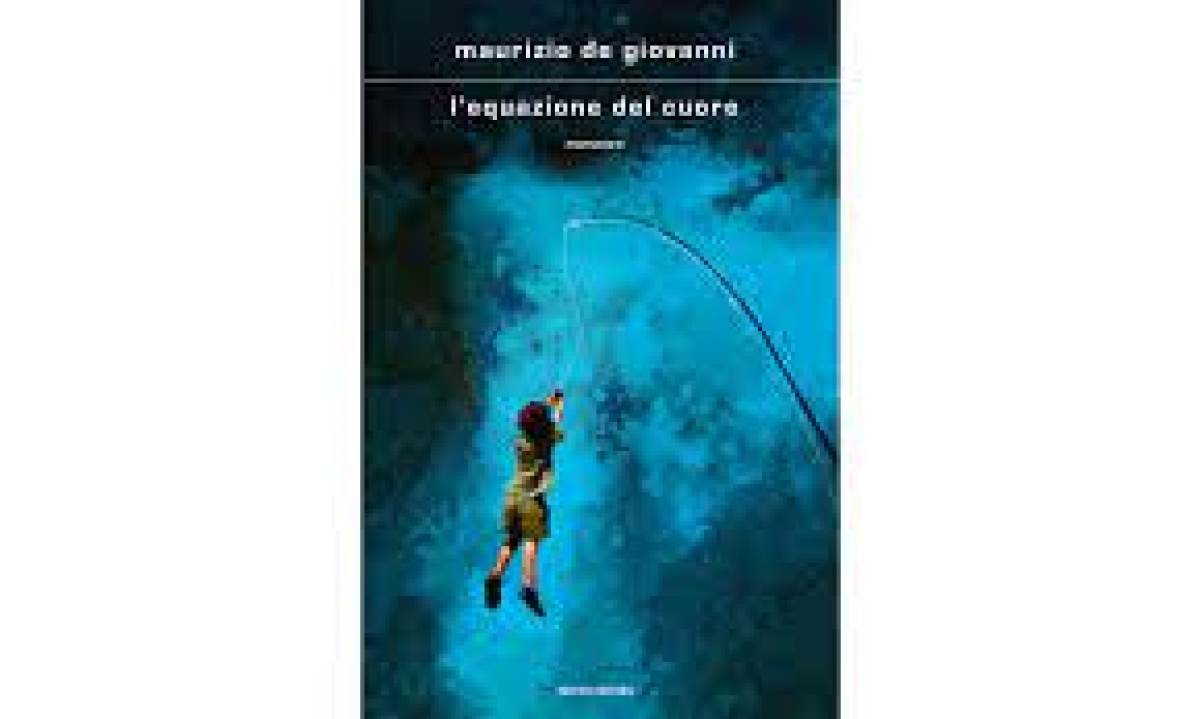
The Equation of the Heart
Title of the original version reviewed: «L'equazione del cuore»
AI Translation Notice: This review was translated from the original Italian using artificial intelligence. Book quotes and excerpts are translated interpretations and will not match the author's original English phrasing or official published translations.
Massimo, an elderly retired mathematics professor, lives in solitude on an island in the Gulf of Naples: he lost his wife Maddalena a few years ago; his daughter Cristina married a wealthy northern entrepreneur and only returns in the summer for a brief stay, accompanied by her eight-year-old son, Checco. In dreams, Massimo imagines telling his wife about the fruit trees and
that sea bass and grey mullet could be caught from the rocks year-round, whereas striped seabream and gilthead bream only in spring. (...) Maddalena, whose voice was so low that it was strange it could even be heard amidst the blowing of the wind and the cries of the seagulls
, would ask him about Cristina, and the old professor would reply that he had so much to do and, above all, could dedicate himself to mathematics,
follow the cyclical waves of the sea and calculate their variables with the wind and the moon
; and Maddalena, before fading away, would remind him that behind a daughter, even an adult one, "one must see a child that never ends." The state of bliss in which the old professor seems to live is abruptly shattered by a telephone call announcing the death of his daughter and son-in-law in a car accident, in which Checco was also involved and is now in hospital in critical condition. Massimo is forced to leave his earthly paradise and travel, reluctantly, to a cold and foggy northern town. For a while, the narrative seems intent on exploring industrious provincial Italy, with its undercurrent of intrigue, gossip, and tedious, fragile affluence; then it takes the path of Noir, albeit grafted onto a story that has little of the classic "mystery" about it. The book's true theme lies elsewhere: how to reconcile rationality and feeling? A rational approach would dictate ending Checco's life when faced with the prospect of the child remaining in a coma or emerging severely disabled. And so the professor would do (he could return at once to his earthly paradise!) were it not for the furious intrusion of Alba, the child's nanny.
Who the fuck are you, useless hermit, not even knowing how much he loves you...? (...) Massimo stood motionless where he was, in the exact same position. Suddenly he felt cold, an immense cold. (...) Yes, perhaps I didn't take something important into account, doctor
. Alba's outcry, in its primal and boundless love, compels the old professor to react. He does so in his own way. He must understand why a seemingly flawless order—a constellation of affluence, social prestige, and strong family ties—shattered, leaving Checco on the brink of death. "Tomorrow I leave, if there is nothing for me to understand." It remains unclear whether the old professor wishes to investigate the causes and dynamics of the accident out of genuine empathy, or whether he does so merely to identify a rule that might "render the disorder intelligible," bringing peace to his mathematical mind. Dear professor, there is not always a relationship of cause and effect; at times it is impossible to find a method that lends equilibrium to human beings; often emotions burst in unbidden where reason would have it otherwise.
In the final chapter, de Giovanni cites Paul Dirac's equation, erroneously dubbed the equation of love: it supposedly indicates that two particles that have interacted with each other for a certain time will continue to do so even after they have been separated. It is like saying that bonds of love are destroyed and do not evolve, insofar as two people who have loved each other are indissolubly linked. In reality, the physicist Dirac's equation states the opposite: it describes the motion of a free particle that interacts neither with external fields nor with other particles. It is disheartening that a writer like de Giovanni resorts so superficially to an urban legend used to sell tattoos to lovers; nor is it clear why he should do so, foregoing a deeper exploration of the story of an old hermit discovering his daughter's true personality and finally grasping his profound bond with his grandson.
The novel is very well written; the narrative flows pleasantly and smoothly. The first fifty pages possess great intensity; thereafter, the plot unfolds laboriously, almost as if the writer had lost his direction. The shifting of the narrative voice, increasingly frequent over the course of the story, and the recourse to conversations with the comatose grandson are devices that demonstrate de Giovanni's storytelling skill, but they also expose the structural weakness of the narrative: it does not hold up if left to its natural evolution, neither as a Noir nor as psychological analysis.
Why read it? It is enjoyable.