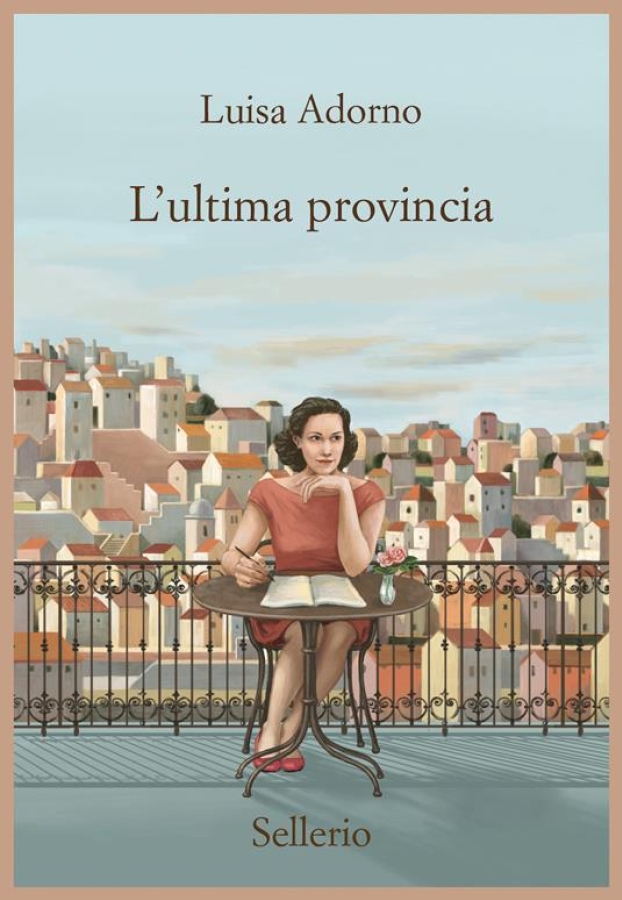
The Last Province
Luisa narrates in the first person her entry into her husband's family. Cosimo is the son of a Sicilian prefect who travels across Italy guided by two tenacious principles: nostalgia for Sicily, > when we were at Bosco Canniti...(...) a small piece of black earth, fine as sand, rugged with lava boulders, with ledges, knolls, sudden precipices: (...) a latifundium in its tenderness ; having a post where there is no "noxious weed," that is, where "poverty and a right-wing majority imprinted a slow breath." When Cosimo declared that he would spend the summer at the prefecture in his father's new post, "at that moment my human interest in him was born," along with a curious and affectionate willingness to let herself be drawn into a provincial family, so distant from her own culture and social background. And herein lies the essence of this novella. Luisa, an urbanite, left-wing and independent, does not adopt an attitude of superiority toward her husband’s family; rather, she describes with gentle irony the traits of a small social unit (the Prefect, the Prefettessa, the maid Concetta, and the dog), stubbornly Sicilian throughout, despite their numerous relocations across Italy. They form a series of portraits marking a sort of *Bildung* for the young woman, initially bewildered and amused, and later permeated by the subdued sweetness of provincial life. A few examples: The Prefettessa is ill, and amidst her feverish delirium fears that the faithful maid will abandon her: «Is it true that you are leaving with the *mondine*?, she asked breathlessly.» «Cu cui? [With whom?],» the other retorted, «and from that moment on it became a habitual curse:» «Cu' sti mondini». And the discovery of pyjamas at the dinner table? «In pyjamas, alongside care for one's clothing, one drowns self-control, and the restraint of one's speech. Mostly they stay silent, content, with the murky air of someone who has just got out of bed. If they speak, it is only in dialect. If they shout, it is 'cacchio'. Cacchio of a woman, of light, of a fly, depending on whatever jolt stirs them > . Official ceremonies are duties that the Prefect carries out with pained yet meticulous solicitude. He had put on a pair of comfortable shoes. (...) It was the feast of Saint Joseph (...) a procession with ranks of boarding-school boys, of little orphans.... grey rows of yoked young girls. (...) In April he had followed the Good Friday procession, in May that of the patron saint.... > . Having become a mother, with her baby in swaddling clothes, holidays at Borgo Canniti are an astonishing discovery for Luisa. Right from the ferry across the strait, soaring and solitary on a flat horizon Mount Etna had appeared, (...) A fine plume, ave!« exclaimed the Prefect. On the small farm »the heat was shelterless. (...) Indifferent to the dazzling reality, the Prefect was content with a straw hat, pyjamas, and a walking stick, to pace the grounds several times each day > . (...) When the sun disappeared behind the mountain and the small houses rose like a curtain to let in the evening air, the voices and noises seemed to die down. (...) From the bricks rose to our legs, enveloping them, an animal warmth that the fresh breath of the sea gradually cooled: the scent of jasmine was so sharp and precise that one could almost hear it To the child > Ce lo date 'u succu d'uva? the Prefettessa's sister asked in the meantime. (...) Within a few hours, before the gathered family, Concetta was slipping the first spoonful of juice into the child's mouth . The novella is slender, devoid of a true plot, vague and light like a sketched painting. Sustaining it is a refined, evocative, and pleasing style of writing, in which the recourse to dialect enriches the narrative, offering moments of fantastic suspension. It is as if an ancestral world, magical and intimate, peeked through an educated and thus distant stylistic approach: dialect breathes life into the characters and the descriptions of the settings. Too much is left unsaid for one to offer a wholly positive assessment. Why read it? Pleasant
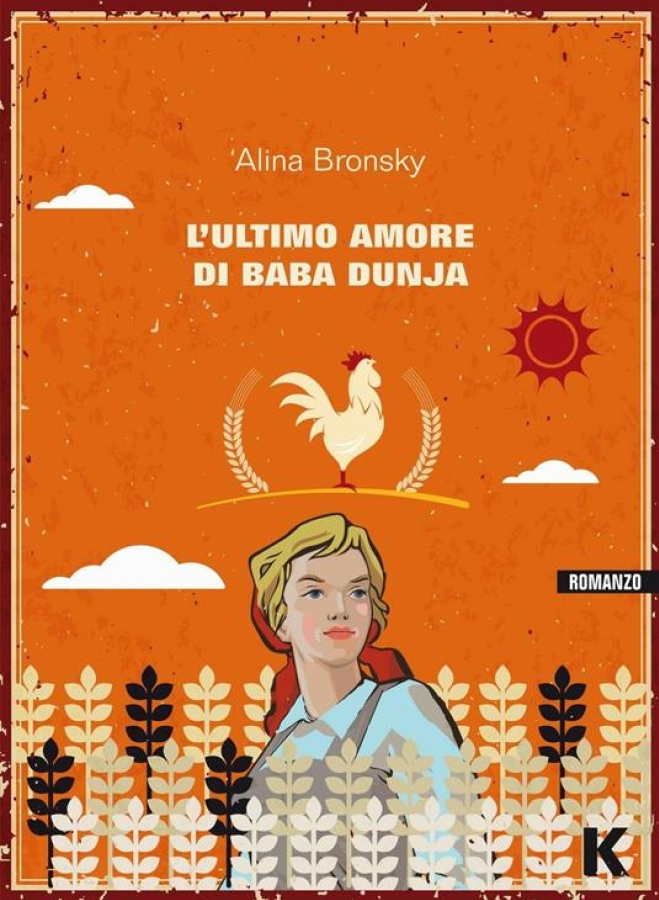
Baba Dunja's Last Love
> She has a small, wrinkled face and narrow, dark-brown eyes. She is tiny and round, barely reaching a meter and a half . This is Baba Dunja, and this is how a journalist describes her; but the name the author gave her would suffice: *baba*, synonymous with old woman, and *dunja*, an affectionate diminutive that in South Slavic stands for "quince." Unlike Baba Yaga, the witch of Russian fairy tales, Baba Dunja is good-natured, ready to shoulder the burden of her small community, Chernovo, the village of death. Only further into the reading do we discover that Chernovo is near the Chernobyl power plant and lies within a radioactive zone: an abandoned village inhabited by a sparse handful of exiles in search of solitude and death. > The village has a story of its own, intertwined with mine, like two locks of hair in a single braid . There are the living, few in number: Marja, the fat and lazy neighbor ( > her former beauty has not entirely vanished; it still lingers in this room like a ghost ), Sidorov, a mad old man in love with Marja, Petrov, a young man with little time left to live, Lenochka, "who from behind looks like a young girl and from the front like a doll," and the Granilovs, husband and wife, "walking past their land one can smell honey and rose oil." And there are the dead: > the old liquidator in the striped shirt, (...) the baby stillborn in my hands, (...) the mother lifted a corner of the towel and smiled. (...) Soon she would follow him. (... The young girl with the red braid....(...) These are my dead who followed me to Chernovo, and there are still others who passed before my eyes, by the dozen, along with their cats and dogs and goats . In this landscape suspended between the living and the dead, time seems not to flow, in the serene anticipation of death. Then a man bursts into the small community with a little girl, the latter inevitably destined to die from the effects of radiation on her fragile immune system. When Baba Dunja urges him to leave quickly, the man reacts violently, throwing the old woman to the ground. Petrov intervenes in her defense, killing the man. At this point, all the inhabitants are arrested or summoned as witnesses. It would be enough to say that it was Petrov, but once again the benevolent fairy-tale witch shoulders the burden of Chernovo's small group of the living: she alone claims guilt for the crime. Baba Dunja of the village of the dead becomes famous; she saved a child—let the poor old woman die in peace! Send her to Germany to her daughter! Pardoned by the president, the airplane awaits to take her to her daughter, far from the village of the dead. > In the end, I learned too (Baba Dunja tells her daughter). (...) In fact, I learned to smile after returning to Chernovo. (...) I walk for more than three hours. It is as if the road had lengthened, as if Chernovo had receded during my absence . (...) The houses of Chernovo loom on the horizon, like sparse, crooked teeth inside a mouth. (...) Hopefully at least someone is there, I think; if no one is, it will mean I'll live alone, with all the spirits and the animals. "Baba Dunja recalls the protagonist of a recent novel by Alina Bronsky:" *My Grandmother's Braid* > (see review on this site): here, however, the grandmother is exceedingly sweet, steeped in love for all living beings and for the dead as well. One wonders why Baba Dunja did not channel such inner strength into helping her daughter and granddaughter, lost in the loneliness of big cities. To me, the reason is clear: Baba Dunja can only be at peace with herself and with others in Chernovo, in her own place. True, the factory is abandoned, no one has worked the fields for decades, above all, lush green weeds and large-leaved plants grow, with faint purplish reflections > , but Chernovo is where she got married, raised her children, where they ate the chocolate treats given by the factory for New Year's Eve. One can grow up in Capri or in the Tamburi neighborhood of Taranto, right against the toxins of the massive steel mill, spend one's childhood or raise children in a gorgeous or a wretched place, yet one always longs to return to one's own place. Chernovo, precisely because it is the village of death > , through its extreme conditions is a metaphor for how important our physical space is to us: the landscape, the smells and sounds, the streets and squares, the inhabitants and animals with their everyday faces, so familiar as to become parts of ourselves. In no part of the earth can I settle, (...) I seek an innocent land," so sings Ungaretti in *Girovago* (from the collection *Allegria*). At first, the writing is made up of short, rudimentary, almost truncated sentences, giving the impression of an unsteady hand. Then the narrative style takes flight: the landscape emerges, memories and emotions deepen in intensity, characters are sketched in muted yet striking tones that leave a lasting impression, and the dialogue sets the narrative pace. If one criticism can be leveled, it is that towards the end the story takes on melodramatic, cloying notes that could easily have been spared. Why read it? Fascinating in her sweetness, the figure of Baba Dunja is a fine metaphor for the importance of place
A Socialist Love
> Here I live as I lived everywhere, that is, as Kuliscioff: cited in a fine publication edited by Vittorina Maestroni and Thomas Casadei (*Medicina, politica, emancipazione. Anna Kuliscioff e noi*, Mucchi editore 2024), this phrase aptly encapsulates Anna Kuliscioff’s personality: so many professions, so many commitments, and so many nationalities, yet always herself. It is no coincidence that this proud assertion is drawn from a letter to Andrea Costa, then her life partner and father of her only daughter, Andreina. Anna was in Naples studying medicine, and their relationship was unraveling, soon to reach its end. But who was Anna Kuliscioff? Born Anja Rosenstein between 1853 and 1857 in Russia to a wealthy Jewish merchant family, she was initially an anarchist, rechristening herself "Anna Kuliscioff" as an allusion to the noun *kules*: the gruel that was then the sole meal of the poor. In 1877, she met Andrea Costa, with whom she had an intense romantic relationship and co-founded the Italian Socialist Party. Costa was the classic Romagnolo—fine moustache, impetuous, and daring. Thus far, we can understand the allure of the young revolutionary for the slender, elegant, polyglot aristocrat. All portraits of Anna concur in depicting her as > a young blonde woman with a high forehead, very fair complexion, and blue eyes, and as Filippo Turati put it, > the moment I saw her, Anna was breathtakingly beautiful. An apparition of light. It is less clear what Anna saw in Filippo Turati when she met him in 1885 and embarked on a common-law relationship with him that would last a lifetime, until Anna’s death in 1925. Filippo himself described himself as *a faun*, big and burly, awkward, plagued by nervous ailments, so attached to his mother that he slept at her house every night rather than in the shared home he and Anna maintained in Milan. It is from this complex relationship that a fictionalized biography should have set out to comprehend Anna's contradictory personality: at the center of one of Milan's most exclusive salons, welcomed by the Lombard aristocracy for her refined manners, a scientist esteemed by Cesare Lombroso himself, a "doctor of the poor" whose practice was always open to working-class women—and therefore a feminist who placed the condition of working women at the heart of her struggle, even in conflict with other prominent feminists of the time—the inspiration behind the earliest legislation protecting maternity and infants, and finally the most cosmopolitan of the socialist leaders of the era, capable of engaging in dialogue with Engels and German Social Democracy. > The harmony between genius and heart is so rare, and this is Turati's gift, so Anna wrote to Napoleone Colajanni in 1885; and thus she found in Filippo a good man, who knew how to act as a father to young Andreina without being overbearing: a filial bond that must have been deep, given that Anna’s daughter introduced her fiancé to Filippo before facing her mother, whom she knew would be disappointed that Andreina had chosen the scion of a wealthy, traditional bourgeois business family. Yet Anna was a woman both ambitious and realistic; she knew that as a woman she could carry no political weight of her own, and so she "used" Turati—a gentle, devoted man—to bring political battles into parliament and society. More often than not, Filippo disagreed; at times he did not listen to his partner; yet frequently he championed Anna's ideas, amidst the malicious barbs of his colleagues. Thus far, an image might emerge of a woman bound to Filippo out of opportunism, almost exploiting Turati's position. Yet if one studies the letters between the two beyond the political realm, an immense love emerges on Anna’s part. In the famous "family feud," Anna openly accused Turati of conservatism and of being submissive to the party leadership, which refused to extend universal suffrage to women; yet immediately afterward, she worried whether Filippo had put on his wool undershirt because of his frail health, addressing him with an affectionate Milanese pet name. What desperate love can be felt in these words: > I swear to you that perhaps no one has ever loved you as much as I do, and perhaps that is my misfortune. Far from you, with the doubt already taking root that it might be better for you were I to disappear, so that you might meet another woman capable of making you truly happy, the slightest indifference from you looms large and plants itself between the two of us like an insurmountable reef. (Letter from Kuliscioff to Turati, 1900, from Salsomaggiore). Writing a "fictionalized" biography is exceptionally difficult: one must frame the subject's life historically while simultaneously being able to lend depth to figures that are often intricate and elusive. Take, for instance, Sebastiano Vassalli’s *La notte della cometa*, in which Dino Campana is portrayed in his most secretive facets, contextualizing the great poet’s life within the milieu of early twentieth-century Marradi, within the family dynamics of a provincial bourgeoisie, and in light of the 1904 asylum law. The trope of the "mad poet" dissolves beneath Vassalli’s impassioned pen. Without even calling upon a literary giant, consider Raffaele Messina’s *Artemisia e i colori delle stelle*, in which the author takes the liberty of imagining the celebrated painter reflecting upon her life and the lifelong sentence she carries with her—of being remembered for the infamous rape rather than for her art. This narrative device lends rhythm to the biography, together with the Neapolitan setting so finely portrayed by the author (see the reviews of both books on this site). All of this is sorely lacking in *Un amore socialista*: there is no passion, it lacks the courage to invent, to let the imagination take flight, and it must be said that the prose itself is simply not there. It is a flat chronicle, all the more flawed because it assumes readers can contextualize the events on their own—and we are talking about history spanning the nineteenth and twentieth centuries. Why skip it? It is thoroughly disappointing, especially for those of us enamored of Anna Kuliscioff.
Like a fawn is my love
In a 2011 book (*Falling Out of Time: A Novel in Voices*), Grossman observes that the grief over the loss of a child is so immense as to render a father > capable of conceiving him... whoever loses a child is inevitably a woman . It would therefore be easy to conclude that the author wished to adopt the mother’s point of view in writing this novel. Orah fears losing Ofer, her younger son who has gone off to war, and hopes never to forget him. She takes advantage of a long hike to recount Ofer’s life as well as her own (her love for her men, the childhood and gradual detachment of her sons) and thereby rip through > all those visible and invisible threads... that were moving around her and above her at that moment, (and that) wove together into a dense, gigantic web.... (but) how can one describe and bring a person back to life using only words? My God, using only words? Yet Grossman himself notes that the novel was largely written before the death of the author’s son, who died in August 2006. On the other hand, Orah’s narrative is so steeped in existential anguish and epochal pessimism as to transcend the theme of mourning, however devastating the loss of a child may be for a mother. What Orah speaks of is the story of Israel, a country in which there is no future for individuals, for familial and romantic bonds, or for the people as a whole, caught in endless conflict with the Arab nations > There, the sweet illusion in which they had lived until that moment had shattered, their clandestine cell had been discovered. For twenty years they had walked suspended in mid-air, on the edge of a precipice, conscious of doing so, and now they were falling into it. They would fall endlessly . Orah has just separated from her husband and is about to embark on a trek with Ofer, who has just completed his lengthy military service, mandatory for all young Israelis. Yet another war breaks out, and the young man decides to return to combat. Orah refuses to wait at home for the news of her son’s death and sets out on the hike anyway, accompanied by an old friend, Avram. Across an enchanted landscape, brimming with light, flowers, and forests, unfolds Orah’s slow, dense narration. It can be read on four levels. On the first level is the adult world, comprised of Orah herself and her two men, Ilan and Avram. Ilan is tall, vigorous, confident, and positive. Avram is short, pudgy, something of a poet and writer, in love with words. Orah loves them both. She marries Ilan, with whom she has Adam, but conceives Ofer with Avram, even though the latter refuses to act as a father. He is broken by the torture endured at the hands of the Egyptians, who took him prisoner in one of the many wars. The long trek provides Orah the opportunity to introduce Ofer to his real father, and also to revitalize the deep bond that unites her with Avram. Reaching back into memory unearths painful events, deep wounds, nightmares, ever spawned and fed by continuous, unending wars. Speaking of Ofer allows them to rediscover their old love, mutual affection, and an attraction never forgotten. A phone message, in which Avram’s new partner announces the “false alarm” of a possible pregnancy, shatters the rediscovered connection. Orah > sprang to her feet, planted herself before him, incredulous: and maybe you’ll have a daughter, Avram, a baby girl... You will remember... you will remember Ofer, his life, his whole life, won’t you? The second level is the world of the young, represented here by Adam and Ofer. The theme is unmistakably that of detachment, so often experienced by parents watching their children become adults. Gorgeous is the description of the embrace between Orah and Ofer, conveying a sense of growing physical distance. > I could embrace him only if he wanted it... Ofer used to hold her cautiously, carefully keeping his body at a distance from her breast, leaning down toward her in a ridiculous arch . But there is something more. The two boys are ready to serve their country enthusiastically, even unto the ultimate sacrifice. One episode tears an unsettling rift in this apparent certainty. When Orah accompanies Ofer to the military muster, she and her son are briefly filmed by Israeli television. The boy is swaggering; the mother, startled and uncertain. But as soon as the camera moves away, Ofer whispers to his mother: > if I get killed, get out of Israel. Just leave. You have no business being here... if this curse passes from generation to generation, then you have nothing to seek here . And then there is the third level: the childhood of Adam and Ofer. The pages dedicated to the two sons’ early years are the finest. With an entirely maternal sensitivity and delicacy, Grossman manages to fully capture the profound bond between a mother and her offspring. The rearing of the “two shoots” is also the pivot of the relationship between Orah and Ilan, as happens with all parents. > They delighted in splinters of memory and little moments that took on importance only between the two of them, turning golden, precious: the goldmines of their life . Yet small details—such as Adam’s nervous tics and Ofer’s decision to be an Englishman (a naive subterfuge to shield himself from the hatred of the Arabs that oppresses and terrifies him as a child)—show how the nightmare of endless wars intrudes into childhood itself, denying it any true serenity and marking the gradual estrangement of the sons from a mother who could not save them. > The memory of the flash of fear that had flared in her younger son, the dread that she might devour him, was carved into her mind like an ancient graffito. Go explain a moment like that between mother and child to Avram, she thought. And yet she did, she described it to him in detail, so that he would know, suffer, live, remember . And finally, there is the loss of human dignity: the fourth level of the narrative, the one that overwhelms everything. Ofer’s patrol forgot that they had locked a man in a cold storage room. “How could you just forget a human being?” It was useless for her to realize rationally that it could not be the responsibility of Ofer, a mere soldier; the idea that inhumanity had gripped her son as well, rendering him indifferent, completely overwhelms her, and > cracks and fractures widened and spread with great speed through the most delicate, intimate tissues... their family was disintegrating at an incredible speed, overwhelmed by a crushing force that seemed to have been lying in wait inside them all those years and was now assailing them with an incomprehensible fury, even with a strange, vengeful joy . Even in wartime, one would wish to live > a private, quiet life. Do you understand? A small, unheroic existence, keeping ourselves out of this damned fray as much as possible : to carry out, as Tolstoy puts it in *War and Peace*, “the real life of people... independently” of political and military upheavals. It is not possible. War invades peace, destroying even the most intimate feelings, the deepest relationships. Grossman’s novel is a kind of Israeli *War and Peace*, with a significant difference: there is no solution for Israel, it is impossible to drive away the enemy (they are too numerous, the hatred and the dead on both sides now too deeply entrenched); they are condemned to fight forever. Faced with such an atrocious fate, the reader would like to lose himself, and withdraw, into the novel’s marvelous imagery, so sweet and delicate, revealing a subtle, affectionate, and empathetic knowledge of both the world of childhood and that of womanhood. Why read it? A great masterpiece!
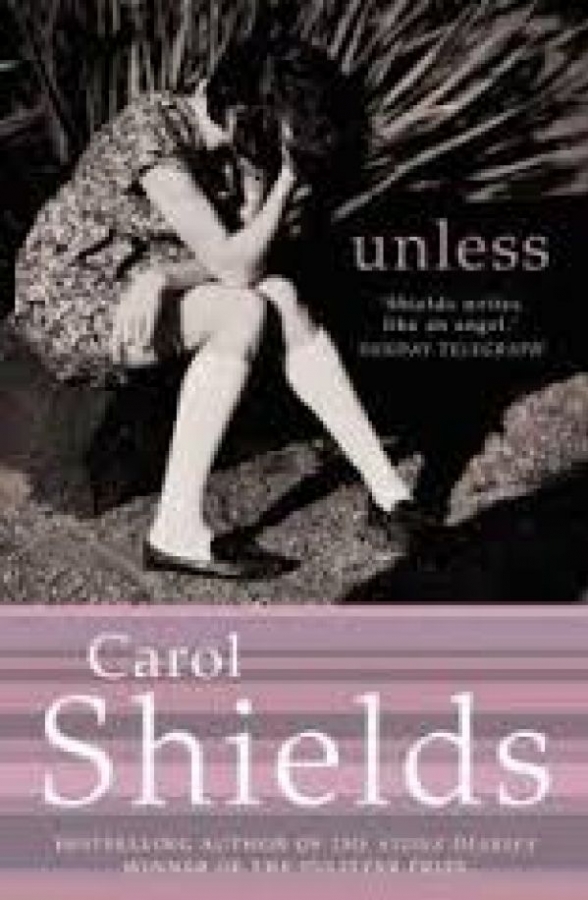
Unless (unless)
Reta, a doctor’s wife and mother of three, is with her friend Danielle, for whom she translates from French into English. > It would be better (...) to use the word mind instead of heart; (...) referring to the heart as the seat of feelings is no longer in fashion, condemned by critics as evanescent. (...) Danielle pondered for a moment, then smiled at me affectionately yet mordantly, and placed her hand on her breast: but this is where I feel grief, she said, and tenderness . Is it possible to confront rationally a daughter’s abandonment, the profound grief that turns the small habits of life into “costume jewelry”?. > In our big, old house (...) we lived the life we chose long ago: abundant, intense, yet with interludes of peace, surrounded by furniture, books, soft cushions to lie upon, food in the fridge, even more in the freezer . Suddenly Norah, the eldest daughter, drops out of university, takes to the street to beg with a sign bearing the word “Goodness”. How to react? The malaise is so profound, invading every moment of life and engulfing the whole family, driving each of them to withdraw into themselves, desperately trying to make sense of it, to offer help, to endure the sorrow while continuing the routine of daily life. Yet it is not possible; the suffering is too immense. Reta finds herself in the restroom of a restaurant and on impulse writes on the wall: > my heart is broken, which I would later recognize as an act dramatic, childish, indulgent, grandiose, and full of strength. (...) Immediately I felt relief between my ribs. (...) Something akin to joy swept over me, if only for a moment (...) as if under an enchantment. I had allowed myself to be receiver and transmitter at once, not a dead thing but a living link to all that would become unbearable suffering. In that moment I trusted my instinct, I set down words that revealed the truth, bearing witness to the most private and alarming of visions, rather than the self-pitying and melodramatic graffiti it actually was. Reta reacts by dedicating herself to writing a novel, a work of fiction she wants to be light, superficial, and blessed with a happy ending. Two fiances are meant to marry, but she is not convinced about marriage; she is not truly in love. How much of Reta’s suffering finds its way into the novel? And how much does it reflect her own marriage? Reta is at a crossroads: to give the story a dramatic twist, as her editor would like in order to turn it into a work of substance, or to stick to the original idea, namely a "romance > , aimed at the general reading public rather than the critics. Reta remains anchored to her project because she clings to hope, to the longing to find her daughter again. The protagonist does not marry; she chooses her own happiness; just as the writing of the novel concludes, Norah’s ordeal also comes to an end. Through a sequence of fortunate circumstances, the daughter, gravely ill, is rescued in extremis and treated; she returns to her family. In the hospital, the doctors notice that Norah has numerous burns; she had in fact been caught in a fire, when a young woman committed suicide by setting herself ablaze. In that moment Norah realized that the world is not good—that, on the contrary, injustice and existential suffering prevail outside the walls of home and university. God is dead! Like Simone Weil, who saw in her own physical wasting the only way to resurrect God, so Norah pursues her own self-destruction to cry out her longing for God, to bear witness to the desire for Goodness. And thus Norah’s behavior also has its logical explanation, an understandable motive: it is the mind, and not the heart, that is the source of Norah’s act. It is a complex and difficult book. The writing is elegant and masterly, the reading flows smoothly, enthralled by the beauty of the language. Too many themes are addressed, from philosophical questions to the female condition, down to the cathartic function of narrative imagination; missing, however, is psychological depth, which would better illuminate the motives behind Norah’s behavior and the reactions of Reta, her husband, and their other daughters. It is as though the author fled from the human condition to retreat into a metaphysical, political, and sociological dimension: an approach that dissipates the universality of a story told with such skill and preciousness. On the other hand, the use of unless” (in Italian “a meno che non”) presupposes the third conditional form, already indicative in itself of a deliberately sophisticated approach to narrative: perhaps greater simplicity would have lent more vigor to the story. Why not read it? It is difficult to grasp, at times prolix and tedious.
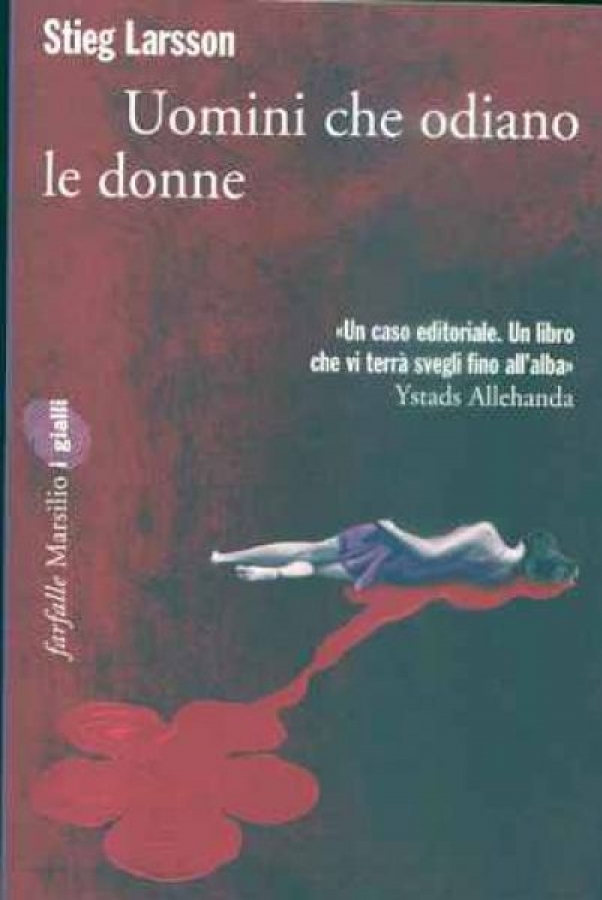
Men Who Hate Women
The novel is a thriller. A journalist is hired by a powerful industrialist, Vanger, to investigate the disappearance of his niece, which occurred twenty years earlier. The journalist thus moves to a remote island in northern Sweden, where the elderly industrialist has retired. Meanwhile, the narrative follows a young woman who works for a security firm and is remarkably adept at computer-based investigations. Owing to her violent, troubled past, the young woman endures the abuses of a lawyer who is supposed to serve as her legal guardian and supervisor. In the meantime, the journalist begins to uncover clues that point to the sexual deviance of a family member: this person tortures and murders women. At a certain point, the journalist and the young woman begin working together, embark on a romantic liaison, and become embroiled in a series of perils, frequently risking their lives. The story draws to a happy resolution with the death of the serial killer, the discovery of the niece—who had fled to Australia to escape the serial killer, her own brother who had been abusing her—and finally the journalist’s triumphant return to his publication. In truth, the story does not end entirely on a positive note, as the young woman has fallen in love with the journalist, only to watch him walk away with another woman. While structured as a thriller, its true underlying theme is men’s attitude toward women. Women are invariably the victims, whether subjected to physical violence or wounded in their deepest feelings. The figure of the journalist is indeed emblematic: driven by intense political conviction, he nevertheless drifts from one woman to the next, favors noncommittal relationships, and fails to realize that he has drawn into a romantic bond a young woman who believed she had finally found an emotional anchor. > "Salander, you really are a pathetic idiot," the girl said aloud to herself. She turned on her heel and set off once more toward her freshly cleaned apartment . At times, the book slips into banality and dwells excessively on the sexual theme. The style is sparse and unadorned, making the reading experience both compelling and engaging.
The Fish-Men
Antonia Nevi is a young geographer at the University of Padua who has inherited from her uncle, Ilario Nevi, a house in Focomorto in the Ferrara area, a plot of land in Isola di Ariano in the Polesine, and a sizable sum of money. We find ourselves in the Po Delta, a vast territory that, as Antonia herself describes in one of her essays, the great river > has carved out, altered, and nourished, but also terrified and devastated , and which was definitively overwhelmed in the post-war period, from the concreting over of the coastline to the land drainage projects that left behind a scarred landscape and vast, depopulated spaces. For Antonia, this is an opportunity to return to a cherished place following painful personal experiences (she lost twins she was carrying in her womb) and a troubled romantic relationship; above all, however, it is a way to evoke the memory of her uncle, a figure of great importance to her. From whom could her passion for the Po Delta have come if not from Ilario Nevi, who first experienced this land as a partisan, then documented its poverty and devastation, and finally retreated there to hole up through the long years of old age? Ilario Nevi > had never looked his age. At seventy he looked like a man in his fifties; at almost a hundred you would have taken him for eighty. Still a decent amount of hair, a lean physique just slightly broad at the hips, an upright gait, an alert gaze. Impeccably dressed until the very end -- always in a suit, never seen wearing a tracksuit -- and, naturally, clean-shaven. During her scouting of the inherited land, Antonia discovers in a shed > statuettes and statues of various sizes. (...) Pencil drawings, charcoal sketches, watercolours... All replicas of the same creature. The being was vaguely anthropomorphic, its posture more or less that of the Vitruvian Man, but the head, white and neckless, was that of a fish. (...) The skin of its back and limbs was covered in golden scales, while the belly was white, like the head, and diaphanous. (...) The being had gills, and its four limbs ended in webbed fingers and hooked claws. Between the legs, or whatever they were, one could see, sharply delineated, now a penis, now a vulva, now both. The story raises high expectations: are we in the presence of a witness to a past in which land and water coexisted, giving rise to hybrid beings? We expect Antonia to set out to investigate this mystery, piecing together the final years of her uncle's life: years devoted to environmental activism. A few pages seem to point in this direction; instead, as happens when an author tries to say too much, we are dragged into a partisan tale, into Ilario Nevi's escapades in the cinematic Rome of the 1980s, and above all, the Fish-Man is no hybrid creature: banal though it is, the uncle was simply a woman who lived her entire life hidden in the guise of a man. Such was my disappointment that I abandoned the book on page 309, abiding by Daniel Pennac’s rule: “Does a book drop from our hands? Let it drop” (from *Come un Romanzo*, 1993). When I attended the book launch, quite a storm had broken out. Several institutions in Ravenna had refused to host the author; it seemed Wu Ming 1 intended to blame the disastrous floods of 2023 and 2024 on the abysmal management of the land (how could one deny it?) and, by extension, on the regional and local authorities. Indeed, I had assumed—mistakenly—that *Gli uomini pesce* was meant to critique land reclamation and foreshadow a reconquest of the territory by the waters: a thesis perhaps unrealistic, but undeniably thought-provoking. The novel is nothing of the sort. Are we still to be scandalized by someone who is “transgender”? Another reason that prompted me to “drop” the book was the prose and the narrative structure. The former is fractured into short sentences, with a reliance on the now all-pervasive habit of verbless clauses between full stops; yet why not use semicolons and colons instead? The plot is rambling and muddled, not least because of the pile-up of disparate storylines that end up dispersing the main narrative thread, which ought to revolve around Antonia, her love for the Po Delta, and her affection for her uncle. Why avoid it? Tedious and prolix.
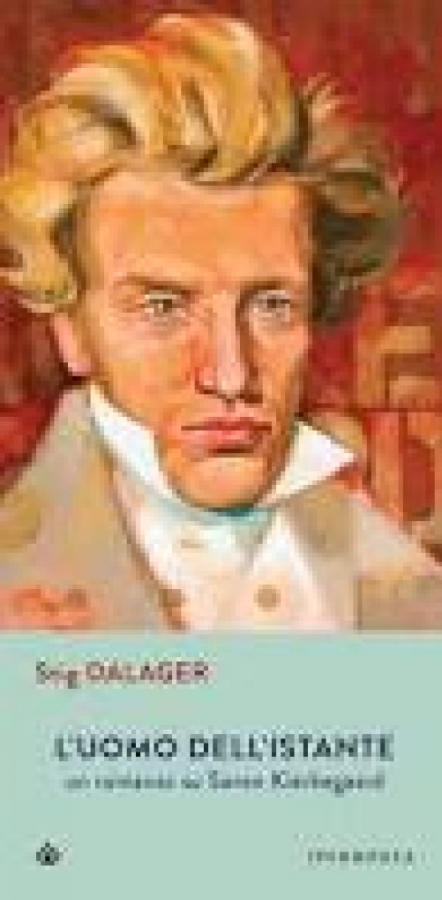
The Man of the Instant
> My illness is fatal and death is necessary to the cause to which I have long dedicated all my spiritual resources, for which I alone could fight and I alone was designated . Dalager imagines that with this sentence Søren Kierkegaard encapsulates the diagnosis of his ailment, and his destiny, at the moment he has himself admitted to the hospital in Copenhagen, in 1855. He is a broken man: alone, reduced to destitution, despised and derided by his fellow citizens, persecuted by the Lutheran Church, which considers him a madman and a heretic. In his brief life—he was born in 1813—Kierkegaard produced a vast body of work revolving around a concept revolutionary both then and now: man's essence lies in choice and in the "ardour of freedom" that underlies it. > If a man could always maintain himself upon the pinnacle of the moment of choice, if he could cease to be a man, if in his inmost being he were merely an ethereal thought, (...) it would be foolishness to say that for a man it might be too late to choose, because, in the deepest sense, one could not speak of a choice . Yet man > constantly rushes forward and poses the terms of the choice now in one way, now in another, so that the choice in the following moment becomes more difficult, (...) because when choice is deferred, the personality chooses unconsciously, and the dark powers decide within it . To avoid being dragged along, one must choose oneself, > as a free spirit (...) born of the fundamental principle of contradiction, born by virtue of having chosen himself. (...) This troubles him, yet so it must be: for when the ardour of freedom has awakened within him, (...), he chooses himself and the struggle for this possession as for his supreme salvation, and this is his supreme salvation . (*Either/Or*, pages 39, 40 and 93 Ed. Mondadori 1956). It was no easy task to fictionalize the life of a philosopher seemingly alien to his time, almost detached from reality, concerned with another realm: consciousness. Dalager succeeds brilliantly because Kierkegaard is captured in a state of extreme vulnerability, in the days preceding his death, when the courage to live is now bound solely to memory, not to the present instant. > To him, memory is exceedingly young, like water meandering through the desert of life; it always tells the same story and soothes his pain, (...) but his remembering is not that of the old, of things distant in time. For me (Kierkegaard writes to his beloved, Regine) every harmonious contact between the idea and life is instantly transfigured into memory. (...) In memory (Dalager adds) there is something distant that has lost the sting of grief and retained the sweetness of melancholy . Now dying, frail, subjected to humiliations like all terminally ill patients, reduced to his fragile physical nature, in his mind Kierkegaard retraces the fundamental milestones of his life: his severe and authoritarian father, an affectionate mother who would die far too soon, the many brothers and sisters who would not reach the age of thirty; his promising studies that already pointed to an independent and overly brilliant student; the engagement to Regine and the decision to break it off (the pivotal episode of his life, to which he would constantly return in memory); the sojourn in Berlin, officially to attend lectures on German philosophy, but in reality to write desperately and in solitude; and finally the last chapter of his life, ever more steeped in spirituality and faith, yet ever more critical of ecclesiastical authorities and official religion. The lengthy biographical digressions, frequently underpinned by passages from Kierkegaard's works, alternate with glimpses of hospital life, returning us to the reality of a suffering, terminally ill patient. > In the dark he feels a hand succouring him, helping to lift his frail body just enough, (...) for a moment he thinks once again that he is near death. Instead, he succumbs to a deep sleep that leads him into a hidden room of the soul, similar to the room of his childhood (...) yet different, because along the walls are the beds of all his brothers and sisters (...) voices and laughter blend together. until suddenly their mother appears, singing something to lull them to sleep. (...) Where are you going? his mother asks him. Toward my death. And already here, she replies, you are in eternity. The narrative is very well written, and this is its primary virtue. Its flaw lies in the work's spurious nature: it is not a biography, because there is too much fictionalization, beginning with the brilliant literary device of the dying Kierkegaard; it is not a synthesis of the Danish philosopher's thought, even though Dalager frequently delves into illustrating his major writings, rendering the narrative long-winded and intricate; it is not a novel, because the psychological analysis of the protagonist is deficient and the characters are flattened into their historical dimension. In particular, one theme of great interest remains unexplored: the narrative reveals how Kierkegaard regrets the choices he made, especially the breaking of his engagement to Regine. The desire to choose breeds anxiety, and it is better to be carried along by events—this is part of the Danish philosopher's thought. Yet why did Kierkegaard make certain choices that he would later, in some way, perceive as detrimental to his happiness? What prevented him from giving tangible form to his love for Regine? Was it enough for him merely to fantasize and write about it, as he did in *The Seducer's Diary*, moreover without the slightest regard for Regine? Is there not in Kierkegaard a narcissistic desire for manipulation and complacent superiority that makes him resemble a cynical seducer more than the noble moral figure he purported to be? It would have been interesting to investigate these aspects of Kierkegaard's character and life, for what would have emerged is a far more complex personality than the one portrayed in this novel. Why not read it? It is not an introduction to Kierkegaard; it is a middle ground that leaves one unsatisfied.

The Man of Elcito
Brigandage was an endemic scourge of the Papal States as well as of the Kingdom of the Two Sicilies; between 1860 and 1870 the phenomenon took on a strong anti-unification character, not so much out of an attachment to the old regimes, but rather as a reaction against a State that portended to be centralist, bureaucratic, and repressive toward the lower classes. The clash between the outlaw bands and the army of the newly formed Italy was violent; recourse was made to summary executions, which engulfed the civilian population accused of aiding the brigands. *Lʼuomo di Elcito* is set in the Marche region in 1866. It is not a historical novel: the historical backdrop serves merely as the occasion to examine how a man transforms from an “empty shell” into possessing an identity of his own—not through conscious choice, but swept along by the current of events. The protagonist is Sergeant Toschi. With consummate narrative skill, the novel opens with the account given to Colonel Negri of the cholera epidemic that ravaged Ancona in 1866. Toschi, along with a few soldiers, had remained in the Marchigiano city while its inhabitants and the rest of the troops fled for fear of contagion; in truth, Toschi had not followed the others because he and his comrades had been thrown into prison. To the colonel, however, the sergeant spun a different tale: with immense valor, his squad had held the city. From the outset, the protagonist’s manipulative faculties emerge—talents that will resurface in the correspondence between Toschi and the colonel, and later in the half-truths our sergeant will feed to the notorious, formidable brigand Olmo Carbonari. Once again, the imagination proves to be a resource, as well as an aesthetic pleasure found in inventing, telling, and listening to stories. Precisely on account of the devotion to duty displayed during the events in Ancona, Toschi and his squad were entrusted with an important mission: to track down, capture, and exterminate > pockets of brigands (...) who have no interest whatsoever in living under a single Nation . It is an assignment the sergeant and his men pursue with an almost fanatical zeal, perpetrating violence, rape, and murder. Why such relentless ferocity? From the incessant references to his father, we understand that Toschi was driven by an unremitting urge for vindication: > I became a sergeant at thirty-two, I defended the Nation in Piedmont with the Hunters of the Alps, and I fought alongside Garibaldi. Is that enough for you? No, I know it is not enough for you... During nights plagued by nightmares, Toschi sensed that what he was doing gave no meaning to his life. > He walked along a dusty road under a huge white moon that illuminated the night, the hills, and the fields. He encountered the band of the brigand Colucci. The men marched in single file, each holding a finger inside the hole in his head. Why do you keep a finger inside your head?, Toschi asked. To keep our thoughts from escaping, one of them replied; if we lose our thoughts, we forget where we are supposed to go . And precisely to furnish himself with a purpose, to “catch a fly that isn't there,” the sergeant decided to continue the hunt for the brigands even after his discharge, when he could have simply returned home. It felt natural for him to do so. Events led him to become embroiled in a shootout, culminating in his acceptance into the mountain community founded by the brigand Olmo Carbonari within an ancient monastic settlement. > The room where he was confined became the empty belly of an inverted world, a hidden place where (...) his identity was no longer his own. And despite this, the brigand had restored to him his name: Anselmo . With subtle mastery, from the moment Toschi is welcomed into the community of Elcito, the author begins referring to the protagonist by his given name, as if to signal that he had finally attained his true self. There he discovered solidarity and ancestral—and therefore profound—bonds of friendship; he lived in a natural world in perfect harmony with humanity, and he even uncovered selfless love; yet something remained missing: he was still “incapable of recognizing himself.” Along with some of his new companions, Anselmo took part in an expedition that found shelter with a peasant sympathetic to the brigands. Spurred first by a mundane call of nature and then by the urge to slip away and return home ( > the choice to flee had always been there, timid, drowsy ), Anselmo stole away into the night; he thus saved himself, for in the meantime the soldiers, tipped off by the treacherous peasant, slaughtered his companions. What was he to do? > The radiant morning light illuminated the verdant crowns of the trees, the terraced vines cascading down the hills, and a few distant peasants. (...) For once he envied the total lack of prospects that punctuated their days... But how could he continue waking up every morning and sleeping every night, knowing his companions had been betrayed and butchered? > The novel concludes on an open, unresolved note. The final events seem to unlock numerous possibilities, both political and existential. I like to think that the protagonist ultimately found inner peace: balance and serenity born of a conscious choice, not merely prompted by solidarity toward his fallen comrades or, worse still, by revenge. This hoped-for resolution also stems from the book’s most compelling section, where the author depicts Olmo Carbonari’s community: a marvelous, perhaps imaginary realm where humans, beasts, and nature coexist in flawless harmony—a sort of elemental communism in which human consciousness, shattered today by the oppression of man over man, has been made whole again. Or perhaps, Anselmo’s fate simply mirrors that of the monks of the ancient settlement, who shut themselves inside their dwellings and let themselves die, because “they could not accept the hatred that had taken root within them.” It is an excellent novel. The narrative architecture is solidly built and engaging; the author adroitly deploys literary devices now common among many successful novelists: the protagonist delineated through dreams and recollections, shifts in perspective, stories within the main story, the epistolary format, framing characters, and narrative twists. It brings to mind, for instance, Faletti at his best. As is often the case in contemporary Italian literature, the prose is matter-of-fact, discursive, failing to conjure an atmosphere that is not strictly rooted in the plot. An exception is the description of the town of Elcito: one senses that the author is writing of something he feels deeply—the simplicity of life immersed in the natural world. A bolder willingness to depict nineteenth-century Marche, to truly inhabit this landscape, convey its peculiarities, and grant greater room to the setting would certainly not have gone amiss. Why read it? It is a contemporary tale that conjures an enduring utopia.