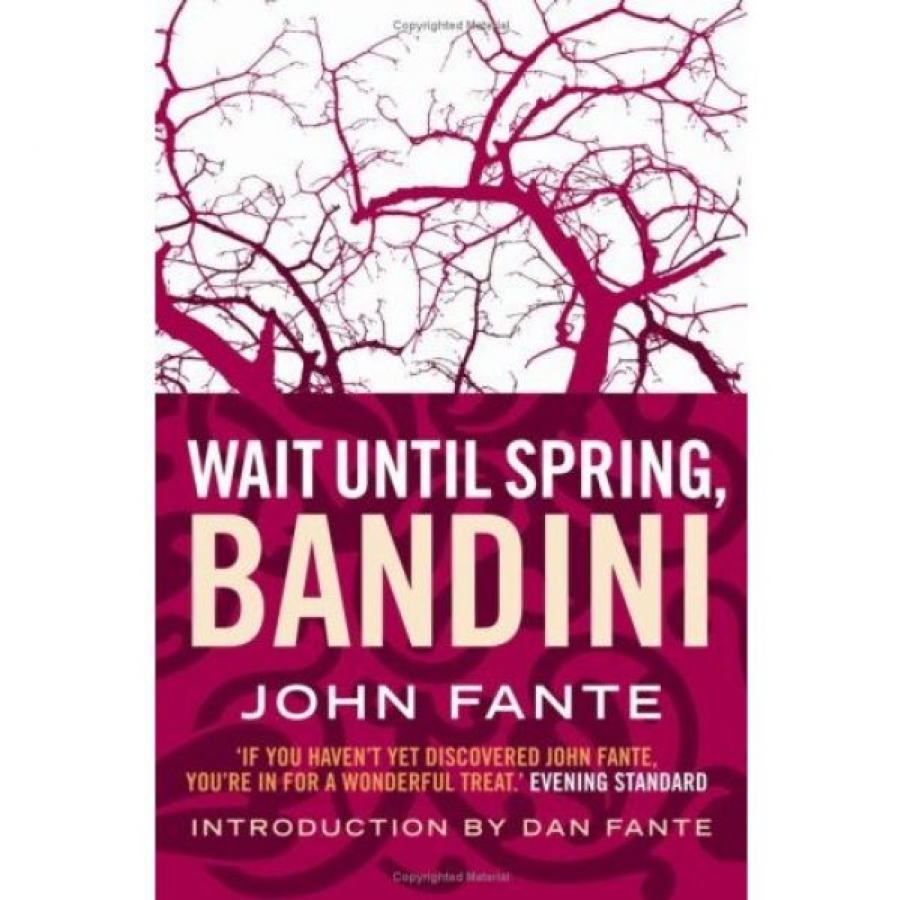
Wait until spring, Bandini
The story belongs to *The Bandini Quartet* saga, chronicling the fortunes of the Italian-American Bandini family, and of Arturo Bandini in particular. The setting is the family: a bricklayer father who is consequently unemployed during the long Colorado winters, a mother striving to maintain a sense of decency and a bare minimum of subsistence, and three sons, the eldest of whom, Arturo, must also shoulder the burden of his father’s frequent, drunken disappearances. In this already fraught domestic sphere, the father’s infidelity with a wealthy local woman triggers the mother’s breakdown; she sinks into prolonged bouts of depression and refuses to let her husband back into the home. It falls to Arturo to seek out his father and bring him back. The themes are those familiar to the author: family dynamics, the bond between son and parents, Catholic culture, and so forth. The narrative unfolds sluggishly, at times becoming tedious and verbose. The musical cadences that characterized the previous novel are absent here. Predictable tropes tied to Italian heritage and Catholicism often seem to dominate (for instance, guilt, recourse to confession, and rituals). The mother’s revolt—her defiance in the face of wounded dignity—emerges as a high point in the narrative and constitutes its finest pages. Another theme is Arturo’s coming-of-age, a journey inevitably accelerated by his mother’s fragility and his father’s absence.
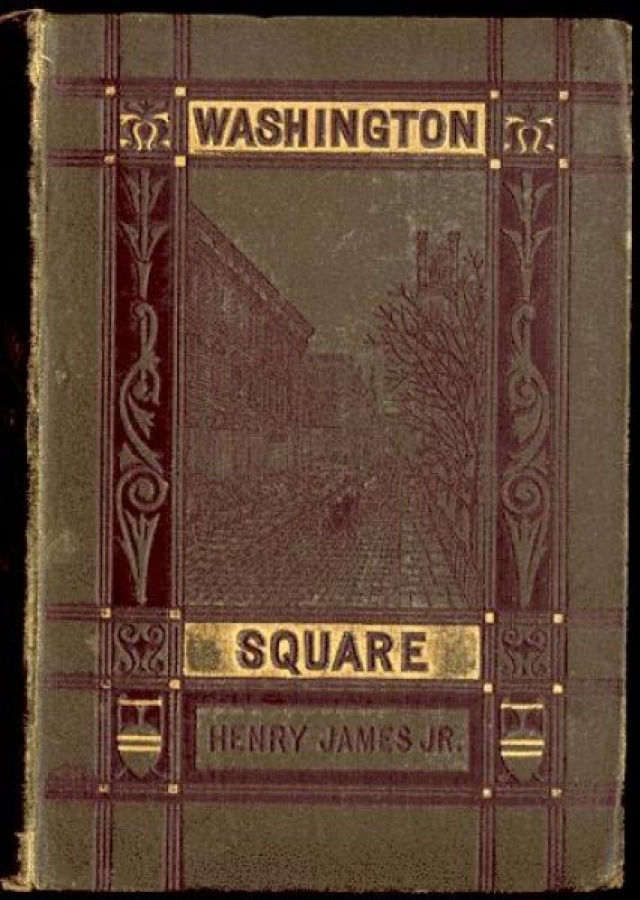
Washington Square
The book is set in late nineteenth-century New York. Catherine, the daughter of a prominent physician in the city, is courted by a young man who is interested in her dowry. Catherine’s father refuses and declares that he will not grant the girl her inheritance. A romantic drama unfolds, in which Catherine’s aunt assumes an important role: a woman who, driven by a romanticized conception of love and the futile pursuit of extraordinary occurrences, wishes the girl would abandon her father and marry the young man regardless. Following a journey to Europe with her father, Catherine realizes that he holds no esteem for her whatsoever, and decides to marry the young man even against her parent’s will. Yet the young man, who had hoped the father would change his mind, abandons the girl, knowing he cannot gain access to the doctor’s fortune. Years pass, Catherine does not marry, and after her father’s death the young man reappears—now an aging man—hoping to resume their former relationship. But Catherine turns him away. The underlying theme of the book is the story of a young woman who is the object of the aspirations and notions of others. The father believes his daughter to be foolish, devoid of qualities, and maintains toward her until the very end a contemptuous attitude, aimed more at asserting his own intellect and foresight (he had grasped from the outset that the young man was after the dowry) than at considering his daughter’s feelings. The aunt is in search of emotional thrills to fill her life and does not consider that her actions (her friendship with the young man, her attempt to manipulate the girl, etc. ) might cause harm to the point of ruining Catherine’s life. The young man is patently a scoundrel, a vacuous figure who seeks until the very end to use the girl to secure a position for himself, unconcerned about returning after so many years to wound her anew. Throughout this story, Catherine’s personality gradually emerges; she finds the strength to take a solitary stand, determined not to compromise with anyone, even at the cost of her own happiness. She has been and continues to be manipulated; her father holds an opinion of her shaped by stereotypes, yet she lives her own life, now indifferent and in opposition to those around her. To the young man, now a mature man, who asks if she is angry, Catherine replies: > no, I am not angry; anger does not last that way for years. But there are other things. Impressions that endure, when they have been strong. But I cannot speak... Catherine picked up her knitting needles, sat down with them again, for life, as it were .
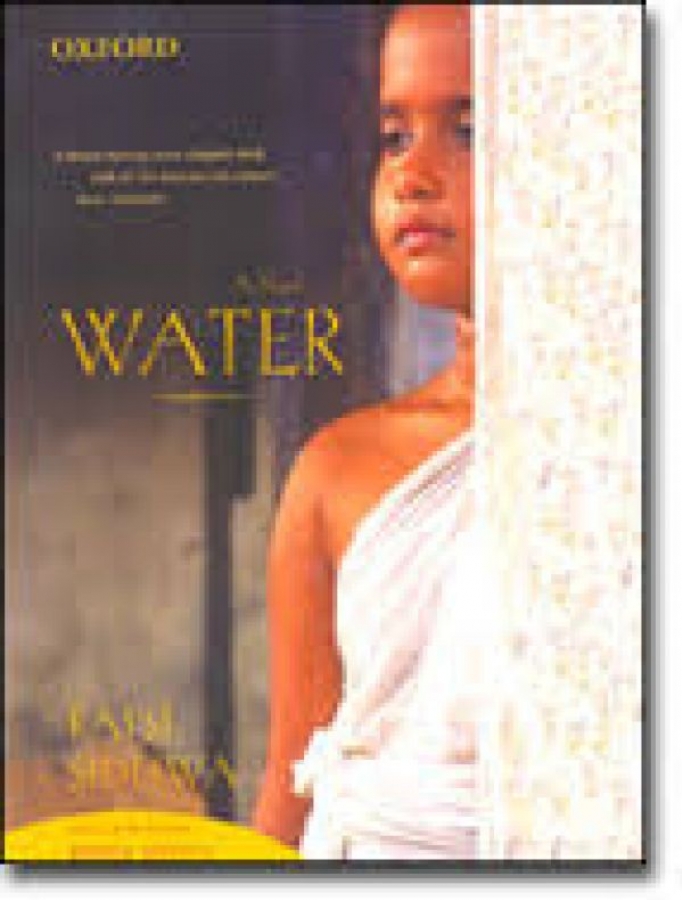
Toilet
In Hindu tradition, a widow > must remain in perpetual mourning... her head is shaved clean. her ornaments removed... she must eat no cooked food in order to cool sexual energies, avoid worldly gatherings because a widow brings misfortune (having caused her husband's death), and she must remain chaste, devout, and faithful to her husband’s memory . Religious tradition is compounded by economic motives. Through the marginalization of widows, sequestered in dedicated dwellings, the relatives—of both the woman and the deceased—rid themselves of a claimant to the inheritance. Yet > the combination of moral unworthiness and innocence lends (widows) an irresistible erotic appeal. And eroticism is heightened by their vulnerability and availability . The lack of financial means (they are frequently abandoned by their families), loneliness, and social ostracism render widows easy victims of prostitution. The book addresses the lives and destinies of these widows. It does so through the story of a young girl. Chuyia is not yet six years old when she is given in marriage to a man far older than herself. She is still living with her family, waiting to become a woman, when her husband dies. She is cast out mercilessly into a house for widows. Uprooted from her world, abandoned and forgotten by her parents, the child must rebuild an emotional sphere of her own. She finds it in several companions in misfortune, older than she: old Bua, who still reminisces about the sweets and delicacies served at her lavish wedding; Shankuntala, who lives out her fate as a widow with profound devoutness and wonders whether her life is not > an illusion that burst like a bubble and opened into another illusion in which she was a widow , and the radiant Kalyani, who, precisely because of her beauty, has been coerced into prostitution and has learned to “live like a lotus, uncorrupted by dirty water”. Kalyani’s life is, in fact, a series of discrete episodes, of compartments—some opened to the sunlight, others (“the nocturnal calls”) repressed and hidden from herself. In their own way, each of the widows has found a modus vivendi to render life bearable, an existence otherwise intolerable. And this would have been Chuyia’s fate, were it not for two terrible events: Kalyani takes her own life upon learning that the young man she loves is the son of the man to whom she is prostituted; Chuyia, not yet nine years old, is drugged and raped, so as to initiate her into prostitution. How can the pious Shankuntala continue to believe in a religion that justifies such cruel and unjust destinies? Is it truly that God is Truth, or is it not rather, as Gandhi says, that Truth is God? Meaning that we must act out of the awareness of being part of a whole, in which every being possesses equal dignity and the right to live. With this awareness, which finally sets her free, Shakuntala resolves to save Chuyia at least, entrusting her to Gandhi. The happy ending is not an unexpected twist—though a welcome one nonetheless. It is the consequence of a cultural and psychological maturation. It is the sign of liberation. The novel unfolds slowly, with a rhythm that mirrors the inexorability of the widows' destiny. The opening scene radiates a childhood serenity that is prematurely dispersed. > Birds hopped among the tree branches, making the leaves tremble and filling the forest with chirping... All of Chuyia’s senses sharpened in the wild beauty of the forest, her breathing slowed to harmonize with the deep rhythm of the plant world, and her heart was at peace . It is the image of that communion with the “whole,” with Truth—Gandhi’s message: a communion shattered by the cruel rules of society. We then follow the young girl into the house of widows. There is no facile moralizing, no overt social denunciation: things are as they are, and as they have always been. Admittedly, small acts of defiance occur, yet a melancholic resignation to one's fate prevails. The women always return to memory, immersing themselves in prayer and the veneration of the dead. A nostalgic gentleness prevails, reflected in the prose: rich in vocabulary, full of refined adjectives, serene as widows are expected to be. The novel gathers speed in its final pages, when, confronted with the horror of what has occurred, Shankuntala reclaims control of her own destiny, and the tumult of the crowd, the cries of the people, and the headlong rush of events take over. Why read it? It depicts the Indian world, suspended between ancestral traditions and renewal. It also depicts the absurd and oppressive rules of any religion and tradition.

The way home
Chris grew up in a respectable middle-class family. His father runs an installation business: hardworking, reserved, yet attentive to the family’s needs; like all parents, he is full of expectations regarding his son’s future. The mother is protective, affectionate, ready to indulge anything from her boy, so loved and desired. It is a peaceful and well-off household, yet how is it possible that Chris deals drugs, gets involved in petty theft and brawls? > He was not trying to hurt his parents, really. But in his mind there was this thought: they have unreasonable expectations of me. They do not understand who I am... I don't want to be their good boy and I don't want the things they want for me. If they do not understand, it is their problem, not mine . Charged with drug dealing, assault, and causing accidents while attempting to flee the police, Chris receives a severe sentence. He is committed to a juvenile correctional facility, predominantly populated by Black youths. Proving to possess greater resilience than anticipated, the young man manages to survive in an environment that should be hostile to him. Indeed, he establishes a series of friendships that endure beyond prison walls. His only friction is with an older, violent, and aggressive youth named Lawrence. The author does not, however, delve deeply into the prison environment, which resembles a boarding school more than a prison, even a juvenile one. Attention is entirely focused on depicting the relationship between Chris and his father: a cold, detached dynamic marked by mutual distrust. For the father, the disappointment was too profound to offer solidarity and affection to his son. The boy senses his parent's low esteem and withdraws into himself, bolstered by his new experience, which he regards as an achievement. Parent-child relations are fraught to such an extent that one is astonished when, in the novel’s second half, Chris is found working for his father. During an installation job in an apartment, Chris and Ben, a former fellow inmate, discover a bag of money under a floor. They do not steal the cash; they leave it where they found it, promising each other to keep quiet. Ben, however, mentions it to Lawrence over drinks one evening. Lawrence steals the money, unaware that it belongs to two dangerous criminals who stashed it away to retrieve upon their release from prison. The two thugs murder Ben in an effort to discover who has the cash. Chris reveals nothing to his father or the police, contacting Lawrence instead to seek mutual vengeance for their friend’s death. Such is the prison code of honor. To his girlfriend, who urges him against it, Chris replies that > there are two personalities in me, there is the person you know, and the one that is still inside me. The boy who did bad things and was locked up in prison. The one you have never met . It seems Chris is lost for good, yet it is Lawrence who saves him, ensuring Chris does not carry out the revenge, which falls solely upon himself, the bad seed. Indeed, destiny is sealed at birth: Chris was "born in a good suburb, raised in a loving home," while Lawrence > had never found that place ( where) they speak to you with kindness and patience instead of sarcasm and cruelty . The novel pursues several narrative threads: intergenerational conflict, the passage from adolescence to adulthood—which often finds positive resolution through sheer luck alone—and parents coming to terms with the fact that their children harbor their own aspirations and desires. The happy ending should not lead us into facile optimism regarding social change. Everything is already determined from birth: those who are white can be saved, even if they occasionally lose their way; those who are Black can only be dragged down, back into the world from which they desperately strive to rise. Compelling social and psychological themes are diluted by a sluggish narrative pace, devoid of action and at times mundane. Particularly in the depiction of prison life, the author seems eager to present a placid, reassuring vision of the so-called rehabilitation of juvenile offenders. The leap between the first part—the bad Chris—and the second—the good Chris—is so pronounced and thinly explored that it strains the credibility of the entire narrative. Finally, reviews often tout Pelecanos as a writer of noir, albeit with a social bent. From this vantage point, one is left disappointed by the dearth of action and suspense. Why read it? It makes for a pleasant read, but nothing more.

We need new names
The author was born in Zimbabwe and has lived in the United States since the age of eighteen. The novel unfolds across these two worlds, so different yet fundamentally similar, because in both the individual is torn apart and oppressed by the violence of circumstances and of men. The first part of the narrative, undoubtedly the most accomplished, is set in a Zimbabwean village: > Paradise is a cluster of tin cans spread out in the sun like wet sheepskin pegged to the ground to dry; the shacks have the muddy color of dirty puddles after the rains. The shacks themselves are hideous, but from here they look much better, almost pretty even, as if looking at a painting . Darling, protagonist and narrator, guides us through a succession of episodes, scenes of the country’s material and moral devastation. It is a story told through the eyes of a gang of children, who reenact through play the dramatic circumstances they are forced to witness. When two BBC reporters ask with astonishment what they are doing among the graves of the village cemetery, simulating death and burial, the leader of the little gang replies with equal astonishment: “Can’t you see this is reality?” On the other hand, through play, the children manage to rid themselves of the anger that oppresses the helpless adults like “a big, terrible, toothless dog.” At a certain point, nothing remains but flight. > Look at them leaving in droves, the children of the land, just look at them leaving in droves. (...) Moving, running, emigrating, going, abandoning, walking, leaving, flying, fleeing; everywhere, to countries near and far, to countries never heard of, to countries whose names they cannot pronounce. (...) Look at them leaving in droves despite knowing they will be received with suspicion in those strange lands to which they do not belong, knowing they will have to sit on one buttock because they must not sit comfortably, so as to be ready to get up and leave, knowing they will have to speak in whispers because their voices must not drown out those of the natives . Darling goes to America, taken in by an aunt. It is still she who tells us the story of a young girl becoming an adolescent in a world that is not hers, but inevitably must become so. It is not the America she had dreamed of when she lived in Zimbabwe. > This place doesn’t feel like my America, it isn’t even real. It is as if we were in a terrible story, as if we were in some crazy part of the Bible where God is busy punishing men for their sins and making them miserable. (...) In America the streets are like the devil’s hands, like God’s love, reaching everyone, only the sad thing is that these streets don’t really take me home . The young Darling grows up like any Black American teenager: she integrates seamlessly, yet the events involving her, the friendships and the people she encounters, continually draw her back to her childhood, to her playmates, to her native land. One day, to return home—if only via the internet—she connects via Skype with her mother in Zimbabwe; instead, a childhood friend answers. Darling adopts the typical attitude of Westerners toward Africa, expressing our solidarity from afar, comfortably and complacently, with the suffering of these peoples. > But you are not the one suffering (her friend reacts). You think watching on the BBC means you know what is happening? No, you don’t; (...) it is us who are here who truly feel the suffering, so it is us who have the right to say something (...) If it were your country, you would have loved it enough to live in it and not leave it. You had to fight for it (...) You left it, Darling, my dear, you left the house burning and you have the nerve to tell me with that stupid accent (...) that this is your country? (...) Her sarcastic tone (...) slaps me in the face, catching me by surprise. I am so shocked that I don’t know what to say . One must belong somewhere; one cannot remain suspended between too many worlds, as an outsider. We must have new names, live new experiences intensely, become involved, feel part of something. > When someone speaks about their home, you have to listen carefully because that way you know exactly who they are . This complex and profound book conveys something else as well. In the final pages, Darling remembers (or perhaps merely dreams of) when, as children, they used to play at catching Bin Laden. It was not a very amusing game, so at a certain point the little gang turned their attention to an old dog, solitary and cantankerous, standing in the middle of the road. Suddenly a truck came along and ran over the animal, crushing it to a pulp without killing it instantly. And it is with this terrible image—of laceration and incomprehensible death—that the author closes the book. Then we understand what the novel’s title means: we need new names to speak of displaced peoples, to integrate with other cultures and customs, but we also need new words to narrate the blind violence that oppresses and divides us all, Westerners and non-Westerners alike, binding us to a common destiny. The prose is the fundamental triumph of this splendid book. The author moves across two worlds that are distinct from a stylistic standpoint as well. In the first part, the English language is interwoven with vocabulary and idioms from the native tongue, leading the reader to identify with the places and the people not merely through the story, but above all through the use of language. When she turns instead to Darling’s adolescence in America, the author frequently resorts to youth slang, without overlooking the linguistic hybridity of the diverse ethnicities that comprise the vast immigrant populace. There is, moreover, a stylistic nuance that reveals the meticulous craft of the writing. When Darling speaks in America of her homeland, she no longer uses that creative blend of English and native words: her gradual estrangement from her land is mirrored in her language, increasingly detached and sterile. It is reflected, ultimately, in her consciousness. Why read it? It is a book of exceptional caliber, truly beautiful.
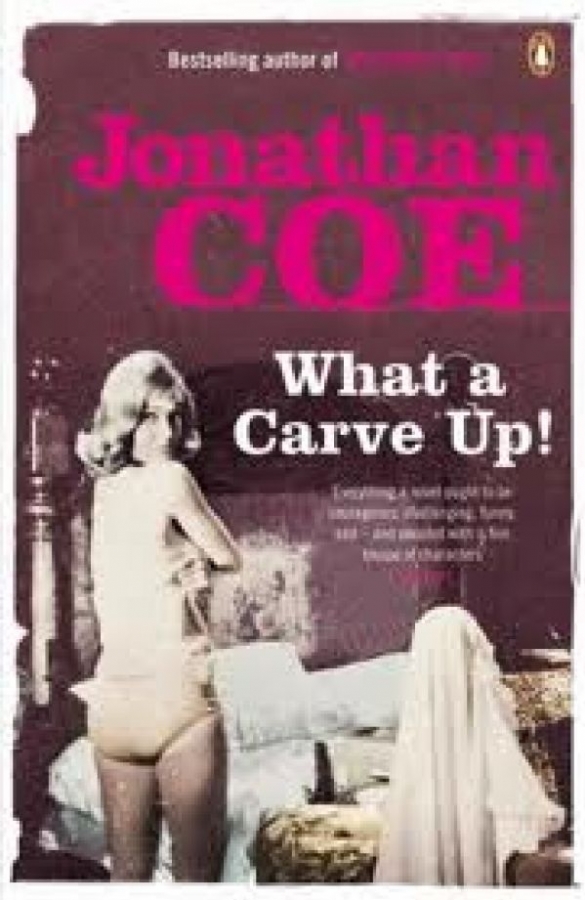
What a Carve Up: The Winshaw Family
The book's English title, *What a Carve Up!*, is an explicit reference to a 1961 comedy horror film in which several characters gather for the reading of a will and are murdered one by one. Michael, the protagonist of Coe's novel, was taken by his parents as a child to see this cinematic version, along with a documentary about his hero, Yuri Gagarin. The film's sex scene and the astronaut's death in a mysterious plane crash put an end to Michael's innocent childhood, hurling him into the world of the "apparent and insoluble mysteries of adults," giving rise to a "story with no real ending, whose mysteries I had to unravel soon." Tabitha Winshaw, an elderly woman widely regarded as mad, entrusts Michael, a promising yet penniless writer, with the task of writing her family's history. The young writer sets out to produce a literary work in which anger and passion take over, preventing him from pursuing both the investigation and the writing. If this book, Coe has his protagonist say, > communicates anything at all, it is how much I hate these people, what bastards they are, how they have stripped everything bare, with their vast interests and their influence and their privileges and their grip on every centre of power: how they have backed us all into a corner, how they have carved up the blood of the entire country . The biography of the individual members of the Winshaw family delineates an extremely harsh yet unfortunately realistic social portrait of the Margaret Thatcher era. The general perception of the "Iron Lady" is that of a decisive, unyielding woman—conservative, yet rigorous and honest. In reality, the Thatcher era was a stagecoach robbery orchestrated by reckless, unscrupulous businessmen. At times redundant and verbose, this part of the book stands as a fierce indictment of the contempt shown toward, and the betrayal of, an entire country. Upon learning that a member of the Winshaw family has been murdered, another member of this perverse cabal quips ironically: > Stabbed in the back, how appropriate; does that mean Mrs Thatcher is in the house somewhere? In parallel with the socio-political narrative, Michael's life unfolds through constant chronological shifts, which often fragment and distract the reading experience. It is, however, the finest part of the novel, as well as the most indecipherable. Michael spends his days watching television, overwhelmed by the news and obsessively rewatching the film he had been unable to see in its entirety as a child, when his parents dragged him away during the sex scene. Yet he was left with > the strange feeling that that film had never ended, that I had continued living inside it . The often inexplicable sequence of events and the characters who enter or re-enter Michael's life seem to be > potential bridges to the past: a way of retracing my steps until I found myself face to face with the innocent eight-year-old child who loved to write and who now seemed like such a complete stranger . Yet if life—whether real or imagined?—is nothing more than a perpetual return to oneself, the novel could only conclude with a reenactment of the scene from the beloved film: the members of the Winshaw family gather together for the reading of a will and are progressively murdered by the relative they believe to be dead. And Michael, too, could only meet a mysterious death mid-flight, like Yuri Gagarin. The author himself, through his protagonist, defines the book as > a terrible book, an unprecedented book, part personal memoir, part social narrative, all bound together in a lethal and devastating fermenting concoction . This statement neatly encapsulates the author's attempt to recount a social and political reality through the filter of the imagination. Michael's life is ultimately an ongoing return to the age of freedom, when in childhood everything seems possible to us, even becoming astronauts. The loss of this freedom is a private matter (one grows into adulthood, confronts reality, contends with illness), but it is also a social reality: witnessing, often as helpless spectators, a political catastrophe—the disappearance of a society, of its culture, of its mechanisms of solidarity, of an honest press, of peace, and of the rejection of war. And what, in the end, is left to us? The hope for an extraordinary event: that all the villains might be locked in a room together, allowing for the exaction of a collective vengeance. And only then can one contemplate losing oneself once more in freedom, just as Yuri Gagarin did, dying a hero. The problem with the book is that this blending of personal memoir and social narrative does not entirely succeed, as the author is overly tempted to indulge in literary contrivances (the ending of the book is trite), overtly psychoanalytic references, and an excessive reliance on interlocking plots and stories within stories. Synthesis is thus lost, the characters pale, and the entire narrative fragments. Why read it? It is undoubtedly very well written, engaging, and ironic.
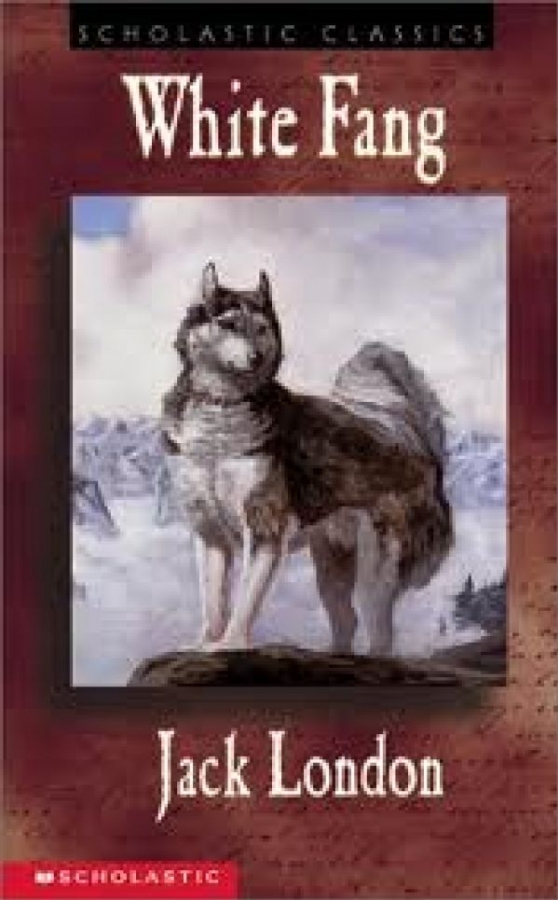
White Fang
*White Fang* is the tale of the birth of friendship between wolf and man, but also the chronicle of a catharsis, of a transition from solitude to sociability. The novel opens with the mortal conflict between the two animal species. Two men, with their dogs, are pursued by a pack of wolves desperately seeking food in the cold North American winter. Patiently, with lucid and ruthless precision, the wolves gradually eliminate the various members of the party before launching their final assault on the sole survivor. In this fateful moment, there is no longer room for the arrogance of the human species, for its intellectual contortions, for its presumed supremacy. The man > cast a terrified glance at the circle of wolves that would predictably form around him, and suddenly the realization struck him that this wondrous body of his, this pulsing flesh, was nothing more than meat, quarry for voracious beasts, to be torn and ripped apart by the ravenous fangs (of wolves) to become their nourishment, just as the mouse and the rabbit had often been nourishment for him . Upon the arrival of some hunters, the wolf pack flees, disbanding. A female and two males depart together. This is the finest part of the book, in which London effectively depicts the wilderness of the forest, the clash of the two males for the female, mating and the birth of the pups, their discovery of the surrounding world, and the famine that decimates the family, sparing only the she-wolf and one of the cubs, White Fang. Nature is fascinating yet brutal; among the various species there is a relentless struggle for food, in which the strongest and most cunning prevails. The competitive vision of the nineteenth century, of a triumphant bourgeoisie, emerges in London’s pages, alongside a romanticism nourished by the richness and mystery of the wilderness. White Fang's mother is a cross between a wolf and a dog. For London, genetic inheritance is an imprinting no being can escape, > because life reaches its summit when that which it is equipped to do is realized to the fullest . The encounter with a tribe of Indians revives in White Fang’s mother her nature as a “dog,” dependent on man. Contact with man is an extremely harsh trial for White Fang, an ongoing conflict between his independent nature and devotion to man’s strength, who in his animal psychology is experienced as a "god > . There is no affection toward man; instead, in White Fang there is fear and admiration. Alongside the men are the dogs. Alone against all, White Fang grows hard, ruthless, a warrior: he never learned to play with (the dogs), he only knew how to fight > . He becomes a cold fighter, but also a solitary and sorrowful animal, having never known the affection and play of other pups. His qualities as a fighter will prove invaluable when, sold to a cruel white man, he is used in dog fights, in which he always emerges victorious. White Fang comes to know the world of hatred to its depths, knowing he can defend himself against it only through strength and cunning: he has no friends and seeks none. And it is during one such fight that White Fang, gravely wounded, is rescued, tended to, and cared for by a wealthy gold hunter. From this point onward, the story becomes trite and predictable. Little by little, day after day, White Fang discovers that he is capable of affection and devotion toward man; he is no longer alone, he is surrounded by an environment full of love, he discovers friendship and, with it, fatherhood: the pup sprawled in front of him. (White Fang) pricked up his ears and looked at him curiously. Then their noses touched and he felt the pup's warm little tongue upon his jaw. White Fang's tongue came out, he knew not why, and licked the pup's muzzle. The first two parts of the book are splendid and clear in their meaning. The wolves’ attack on the men and the expert naturalist’s depiction of the forest are an evident exaltation of wild nature, of the untamed strength of environments where one fights on an equal footing" to survive and not for amusement. Then, instead, the complexity of human relationships takes over: hatred, amusement at the expense of the innocent (animals), the ambiguity of human affection, which demands fidelity and obedience regardless. White Fang is ultimately a victim of man, as are all animals. His instinct must bend to the laws of man, and only in fatherhood does he reclaim his wolfish destiny. From the standpoint of writing, Jack London’s fundamental virtue is his narrative pace, action-packed yet set within an exceptionally compact plot. The author has no need to expand the story, which is instead a continuous deepening of the same theme, entrusted to a rich and multifaceted use of verbs and adjectives. Why read it? It is a pleasure to let oneself be swept away by London’s love for wolves and nature.

The White Tiger
In the splendid stories of *Between the Assassinations*, Arvind Adiga had developed a pessimistic chronicle of an unalterable social destiny, from which one can escape only through a desperate individual choice. The Indian writer returns to this theme with this novel, which recounts the story of a man's rebellion against the petrification of caste, the exploitation of the poor by the rich, and the social imprisonment forged by tradition and family ties. There are no grand ideals behind the revolt; there is merely the desire to have > the chance to be a man, and for that, it was worth killing . The author imagines the protagonist writing to the Chinese premier to explain how one becomes a successful entrepreneur in modern India, "the centre of technology and outsourcing." One need not have attended university or worn fine clothes: entrepreneurs are made of "half-baked clay," they must emerge from the dark side of society and possess the resolve of those who have nothing to lose, who know that there are "only two destinies: eat or be eaten." The protagonist fits the profile. True, in the impoverished village where he was born and raised, they did not even give him a name, calling him merely Munna—boy—yet, from childhood, he senses that he is not destined to "remain a slave." Only, it is not so easy to "spit out one's past." One must break free from the "cage" in which one has been trapped since birth. To depict this social and psychological condition, the author employs an effective metaphor: the poultry slaughterhouse. > Go to Old Delhi and watch how they keep the chickens there in the market. Hundreds of pale hens and brightly coloured roosters, stuffed tightly into wire cages, packed together like worms in a belly (...). On a wooden table (...) sits a young butcher, smiling complacently, displaying the flesh and organs of a freshly slaughtered chicken (...). The roosters see the organs of their brothers lying around them. They know they will be next. Yet they do not rebel. They do not try to escape from the coop.(...) Because the desire to be a servant has been bred into me; carved into my brain, nail after nail, and injected into my blood, in the same way that waste and industrial poisons have been poured into Mother Ganga. (...) Servants must prevent other servants from becoming innovators, experimenters, or entrepreneurs. (...) The coop is maintained from the inside . The narrative is precisely the protagonist's liberation from this subtle yet unbreakable prison. By chance, he manages to move to New Delhi as a driver for the brother of the village boss. He remains a servant in every sense, at beck and call for any need; yet driving the car grants him access to every facet of his master's life, from intimate matters to shady dealings. It is a kind of unveiling, a discovery of the sins and emptiness of the rich. The obedience and subservience inculcated over centuries would have nevertheless kept him a faithful servant; at most, he might have indulged in some petty, innocent pleasure, as other drivers do: urinating in the masters' flowerpots, slapping them while they sleep, beating their pets. An incident helps awaken his consciousness. The master's wife runs over a poor person, and the boss's family demands that Munna take the blame and go to prison. Even the protagonist's own relatives urge him to make this sacrifice, as though it were the most natural thing in the world. Fortunately, the police, suitably bribed, close the investigation, leaving no consequences; but the protagonist grasps the hollow nature of traditional values of loyalty and the hypocrisy of the benevolent paternalism displayed by his master. He often has to drive the latter, carrying a bag full of cash, to bribe government officials. He decides to seize the opportunity: he murders the master and takes the money, laying the groundwork to become a successful entrepreneur. The caustic irony of the narration must not mislead: the novel is staunchly realist, a cold social accounting and a vigorous political indictment. The whole of Indian society emerges desecrated and exposed in its true nature, both modern (the myth of the world's largest democracy, the headlong and all-resolving economic boom) and traditional, which so fascinates Westerners. The protagonist is a stereotypical figure, as cold and cynical as the master he killed: a true "white tiger," because he is cruel and at the same time rare. Munna achieves success, but this offers no solace to the reader. The hope lies in the fact that he performs two acts of humanity: fleeing after the crime, he risks capture by the police to save a young cousin who lives with him; he compensates the mother of a man struck by one of his drivers. Slight gestures of solidarity, which cannot make us forget that the protagonist failed to warn his relatives of the vengeance of the boss's family, who will indeed slaughter them all. Where what matters is "the size of the belly"—money—there is little room to be "good"! The novel's primary virtue is its narrative style: prose that is spare yet rich. The flaw lies in the plot, which fails to sustain an intense narrative pace, rendering the tale often repetitive, burdened with too many sociological and political digressions. In its execution, the author fails to sustain the expectations raised by the intriguing literary device of the letter to the Chinese premier. Why read it? A strong realist stamp, highly effective prose.
Women in love
The narrative unfolds within a framework of relationships among four protagonists: two men bound by a close friendship, and two sisters, both young schoolteachers. The historical context is England in the second half of the nineteenth century, marked by the advent of machines, positivism, and a yearning for a poetic world, epitomised by the English countryside. The two men operate within the roles assigned to the male by English society. Birkin is a romantic young man who seeks in woman a submissive companion (a wife and a mother), believing that true friendship, essential to a man's completeness, is that shared with other men. One might say his touchstone is Plato's *Symposium*, even if he does not go so far as a homosexual relationship—which, in fact, he gently declines when proposed by his friend. Gerald is a young engineer, a wealthy industrialist who has radically overhauled the organisation of the mines he owns, defying his father’s authority. A horrific childhood incident (he inadvertently contributed to his brother's death), a troubled relationship with his father, and a positivist world-view—which nevertheless conflicts with profound inner torment—conspire to lend him an outward confidence while driving him to seek comfort and solace in woman. In him, male friendship borders, almost overtly, on the pursuit of a homosexual relationship. While the men serve as a point of reference, locked as they are within their social roles and their egos, it is the two women who shatter convention entirely: and this not out of an impulse toward social emancipation, but because sensuality and physical restlessness contribute to subverting the concept of woman as wife and mother. It is Ursula, one of the sisters, who entices Birkin, drawing him into a sexual relationship—intensely erotic even by contemporary standards—that the man himself perhaps did not seek. It is Ursula, once again, who resists marriage, prevaricates, and, when she finally yields, finds herself in conflict with her parents. Gudrun's personality appears more complex: she too is driven by a powerful sensuality, which is sublimated into an intellectual quest for freedom, for an unconventional life. Her relationship with Gerald develops precisely around this contradiction: on the one hand, she experiences a fierce physical attraction; on the other, she disdains him for his prosaic nature, for his conventional view of gender roles. From this contradiction the final tragedy erupts, in which Gerald attempts to kill the young woman before taking his own life. Alongside the protagonists stands nature, which forms an integral part of the tale. It is a kind of pantheism, a living nature that merges with the protagonists: > nothing else would work, nothing else would give satisfaction, except this coolness and this netting of vegetation, which penetrated into the blood. How fortunate he was that there was this pleasant, subtle vegetation interacting, waiting for him as he waited for it; what a fullness, what a joy! . Yet nature also leads toward dissolution, toward death. > A small, bright moon shone just ahead, a brilliant thing, a bearer of sorrow, that was always there, eternal, from which there was no escape. He (Gerald) wanted to go to the end, he could bear no more. Yet he could not sleep . The plot unfolds slowly. At the outset, there is the depiction of the small English town along with the introduction of the protagonists. In truth, these appear as standalone scenes, unframed by a broader narrative arc. Each of these scenes is meant to introduce certain interior themes, tied to the web of relationships, which will later erupt in the second half of the story. At times, the author embarks on digressions into social philosophy, using the protagonists (Birkin in particular) as mouthpieces. The death of Gerald's father and the erotic scene between Ursula and Birkin mark the turning point of the novel, which moves, ever slowly, toward Ursula's marriage to Birkin, Gudrun's decision to enter into a romantic relationship with Gerald, and ultimately the journey to Austria, amidst the snow and cold. Here, Gerald's jealousy of Gudrun, his realisation that he cannot master the young woman, and her decision to leave him drive everything toward the final tragedy. The writer writes exquisitely, with a style steeped—both in its diction and in the cadence of its prose—in a pantheistic sensualism reminiscent of D'Annunzio. The two authors appear remarkably similar in the elegance and refinement of their language as well.
World without end
Two hundred years after the events recounted in *The Pillars of the Earth*, Kingsbridge has become a prosperous town whose prospects for growth are, however, jeopardized by monastic rule, which curtails entrepreneurial freedom in favor of rigid stagnation and heavy taxation. There is, consequently, the risk of an economic and social decline. The engine of innovation and change is a woman, Caris. She refuses to accept the traditional role assigned to women—as mother and wife—and chooses to lead an independent life, renouncing motherhood and pursuing a troubled romance with Merthin. Caris will subsequently become a shrewd wool merchant, an innovator—introducing the manufacture of textiles and thereby giving rise to the English cloth industry—a nun and abbess (paradoxically more independent in this role than she would have been had she married), a physician of great renown, a courageous political figure, and ultimately Merthin’s wife. He, in turn, represents the engineer and the archetypal male figure, capable of profoundly innovating construction techniques, yet conversely unable to comprehend the complexity of the female character. Summarized in this manner, the book might sound compelling. In reality, the staggering number of subplots, situations, and characters fails to lend dynamism or allure to the narrative: there is no suspense for an action-driven novel, while the characters remain predictable and flat. Caris’s tormented life and her problematic, complex evolution are never explored in depth, as though this character surrendered her love life and accepted her fate as an independent woman without suffering, almost like an "automaton," bereft of feelings and remorse. Moreover, the sheer breadth of the subjects covered renders the historical reconstruction itself exceedingly fragile, and ultimately unable to hold the reader’s attention. One need only consider the description of the battle during the Hundred Years’ War: accurate regarding the decisive role of the archers, yet tedious, verbose, and scarcely engaging.

Wuthering Heights
A wild setting and free, violent personalities are the hallmarks of a complex and difficult novel. The complexity stems from the book’s “matryoshka” architecture: a first-person narrator records the story recounted by a second first-person narrator. Furthermore, the novel unfolds across different timelines, with frequent flashbacks. The difficulty lies in its language: the frequent use of dialectal English, a vocabulary-rich style, and an involved syntax. A gentleman moves to the country and, on a stormy evening, finds himself at Wuthering Heights (*Wuthering Heights*), undergoing an unsettling and, in some respects, terrifying experience. One feels transported back in time to a pre-industrial era unfamiliar with the manners of Victorian England, where a magical interpretation of the world still holds sway. This regression, which underscores the divide between city and country, between civilization and barbarism, is heightened by the use of dialect among many of the inhabitants of Wuthering Heights. From the outset, the novel’s opening foreshadows what will become the book’s underlying theme: the eruption of man’s primordial passions. Having struggled back to his residence, the gentleman has Nelly—the housekeeper who raised all the protagonists—recount the family’s history to him. Without presuming to detail the entire plot, one can summarize that the narrative hinges entirely upon the love between Heathcliff and Catherine; a love grounded precisely in the shared nature of the two characters: free, wild, and violent. Their love cannot be consummated in marriage—and thus recognized by society—precisely because Victorian respectability cannot accept that Heathcliff, a poor, dark-skinned orphan, might aspire to the hand of a young lady of good family. Yet Catherine happens to share Heathcliff’s temperament, and thus chafes against the rules of polite society. Catherine’s death, following a dramatic encounter with Heathcliff, unleashes the latter’s vengeful, sinister soul. At this point, the narrative drifts increasingly into the effects of terror and mystery typical of Gothic fiction, to the extent that at times Catherine’s ghost returns to haunt Wuthering Heights, reminding Heathcliff not only of their love, but also of his guilt. Yet the ending is predictable: bourgeois rationality prevails (there is no ghost), and the family scions marry happily. Yet is the story true, or merely a figment of the narrator Nelly’s imagination? Could it be that the housekeeper interprets the family’s affairs through the lens of her own fancy and local gossip? Heathcliff and Catherine are characters both modern and ancient at once. From modernity they bear the yearning for freedom and self-actualization; from the bygone world they retain a crude, vindictive spirit. The contrast with Victorian society is framed nostalgically—that is, as a return to a rural world where feelings could be expressed with greater freedom and transparency than under the strictures of bourgeois society. This sociological interpretation does not, however, translate into a genuine analysis of the characters, who remain impersonal and trapped in the roles assigned them by the author. The plot unfolds slowly, devoid of rhythm, often predictable and repetitive. Why not read it? The book is fundamentally boring, and the reading experience is weighed down by an unnecessarily difficult English.