Jonathan Coe
Books by this author (2)

The house of sleep
The theme of sleep purports to be the book’s unifying thread, to the point that the novel is divided into parts corresponding to the various stages of sleep. In reality, it is a device—perhaps overly intellectual—to tell the story of the love between Robert and Sarah. We find ourselves in a university hall of residence. Sarah suffers from a sleep disorder that leads her to confuse dreams with reality. At their first meeting, Robert tells her he has just lost a cat to which he was deeply attached. Sarah dreams that Robert has lost a twin sister, Cleo, who does not actually exist. And it is upon this misunderstanding, originating in Sarah’s secret—her sleep disorder—that their relationship takes root: > as she left, they looked directly into each other's eyes for the first time; and something happened then, some connection was made, just for a moment . Their relationship is built on confidences, which > ranged freely over feelings, friendship, families and gender, shared intimacies and self-revelations which became deeper and more frequent as the objects themselves grew larger and more complex . The relationship between Robert and Sarah cannot, however, develop into a true romantic affair, partly because Sarah is a lesbian and partly due to Robert’s inability to translate his feelings into romantic advances. Their story remains in limbo until Sarah’s and Robert’s paths diverge: their university years come to an end, and when Sarah terminates a relationship with a woman, Robert realizes he is incapable of seizing this opportunity to translate his affection for his friend into a sexual relationship. At this point, the plot (in truth, the narrative constantly jumps between past and present, complicating the reading experience) shifts into the future, when the university residence has been converted into a sleep clinic—as it turns out, run by Sarah’s first lover, a paranoid man convinced that his mission in life is to find a way not to sleep. This is the least convincing section of the book, which seems to slide into a thriller, peppered with superficial musings on psychological science and references to analogies between dreams, fantasy, and cinema. The finest pages are those chronicling the life of Sarah, now a schoolteacher, in some way haunted by her sleep disorder—with which she has come to terms—and ever waiting for Robert, the only person with whom she knows she is truly in tune. Only towards the end of the novel is it revealed that Robert has undergone gender reassignment (because he understood his true nature, or out of love for Sarah?), becoming Cleo, a physician specializing in sleep disorders. And, like any thriller, everything is resolved, and Cleo can finally reveal herself to Sarah. The book’s primary virtue is the prose: pleasant, brilliant, and fluid. Its chief flaw is the inconclusiveness of the events and the characters: everything remains superficial, creating a palpable disconnect between the narrative structure of a thriller and the unmistakable ambition to deliver something more. What, exactly? It is impossible to say. Why read it? The individual pages read exceptionally well; the story as a whole disappoints.
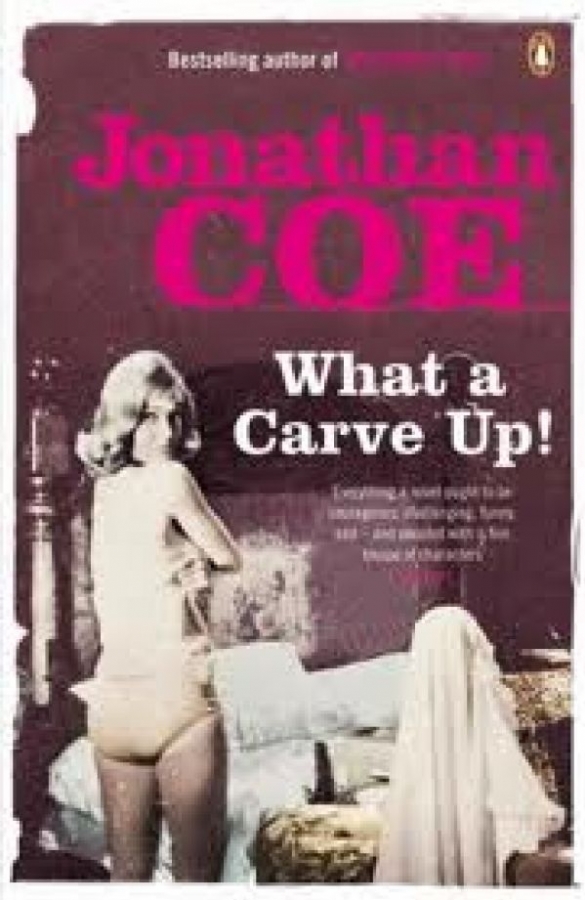
What a Carve Up: The Winshaw Family
The book's English title, *What a Carve Up!*, is an explicit reference to a 1961 comedy horror film in which several characters gather for the reading of a will and are murdered one by one. Michael, the protagonist of Coe's novel, was taken by his parents as a child to see this cinematic version, along with a documentary about his hero, Yuri Gagarin. The film's sex scene and the astronaut's death in a mysterious plane crash put an end to Michael's innocent childhood, hurling him into the world of the "apparent and insoluble mysteries of adults," giving rise to a "story with no real ending, whose mysteries I had to unravel soon." Tabitha Winshaw, an elderly woman widely regarded as mad, entrusts Michael, a promising yet penniless writer, with the task of writing her family's history. The young writer sets out to produce a literary work in which anger and passion take over, preventing him from pursuing both the investigation and the writing. If this book, Coe has his protagonist say, > communicates anything at all, it is how much I hate these people, what bastards they are, how they have stripped everything bare, with their vast interests and their influence and their privileges and their grip on every centre of power: how they have backed us all into a corner, how they have carved up the blood of the entire country . The biography of the individual members of the Winshaw family delineates an extremely harsh yet unfortunately realistic social portrait of the Margaret Thatcher era. The general perception of the "Iron Lady" is that of a decisive, unyielding woman—conservative, yet rigorous and honest. In reality, the Thatcher era was a stagecoach robbery orchestrated by reckless, unscrupulous businessmen. At times redundant and verbose, this part of the book stands as a fierce indictment of the contempt shown toward, and the betrayal of, an entire country. Upon learning that a member of the Winshaw family has been murdered, another member of this perverse cabal quips ironically: > Stabbed in the back, how appropriate; does that mean Mrs Thatcher is in the house somewhere? In parallel with the socio-political narrative, Michael's life unfolds through constant chronological shifts, which often fragment and distract the reading experience. It is, however, the finest part of the novel, as well as the most indecipherable. Michael spends his days watching television, overwhelmed by the news and obsessively rewatching the film he had been unable to see in its entirety as a child, when his parents dragged him away during the sex scene. Yet he was left with > the strange feeling that that film had never ended, that I had continued living inside it . The often inexplicable sequence of events and the characters who enter or re-enter Michael's life seem to be > potential bridges to the past: a way of retracing my steps until I found myself face to face with the innocent eight-year-old child who loved to write and who now seemed like such a complete stranger . Yet if life—whether real or imagined?—is nothing more than a perpetual return to oneself, the novel could only conclude with a reenactment of the scene from the beloved film: the members of the Winshaw family gather together for the reading of a will and are progressively murdered by the relative they believe to be dead. And Michael, too, could only meet a mysterious death mid-flight, like Yuri Gagarin. The author himself, through his protagonist, defines the book as > a terrible book, an unprecedented book, part personal memoir, part social narrative, all bound together in a lethal and devastating fermenting concoction . This statement neatly encapsulates the author's attempt to recount a social and political reality through the filter of the imagination. Michael's life is ultimately an ongoing return to the age of freedom, when in childhood everything seems possible to us, even becoming astronauts. The loss of this freedom is a private matter (one grows into adulthood, confronts reality, contends with illness), but it is also a social reality: witnessing, often as helpless spectators, a political catastrophe—the disappearance of a society, of its culture, of its mechanisms of solidarity, of an honest press, of peace, and of the rejection of war. And what, in the end, is left to us? The hope for an extraordinary event: that all the villains might be locked in a room together, allowing for the exaction of a collective vengeance. And only then can one contemplate losing oneself once more in freedom, just as Yuri Gagarin did, dying a hero. The problem with the book is that this blending of personal memoir and social narrative does not entirely succeed, as the author is overly tempted to indulge in literary contrivances (the ending of the book is trite), overtly psychoanalytic references, and an excessive reliance on interlocking plots and stories within stories. Synthesis is thus lost, the characters pale, and the entire narrative fragments. Why read it? It is undoubtedly very well written, engaging, and ironic.