Follett Ken
Books by this author (2)
World without end
Two hundred years after the events recounted in *The Pillars of the Earth*, Kingsbridge has become a prosperous town whose prospects for growth are, however, jeopardized by monastic rule, which curtails entrepreneurial freedom in favor of rigid stagnation and heavy taxation. There is, consequently, the risk of an economic and social decline. The engine of innovation and change is a woman, Caris. She refuses to accept the traditional role assigned to women—as mother and wife—and chooses to lead an independent life, renouncing motherhood and pursuing a troubled romance with Merthin. Caris will subsequently become a shrewd wool merchant, an innovator—introducing the manufacture of textiles and thereby giving rise to the English cloth industry—a nun and abbess (paradoxically more independent in this role than she would have been had she married), a physician of great renown, a courageous political figure, and ultimately Merthin’s wife. He, in turn, represents the engineer and the archetypal male figure, capable of profoundly innovating construction techniques, yet conversely unable to comprehend the complexity of the female character. Summarized in this manner, the book might sound compelling. In reality, the staggering number of subplots, situations, and characters fails to lend dynamism or allure to the narrative: there is no suspense for an action-driven novel, while the characters remain predictable and flat. Caris’s tormented life and her problematic, complex evolution are never explored in depth, as though this character surrendered her love life and accepted her fate as an independent woman without suffering, almost like an "automaton," bereft of feelings and remorse. Moreover, the sheer breadth of the subjects covered renders the historical reconstruction itself exceedingly fragile, and ultimately unable to hold the reader’s attention. One need only consider the description of the battle during the Hundred Years’ War: accurate regarding the decisive role of the archers, yet tedious, verbose, and scarcely engaging.
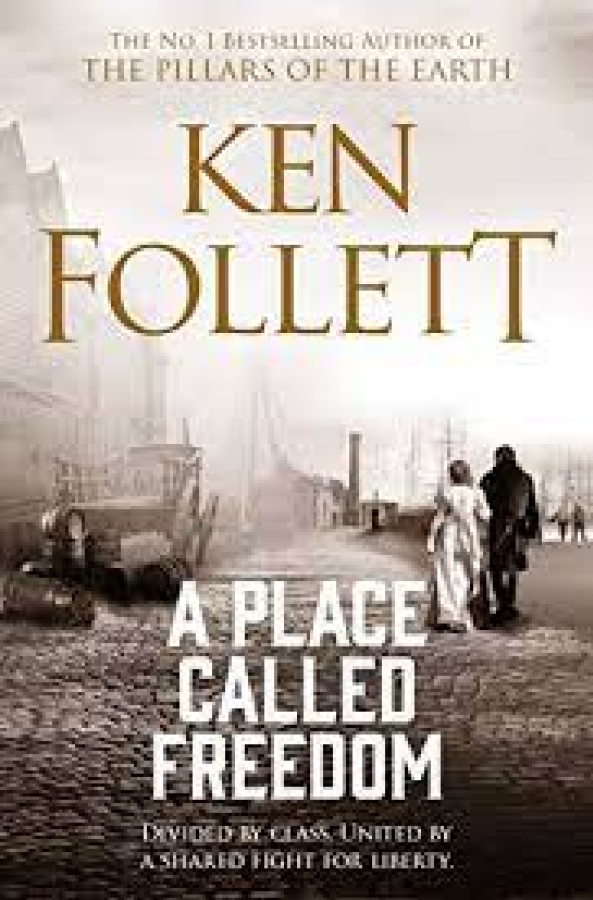
A place called freedom
Ken Follett imagines finding a box buried in the garden of the house where he has just moved. Inside, engraved on a collar, he discovers this inscription: > this man is the property of Sir George Jamisson, year 1767.(...) if the steel collar could speak,(...) what story would it tell? From this opening, reminiscent of the discovery of buried treasure, begins a tale that aspires to be historical and social, in the vein of Émile Zola, but quickly degenerates into a potboiler. We are in mid-eighteenth-century England, though the exploitation of the iron and coal deposits of the "Black Country" in the English West Midlands had already begun by the mid-sixteenth century. Working conditions were brutal, owing to rudimentary mining techniques and the greed of the masters, to whom the miners were even bound by seven-year indentures. Men, women, and children descended into the depths of the earth; casualties were numerous and frequent, caused chiefly by explosions resulting from gas leaks. The miners were left with nothing but dreams of freedom in a life beyond this world. > Look no more with eyes of pity/see our victory/when we build that heavenly city/all men will be free . In these words lie both resignation and redemption, an unshakeable will toward freedom. And it is this very will that impels Mack, a young and charismatic miner, to place himself at the head of his people. Within the nascent bourgeoisie, too, stir impulses toward freedom, though viewed more as an impatience with rigid social codes than as an awareness of the brutish exploitation of the people. Lizzie belongs to a once-affluent, now-impoverished family: she could marry one of the young Jamissons because she is pretty and well-mannered—if overly independent—and, above all, because she owns land particularly rich in coal. This Lizzie is a peculiar character: she likes wearing men's clothes so she can move about more freely, rides astride like a man, and seeks to understand the life of the miners; moreover, she is drawn to Mack's magnetism, to the aura he exudes: > with pride he moved his powerful body, the confidence with which he tilted his head, the intense gaze in his gleaming green eyes. She felt drawn . Lizzie refuses to acknowledge her passion for Mack, even when she descends into the mines and sees the young man at work—untamed and strong, saving lives during a gas explosion; when she admires him for his courage in demanding better working conditions; and when, at last, she sees him emerge naked from the cold waters of the stream during his flight to London. It takes time for Lizzie to recognize her love for Mack, and with it, her own desire for freedom. She will marry one of the two young Jamissons—a mendacious, soft, and obtuse man—and travel with him to Virginia to a coffee plantation, where she will once again cross paths with Mack, transported as a slave from England; and it is with him that she will ultimately find freedom in the Wild West. One cannot help but wonder what Ken Follett truly means by freedom: the independent, transgressive ways of a young bourgeois woman—aspirations closer to our own era than to anything a young woman in sixteenth-century England could have conceived—or the emancipation of a people setting out on the path toward working-class rights and social justice? Considering that the author is a Labour Party sympathizer, the novel bears subtle witness to the devolution of socialist thought: from a working-class movement to left-wing liberalism. Where is freedom to be found? Only in the Wild West, far from the bourgeois constraints of society. Would it not have been better to delve deeper into the social and individual realities of an emerging working-class world within the mining and metallurgical industries, which were to play a decisive role in the Industrial Revolution and the birth of class consciousness? Written, as with all his fiction, in fine, elegant English enriched by period slang, and carried by an intricate, at times gripping plot (such as Lizzie's descent into the mines), the novel nevertheless displays Ken Follett's customary shortcomings: too many overlapping storylines (the exploitation of the miners, the struggle of the London dockers, slavery, and the American colonists' yearning for independence) and thinly developed characters, particularly Lizzie, who is meant to be the linchpin of the entire narrative. What longing one feels for Jane Austen's heroines! Why read it? It is an easy read, even if, ultimately, it proves flat and long-winded.