Finished reading on: February 07, 2014
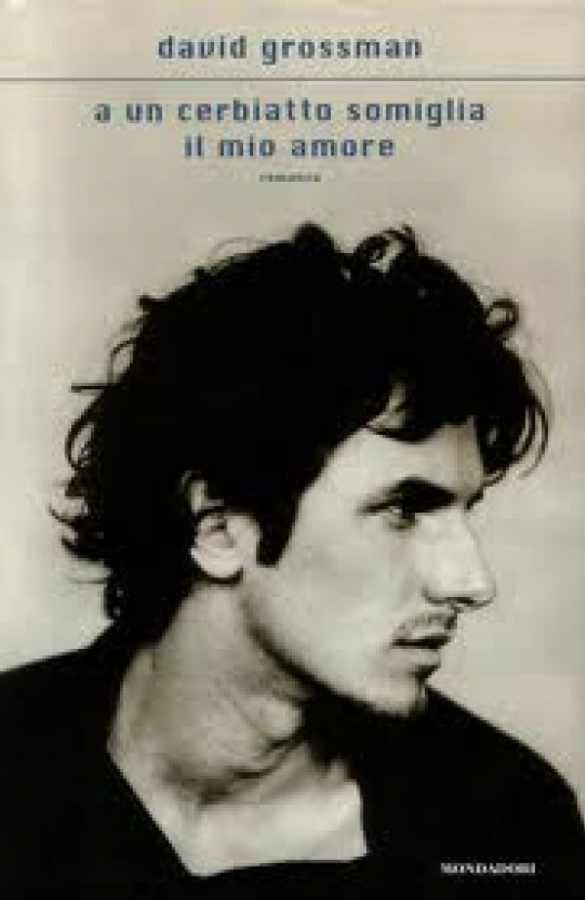
Like a fawn is my love
Title of the original version reviewed: «A un cerbiatto somiglia il mio amore»
AI Translation Notice: This review was translated from the original Italian using artificial intelligence. Book quotes and excerpts are translated interpretations and will not match the author's original English phrasing or official published translations.
In a 2011 book (Falling Out of Time: A Novel in Voices), Grossman observes that the grief over the loss of a child is so immense as to render a father
capable of conceiving him...
whoever loses a child is inevitably a woman
.
It would therefore be easy to conclude that the author wished to adopt the mother’s point of view in writing this novel.
Orah fears losing Ofer, her younger son who has gone off to war, and hopes never to forget him.
She takes advantage of a long hike to recount Ofer’s life as well as her own (her love for her men, the childhood and gradual detachment of her sons) and thereby rip through
all those visible and invisible threads... that were moving around her and above her at that moment, (and that) wove together into a dense, gigantic web....
(but) how can one describe and bring a person back to life using only words? My God, using only words?
Yet Grossman himself notes that the novel was largely written before the death of the author’s son, who died in August 2006.
On the other hand, Orah’s narrative is so steeped in existential anguish and epochal pessimism as to transcend the theme of mourning, however devastating the loss of a child may be for a mother.
What Orah speaks of is the story of Israel, a country in which there is no future for individuals, for familial and romantic bonds, or for the people as a whole, caught in endless conflict with the Arab nations
There, the sweet illusion in which they had lived until that moment had shattered, their clandestine cell had been discovered.
For twenty years they had walked suspended in mid-air, on the edge of a precipice, conscious of doing so, and now they were falling into it.
They would fall endlessly
.
Orah has just separated from her husband and is about to embark on a trek with Ofer, who has just completed his lengthy military service, mandatory for all young Israelis.
Yet another war breaks out, and the young man decides to return to combat.
Orah refuses to wait at home for the news of her son’s death and sets out on the hike anyway, accompanied by an old friend, Avram.
Across an enchanted landscape, brimming with light, flowers, and forests, unfolds Orah’s slow, dense narration.
It can be read on four levels.
On the first level is the adult world, comprised of Orah herself and her two men, Ilan and Avram.
Ilan is tall, vigorous, confident, and positive.
Avram is short, pudgy, something of a poet and writer, in love with words.
Orah loves them both.
She marries Ilan, with whom she has Adam, but conceives Ofer with Avram, even though the latter refuses to act as a father.
He is broken by the torture endured at the hands of the Egyptians, who took him prisoner in one of the many wars.
The long trek provides Orah the opportunity to introduce Ofer to his real father, and also to revitalize the deep bond that unites her with Avram.
Reaching back into memory unearths painful events, deep wounds, nightmares, ever spawned and fed by continuous, unending wars.
Speaking of Ofer allows them to rediscover their old love, mutual affection, and an attraction never forgotten.
A phone message, in which Avram’s new partner announces the “false alarm” of a possible pregnancy, shatters the rediscovered connection.
Orah
sprang to her feet, planted herself before him, incredulous: and maybe you’ll have a daughter, Avram, a baby girl...
You will remember...
you will remember Ofer, his life, his whole life, won’t you?
The second level is the world of the young, represented here by Adam and Ofer.
The theme is unmistakably that of detachment, so often experienced by parents watching their children become adults.
Gorgeous is the description of the embrace between Orah and Ofer, conveying a sense of growing physical distance.
I could embrace him only if he wanted it...
Ofer used to hold her cautiously, carefully keeping his body at a distance from her breast, leaning down toward her in a ridiculous arch
.
But there is something more.
The two boys are ready to serve their country enthusiastically, even unto the ultimate sacrifice.
One episode tears an unsettling rift in this apparent certainty.
When Orah accompanies Ofer to the military muster, she and her son are briefly filmed by Israeli television.
The boy is swaggering; the mother, startled and uncertain.
But as soon as the camera moves away, Ofer whispers to his mother:
if I get killed, get out of Israel.
Just leave.
You have no business being here...
if this curse passes from generation to generation, then you have nothing to seek here
.
And then there is the third level: the childhood of Adam and Ofer.
The pages dedicated to the two sons’ early years are the finest.
With an entirely maternal sensitivity and delicacy, Grossman manages to fully capture the profound bond between a mother and her offspring.
The rearing of the “two shoots” is also the pivot of the relationship between Orah and Ilan, as happens with all parents.
They delighted in splinters of memory and little moments that took on importance only between the two of them, turning golden, precious: the goldmines of their life
.
Yet small details—such as Adam’s nervous tics and Ofer’s decision to be an Englishman (a naive subterfuge to shield himself from the hatred of the Arabs that oppresses and terrifies him as a child)—show how the nightmare of endless wars intrudes into childhood itself, denying it any true serenity and marking the gradual estrangement of the sons from a mother who could not save them.
The memory of the flash of fear that had flared in her younger son, the dread that she might devour him, was carved into her mind like an ancient graffito.
Go explain a moment like that between mother and child to Avram, she thought.
And yet she did, she described it to him in detail, so that he would know, suffer, live, remember
.
And finally, there is the loss of human dignity: the fourth level of the narrative, the one that overwhelms everything.
Ofer’s patrol forgot that they had locked a man in a cold storage room.
“How could you just forget a human being?” It was useless for her to realize rationally that it could not be the responsibility of Ofer, a mere soldier; the idea that inhumanity had gripped her son as well, rendering him indifferent, completely overwhelms her, and
cracks and fractures widened and spread with great speed through the most delicate, intimate tissues...
their family was disintegrating at an incredible speed, overwhelmed by a crushing force that seemed to have been lying in wait inside them all those years and was now assailing them with an incomprehensible fury, even with a strange, vengeful joy
.
Even in wartime, one would wish to live
a private, quiet life.
Do you understand? A small, unheroic existence, keeping ourselves out of this damned fray as much as possible
: to carry out, as Tolstoy puts it in War and Peace, “the real life of people...
independently” of political and military upheavals.
It is not possible.
War invades peace, destroying even the most intimate feelings, the deepest relationships.
Grossman’s novel is a kind of Israeli War and Peace, with a significant difference: there is no solution for Israel, it is impossible to drive away the enemy (they are too numerous, the hatred and the dead on both sides now too deeply entrenched); they are condemned to fight forever.
Faced with such an atrocious fate, the reader would like to lose himself, and withdraw, into the novel’s marvelous imagery, so sweet and delicate, revealing a subtle, affectionate, and empathetic knowledge of both the world of childhood and that of womanhood.
Why read it? A great masterpiece!