Finished reading on: June 14, 2026
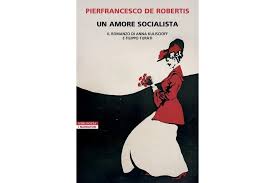
A Socialist Love
Title of the original version reviewed: «Un Amore Socialista»
AI Translation Notice: This review was translated from the original Italian using artificial intelligence. Book quotes and excerpts are translated interpretations and will not match the author's original English phrasing or official published translations.
Here I live as I lived everywhere, that is, as Kuliscioff:
cited in a fine publication edited by Vittorina Maestroni and Thomas Casadei (Medicina, politica, emancipazione. Anna Kuliscioff e noi, Mucchi editore 2024), this phrase aptly encapsulates Anna Kuliscioff’s personality: so many professions, so many commitments, and so many nationalities, yet always herself. It is no coincidence that this proud assertion is drawn from a letter to Andrea Costa, then her life partner and father of her only daughter, Andreina. Anna was in Naples studying medicine, and their relationship was unraveling, soon to reach its end. But who was Anna Kuliscioff? Born Anja Rosenstein between 1853 and 1857 in Russia to a wealthy Jewish merchant family, she was initially an anarchist, rechristening herself "Anna Kuliscioff" as an allusion to the noun kules: the gruel that was then the sole meal of the poor. In 1877, she met Andrea Costa, with whom she had an intense romantic relationship and co-founded the Italian Socialist Party. Costa was the classic Romagnolo—fine moustache, impetuous, and daring. Thus far, we can understand the allure of the young revolutionary for the slender, elegant, polyglot aristocrat. All portraits of Anna concur in depicting her as
a young blonde woman with a high forehead, very fair complexion, and blue eyes,
and as Filippo Turati put it,
the moment I saw her, Anna was breathtakingly beautiful. An apparition of light.
It is less clear what Anna saw in Filippo Turati when she met him in 1885 and embarked on a common-law relationship with him that would last a lifetime, until Anna’s death in 1925. Filippo himself described himself as a faun, big and burly, awkward, plagued by nervous ailments, so attached to his mother that he slept at her house every night rather than in the shared home he and Anna maintained in Milan. It is from this complex relationship that a fictionalized biography should have set out to comprehend Anna's contradictory personality: at the center of one of Milan's most exclusive salons, welcomed by the Lombard aristocracy for her refined manners, a scientist esteemed by Cesare Lombroso himself, a "doctor of the poor" whose practice was always open to working-class women—and therefore a feminist who placed the condition of working women at the heart of her struggle, even in conflict with other prominent feminists of the time—the inspiration behind the earliest legislation protecting maternity and infants, and finally the most cosmopolitan of the socialist leaders of the era, capable of engaging in dialogue with Engels and German Social Democracy.
The harmony between genius and heart is so rare, and this is Turati's gift,
so Anna wrote to Napoleone Colajanni in 1885; and thus she found in Filippo a good man, who knew how to act as a father to young Andreina without being overbearing: a filial bond that must have been deep, given that Anna’s daughter introduced her fiancé to Filippo before facing her mother, whom she knew would be disappointed that Andreina had chosen the scion of a wealthy, traditional bourgeois business family. Yet Anna was a woman both ambitious and realistic; she knew that as a woman she could carry no political weight of her own, and so she "used" Turati—a gentle, devoted man—to bring political battles into parliament and society. More often than not, Filippo disagreed; at times he did not listen to his partner; yet frequently he championed Anna's ideas, amidst the malicious barbs of his colleagues. Thus far, an image might emerge of a woman bound to Filippo out of opportunism, almost exploiting Turati's position. Yet if one studies the letters between the two beyond the political realm, an immense love emerges on Anna’s part. In the famous "family feud," Anna openly accused Turati of conservatism and of being submissive to the party leadership, which refused to extend universal suffrage to women; yet immediately afterward, she worried whether Filippo had put on his wool undershirt because of his frail health, addressing him with an affectionate Milanese pet name. What desperate love can be felt in these words:
I swear to you that perhaps no one has ever loved you as much as I do, and perhaps that is my misfortune. Far from you, with the doubt already taking root that it might be better for you were I to disappear, so that you might meet another woman capable of making you truly happy, the slightest indifference from you looms large and plants itself between the two of us like an insurmountable reef.
(Letter from Kuliscioff to Turati, 1900, from Salsomaggiore).
Writing a "fictionalized" biography is exceptionally difficult: one must frame the subject's life historically while simultaneously being able to lend depth to figures that are often intricate and elusive. Take, for instance, Sebastiano Vassalli’s La notte della cometa, in which Dino Campana is portrayed in his most secretive facets, contextualizing the great poet’s life within the milieu of early twentieth-century Marradi, within the family dynamics of a provincial bourgeoisie, and in light of the 1904 asylum law. The trope of the "mad poet" dissolves beneath Vassalli’s impassioned pen. Without even calling upon a literary giant, consider Raffaele Messina’s Artemisia e i colori delle stelle, in which the author takes the liberty of imagining the celebrated painter reflecting upon her life and the lifelong sentence she carries with her—of being remembered for the infamous rape rather than for her art. This narrative device lends rhythm to the biography, together with the Neapolitan setting so finely portrayed by the author (see the reviews of both books on this site). All of this is sorely lacking in Un amore socialista: there is no passion, it lacks the courage to invent, to let the imagination take flight, and it must be said that the prose itself is simply not there. It is a flat chronicle, all the more flawed because it assumes readers can contextualize the events on their own—and we are talking about history spanning the nineteenth and twentieth centuries.
Why skip it? It is thoroughly disappointing, especially for those of us enamored of Anna Kuliscioff.