Salman Rushdie
Books by this author (3)
Midnight's Children
Can "a person's life be the mirror of a country"? To this question Rushdie responds not with a historical-biographical novel (the classic story of a family intertwined with that of a nation), but with a fantastical, imaginative, and astonishing tale. The protagonist is born in Bombay at midnight on August 15, 1947, the day of India's independence, but also of Pakistan's separation: the so-called "partition." And through this coincidence he has been mysteriously "tied to history" both literally and metaphorically, both actively and passively. Duality is the guiding thread of the narrative, of the protagonist's life as well as of the vast Indian subcontinent, characterized precisely by interdependence and diversity at once. The author imagines that the protagonist, Saleem Sinai, narrates his family's story and his own up to 1984, when Indira Gandhi was assassinated. Saleem's grandparents are Muslims originating from Kashmir, the "mother" of Indian Islam. His grandfather, a Westernized doctor, had been called to treat his future wife, permitted to examine only parts of her body, which remained covered out of modesty. He had therefore fallen in love "in pieces." It is a primary metaphor that recurs frequently throughout the narrative: that of fragmentation. Just as the > ghost of that perforated sheet condemned me to see my own life, its meanings and its structures, in fragments as well , the detachment of Pakistan weighed like a curse upon the new nation, leading to an endless conflict with India. Saleem's grandparents have a daughter who, after her marriage, moved with her husband to Bombay in India, where Saleem was born. At the moment of birth, the midwife swaps the couple's real child with Saleem, who thus usurps his place as a well-to-do child, while the other is destined for poverty. Does independence, then, bear the mark of betrayal? On the day of Saleem's birth, a thousand children were born in India. All possess extraordinary powers, and Saleem has the incredible faculty of communicating telepathically with them all: that is, he manages to forge in his mind an interdependence among distant children with entirely different languages and customs. The mystery of this great country is metaphorically fulfilled—constituted, at the moment of independence, by over five hundred states and a religion, Hinduism, made up of thousands of local deities. How can a country so vast and so fragmented hold together? In 1966 Nehru died, ushering in the era of Indira Gandhi, who introduced authoritarian rule culminating in the phase of the so-called Emergency, when she instituted an outright dictatorship. Saleem's family moves to Pakistan, where they hope to be safer from discrimination and violence against Muslims. Here, strangely, Saleem loses his telepathic powers (has Indira destroyed the unity of the country?). He enlists in the Pakistani army and goes to fight in Bangladesh against the Indian army. Having deserted the army, by then in total disarray, and after hiding in the jungle (a metaphor for the abyss into which India had fallen?), he flees to India, where he marries, lives in a village of acrobats and musicians, and takes up political activity, notably alongside a snake charmer. He seems, perhaps, to have found his path, when Indira Gandhi's crackdown erupts and Saleem discovers that he is one of the few surviving children born on August 15, 1947, > because it is the privilege and the curse of midnight's children to be both masters and victims of their times, to have no private life of their own and to be sucked into the cauldron of the multitudes, and to be unable to live and die in peace . Alongside the bond between personal life and national history, the novel also confronts more intimate themes: Saleem's ugliness (afflicted by an enormous nose), his incestuous love for his half-sister, and the nostalgia for childhood, which, nevertheless, "disappears, or rather, is killed." And the pride of childhood is precisely one of the most intriguing and universal themes of the book: the ability to hide and to travel in one's mind, through one's own imagination, creates a unity that does not exist in reality: > Wonderful irony; the Widow (Indira Gandhi), by bringing us here to separate us, has in fact brought us together! Children, something is being born here, in this dark time of our captivity; let the Widows do their worst; unity is invincibility! Children: we have won ! As happens all too often with Rushdie, the pursuit of baroque, wondrous prose overpowers the narrative, which seems to become—especially in the final part of the book—merely an occasion for "special effects." Already lengthy in its own right, difficult to follow—owing also to its references to Indian history—as one advances through the reading, one becomes completely lost in a deluge of words, neologisms, and complex, rhetorical syntactic structures. One must allow oneself to be carried away by the prose, yet at times it is a struggle to read on. Why read it? The core premise is truly remarkable, just as it remains a remarkably timely book for us Italians: the duality between interdependence and diversity, between unity and fragmentation, constitutes a defining trait of every Italian. Having managed to depict this in imaginative terms represents the fundamental merit of the book. As Paolo Bertinetti wrote in the daily newspaper *La Stampa* on August 12, 2017, the novel's greatest merit, > besides a very fine sense of humour and a pyrotechnic gift for linguistic invention, lies in dismantling the criteria of verisimilitude by placing reality and dream, realistic narrative and mythic invention on the same plane .
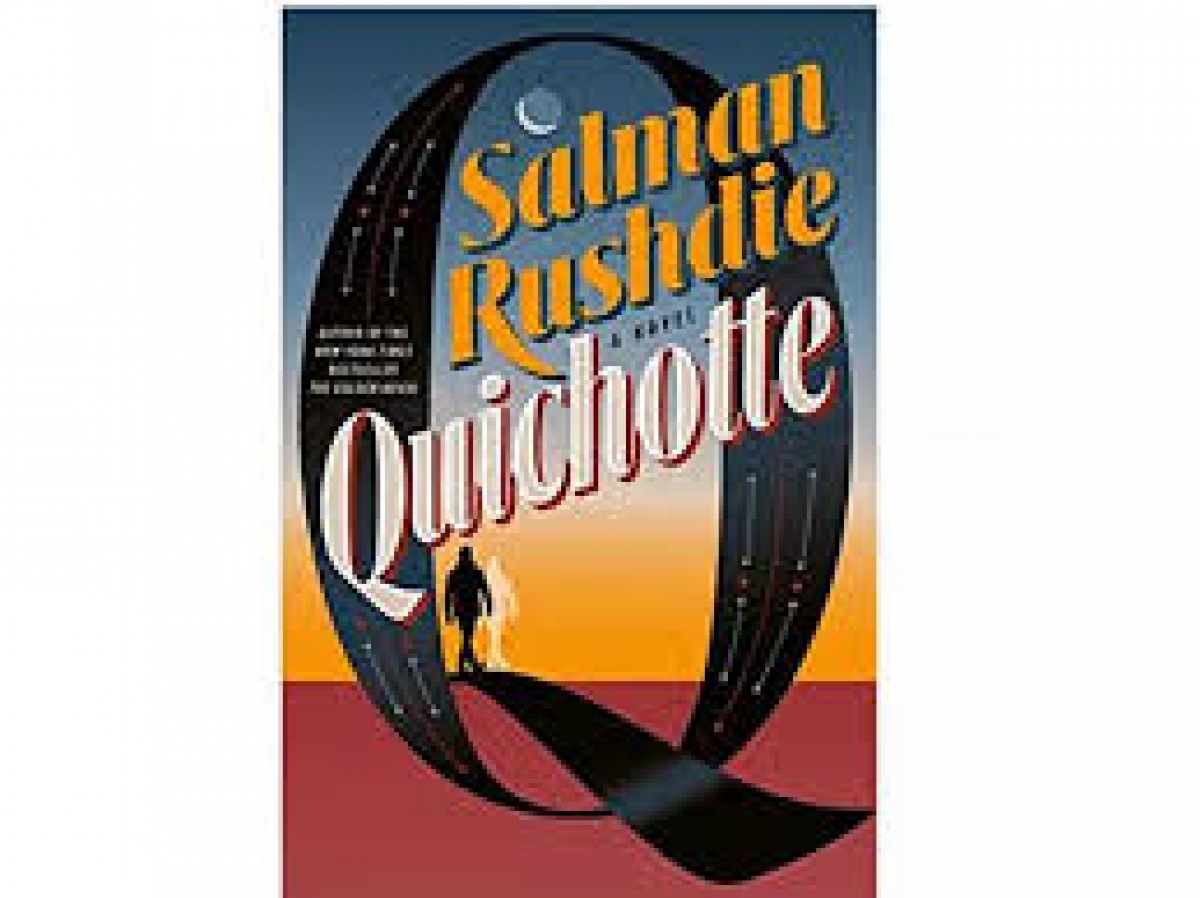
Quichotte
> For as I live this poor life of mine, I seem to brush past another as in sleep; and that that sleep is my present life (Camillo Sbarbaro). In a shattering world, is it possible to save oneself through fantasy, by conjuring up another reality? And in so doing, to elude death? Rushdie attempts to answer this question with a grand fresco: at its center lie the sources of our era's illusions, those that lead us to believe that "anything can happen"—television, cinema, new media, and so forth; then there is the tale of a modest thriller writer: an elderly pharmaceutical salesman peddling opioids is a modern Don Quixote, bearing the evocative name Quichotte, who sets off across the highways of America to win the heart of a television star; next comes the Author, an Anglo-Indian writer as chance would have it, who, as he constructs the story, realizes that Quichotte, > the lonely seeker of love, the loser nobody who believed himself capable, unaided, of winning the heart of a queen, had been with him all his life, a shadow of himself, glimpsed sometimes out of the corner of his eye, whom he had lacked the courage to confront ; and finally Rushdie himself, who seeks to detach himself from the present, so unsettling and ambiguous, in order to bind past and future and thereby conquer death. In the outer frame of this fresco of concentric circles, the "Great Partition"—a dominant theme of the Indian author—is renewed: climate change ravages the earth and imperils survival, populism advances triumphant with its easy panaceas, racism and violence spread, Great Britain is fracturing, cities once open and tolerant like London turn inward with rancor and mistrust, the anchors of an exile like Rushdie dissolve: > the world no longer has an end except that you must finish your book. When you have done so, the stars will begin to fade . This vast fresco, a sort of testament, could not but come at the expense of the narrative: it splinters into a thousand tributaries, loses itself in parenthetical—even philosophical—asides, weighed down by a verbosity typical of Rushdie, yet here unsupported by dazzling prose. The most intriguing narrative thread is the one centered on Quichotte. As he journeys along the roads of America, he is joined by the son he always wished for, Sancho—at first incorporeal, then acquiring flesh and blood through the intervention of the Blue Fairy and the Talking Cricket. A modern Pinocchio, Sancho possesses an individuality of his own but must forge a conscience; unwilling to do so, he will vanish into nothingness: that is, only ethics confers true life. Meanwhile, an eccentric billionaire pitches on television a "door" to another dimension to escape climate catastrophe. Quichotte thus has a purpose: to lead his beloved into another world, to save her. But is any of this real, even within fiction, or merely the byproduct of the opioids that now pervade our society? Most likely they are hallucinations through which one believes survival is possible, that one can do nothing while hurtling toward catastrophe. Together with his beloved, Quichotte bravely throws himself through the door, only to find himself in the Author's reality-unreality—a reality destined to disappear with the end of the book, as happens with all tales of fantasy. > The microscopic man, the creature of the Author's imagination, had brilliantly done the impossible and had joined the two worlds, had crossed from the fantasy world into the Author's real world (...) Stop, cried the Author, knowing what would happen next, the thing he could not stop, because he had already written it; it had already happened, so he could not prevent it from happening. His heart pounded, as if it might tear away from his chest. Everything was coming to an end. Rushdie > could not prevent the end of the world, nor the death of the Author, nor the end of two precious, if small, human lives . How many subjects the great Indian writer seeks to tackle! It is as though his entire life were before him and he wished to retrace it through a staggering tale: the great literature that inspired him, the vicissitudes of his family and homeland, the anguish of existence, the pleasure of fiction—even television fiction. It is as if he wanted to tear away a veil and, through the real-unreal, confront us with our destiny: the extinction of the human species, individual death. To be sure, we are gripped by nostalgia for what the narrative failed to deliver, the incredible story of the modern Don Quixote: how many of us would wish to possess the courage of this eccentric old man, television-addicted and yet wise, to plunge headlong into an improbable romance with a star! If anything can happen.... We have grown accustomed to a baroque, D'Annunzian, sweeping prose; instead, we are confronted with a flat style, easily readable but prosaic and banal, like that of ordinary writers. At times, the great Rushdie resurfaces. Faced with the prospect raised by Sancho that his beloved might not want an elderly bachelor, Quichotte indignantly cries out: > What kind of question is that? (...) It is the question of an ignoramus. It is the inquiry of a baboon trying to speak English. It is the spitting of a fish out of water. It is the dance of an amoeba that thinks it is a human being. It is an insult to the greatness of my quest...
The Enchantress of Florence
We are in the East, in the magical empire of Akbar the Great. > If the war-torn world was a hard truth, then Sikri (the capital of the empire) was a splendid lie . It is a magical world where the mystery of the great sovereign "enchants all the earth, and the future, and all of eternity." Into this wondrous land arrives a traveler hailing from the West, who calls himself Mogor dellʼAmore. He enchants the sovereign and the entire court with tales of an incredible city, Florence: > for him knowledge was of no use, except to remind him of what should never be forgotten: that sorcery requires no potions, familiar spirits, or magic wands. Language made of silver words is enough for enchantment . Mogor dellʼAmore tells of three young Florentines: one of them leaves his native city in search of adventure and becomes a great general in the Ottoman army. In a war against the Persians, he meets a princess who becomes his bride. With this woman he returns to Florence to become the captain of its army. This princess is "the enchantress of Florence," who uses her magical powers to bewitch the entire city. Yet the boundary between sorcery and enchantment is exceedingly tenuous, and soon superstition is unleashed against the woman. What a contrast between the magical world of Sikri and the paltriness of Florence! The princess flees to the New World, but > her magic was no longer strong enough to help withstand temporal forces, just as it was not powerful enough to alter the geography of the earth. No middle passage was found, and she found herself trapped in the new world until she chose to die . Yet even the magical world of Sikri must vanish to yield to the force of reality. > I have returned home after all (said the princess to the great emperor), you allowed me to return, and so here I am, at the end of my journey. End until you are not, said the great regulator of the universe, my love, until you do not exist . Everything can exist within the imagination, even beyond time; nothing can survive in reality. With an imagistic and baroque style, the author narrates an incredible, entirely fictional tale that nonetheless, beneath the tone of a fairy tale, develops three arguments: a) the East is superior to the West, insofar as the East gives expression to the wealth of the imagination; b) fantasy is an enchanted realm that allows one to achieve perfection; c) the movement of history from East to West (from Sikri to Florence, and ultimately to the New World) corresponds to a slow, inexorable decline of civilization. The individual words and the phrasing captivate the reader, yet the events are too implausible and, at the same time, excessively real to enthrall and convince. The digressions—which appear to stem more from a brand of literary narcissism than from the requirements of the plot—encumber the novel, rendering it prolix. Why not read it? Certain pages are delightful, the premise of the book is intriguing, yet it is too fragmented and long-winded to make the overall reading experience genuinely compelling.