Finished reading on: October 23, 2019
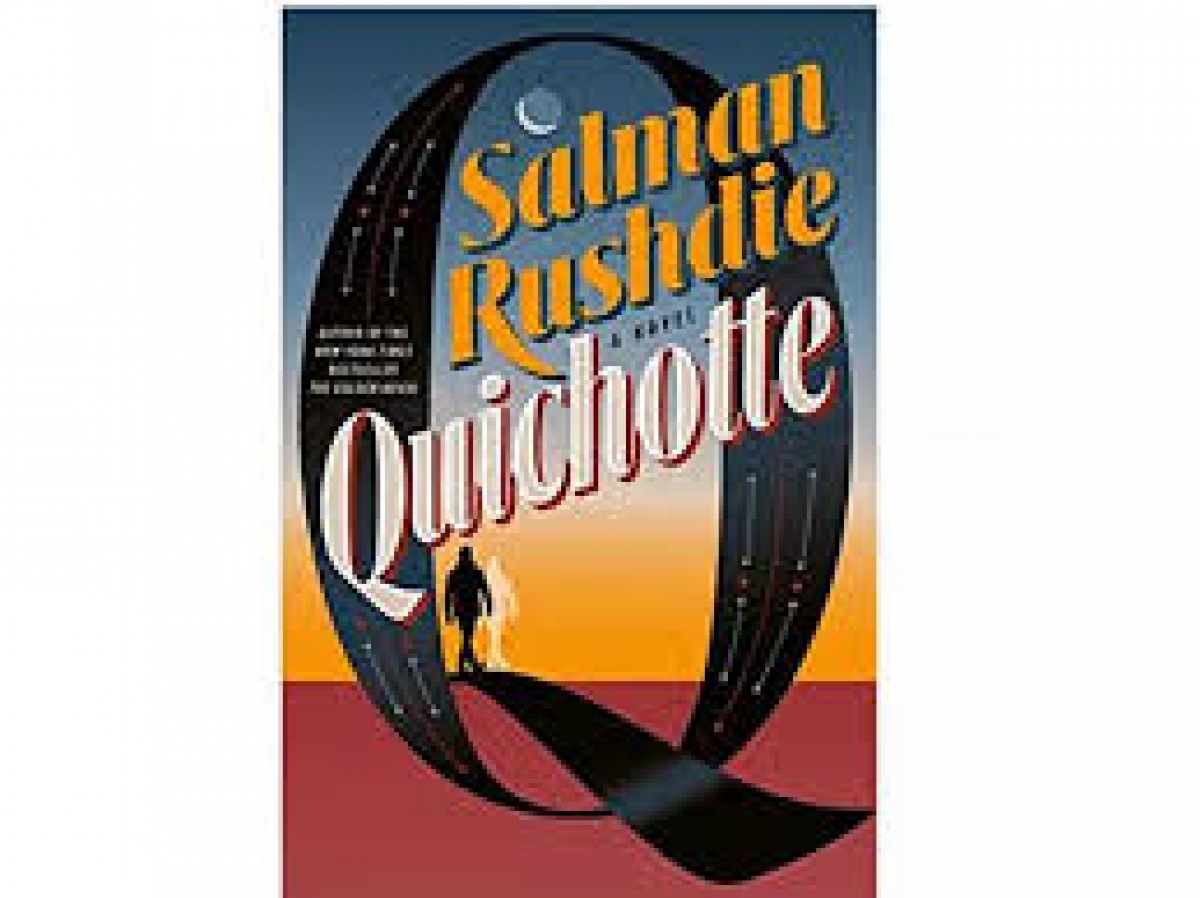
Quichotte
Title of the original version reviewed: «Quinchotte»
AI Translation Notice: This review was translated from the original Italian using artificial intelligence. Book quotes and excerpts are translated interpretations and will not match the author's original English phrasing or official published translations.
For as I live this poor life of mine, I seem to brush past another as in sleep; and that that sleep is my present life
(Camillo Sbarbaro). In a shattering world, is it possible to save oneself through fantasy, by conjuring up another reality? And in so doing, to elude death? Rushdie attempts to answer this question with a grand fresco: at its center lie the sources of our era's illusions, those that lead us to believe that "anything can happen"—television, cinema, new media, and so forth; then there is the tale of a modest thriller writer: an elderly pharmaceutical salesman peddling opioids is a modern Don Quixote, bearing the evocative name Quichotte, who sets off across the highways of America to win the heart of a television star; next comes the Author, an Anglo-Indian writer as chance would have it, who, as he constructs the story, realizes that Quichotte,
the lonely seeker of love, the loser nobody who believed himself capable, unaided, of winning the heart of a queen, had been with him all his life, a shadow of himself, glimpsed sometimes out of the corner of his eye, whom he had lacked the courage to confront
; and finally Rushdie himself, who seeks to detach himself from the present, so unsettling and ambiguous, in order to bind past and future and thereby conquer death. In the outer frame of this fresco of concentric circles, the "Great Partition"—a dominant theme of the Indian author—is renewed: climate change ravages the earth and imperils survival, populism advances triumphant with its easy panaceas, racism and violence spread, Great Britain is fracturing, cities once open and tolerant like London turn inward with rancor and mistrust, the anchors of an exile like Rushdie dissolve:
the world no longer has an end except that you must finish your book. When you have done so, the stars will begin to fade
. This vast fresco, a sort of testament, could not but come at the expense of the narrative: it splinters into a thousand tributaries, loses itself in parenthetical—even philosophical—asides, weighed down by a verbosity typical of Rushdie, yet here unsupported by dazzling prose. The most intriguing narrative thread is the one centered on Quichotte. As he journeys along the roads of America, he is joined by the son he always wished for, Sancho—at first incorporeal, then acquiring flesh and blood through the intervention of the Blue Fairy and the Talking Cricket. A modern Pinocchio, Sancho possesses an individuality of his own but must forge a conscience; unwilling to do so, he will vanish into nothingness: that is, only ethics confers true life. Meanwhile, an eccentric billionaire pitches on television a "door" to another dimension to escape climate catastrophe. Quichotte thus has a purpose: to lead his beloved into another world, to save her. But is any of this real, even within fiction, or merely the byproduct of the opioids that now pervade our society? Most likely they are hallucinations through which one believes survival is possible, that one can do nothing while hurtling toward catastrophe. Together with his beloved, Quichotte bravely throws himself through the door, only to find himself in the Author's reality-unreality—a reality destined to disappear with the end of the book, as happens with all tales of fantasy.
The microscopic man, the creature of the Author's imagination, had brilliantly done the impossible and had joined the two worlds, had crossed from the fantasy world into the Author's real world (...) Stop, cried the Author, knowing what would happen next, the thing he could not stop, because he had already written it; it had already happened, so he could not prevent it from happening. His heart pounded, as if it might tear away from his chest. Everything was coming to an end.
Rushdie
could not prevent the end of the world, nor the death of the Author, nor the end of two precious, if small, human lives
.
How many subjects the great Indian writer seeks to tackle! It is as though his entire life were before him and he wished to retrace it through a staggering tale: the great literature that inspired him, the vicissitudes of his family and homeland, the anguish of existence, the pleasure of fiction—even television fiction. It is as if he wanted to tear away a veil and, through the real-unreal, confront us with our destiny: the extinction of the human species, individual death. To be sure, we are gripped by nostalgia for what the narrative failed to deliver, the incredible story of the modern Don Quixote: how many of us would wish to possess the courage of this eccentric old man, television-addicted and yet wise, to plunge headlong into an improbable romance with a star! If anything can happen....
We have grown accustomed to a baroque, D'Annunzian, sweeping prose; instead, we are confronted with a flat style, easily readable but prosaic and banal, like that of ordinary writers. At times, the great Rushdie resurfaces. Faced with the prospect raised by Sancho that his beloved might not want an elderly bachelor, Quichotte indignantly cries out:
What kind of question is that? (...) It is the question of an ignoramus. It is the inquiry of a baboon trying to speak English. It is the spitting of a fish out of water. It is the dance of an amoeba that thinks it is a human being. It is an insult to the greatness of my quest...