Finished reading on: July 22, 2014
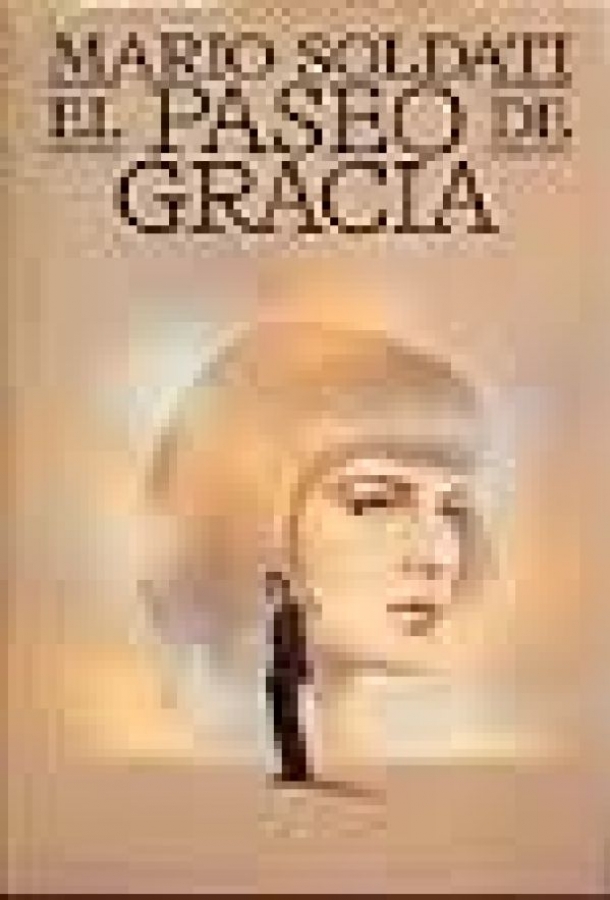
The Paseo de Gracia
Title of the original version reviewed: «El Paseo de Gracia»
AI Translation Notice: This review was translated from the original Italian using artificial intelligence. Book quotes and excerpts are translated interpretations and will not match the author's original English phrasing or official published translations.
Eugenio is a well-known Italian set and costume designer living in Los Angeles.
A phone call from Italy takes him back to the origins of his career and to the figure of Olga.
Many years earlier, when he was still in Italy, Eugenio had had an affair with a friend of his wife, namely Olga:
petite, pretty, dark-haired, with fringe and kiss curls à la Louise Brooks (...) she had an elusive, ambiguous gaze
.
Eugenio loved his wife, an intelligent, cultured, and refined woman, yet he was captivated by the repetitive cadence of the encounters with his mistress: a long period of indifference, a furtive, silent, violent, swift coupling, and then indifference once more, as if nothing had happened.
What is the appeal of a betrayal so barren of eroticism and sentiment?
Eugenio felt superior to Olga, (...) to the point of taking pleasure only if he risked—oh, with impunity!—the charade of pretending to be inferior and worshipping her as though she were truly his superior (...) (yet) Eugenio always knew that Olga was a wretched slave
.
It was the pleasure of deceiving himself, even if only for five minutes (the duration of the coupling), that was the trigger of Eugenio’s desire; he who, in his selfishness, relished the thought that Olga deluded herself into believing she was the mistress, knowing all the while that it was merely a game.
Naturally, this was not the case: the woman had no desire to be the futile occasion for the man’s outsized ego, for a "double lie" perpetually identical to itself.
Eugenio never noticed, and found it convenient not to notice, or even suspect, that she too might possess a soul, might even, in the long run, begin to care for him
.
Olga fled, vanishing without a trace, yet she lingered in Eugenio’s fantasy: the aspiration of a subject woman who becomes sovereign for a few minutes.
The novel resumes "in the present."
Eugenio has returned to Italy to shoot a film, but his stay in Europe is nothing other than a search for Olga.
And when he must travel to Barcelona, where the woman is rumored to live, Eugenio repeatedly walks down El Paseo de Gracia in the hope of crossing paths with Olga, who,
strangely, miraculously, would appear to him identical to how she had been fifteen years before: with her sleek helmet of hair à la Louise Brooks, her silly yet sly little face, her pouty smile
.
And he would have said to her,
with the greatest possible composure: Of course it is all over.
But...
but perhaps, we could try once more...
just once
.
The backdrop is the marvelous yet hollow world of cinema.
The author also develops a series of intrigues, intended to impart at least some narrative pace to a plot composed essentially of sensations and reflections.
A primary layer of meaning in the novel lies in the depiction of transgression, all the more captivating the further removed it is from ordinary life.
As the author observes,
long periods of abstinence (...). Then, a sudden, subtle awakening of desire, but, for a few days, merely a distracted reminder, a seemingly harmless memento.
Finally, all at once, a restlessness that gave him no peace (...) And everything repeated itself more or less as it had the time before
.
There exists, moreover, a deeper, existential and philosophical key to the text, aptly expressed by the passage on the obsession with tiles.
Eugenio sees the same pattern continually repeated across the bathroom tiles, yet with endless subtle variations.
Viewing the tiles from different vantage points, two recurring figures emerge: the Bravo, who could be recognized
always in profile, his coarse, heavy hooked nose immediately visible, his cruel mouth, the piercing eye of a stalking beast; and the Soubrette, a small and graceful little face (...) with her delicate little mouth smiling in turn
.
The Soubrette was the Bravo reversed: the dominator can become the dominated, the violent the docile, and so forth; in varying circumstances, we can all be both at the same time.
Already in Lo Smeraldo, a visionary novel, Soldati explored the theme of the double by resorting to the device of the dream.
Do other worlds exist within us? In the more traditional A cena col commendatore, he returns to the complexity of the human soul: the mask behind which we hide is not an artifice, but an intrinsic part of consciousness.
In these two novels, the narrative is sustained by the prose; in the former, D’Annunzian and lavishly imaginative; in the latter, simple and reminiscent of the nineteenth century.
In this book, by contrast, the style is fractured, laborious, verbose, poorly sustained by a slender and inconclusive plot.
Why avoid it? It does not do justice to Soldati the writer.
It marks a decline in quality.