Finished reading on: January 20, 2014
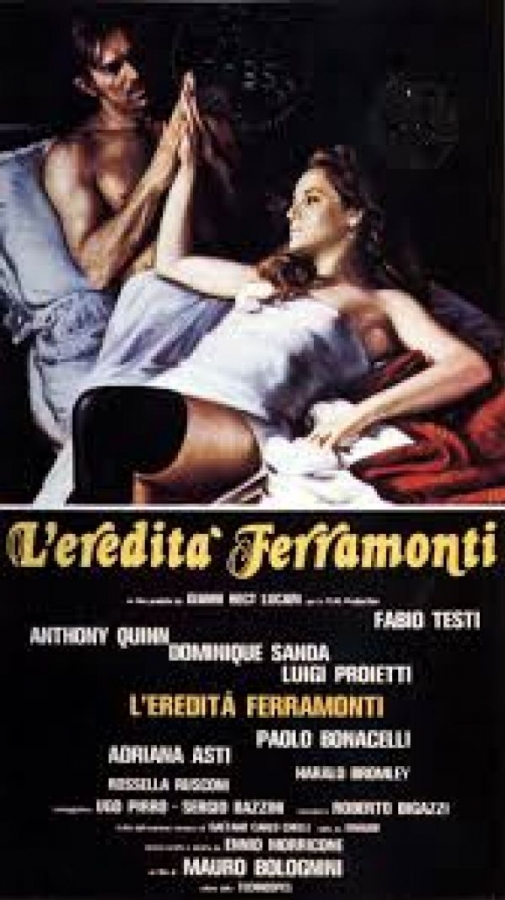
The Ferramonti Inheritance
Title of the original version reviewed: «L'eredità Ferramonti»
AI Translation Notice: This review was translated from the original Italian using artificial intelligence. Book quotes and excerpts are translated interpretations and will not match the author's original English phrasing or official published translations.
Chelli is a “minor” nineteenth-century author, forgotten and relegated to the margins of Italian literature.
Only Benedetto Croce remembered him in his Letteratura della Nuova Italia, misspelling his surname to boot (calling him Ghelli) and citing him as a chronicler of the bourgeoisie of Rome as capital.
Chelli, however, is a fine writer, both for his narrative technique and his original handling of the character system.
The historical context is Rome in the second half of the nineteenth century, undergoing profound urban and social transformation since becoming the capital of a major state.
The social milieu consists of petty-bourgeois shopkeepers and clerks; the dominant values are the “god of money” and social ascent at all costs.
From Piazza di Ponte to Campo dei Fiori, Padron Gregorio Ferramonti enjoyed the notoriety and esteem accorded to a man believed to be nearly a millionaire.
He had built his fortune with his own hands
.
It is true that his wealth was the subject of much gossip, but Ferramonti,
like all enriched wretches, navigating murky waters, knew men, held them in no esteem, and above all mistrusted them
.
This contempt extended to his children as well: his two sons, Mario and Pippo, and his daughter, Teta.
The first squanders his father’s money; the second is coarse and ignorant; while the daughter bears the grave fault of having married a modest, even penniless, petty ministry clerk.
Padron Ferramonti severs all relations with his children, who are full of rancor toward their father and, above all, terrified of being disinherited.
Yet they are so superficial, so devoid of energy and ambition, that they could hardly wage a successful fight for the Ferramonti inheritance.
Irene will take this task upon herself.
She brought...
a note of elegance, a charming smile, and a splendor of beauty, a thrill, a joy, a subtle intoxication that permeated men and things, (yet) she felt in her nerves, in her blood, and in her brain something she could not define: a fever consuming her whole being, warning her that she was born for wealth and dominion
.
The Ferramonti inheritance had to be hers! She had to overturn a destiny that had decreed her
born poor, among shopkeepers, among people who would have thought her raving mad had they been able to know her for what she really was
.
To achieve her goal, Irene marries Pippo, manages to reconcile the three siblings, and becomes Mario’s mistress in order to enter the “grand circuit” of the Roman bourgeoisie and profit from her brother-in-law’s fortunate financial speculations.
And finally, she targets her father-in-law, Padron Gregorio, winning him over with her charm,
with her myriad caresses of an affectionate kitten... with gentle chatter that steeped him in ineffable bliss
.
When the old man dies of an apoplectic stroke, brought on by the many delicacies fed to him by his so-very-affectionate daughter-in-law, Irene finds herself holding a document that would make her the heir to the lion’s share of the estate.
We readers follow her, intrigued and astonished, in the execution of her ambitious and daring design; and Chelli is so skillful that we fail to see where he is heading, or the rationale behind so many unpredictable moves.
We are convinced of her victory because the psychological gulf between Irene and the other characters is simply too vast.
And yet, our “heroine” suffers a resounding defeat.
Why? Chicanery, ruthlessness, the lust for money, and well-concealed adultery are all acceptable to the Roman bourgeoisie—public scandal is not.
She was unhappy.
She could not recall a single day of her existence that marked a truce in the secret rebellion against her own destiny, with which her heart was poisoned...
(and so she surrendered) to the audacities of a woman who defies the world, having once sought to deceive it through hypocrisy
.
She flaunts her affair with her brother-in-law (Mario is a notorious libertine) and consents to dress scandalously and provocatively, letting herself be seen walking
with a roguish sway of the hips that momentarily revealed through the slit of her skirt her left leg, seemingly bare under the flesh-colored stocking, the scarlet garter against the white hose, and her arched little feet in satin slippers; then came an explosion: it was a marvel! nothing like it had ever been seen! And to think that at first she had wanted to refuse!..
In short, the desire to please, to feel pursued by
a wave of obscene thoughts, like an outpouring of equivocal smirks and reckless glances
, gains the upper hand over the cold calculator and ruins her.
Her fragility betrays her.
It becomes easy for the lawyers to argue that Irene duped old Gregorio with the vile arts of a harlot, and that the will was therefore extorted by deceit.
The victor turns out to be none other than the despised yet shrewd petty ministry clerk, who finds himself heir to a vast fortune after Pippo and Mario die tragically, driven to despair after being abandoned by the woman they loved, Irene.
Prudent, opaque bourgeois conduct triumphs over the courage—transgressive though it may be—of one who seeks to upend the social hierarchy: a bleak omen for the new Italy.
Behind a seemingly simple plot lies a sophisticated narrative technique.
It is as if we were standing before a film in which the camera constantly shifts perspective, without lingering on a single character or setting.
Each protagonist becomes, in turn, the focal point of the narrative, so that each appears able to move freely and steer the story toward an outcome different from the one that actually unfolds.
Only intermittently does Irene’s point of view emerge, and the reader realizes, with astonishment, that the entire sequence of events is part of the woman’s overarching design.
Yet precisely when the camera focuses on her, it becomes apparent, contrary to all expectation, that she is not, perhaps, a purely wicked orchestrator of deceit.
She is also a woman, solitary and vulnerable, with her own doubts and weaknesses.
The author acts like a director who allows his actors to improvise.
Without an omniscient psychologist,
the official portraits of the actors and the explanations of the inner workings of their actions fall away; each is described and intelligible only insofar as they are the object of their own analysis or that of others, and the persuasiveness of these diverse perspectives is in direct proportion to the perspicacity of the observer
, that is, of the reader (Roberto Bigazzi, preface to the 1972 Einaudi edition).
Why read it? A sophisticated fresco of the Roman bourgeoisie; a splendid portrait of a woman—social-climbing and transgressive.