Finished reading on: October 27, 2018
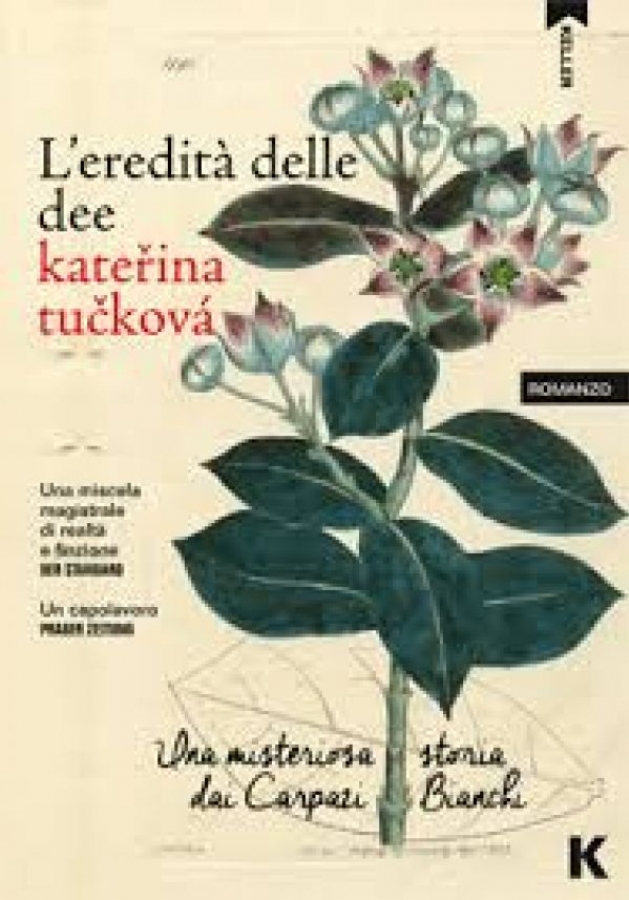
The Legacy of the Goddesses
Title of the original version reviewed: «L'eredità delle dee»
AI Translation Notice: This review was translated from the original Italian using artificial intelligence. Book quotes and excerpts are translated interpretations and will not match the author's original English phrasing or official published translations.
The Kopanice region lies on the border between Moravia (the south-eastern area of today’s Czech Republic) and Slovakia, comprising various villages scattered across the slopes of the White Carpathians.
Si tratta di una regione che ha pienamente conservato le sue tradizioni folcloristiche, anche perpetuate in una forma arcaica, soprattutto perché è un luogo quasi isolato dal mondo circostante
.
The women called goddesses are
subjects who possess, according to widespread belief, specific abilities enabling them to heal illnesses, to see the past, to foretell the future, and to uncover information generally inaccessible to ordinary people
.
So read Gestapo documents, intent on confirming the theory that a remnant of Germanic population had survived in Moravia, thereby justifying the Third Reich’s claims over Central Europe.
It is not political motives, however, that prompt Dora, a young ethnography researcher, to study the goddesses.
She herself was raised by a goddess, her aunt Surmena, ever since discovering—still a child—the body of her mother, hacked to death with an axe by her father.
For a long time, she had thought that this was the origin of all her suffering.
But that was not true.
(...) Dora was not stupid, and the stricken faces of the villagers spoke clearly: her and her brother’s misfortune had begun much earlier, at a time that her short memory could not recall
.
With the resolve of a scientist and the tension of someone personally implicated, Dora retrieves and scrutinizes archival documents, tracing back the course of history: from the witch hunts to the meticulous Nazi investigations, right through to the socialist era, with its rationalistic and conspiratorial theories.
She does not confine herself to analyzing and comparing police reports, research by anthropologists and ethnographers, letters and accounts; she frequently returns to the places of her childhood to gather the women’s testimonies and experience anew
the woods filled with beeches and oaks, (...) the meadows teeming in summer with rare orchids, marsh orchids, and anemones, interspersed with strips of cultivated fields, with low cottages clinging to the ground, (...) with those cold mornings of a sweltering summer, (...) and with those harsh winters.
(...) With that round, gigantic moon rising over the dense mountain peaks.
(...) And before the doorstep, on the ridge of the hill, one seems to be in heaven, with the entire world unfolding at our feet.
Ma perché tornare al passato? Riportare alla luce i mostri? Sulla famiglia di Dora incombe la maledizione di una dea cattiva, contro la quale Surmena aveva combattuto tutta la vita.
Se non si affida a «quelle occulte mani che mʼintridono» (come dice Ungaretti) come può spiegare Dora i tragici eventi: il truce omicidio della madre, il fratello minorato in coma per un attacco epilettico, la zia Surmena rinchiusa in manicomio a morire come una povera pazza, il suicidio del padre?
She rested her head against the tiled wall of the hospital and closed her eyes.
(...) And what if it really was the fault of the curse that had dragged itself down to them? What would it have meant for her to grow up with that awareness?
The novel can be read from many angles: as a historical thriller, a conflict between science and superstition, a romantic immersion into an ancestral world of women, a search for Central Europe’s common roots—Germanic and Slavic at once because steeped in the same Indo-European paganism; and above all the story of Dora, of her loneliness, of her desperate need for a family, of her resilience that refuses to surrender to mystery.
Dora cannot accept the vilification of her beloved Aunt Surmena, accused of collaborating with the Nazis and for that reason unjustly persecuted by the socialist regime.
The author wanted to tackle too many subjects: the result is an overabundance that wearies the reading, dissolves the plot, and fragments the narrative.
And the reader is left with one question: who is Dora? The protagonist is submerged beneath too many facts and too many characters, and we still do not understand who she is, even after more than four hundred pages.
Why not read it? It is intriguing at the beginning, but ultimately proves prolix and tedious.