Finished reading on: December 22, 2015
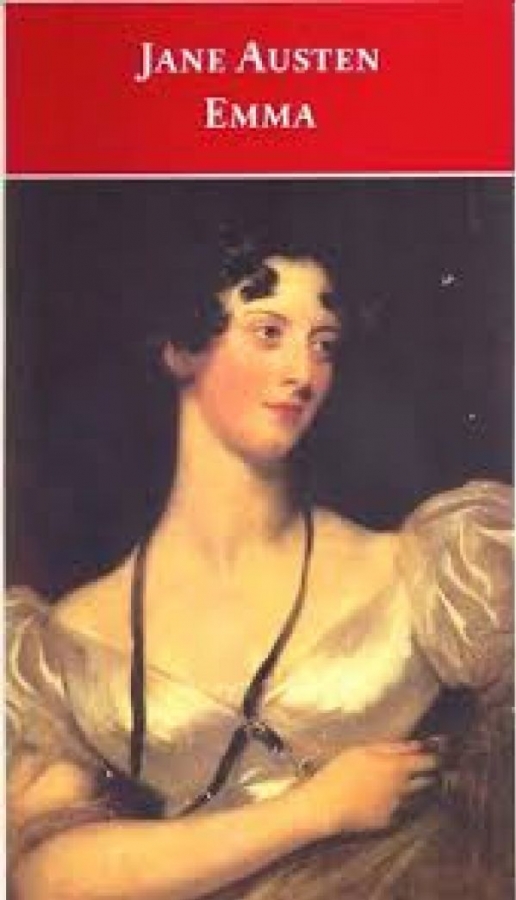
Emma
AI Translation Notice: This review was translated from the original Italian using artificial intelligence. Book quotes and excerpts are translated interpretations and will not match the author's original English phrasing or official published translations.
Emma is a young woman, determined, independent, but inclined “to think a little too well of herself.”
She lives in a small English country town with her father: a frail widower, fearful of novelties and above all of being abandoned by his adored daughter.
Then again, why marry?
If I were to fall in love, indeed, it would be a different thing! But I have never been in love; it is not in my way or in my nature; and I do not think I should.
And, without love, I am convinced that I should be a fool to change such a situation as mine; (...) and never, never could I expect to be so truly beloved and important; so always first and only in any man’s eyes as I am in my father’s
.
It is not merely pride and the desire to be mistress of herself; it is also her ideal of a husband: high integrity, adherence to truth and principles, contempt for deception and pettiness.
Will she remain faithful to these criteria, so confidently asserted and lived? In part.
The story begins with the decision of her governess, Mrs.
Weston, to marry and leave the house where she had been in service for so long.
While her father is distraught, for Emma it means losing the only person in whom she could confide, the only one who managed in some way to restrain the young woman’s temperament—sensitive, reflective, yet also headstrong and determined to impose herself upon others.
There is also her brother-in-law, Mr.
Knightley, who has known her since childhood, but with him it is a continuous bickering, a perpetual clash of differing perspectives.
Emma meets Harriet Smith, with whom she strikes up an intense friendship.
But if
Mrs.
Weston was an object of respect, based on gratitude and esteem, Harriet would be loved as one to whom she could be useful.
For Mrs.
Weston there was nothing to be done; for Harriet, everything
.
Harriet possesses no dowry and comes from a low social class, but that is no reason she must demean herself by marrying just any suitor! With a healthy dose of presumption and recklessness, Emma persuades the docile Harriet not to marry Martin (a humble tenant farmer!) and to set her sights on the hand of Mr.
Elton, the vicar of the small town.
When Mr.
Elton, rejected by Emma herself (why, then, was he the right husband for her friend?), marries a vain and shallow girl who nonetheless brings a handsome fortune, Emma consoles Harriet, pointing out to her that Elton was not such a reliable man after all.
Two new characters appear: Jane, a beautiful but ailing young woman who comes to live with her aunt and whose only prospect is to become a governess in wealthy households; Frank, the son of Mrs.
Weston’s husband, who resides with a rich and overbearing aunt.
Emma attempts to befriend Jane (another young woman to manage?), but is somehow rebuffed and kept at a distance.
During the few days he spends with his father, Frank manages to pay court first to Emma and then to Harriet.
Although Emma, initially flattered and intrigued by the young man, senses that there is something false in Frank’s conduct, it seems Harriet’s turn has arrived—at least so Emma thinks, and she convinces her friend accordingly.
In vain does Mr.
Knightley warn her, pointing out Frank’s weak character, but once again Emma stubbornly disregards her friend’s far wiser judgment.
It is precisely during one of these conversations, often punctilious and contentious, that a premonitory incident occurs.
With a slight movement, quite unlike ordinary friendship, (...) Mr.
Knightley took her hand; whether she had not herself made the first motion she could not say; she might, perhaps, have rather offered it
.
Frank’s aunt dies, and the young man, freed from constraints, confesses that he was secretly engaged to Jane and that his alleged courtship of Emma and Harriet had merely been a ploy to divert attention from the true object of his affections.
Hence the cause of Jane’s distress: the false position in which she found herself.
Emma feels sorry for Harriet and realizes she was mistaken once again in her assessments, but she is deeply offended by the conduct toward Jane, who was forced to submit to deception through Frank’s lack of courage and dignity.
On the other hand,
it might well be said that the world does not belong to woman; its rules are not hers
.
For Emma, there is a surprise.
When she goes to inform Harriet of the affair, she discovers that her friend is in love with Mr.
Knightley and is convinced that her feelings are reciprocated.
Emma ought to be happy; why then does she feel a sense of pique, of subtle jealousy, of the loss of the beloved object?
What blindness, what madness had led her on! It struck her with the force of overwhelming misery!
Emma discovers that she loves and has always loved her friend; great then is her joy when Mr.
Knightley, at first diffidently and then with growing assurance, confesses that he loves her too and wishes to marry her.
But is Harriet deceived once more? No matter: through a subterfuge, Emma dispatches her to London to stay with her sister, so as to get her out of the way; and then, when she must finally face her, she learns that Harriet had deceived her all along, having never stopped loving Martin, whom she had continued to see in spite of Emma.
All ends well, but what remains of the independent and proud Emma? She will live with her father and Mr.
Knightley, withdrawing into the domestic sphere typical of a woman.
Even female friendships, particularly that with Harriet, will dwindle into mere superficial acquaintances; it is difficult to sustain them when one loves a man.
It is a highly intricate novel, perhaps overly long and complex, in its plot as well as in its writing.
The core remains female independence, with certain distinctive elements compared to the author’s other novels.
While in her other books the setting—the small town, the early nineteenth-century petty bourgeoisie, the English countryside—serves as a backdrop, here it occupies the center of the narrative.
One need only consider the second volume: the superficial conversations, the drawing-room gatherings, and the country outings portray a shallow, prudish society, intensely preoccupied with appearances and fortunes.
It is like reading Marcel Proust’s The Guermantes Way and, as in this volume of the Search, the endless dialogues are equally tedious, verbose, and inconclusive.
Another aspect that links the novel to Proust’s work is the theme of the discrepancy between what is imagined and reality.
“Myself creating what I saw,” Mr.
Knightley quotes at one point; and indeed Emma imagines situations that prove to be quite different from those spun by her fancy.
Addressing Harriet, Emma exclaims, “Good God! how have I never seen her!”
The story unfolds slowly, devoid of narrative pace, lacking in action.
Dialogue predominates, frequently repetitive.
Only intermittently are the characters explored in depth; they all revolve around Emma, yet without completing or explaining her.
The syntax is extremely arduous and convoluted, as though the author wished to showcase her prowess in writing and her mastery of “cultivated” English.
Why read it? It is worth reading if one wishes to gain a comprehensive view of Austen’s splendid characters; otherwise, it is better left unopened, for it is long, difficult, and prolix.