Llosa Mario Vargas
Books by this author (5)
The Dream of the Celt
Roger Casement was born in 1864, in the century of the West’s conquest of the world—of that which styled itself as civilization. And the young Roger believes firmly in this civilizing and adventurous spirit, to the point of deciding to go to the Congo, then a land of Belgian conquest. Yet there, reality confronts him in a profoundly different way: > those poor people whipped, mutilated, those children with hands and feet severed, dying of hunger and disease. Those beings squeezed to the point of extinction and murdered on top of that. Thousands, tens, hundreds of thousands. By men who had received a Christian upbringing. I saw them go to Mass, pray, take communion, both before and after committing those crimes. Perhaps in those years I lost my mind. And everything that happened to me afterwards was the work of someone who, even if he did not realize it, was mad . Yet Roger still believes in Western civilization and thus devotes his life to denouncing the crimes perpetrated against these peoples. First in the Congo and then in Brazil, he carries out an investigation on behalf of the British government into the conditions of exploitation and the atrocities being committed. His name becomes famous in Britain and the United States, to the point that he is conferred the title of baronet. Yet it is easy to stand on the side of justice when it concerns distant lands, subject to the dominion of other powers—in this case, Belgium and Peru. It is far harder to confront what lies close at hand, such as Ireland. Roger is Irish, and he decides to dedicate the final years of his life to the struggle for his country's independence, going so far as to pursue the mad scheme of seeking assistance from Germany during the First World War. He is arrested in 1916 and sentenced to death. The life of Roger Casement is recounted in the form of a novel, but here Vargas fails, or refuses, to transfigure history. The result is a well-written chronicle, yet one that neither offers a documented inquiry shedding light on the facts and motives of such a singular and momentous figure, nor manages to impart to the reader the sense of suffering and disillusionment that must somehow have dominated the protagonist. It is, without question, an indictment of colonialism, yet it remains merely that, without ever truly stirring the conscience. Why read it? The sole reason is to discover a truly singular and remarkable figure.
Aunt Julia and the Scriptwriter
Vargas Llosa defined the writer's work as > two things at once: a reconstruction of reality and a testimony to the dissent (of the writer) from the world. Indissolubly united, these two ingredients will appear in the (writer's) work, one objective and the other subjective: the reality with which (the writer) finds himself at odds and the reasons for this enmity; life as it is and what he would like to suppress, add, or correct in life . Outwardly, the novel expresses precisely this conflict. In the odd chapters unfolds the story of an eighteen-year-old who dreams of becoming a writer and who, in 1950s Lima, falls in love with his aunt—Aunt Julia, to be precise. Family relations (grandparents, countless aunts and uncles, cousins), the working environment of the radio station, dive bars and disreputable neighborhoods, Peruvian villages—all form the backdrop for a lively and engaging narrative, yet one that is essentially conventional, leading as it inevitably does to falling in love and the complications bound to afflict a romance between a minor and a much older woman. In the even chapters, by contrast, a writer of radio serials (the scriptwriter) invents incredible, marvelous, and catastrophic tales: entirely fantastical stories, which are without doubt the most captivating part of the novel. The trouble is that imagination runs away with him: the scriptwriter can no longer govern his own stories and, above all, his own characters. One day, the scriptwriter confesses to the aspiring writer that > something embarrassing is happening, I don't remember the scripts very well, I have doubts and slip-ups occur The characters "get mixed up." > When I realize it, it's too late. You have to perform acrobatics to put them back in their places, to explain their transformations . With exceptional mastery, chapter by chapter Vargas Llosa injects into each story broadcast over the airwaves ever-increasing elements of confusion, building toward a pyrotechnic finale. Yet is this conflict between odd chapters (the realistic ones) and even chapters (the imagined ones) truly genuine? The young eighteen-year-old’s story begins like a classic nineteenth-century novel, but it too subsequently loses itself in improbable events—one need only consider the two lovers' wanderings through the Peruvian countryside in search of a mayor willing to marry them. And when, many years later, the young writer—now established in Europe—returns to Peru, he discovers that the vicissitudes of life mirror the fate of old radio scripts: > the humidity had effaced the lettering, mice and cockroaches had nibbled and shat upon the pages, and the scripts had become intermingled with one another. There is no way to choose: at best, one can try to discover some legible text. Was the scriptwriter right, then, when in his delirium he declared: > what is realism, gentlemen, what is this much-vaunted realism? The interweaving of imagination and reality (the true guiding thread of the book) is achieved not so much through the narrative structure (rich in characters and episodes though it may be) as it is rooted in a language and syntax that marvelously fashion a sense of evanescence and fantastical suspension. Consider the opening of the twelfth chapter, undoubtedly one of the finest: in the dusty center of the city, halfway down the jiron Ica, there is an old house with balconies and shutters whose walls, mottled by time and uncouth passersby (sentimental hands carving arrows and hearts and scribbling women's names, perverse fingers sculpting genitalia and swear words), still allow one to glimpse, as if from afar, faint veils of what had been the original paint, that color which in the Colony adorned aristocratic residences: indigo." Why read it? It is a wonderful book that reads in a single breath, an escape from reality. It is the work of a truly great writer.
The Feast of the Goat
What are the mechanisms that uphold a dictatorship? Vargas Llosa sets out from history, from real protagonists and events, to investigate the dark allure of the despot, and he does so starting from a cruel character in whom the peculiarities of tyranny have been distilled, stripped of the smokescreen of ideologies and good manners. We read from the Treccani Encyclopedia that Trujillo ruled the Dominican Republic from 1930 to 1961 > through dictatorial methods until his death, thanks to his control over the armed forces, that exercised (directly or through members of his family) over the national economy, and the systematic resort to terrorist methods against his opponents ; and, I would add, through the backing of the United States and the Church, who saw him as a bulwark against communism. We are in the final phase: the regime’s atrocities have driven the United States and the Church to abandon Trujillo, strangling the small country with sanctions and isolating the dictator internationally. There are three narrative strands, running in parallel and later intertwining, always circling the baneful figure of Trujillo. Urania, a successful young woman living in New York, returns to Santo Domingo to visit her aging father, confined to bed in an almost vegetative state. For many pages we do not comprehend so much rancor toward her father; we only know that Urania > had not managed to overcome the insurmountable revulsion, the disgust men inspired in her... you had never wanted to get treatment . In the second narrative strand, the setting is where Trujillo will be assassinated and where the conspirators anxiously wait (first called executioners, then patriots): they are a heterogeneous group of figures, driven by revenge or by revulsion toward a cruel regime; they were once beneficiaries of the dictator and remain bound to him by a love-hate relationship: a > paralysis, the numbing of the will, of reason and free will that that contemptible character—dapper to the point of ridicule, with his fluting little voice and hypnotist's eyes—exercised over Dominicans, rich or poor, learned or unlettered, friends or foes . His assassination is a catharsis, a deliverance from a tragic spell, rather than a political act. And finally, we find ourselves before Trujillo and his court: the depraved, sadistic sons, the greedy and thousand-times-betrayed wife, the puppet president, the police chief—the perpetrator of the most heinous tortures and crimes—the cunning pettifogger, and many others. All live in perpetual dread: it is the Chief’s habit to dismiss them, expropriate their wealth, cast them into prison, have them killed, on a mere whim, to assert his power over life and death. And they submit; if they fall from grace, they yearn to return to the tyrant's good graces, ready for anything, like Urania's father, formerly an esteemed senate president and then cast aside without explanation. The country is falling apart, inflation and poverty run rampant, the regime is fracturing, yet just hours before his assassination, Trujillo is concerned with only one thing: he is unable to use "the part of the body I will not name" (Patrizia Valduga *La tentazione*). The narrative unfolds slowly, at times verbosely, until one reaches several splendid chapters, for which alone the book is worth reading. The conspiracy hinges on the commander of the Armed Forces, who was supposed to intervene swiftly and decisively upon news of Trujillo's death. Instead, he stalls, temporizes, > plunged into that kind of hypnosis, he thought that perhaps his indolence was due to the fact that, although the Chief's body was dead, his soul, his spirit, or whatever it was called, continued to hold him in thrall . And like the conspirators of July 25, 1943, when the Grand Council of Fascism effectively ousted Mussolini, our conspirator slips into the quicksand of torment. Next, we follow the puppet president in his seizure of power, > a defenseless little man who wrote verses and seemed of so little consequence in this world of real men with pistols and submachine guns , and, allowing for the obvious differences, the mind turns to Dino Grandi or to Pietro Badoglio himself, accomplices to the Fascist dictatorship yet ultimately its gravediggers. And finally, in the last and dramatic chapter, we understand the depth of Urania's bitterness. While still a young girl, her father sold her to the dictator simply to regain the Chief’s favor. And he, > taking her by the arm, threw her down beside him. (...) That mass of flesh crushed her, suffocated her against the mattress. (...) But the suffocation did not prevent her from feeling the roughness of that hand, of those fingers exploring, groping, and forcing their way into her . Many words can be used to describe a tyranny, yet it is epitomized in its most ancestral and brutal manifestation: rape. I am not aware whether there exists a great novel on the Fascist dictatorship capable of probing the dark fascination of tyranny as Vargas Llosa has done. Were such a narrative to exist, it would bring out of the shadows the lavish court that surrounded the dictator: his double-breasted blackshirts, the illustrious heirs of the liberal class, the magniloquent and craven intellectuals—either naive or merely pandering—the cowardly, complaisant generals, and the many women whom Mussolini used and cast aside, or dragged with him to his death. If I were the ANPI, the National Association of Italian Partisans, I would entrust Vargas Llosa with the task of giving us such a fresco, to answer the question: > who was it? (...) Whose fault is it? And all those who died, poor souls? (...) I saw them die, it was all useless... he felt like foolishly bursting into tears (Mario Tobino *Il clandestino*, see review on this site). Masterfully translated, the novel is nevertheless too long, and in particular the extensive reliance on dialogues—often soliloquies—burdens the narrative; it fails to enchant or nourish the imagination, remaining somewhat cold and detached. The writer stands at a distance from the reality of the Dominican Republic; he is a spectator to a drama, interested in investigating the mechanisms of cruelty and dominion without allowing himself to become involved, driven instead by a barely concealed irony. This approach prevents the reader from truly feeling the weight of the characters' dramatic and harrowing ordeals, the tragedy of a nation. Why read it? A profound inquiry into tyranny.
The War of the End of the World
> How was it possible that there, at the end of the world.... something different ordered things, men, time, death, something that it would be unjust to call madness and too broad to call faith and superstition . Such are the reflections of one of the protagonists of an incredible, and in some respects indecipherable, book. Vargas Llosa recounts an actual event that took place in Brazil in 1889, during the transition from empire to republic. A multitude of the disinherited had gathered around a holy man and, in a kind of messianic and religious fervor, had founded a utopian place, free from exploitation. The government of the young republic dispatched a mighty army against them, which, after a bloody battle, carried out a chilling and ruthless massacre. The episode had been recounted many times before, yet Vargas Llosa crafts a complex narrative from it, weaving social and political themes with spiritual and psychological ones. The novel can be divided into three parts. In the first, the author relates the background to the uprising: a strange figure wanders through the *sertão*, followed by a handful of disciples, to rebuild abandoned churches and thus bring a religious sign to a people forsaken by everyone, even their own priests. Then, an ever-growing crowd gathers around him, as the holy man manages to convert the most disparate figures: gang leaders, bloodthirsty killers, merchants, fallen women, hunchbacks, and the wretched. All are drawn by a quest for redemption and peace. In the second part, the utopian enclave of Canudos is created out of nothing; its renown draws yet more people, but it also attracts the attention of monarchist landowners, who hope to exploit the revolt for anti-republican ends, and the interest of socialists and revolutionaries, who interpret through European lenses events that defy the frameworks of Marxist and anarchist ideologies. The first expeditions sent to quell the uprising fail miserably: Canudos's survival is a threat, not because the poor intend to stage a revolution, but because it bears witness to a utopian society. A distinctly Brazilian alternative to exploitation exists, and this is unacceptable to monarchists and republicans alike: the two political factions join forces, and a massive army is dispatched. And here begins the third part, the most extraordinary in the entire book. With exceptional narrative skill, Vargas Llosa describes the siege of Canudos across two hundred pages: a continuous alternation of martial descriptions with the personal chronicles of the various characters. There are four central figures whose stories unify a narrative that would otherwise have been fragmentary. First, a trio composed of a dwarf, a peasant woman, and a journalist who is virtually blind because he has lost his glasses. His blurred eyes take in the terrible scenes through an out-of-focus perspective, lending an air of unreality to the entire narrative (an exceptional literary device). Far from the battlefield, in the aftermath of events, there unfolds a dialogue between this same journalist and one of the monarchist leaders, a baron whose wife was driven mad by the sight of her home torched by the rebels. Reason, the great organizer of the world, has dissolved in the face of the horrific events of Canudos: the rules no longer make sense; the world is turned upside down. > Love, pleasure, thought the baron, bewildered. It seemed to him a sacrilege that those beautiful, forgotten words should appear on the lips of that ridiculous creature, huddled like a heron in the armchair. Was it not comical, grotesque that a mongrel bitch from the sertão should make a man who was, despite everything, cultivated, speak of love and pleasure? But in the world, truth and happiness may be found in the most improbable things, such as in a bond of love and affection between a journalist, a peasant woman, and a dwarf, or in the lesbian love of the baron's wife for her maid, in which the baron himself might have taken part had he realized earlier that it would have pleased his wife. And so it might be that the baron could see that > the people in the boats were not fishing but throwing flowers into the sea, scattering petals, corollas, bouquets upon the water, and crossing themselves, and, though he could not hear it, his chest pounded hard, he was certain that those people were also praying and perhaps singing . It is extraordinarily difficult to give a single interpretation to the book. It can certainly be read in many ways: an indictment of a ruling class ruthless in defending its own interests, a critique of a left wing often vainglorious and far from understanding the specific reality, a cruel depiction of the violence of war as well as the ignorance of the masses. I believe, rather, that the unifying thread is confusion—a crowding of voices and images, a firework display that lasts only a few minutes but illuminates the sky in points of light, without any discernible meaning. Why read it? The narrative style is splendid and sustains a book that is undoubtedly long and fragmentary.
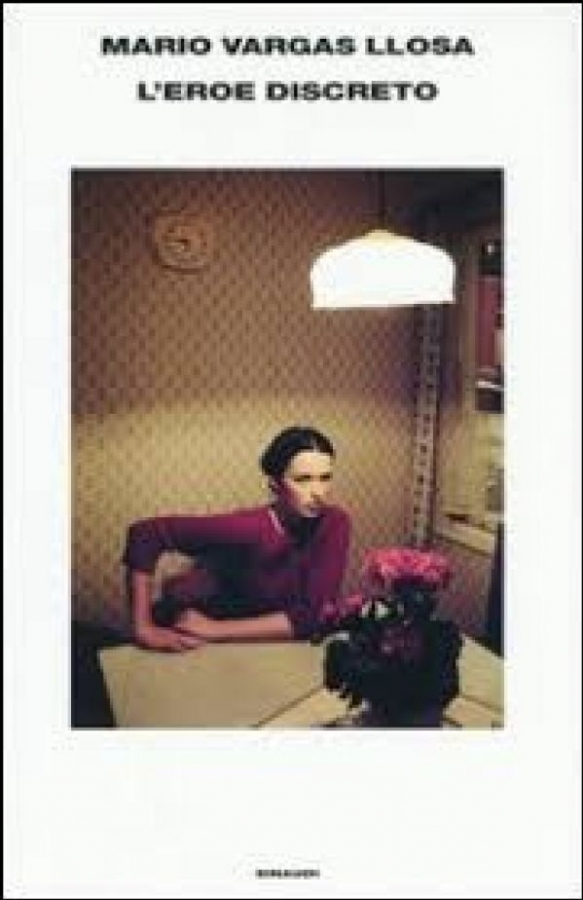
The Discreet Hero
Don Rigoberto is the director of a major insurance company, has just retired, and is about to embark on his long-awaited trip to Europe. He is a cultured man, a lover of literature: he chose a managerial career "out of cowardice," deciding to > not be a creator, only a consumer of art, a dilettante of culture. (...) How sad to be forced to deal with lawyers and judges, (...) instead of immersing oneself from morning to night in those volumes, those engravings, those drawings, and, listening to good music, daydreaming, traveling through time, experiencing extraordinary adventures, being moved, growing sorrowful, reveling, weeping, being exalted and thrilled . Felicito Yanaqué is the owner of an established transport company: a pragmatic man, a self-made, successful entrepreneur who rose through sheer determination and hard work, he too needs to dream; he has done so by taking a mistress, a young woman—a kept woman, admittedly, but one with whom he has nonetheless fallen in love, without many illusions. Two ordinary lives, until certainties are shattered and everything seems to descend into chaos. The insurance company's owner, an octogenarian widower, decides to marry his maid, young and beautiful; a scandal that Don Rigoberto is forced to confront alone because the "newlyweds" have embarked on an extended trip to Europe. Felicito receives threatening letters and extortion demands. The man, a true "discreet hero," refuses to submit, even though he is terrified and everyone advises him to give in and pay the protection money. He constantly remembers the words uttered by his father before dying: > never let anyone walk all over you, son. This advice is the only inheritance I can leave you . The two storylines develop in parallel, with a narrative pacing that aspires to be that of a thriller, yet falls short; the figure of Don Rigoberto serves as a pretext for lengthy digressions on art and the human condition, all of which weighs down the narrative and sidelines Felicito’s story, whose stubborn moral fortitude fails to emerge as forcefully as it should. The two plots conclude, intertwining, with a series of plot twists: surprises that should not be revealed so as not to spoil the reader's enjoyment of the tale; suffice it to say that this is not about organized crime, but about petty, sordid family affairs. As Don Rigoberto—behind whom the author hides—puts it, > in this country one cannot build even the tiniest space of civilization; barbarism eventually destroys everything . There are no redemptive spaces, which is to say > the idea that civilization (...) survived in minuscule citadels, built across time and space, which resisted the permanent assault of that instinctive, violent, obtuse, ugly, destructive, and bestial force that ruled the world . The contrasts between the two protagonists are the linchpin of the entire narrative: on one hand, Don Rigoberto retreats into aestheticism and individualism; on the other, Felicito, naive to the point of absurdity, fights for his dignity and takes charge of his own destiny. Whose side are we on? At one point, Don Rigoberto’s son notes that his father is always talking about Europe and asks him if there is anything he actually likes about Peru. The answer is disconcerting: > three things, Fonchito, he said, feigning the pomp of a great visionary, the paintings of Fernando de Szyaszlo, the poetry in French of César Moro. And the Majes river shrimp, naturally. How often have we heard the very same remarks from a representative of our ruling class—xenophilic, defeatist, and provincial? Could it be that hope lies precisely within the many "discreet heroes" rather than vain intellectuals? Beneath the surface and with subtle irony, Vargas Llosa’s book speaks to the inadequacy of a ruling elite. It is certainly not Vargas Llosa’s best novel. The prose, the portrayal of the characters and settings, the plotting all remind us of the great author; yet the narrative is lackluster and devoid of bite, as though the hand were tired, longing only to drift into senile fantasies. Why read it? It is enjoyable, but do not expect the great Vargas Llosa.