Finished reading on: October 30, 2010
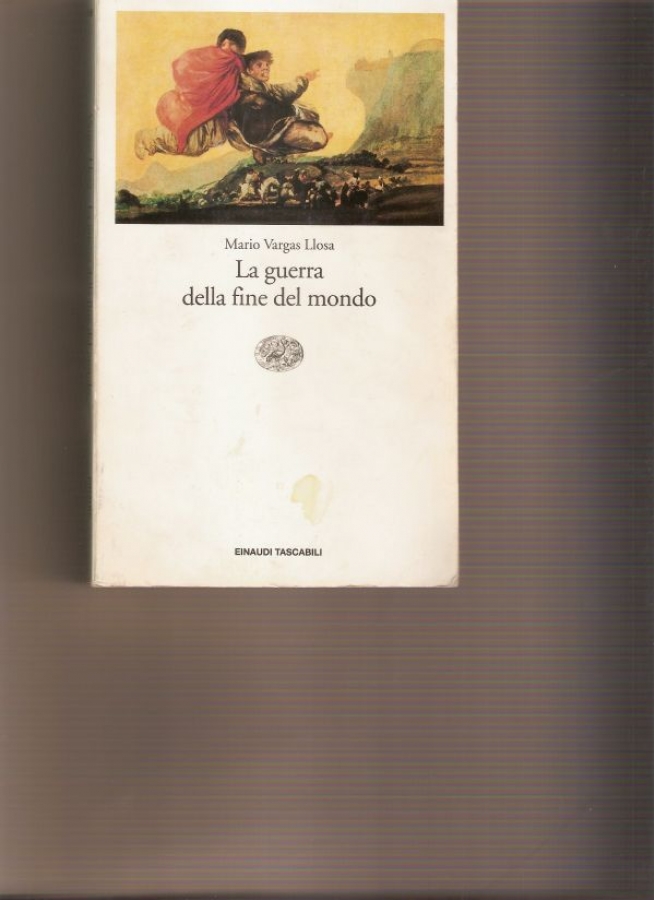
The War of the End of the World
Title of the original version reviewed: «La guerra della fine del mondo»
AI Translation Notice: This review was translated from the original Italian using artificial intelligence. Book quotes and excerpts are translated interpretations and will not match the author's original English phrasing or official published translations.
How was it possible that there, at the end of the world....
something different ordered things, men, time, death, something that it would be unjust to call madness and too broad to call faith and superstition
.
Such are the reflections of one of the protagonists of an incredible, and in some respects indecipherable, book.
Vargas Llosa recounts an actual event that took place in Brazil in 1889, during the transition from empire to republic.
A multitude of the disinherited had gathered around a holy man and, in a kind of messianic and religious fervor, had founded a utopian place, free from exploitation.
The government of the young republic dispatched a mighty army against them, which, after a bloody battle, carried out a chilling and ruthless massacre.
The episode had been recounted many times before, yet Vargas Llosa crafts a complex narrative from it, weaving social and political themes with spiritual and psychological ones.
The novel can be divided into three parts.
In the first, the author relates the background to the uprising: a strange figure wanders through the sertão, followed by a handful of disciples, to rebuild abandoned churches and thus bring a religious sign to a people forsaken by everyone, even their own priests.
Then, an ever-growing crowd gathers around him, as the holy man manages to convert the most disparate figures: gang leaders, bloodthirsty killers, merchants, fallen women, hunchbacks, and the wretched.
All are drawn by a quest for redemption and peace.
In the second part, the utopian enclave of Canudos is created out of nothing; its renown draws yet more people, but it also attracts the attention of monarchist landowners, who hope to exploit the revolt for anti-republican ends, and the interest of socialists and revolutionaries, who interpret through European lenses events that defy the frameworks of Marxist and anarchist ideologies.
The first expeditions sent to quell the uprising fail miserably: Canudos's survival is a threat, not because the poor intend to stage a revolution, but because it bears witness to a utopian society.
A distinctly Brazilian alternative to exploitation exists, and this is unacceptable to monarchists and republicans alike: the two political factions join forces, and a massive army is dispatched.
And here begins the third part, the most extraordinary in the entire book.
With exceptional narrative skill, Vargas Llosa describes the siege of Canudos across two hundred pages: a continuous alternation of martial descriptions with the personal chronicles of the various characters.
There are four central figures whose stories unify a narrative that would otherwise have been fragmentary.
First, a trio composed of a dwarf, a peasant woman, and a journalist who is virtually blind because he has lost his glasses.
His blurred eyes take in the terrible scenes through an out-of-focus perspective, lending an air of unreality to the entire narrative (an exceptional literary device).
Far from the battlefield, in the aftermath of events, there unfolds a dialogue between this same journalist and one of the monarchist leaders, a baron whose wife was driven mad by the sight of her home torched by the rebels.
Reason, the great organizer of the world, has dissolved in the face of the horrific events of Canudos: the rules no longer make sense; the world is turned upside down.
Love, pleasure, thought the baron, bewildered.
It seemed to him a sacrilege that those beautiful, forgotten words should appear on the lips of that ridiculous creature, huddled like a heron in the armchair.
Was it not comical, grotesque that a mongrel bitch from the sertão should make a man who was, despite everything, cultivated, speak of love and pleasure?
But in the world, truth and happiness may be found in the most improbable things, such as in a bond of love and affection between a journalist, a peasant woman, and a dwarf, or in the lesbian love of the baron's wife for her maid, in which the baron himself might have taken part had he realized earlier that it would have pleased his wife.
And so it might be that the baron could see that
the people in the boats were not fishing but throwing flowers into the sea, scattering petals, corollas, bouquets upon the water, and crossing themselves, and, though he could not hear it, his chest pounded hard, he was certain that those people were also praying and perhaps singing
.
It is extraordinarily difficult to give a single interpretation to the book.
It can certainly be read in many ways: an indictment of a ruling class ruthless in defending its own interests, a critique of a left wing often vainglorious and far from understanding the specific reality, a cruel depiction of the violence of war as well as the ignorance of the masses.
I believe, rather, that the unifying thread is confusion—a crowding of voices and images, a firework display that lasts only a few minutes but illuminates the sky in points of light, without any discernible meaning.
Why read it? The narrative style is splendid and sustains a book that is undoubtedly long and fragmentary.