Finished reading on: November 08, 2020
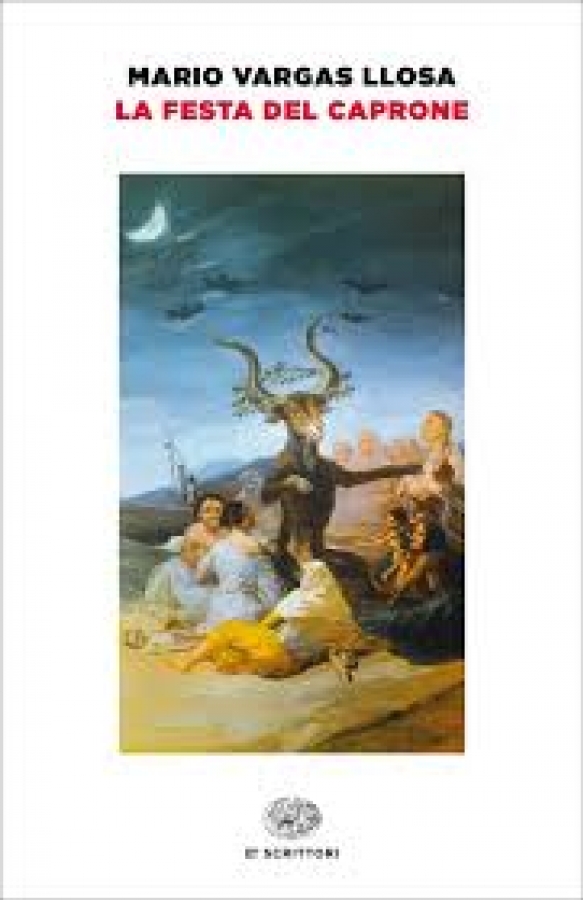
The Feast of the Goat
Title of the original version reviewed: «La Festa del Caprone»
AI Translation Notice: This review was translated from the original Italian using artificial intelligence. Book quotes and excerpts are translated interpretations and will not match the author's original English phrasing or official published translations.
What are the mechanisms that uphold a dictatorship? Vargas Llosa sets out from history, from real protagonists and events, to investigate the dark allure of the despot, and he does so starting from a cruel character in whom the peculiarities of tyranny have been distilled, stripped of the smokescreen of ideologies and good manners. We read from the Treccani Encyclopedia that Trujillo ruled the Dominican Republic from 1930 to 1961
through dictatorial methods until his death, thanks to his control over the armed forces, that exercised (directly or through members of his family) over the national economy, and the systematic resort to terrorist methods against his opponents
; and, I would add, through the backing of the United States and the Church, who saw him as a bulwark against communism. We are in the final phase: the regime’s atrocities have driven the United States and the Church to abandon Trujillo, strangling the small country with sanctions and isolating the dictator internationally. There are three narrative strands, running in parallel and later intertwining, always circling the baneful figure of Trujillo. Urania, a successful young woman living in New York, returns to Santo Domingo to visit her aging father, confined to bed in an almost vegetative state. For many pages we do not comprehend so much rancor toward her father; we only know that Urania
had not managed to overcome the insurmountable revulsion, the disgust men inspired in her... you had never wanted to get treatment
. In the second narrative strand, the setting is where Trujillo will be assassinated and where the conspirators anxiously wait (first called executioners, then patriots): they are a heterogeneous group of figures, driven by revenge or by revulsion toward a cruel regime; they were once beneficiaries of the dictator and remain bound to him by a love-hate relationship: a
paralysis, the numbing of the will, of reason and free will that that contemptible character—dapper to the point of ridicule, with his fluting little voice and hypnotist's eyes—exercised over Dominicans, rich or poor, learned or unlettered, friends or foes
. His assassination is a catharsis, a deliverance from a tragic spell, rather than a political act. And finally, we find ourselves before Trujillo and his court: the depraved, sadistic sons, the greedy and thousand-times-betrayed wife, the puppet president, the police chief—the perpetrator of the most heinous tortures and crimes—the cunning pettifogger, and many others. All live in perpetual dread: it is the Chief’s habit to dismiss them, expropriate their wealth, cast them into prison, have them killed, on a mere whim, to assert his power over life and death. And they submit; if they fall from grace, they yearn to return to the tyrant's good graces, ready for anything, like Urania's father, formerly an esteemed senate president and then cast aside without explanation. The country is falling apart, inflation and poverty run rampant, the regime is fracturing, yet just hours before his assassination, Trujillo is concerned with only one thing: he is unable to use "the part of the body I will not name" (Patrizia Valduga La tentazione). The narrative unfolds slowly, at times verbosely, until one reaches several splendid chapters, for which alone the book is worth reading. The conspiracy hinges on the commander of the Armed Forces, who was supposed to intervene swiftly and decisively upon news of Trujillo's death. Instead, he stalls, temporizes,
plunged into that kind of hypnosis, he thought that perhaps his indolence was due to the fact that, although the Chief's body was dead, his soul, his spirit, or whatever it was called, continued to hold him in thrall
. And like the conspirators of July 25, 1943, when the Grand Council of Fascism effectively ousted Mussolini, our conspirator slips into the quicksand of torment. Next, we follow the puppet president in his seizure of power,
a defenseless little man who wrote verses and seemed of so little consequence in this world of real men with pistols and submachine guns
, and, allowing for the obvious differences, the mind turns to Dino Grandi or to Pietro Badoglio himself, accomplices to the Fascist dictatorship yet ultimately its gravediggers. And finally, in the last and dramatic chapter, we understand the depth of Urania's bitterness. While still a young girl, her father sold her to the dictator simply to regain the Chief’s favor. And he,
taking her by the arm, threw her down beside him. (...) That mass of flesh crushed her, suffocated her against the mattress. (...) But the suffocation did not prevent her from feeling the roughness of that hand, of those fingers exploring, groping, and forcing their way into her
. Many words can be used to describe a tyranny, yet it is epitomized in its most ancestral and brutal manifestation: rape.
I am not aware whether there exists a great novel on the Fascist dictatorship capable of probing the dark fascination of tyranny as Vargas Llosa has done. Were such a narrative to exist, it would bring out of the shadows the lavish court that surrounded the dictator: his double-breasted blackshirts, the illustrious heirs of the liberal class, the magniloquent and craven intellectuals—either naive or merely pandering—the cowardly, complaisant generals, and the many women whom Mussolini used and cast aside, or dragged with him to his death. If I were the ANPI, the National Association of Italian Partisans, I would entrust Vargas Llosa with the task of giving us such a fresco, to answer the question:
who was it? (...) Whose fault is it? And all those who died, poor souls? (...) I saw them die, it was all useless... he felt like foolishly bursting into tears
(Mario Tobino Il clandestino, see review on this site).
Masterfully translated, the novel is nevertheless too long, and in particular the extensive reliance on dialogues—often soliloquies—burdens the narrative; it fails to enchant or nourish the imagination, remaining somewhat cold and detached. The writer stands at a distance from the reality of the Dominican Republic; he is a spectator to a drama, interested in investigating the mechanisms of cruelty and dominion without allowing himself to become involved, driven instead by a barely concealed irony. This approach prevents the reader from truly feeling the weight of the characters' dramatic and harrowing ordeals, the tragedy of a nation.
Why read it? A profound inquiry into tyranny.