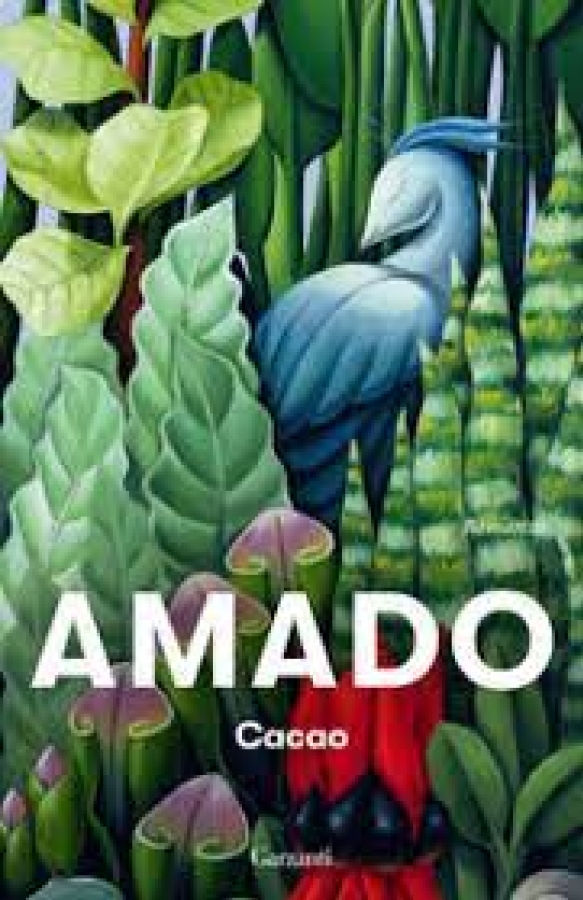
Cacao
This short novel recalls a novella by Giuseppe Verga: *La Varanisa* (see the review of *Le novelle* on this site). The Sicilian writer admirably synthesizes the peasant condition by describing the feet of a wretched girl: > those feet accustomed to walking in the snow and on rocks scorched by the sun, to tearing themselves on thorns, or hardening on stones, could have been beautiful . In the same way, Amado repeatedly emphasizes the large feet produced by the harvesting and processing of cocoa on the vast Brazilian *fazendas*. > The cocoa was dumped into the troughs to ferment for three days. (...) Then, freed from its pulp, the cocoa was put out to dry in the sun in the drying trays. There too we danced on it and sang. Our feet grew broad, our toes splayed. (...) Jaca! Jaca! The children climbed the trees like little monkeys. The jackfruit fell—thud!—and they pounced on it. (...) Their broad feet were like those of adults, their bellies swollen, huge, from the jackfruit and the dirt they ate . The young Amado chronicles the lives of day laborers on the vast cocoa plantations: > that yellow fruit, with sweet seeds, which made them prisoners of a life of dried meat and jackfruit ; "a proletarian novel" imagined as written by a young man reduced to poverty by the greed of a capitalist uncle; exploited and humiliated in factory labor, he pursues a nebulous destiny of redemption among the field hands, among the *affittati*, forced to work like slaves for the great landowners. What drives him? To belong among the wretched of the earth, to break radically with the ambiguities of the bourgeoisie in order to discover that the future lies solely in solidarity among the poor, in their desperate and resolute resistance to exploitation and abuse of power. The narrative bears the stamp of the social novel: a sort of Brazilian Émile Zola, Amado intends to describe coldly—"naturally," as Boccaccio might say—the peasant condition and the transformation of the young narrator and protagonist into an experienced and wretched field hand. The stages of this transformation, both physical and mental, are marked by the grand themes of humanity: the environment, magnificent and violent; communal life, complete with its festive moments; friendships and loves; revulsion toward the ruthless, greedy master and his arrogant, amoral family; the gradual awakening of class consciousness; and ultimately, taking a definitive stand. The protagonist courts the owner’s daughter, who wishes to marry him. > We will do what cannot be undone. (...) You will become a master. I bowed my head to stare at the ground. I was piling up leaves with my hand. (...) No, Maria. I will keep working. If you want to become the wife of an *affittato* . One must not be deceived by the spare, almost investigative style. A certain sense of the fantastical, the unreal lingers, fed by an ambiguous relationship with cocoa, as though amid such wonder social redemption were inevitable. > Darkness enveloped everything. Guitars wept, birds chirped. The golden cocoa fruits and the serpents. Stars shone in the sky. The lanterns along the road looked like souls taking flight. Night on the *fazenda* is sad, gloomy, painful. It is at night that people think...(...) We looked at the cocoa plantation and could find no answer. The question that naturally arises upon reading *Cacao* is whether the human condition of the poor is not fundamentally the same across all latitudes. What difference is there between the characters of this novel and the protagonists of Verga’s *I Malavoglia*, Zola’s *Earth* and *Germinal*, or Steinbeck’s *The Grapes of Wrath* (see the reviews on this site)? Always the same desperate struggle for survival under the rapacious, ruthless weight of the rich? There seems to be no hope, leaving the intellectual with nothing but a resigned detachment: at times adopting a socialist rhetoric (see the "manifesto" section of *The Grapes of Wrath*), in other cases merely describing while invoking literary justifications, as with Verga’s *verismo*, and in still others withdrawing into a melancholic irony, as in Jorge Amado’s later books. It is as if the writer and the poet have accepted defeat, entrusting journalism with the task of reminding us, without exaggeration, that social suffering exists in the world, and not merely bourgeois torments. I read the book after the great lexical and imaginative binge of *Grande Sertão: Veredas* (see the review on this site), which makes Amado’s essential, linear style feel like fresh air—like plunging into clear waters over a sandy bed, free from the lights and shadows of deep, reef-strewn seas. The sentences are short, the adjectives few; the charm of the narrative relies on the events themselves, as if they spoke on their own. Yet, what nostalgia for the writing of João Guimarães Rosa! Why read it? A great social novel.
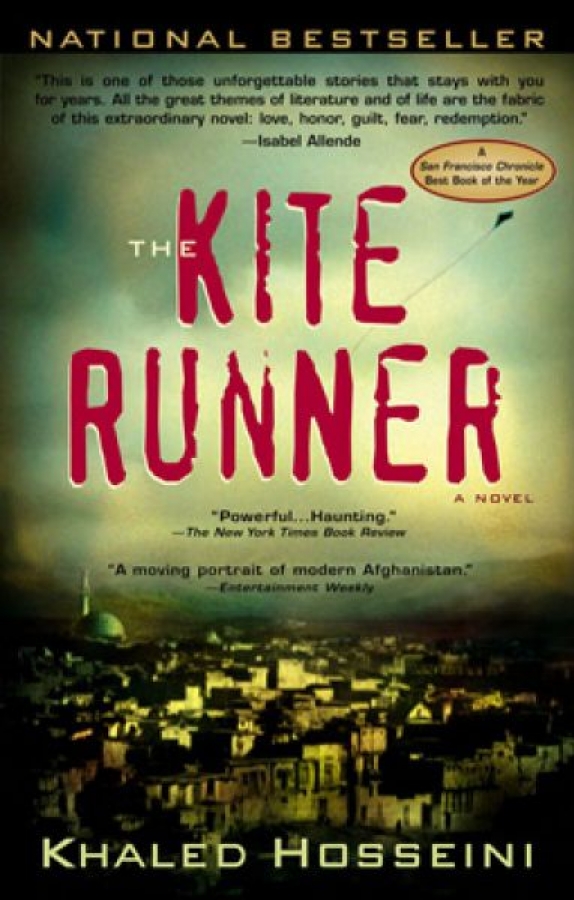
The Kite Runner
It would be wrong to think that this novel is about Afghanistan, which nonetheless constitutes its frame of reference. The theme of the book is cowardice. Amir lives in a fine house in Afghanistan with his father, an important and courageous man, and two servants, Ali and his son Hassan. The latter is Amir’s childhood friend, whom Amir treats with arrogance, albeit tempered by brotherly affection, believing himself superior in caste and culture, and envious of his father’s affection for Hassan. Amir and Hassan are champion kite runners, and on the very day of Amir’s greatest triumph—having won the kite tournament—he fails to intervene to save his friend, who is beaten and raped by Assaf. Amir is a coward, and this guilt haunts him throughout his life, even when he is forced to move to America, marries, and becomes a renowned writer. Only by returning to Afghanistan to rescue Hassan’s son will Amir succeed in redeeming his own cowardice, discovering along the way that his father—to him, an unattainable, flawless figure—was not blameless either, having never told him that Hassan was his brother. The first hundred pages of the book, which recount Amir’s childhood in a peaceful and happy Afghanistan, are very fine, written in a delicate and poetic style. Subsequently, the book loses its luster, ultimately losing its way in the final twenty pages, which recount how the protagonist manages to bring the child to America. The closing scene, a kite tournament in America, is predictable and trite, partly undermining the spiritual and narrative depth of the novel. In this final section, the only scene of real impact is Amir’s fight with Assaf, who has become a ruthless Taliban commander and reduced the boy to his sex slave. Assaf is beating Amir to death, yet Amir is content because he is finally freeing himself from the guilt that has haunted him all his life; he is ultimately saved by the intervention of the boy, who strikes Assaf with a slingshot.
Falling Out of Time: A Story in Multiple Voices
Grossman lost a son, killed during military service. It is a wound so immense that he feels > mutilated in memory.... a prisoner of a remote cell in the penitentiary of my spirit , as though "my life resembled something that never happened." And so he feels the need to create a tale. > That motherfucking thing that happened to me and my son, yes, I must blend it into a story, I must. With a plot, and imagination! And visions and freedom and dreams! Let it burn! A boiling pot!.... if I do not write I will not even be able to understand who he is now, my son, I mean Grossman imagines a village where everyone has lost a child, but they cannot fully express their despair by decree of the duke—that is, of power: > indifferent, slow, sluggish, without a doubt: an exemplary duke . The scribe is tasked with spying on the inhabitants to monitor any violations of the ban. In a way, he performs the function of the external narrator. He transcribes the voices of the grieving parents who, as in a Greek tragedy’s chorus, cry out in a funereal chant—at once sweet and wrathful—their own stories and their yearning to have their child back. Their chant gives voice to all the nostalgia and anguish of a bond between parent and child abruptly severed: the tender memory of birth and of his boyhood, the remorse of not having been a good father, of not having been close to him, the desire to smell his scent, if only for one last time, to touch his skin, to embrace him. > And suddenly, inside us, rises the vapor of his whole body, intact, and for an instant we can imagine: he is here . The immobility of grief could last forever, but it is broken by a man who decides to set out toward "down there," where he believes his son to be. The man’s desperate act sets the other inhabitants in motion as well. As in a sacred procession, they walk toward that mysterious place that is the afterlife. Their march halts before a wall, in front of which they drop to their knees > and each of them, and each of us, whispers their child's name And then Grossman understands that his son is dead: > I recognize the truth of these words. He is dead, he is dead, but his death has not died . Memory detaches itself from pain and, as far as possible, we remember without suffering. Yet then the story, like the ritualization of mourning, allows the son to be distanced: > it is only that my heart breaks, my darling, at the thought that I could find words for all of this . The book is a hybrid of prose and verse poem. Written in prose are the notes of the scribe and the reflections of the Centaur—half writer and half desk—who unquestionably represents the author. The verse structure is used for the chorus, which serves two functions: recounting the dialogues between the various characters, who, rather than speaking to one another, communicate with their lost child; and giving collective voice to the "wanderers," the group heading into the afterlife in search of their deceased children. The narrative form is typical of Greek tragedy, with the significant difference that there is no plot development, no final moment of genuine catharsis. There is no dramatic tension in the overarching plot; in fact, there is no real story. On the other hand, the narrative is introspective, entirely contained within the author's consciousness. The setting is Kafkaesque, surreal, not tragic. It is an interior journey in which the characters are nothing more than instantiations of Grossman’s despair, of his anguish, and of his desperate attempt to accept the death of his son. The lack of a narrative plot allows the detail to prevail over the overarching world of the tale. The narration fractures into poetic fragments, evocative in themselves, yet isolated and sprawling within a narrative context devoid of development. The reader must therefore surrender to the spell of individual words and phrases. Consider the following passage: > as in the moment when a newborn bursts from the womb and from the mother's body, my son's death transformed me into the father I never was, pierced me with a tear and a wound and a sense of emptiness, while filling me with his presence, which has overwhelmed me ever since with an intensity never before seen. His death made me capable of conceiving him. His death made me an empty shell of a father and also of a mother. His death leads me to bare a breast to one who will never suckle, and upon the walls of my womb, formed that day, carves with the nails of an escaping prisoner the tally of days spent without him. Thus, with a transparent chisel, his death carved into me an awareness: whoever loses a child is inevitably a woman . Why not read it? Too many evocations within a story devoid of narrative rhythm. In the end, it is boring.
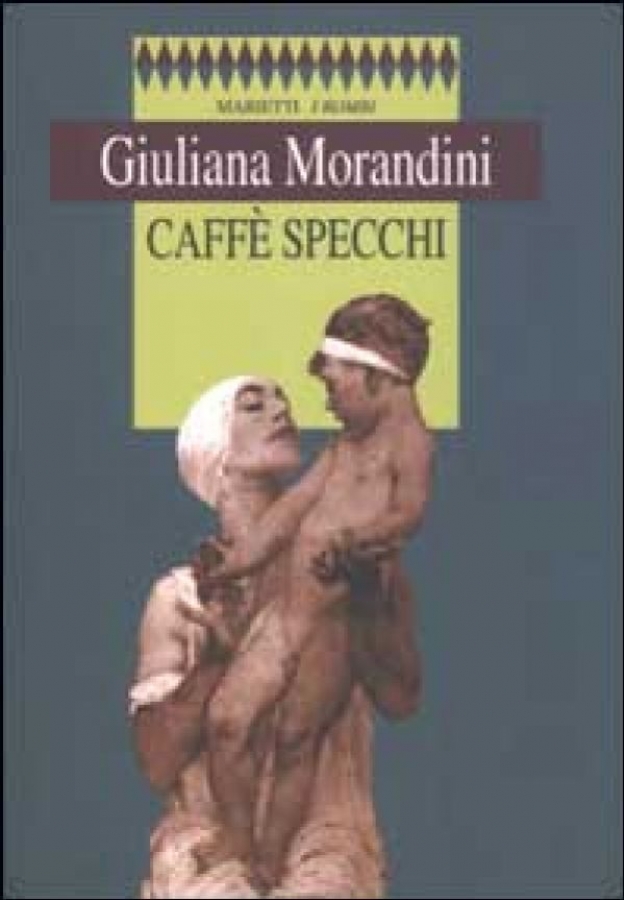
Caffè Specchi
The protagonist returns to Trieste to await custody of her son. In an exhausting wait, mingled with encounters and tragic events (the murder of a young woman), the protagonist experiences the sensation of losing herself. > Suddenly, as if that silence had reached its critical point, the air seemed to congeal, shattering into petals that slipped, swaying, along the pale wall. A rapid decomposition, the dust motes fermenting unforeseen transparencies. In that pause, alarmed glances resumed, and a sense of menace took shape in the atmosphere . The sentence I have quoted encapsulates the virtue and the limitations of the book. One is confronted with refined writing, more akin to poetry than to prose, yet the pursuit of preciousness fragments the narrative, leaving the reader in turn disoriented and struggling considerably to grasp the meaning of the whole. Why not read it? It ought to be read in small doses, but I was unable to finish it.
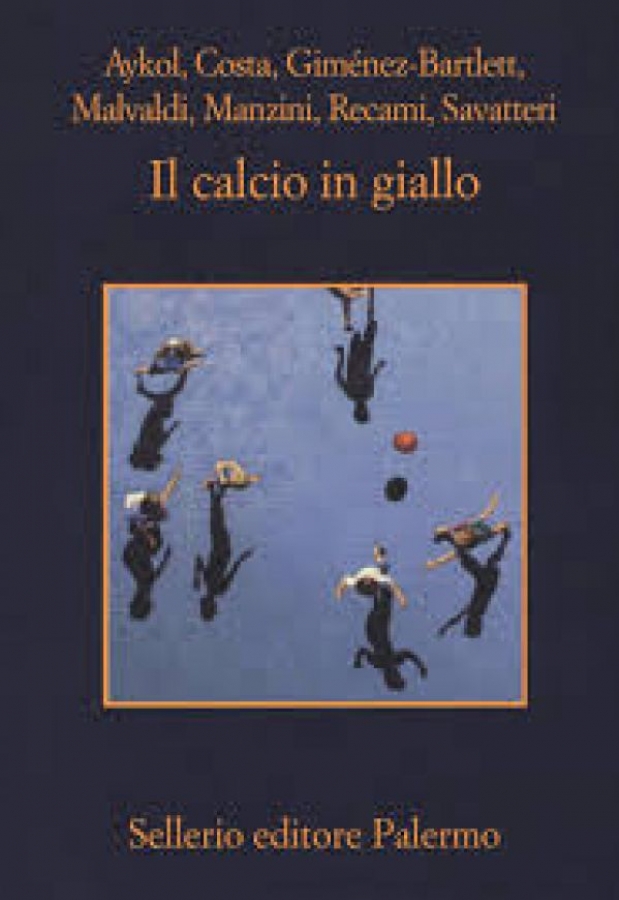
Football in Yellow
The book brings together football-themed short stories by various noir writers, some well-known—such as Aykol, Giménez-Bartlett, Malvaldi, and Manzini—others less familiar: Gian Mauro Costa, Francesco Recami, and Gaetano Savatteri. The plots, characters, and writing styles vary, yet a common thread emerges: football, even at the amateur level or played in the minor leagues, is invariably a sordid, violent affair that brings out the worst in people. The already established authors are predictable: the narrative patterns are those of their novels, unfortunately compressed within the short story form, inherently brief. The contributions of Costa, Savatteri, and Recami are far more engaging; the first two set their stories in Palermo, while the third unfolds against the backdrop of Milan. Recami’s (*«Progresso - Audace 3-2»*) stands out as the finest story, well worth lingering over for its subject matter and deft narration. We find ourselves at a youth match, with parents cheering from the stands. Gianmarco is eleven years old, wrestling with the typical adolescent doubts about his sexual orientation, compounded by the fact that—being gentle, sensitive, and polite—he is mocked by his teammates with taunts like «Giorgi is gay». A talented player, he is targeted by a boy on the opposing team, egged on by his father («break him, take him down, finish him, kill him...»). The man, > an overweight man in his fifties, a third-generation immigrant from Puglia, rather potbellied , «in the throes of an aesthetic crisis», hurls unspeakable abuse at Gianmarco's mother, slaps her, and unleashes the fury of the other mothers, who chase after him intending to beat him. He takes refuge in an abandoned warehouse, where he is caught by Oleg, a giant of a man, clearly a criminal hailing from who knows which Eastern European country. And here the tables turn for our potbellied bully: the braggart turns into a lamb, such a coward that he literally shits himself, completely unable to protect his family from Oleg's threats and violence. Instead, it will be his wife who shields the children and the home, ready to sacrifice herself to do so; yet how could this be? A woman, belonging to the very sex the potbellied man routinely addressed with terms like: «fucking whore...». Meanwhile, Gianmarco makes an astonishing discovery: a famous player, «one of his idols, a tough guy, someone who commanded respect», had come out as gay. How was this possible? «You shouldn’t be surprised in the slightest», Sciacca the school janitor told him from the heights of his wisdom, > in the world of football, they're all faggots. (...) It was undoubtedly the most intense sex education lesson Gianmarco had ever had, and would ever receive in his entire life. He reflected. There was the principle, there was the truth, that’s why at Juventus they’re all faggots. So if I'm gay, does that mean I'm more manly than the pansies who go with women? The female janitor chimes in. > What are you doing, Sciacca, telling the boys your usual dirty little stories? What on earth are you talking about, we were discussing football. The short story format does not lend itself well to noir: it is too brief to allow for the development and suspense that form the very core of a mystery. It feels like watching an episode of *Murder, She Wrote*: at a certain point it must wrap up, and so the story either tumbles into a predictable denouement or remains suspended, leaving the reader unsatisfied. Of greater merit are the settings, the characters, and above all the prose: the latter occasionally proving to be a pleasant surprise. Why read it? It offers the chance to discover lesser-known, yet valuable writers.
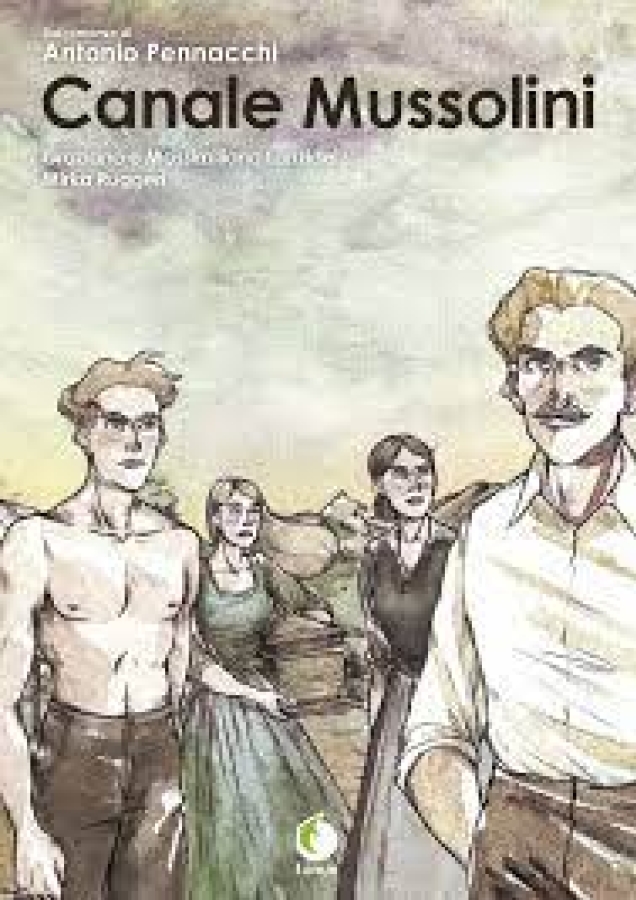
Mussolini Canal
> But look here, my good sir, the two of us cannot go on like this. (...) I haven’t quite grasped what you need, but (...) if I say they did something, they did it, and that is that; you have to believe me, otherwise we might as well drop it. I’m not inventing anything. At most, my memory might fail me . Imagining a dialogue with an interlocutor, Pennacchi adopts a colloquial tone to narrate the saga of the Peruzzis, sharecroppers from the Rovigo area forced to abandon their land under a crushing burden of debt, who travel to the Agro Pontino to colonize the areas reclaimed by the Fascist regime. It is an expansive narrative spanning from the end of the nineteenth century to the early 2000s: a sprawling feast of history and family tribulations that one would wish were a continuation of Riccardo Bacchelli’s *The Mill on the Po*, but unfortunately is not (see the review of Bacchelli’s novel on this site). The Peruzzis are a prototypical large peasant family: anchored by the central figure of the mother and an extensive brood of restless sons and daughters for whom suitable husbands must be found. While in the others the inherited “fury” is tempered by deference to social conventions and expedient cohabitation (with the landlord, the authorities, and fellow peasants), Pericle, the favored second son, cannot contain himself, especially after his experience on the front lines of the First World War. He rebels against the agricultural workers' leagues that still dominated the countryside, throws in his lot with the *squadristi* to the point of murdering an anti-Fascist priest, and, having fallen in love with Armida, a captivating beekeeper, takes her as his own and marries her despite her initial rejection. His active adherence to Fascism enables Pericle to appeal to a powerful *gerarca* to secure a settlement for the family in the Agro Pontino. The Peruzzis' establishment in the still-marshy terrain, the discovery of a different rural reality (with the crucial role played by the cattle), and the founding of Littoria are the most compelling parts of this long novel, not least because it is evident that Pennacchi possesses a thorough knowledge of the region's history, and especially of its reclamation canals, including the Canale Mussolini. Had he explored the colonization of the Agro Pontino more deeply through the perspective of a peasant family, the novel would have attained significant social weight; instead—who knows why?—the author felt compelled to traverse the entirety of modern Italian history: the Ethiopian War, the North African campaign, the partisan resistance, and so forth. The conversational register degenerates into a soliloquy of banal, inaccurate ruminations, a cloud of dust into which Pennacchi dumps his entire ideological baggage; despite the social and political upheavals, the Peruzzis remain frozen like “marble statues,” forever unchanged and deferential to ancestral codes. Even when Armida betrays Pericle, everything is smoothed over beneath the protective wing of the great matriarch, ever vigilant in safeguarding the family’s unity. One detects a sort of nostalgia for a harsh yet orderly world; but perhaps this is merely the reader's yearning to find some genuine sentiment within a narrative that seems to serve only as a pretext for verbose outpourings. The novel has been adapted into a graphic novel by Graziano and Massimiliano Lanzidei alongside Mirka Ruggeri. Setting aside the draughtsmanship, which I am not qualified to appraise, the translation into “comic” form injects dynamism into the plot, bringing several figures into sharper relief: Armida (the carnal passion kindled by her young nephew, the maddened swarm of bees as misfortune gathers), Adelchi, transformed by the Ethiopian War into a racist Fascist, and the young Pericle and Iseo, the designated casualties of an uncritical, opportunistic adherence to Fascism. The graphic novel redeems the book, yet it accentuates the characters’ rigidities—perhaps deliberately—while the Agro Pontino fades, the pencil failing to conjure the atmosphere of the reclaimed lands, much as the author's own pen fails to do. Why skip it? It is verbose; you are better off buying the “comic.”
Reeds in the Wind
The case of Grazia Deledda was a singular one: the only Italian Nobel laureate honored as a prose writer (Montale and Quasimodo were poets; Pirandello and Dario Fo essentially dramatists), Deledda’s oeuvre unsettled our literary establishment, which puzzled for a long time over the reasons behind the prize. As had already happened with Matilde Serao, critics sought to pigeonhole Deledda within literary schools, denying her autonomy and originality: a failed *verista*, the very accusation leveled at Serao? A corollary of Verga and D’Annunzio? Of Federico Tozzi, to whom she was bound by deep friendship? Lyric–visionary and symbolist? It would have sufficed to read her without prejudice to discover how unique Deledda is in Italian literature: an ancestral author, she speaks of sorrow as destiny, of life as a journey toward an elusive haven of stillness (death?), of a living, magical, and indecipherable nature, indifferent to the suffering of mankind. > The red twilight glow, overcome near the altar by the gleam of tapers, covered the crowd as if with a veil of blood, but little by little the veil turned black, faintly illuminated by the gold of the candles. The crowd could not bring itself to leave. (...) It was like the distant murmur of the sea, the stirring of the forest at vespers; it was an entire ancient people moving on, moving on, chanting the naive prayers of the early Christians, moving on, moving on along a dark road, intoxicated with sorrow and hope, toward a place of light, yet distant, unreachable . If we limit ourselves to the plot, one cannot but share the judgment of Benedetto Croce, for whom Deledda’s novels were > all equally plausible, and none fashioned in such a way as to leave a deep impression on the hearts and imaginations of readers . To grasp the emotional and spiritual power of *Canne al vento*, one must let go, surrendering to her prose, beyond the storyline. The novel’s protagonist is Efix, the old servant of three women, once well-off landowners and now reduced to living off the yield of a “smallholding,” tended by the man. The narrative opens precisely in this corner of the world. > The moon rose before him, and the voices of the evening warned the man that his day was done. It was the rhythmic call of the cuckoo, of early crickets, an occasional bird's cry; it was the sigh of the reeds and the ever-clearer voice of the river: but above all it was a breath, a mysterious panting that seemed to rise from the earth itself; yes, the working man’s day was over, but the fantastical life of elves, fairies, and wandering spirits was beginning. (...) Efix heard the sound the *panas* (women who died in childbirth) made washing their clothes down at the river, (...) and believed he caught a glimpse of the *ammattadore*, an elf with seven caps inside which he keeps a treasure, leaping here and there under the almond grove, pursued by vampires with steel tails. Nature, inhabited by malignant spirits, mirrors and feeds the terrible secret Efix harbors within: he killed his mistresses' father, an authoritarian and violent man; he did so to allow the other daughter to flee, to find freedom on the mainland. It is also for this reason that Efix has dedicated his life to the three women, to whom he is bound by a deep tie, as servant, friend, and protector. He wishes for them to be well; he fears dying before seeing them safe, delivered from poverty, with another man to protect them. When Giacinto arrives—the son of the sister who fled to the mainland—Efix hopes he might be the right person, capable of restoring prosperity and peace to his mistresses. He is mistaken: Giacinto is a petty rogue, who flirts with a local girl and flatters Noemi, the youngest and proudest of the women. What is more, Giacinto loses substantial sums gambling, pledging as collateral the “smallholding,” their sole source of income. Efix was unable to defend them, to protect them; thus, he flees, leaves the village behind, and embarks on a prolonged wandering across the Nuoro region, keeping company with beggars and asking for alms at the numerous village festivals. It is a journey that leads nowhere. > A nightingale sang on the solitary tree still suffused with smoke. All the cool of the evening, all the harmony of the serene distances, and the smile of the stars to the flowers and the smile of the flowers to the stars, and the proud joy of the handsome young shepherds and the pent-up passion of the women in red corsets, and all the melancholy of the poor who live waiting for the scraps from the rich man’s table, and the distant sorrows and the hopes beyond, and the past, the lost homeland, love, crime, remorse, (...) the laughter and weeping of the world, trembled and vibrated in the notes of the nightingale atop the solitary tree that seemed taller than the mountains, its crown grazing the sky and the tip of its last leaf driven into a star. And Efix began to weep. He did not know why, but he wept. He felt as though he were alone in the world, with only the nightingale for a companion. (...) All the elves and monsters had stirred and were dancing in the shadows, pursuing and surrounding him . Efix will return home and die in peace, because Noemi has agreed to marry a cousin of hers, a wealthy landowner. The happy-ending narrative, steeped in religiosity, drains the novel of its tension: it is an awkward and affected attempt to give meaning to Efix’s life, to offer us hope. Yet that is not how it is. Like the grieving parents in David Grossman’s *Falling Out of Time*, we all walk in a sacred procession toward that mysterious place that is the hereafter. Yet our march grinds to a halt before a wall. All is silence. "A yellow point shone behind a castle (...). Slowly its light illuminated the entire mysterious landscape, and as if at the touch of a magic finger everything vanished; an azure lake flooded the horizon (...) In the silence, the stream beat like the blood of the sleeping valley. And Efix felt death drawing near, slowly, as if climbing silently up the path, accompanied by a cortege of wandering spirits, by the beating of clothes by the *panas* down at the river, by the gentle fluttering of innocent souls transformed into leaves, into flowers.... Why read it? No one in our literature has sung of living nature with such depth.
Morning chant in the grass
> The whole world was full of enchantments brewing in the sprawling mist. The blocks of lava turned into fortresses, the rock peaks into towers.... the mist hovered over the valleys, transforming them into boiling cauldrons, cauldrons of the Norns, and glided over the lava, over sacred places, over distant heights invisible from the beaten horse trails. And the mist pours in. Where do you come from? What are you waiting for? Do you have something ahead of you?, something behind? Or is it just this, just your life, here and now, which is to say nowhere? How, why, you? An unreal atmosphere and existential anguish run through the entire novel. We are in the Middle Ages, in mythical Iceland; Sturla is a historical figure who pursues the ambitious design of unifying the whole island. In the first part of the book—the most evocative, perhaps because it is set amidst the mysterious nature of an island cold and warm at the same time—the easy friendship of youth turns into betrayals, killings, and violence that mark the relentless clan warfare. The opening storm scene is magnificent, where solidarity allows the group of youths to survive: yet it is a bond that can endure only in dreams, within an enchanted castle from which one must emerge to meet one's destiny: > then he was overcome by such a torpor that it was impossible for him to stay awake. And it was as if the halls within were closing themselves into the mountain. It seemed to him that he started awake, and that the landscape vanished into the mist. Then he woke. And never again did he find that castle and its dwellers . The inter-clan feud drives Sturla to commit crimes, even against the Church. In the second part of the novel, Sturla goes on a pilgrimage to Rome to seek absolution: a journey across a medieval Europe torn apart by violence, through a bleak, somber landscape. Remorse haunts Sturla, manifesting in nocturnal nightmares, in terrifying visions of butchered bodies. Great must be his surprise when what greets him is not a holy city, but a picturesque and corrupt Rome, which absolves him in a surreal, Dionysian, Felliniesque scene, amidst masked figures more befitting an orgiastic revel than a ceremony of expiation. On his return from Rome, Sturla stops in Paris to master the arts of black magic, thereby gaining another means to conquer Iceland. The third part of the novel is an epilogue. Sturla embarks on new battles and commits further atrocities: but he is no longer sure of himself; his weakness will ruin him and lead to his death. He is now a two-faced man, like a legendary figure of whom it was said that > on one side his face was ugly and frightening, and so too was his body, while on the other it was as fair and handsome as one could ever desire . The strength and weakness of the novel lie in its fragmentation: a sequence of scenes, formed by an accumulation of episodes and dreams, the character's thoughts, sustained by an evocative prose that in some respects verges on poetry. Although deeply rooted in the Icelandic setting, from which it draws its fascination and inspiration, what truly emerges is the drama of a man moving toward modernity, unable to let himself be confined, or curtailed, by the rules of medieval society. In his doubts and internal conflict, Sturla is truly a two-faced character: the past, and his social role, which demands he be a warrior and clan chieftain; and the awareness of existential futility, of becoming. In the titular chapter, the metaphysical description of the morning crystallizes this suspension and illuminates the allure of the writing. > It is morning. All was still as the sun climbed the mountain ridge, first flooding the pass with light, then hastening to embrace rock faces and crags. It softened boulders and jagged stones, whitening some, gilding others, blunting the harshness of peaks and cliffs. The wind was so faint that the blades of grass stood motionless, mirrored straight and stiff in the small stream, waiting. For what?. For the time to come, once again. And the flowers exulted when the sun embraced them so gently that not a calyx nor a petal stirred. Neither joy nor sorrow held sway; they were one and the same. They were one and the same, it made no difference. Yet if it was sorrow, it was so mild in that newborn glow, in that golden resurrection, that it was not grief; if, instead, it was joy, it was not happiness. But time lay in wait, with the transience inherent to all things within the eternity of the whole, when everything tends to return to the earth, to crumble and dissolve into primordial matter in search of new, unknown forms . Why not read it? The evocativeness of the vignettes, the depth of the concepts, and the beauty of the natural descriptions fail to compensate for the narrative's fragmentation and the frequent incomprehensibility of its content and sequence of events.

Quiet Chaos
If the Strega Prize has rewarded the best book of the year, one must conclude that Italian literature is in a truly dire state. The book offers two interesting premises. First, the theme of grief, with the difficulty of feeling sorrow over the death of a loved one. The protagonist has indeed lost his wife, yet he exists in a state of suspended animation (hence the title *Quiet Chaos*), being neither shattered by grief nor capable of resuming normal life. Indeed—and this is the second interesting premise—he decides to spend his days waiting outside his daughter’s school. Within this vigil, his life unfolds through a series of encounters: his sister-in-law and his brother, colleagues concerned with the fallout of an ongoing corporate merger, the company’s owners, the prospective buyer himself, and other minor characters. The protagonist remains indifferent to everything happening around him, continuing to wait for something to break this state of limbo. It will ultimately be his daughter who points out that her classmates mock her for his constant presence outside the school, and that it would therefore be advisable for him to return to normal life. The initial premises are therefore interesting, but they dissolve into the banality and superficiality of episodes that lack any clear connection, rendering the story fragmented, prolix, and inconclusive. The narrative device of a first-person account—a tumble of racing words and clauses meant to convey the illogical flow of thoughts—translates into a tedious, ponderous rhythm that fails to penetrate the depths of the situations and emotions. The themes overlap, ultimately obscuring the central issue: the processing of grief.
Captain Tempest
We stand before one of Salgari’s most astonishing novels. The events of *Capitan Tempesta* are set in 1571 during the Turkish conquest of the island of Cyprus, which until then had been in Venetian hands. But who is Capitan Tempesta? > He was a remarkably handsome youth, indeed too handsome to be a warrior, somewhat tall, slender, elegantly proportioned, with two pitch-black eyes like glowing carbuncles, the mouth of a maiden with superb little teeth... all in all, he seemed more a most graceful maiden than a soldier of fortune . This very introduction by Salgari brings forth the underlying motif of the novel: the disguise of a splendid Neapolitan noblewoman in search of her betrothed, who has been taken prisoner. The plot unfolds around the ambiguity of Capitan Tempesta. A skilled swordsman and valiant combatant, he/she triumphs in duels over the finest opponents, both Christian and Turk, who then fall in love with the courageous maiden. After fighting in the defense of Famagusta and defeating in single combat one of the most renowned warriors of the Saracen army, the Lion of Damascus, Capitan Tempesta rushes to the castle of Ussif, where her beloved fiancé is held captive. Through cunning subterfuge, she manages to enter the good graces of the cruel Haradja, who becomes infatuated with the handsome youth, unaware of her true nature. Capitan Tempesta succeeds in freeing her betrothed and flees by sea, but is overtaken and captured after a typically Salgarian naval battle. She is freed, however, by the Lion of Damascus, who, hopelessly captivated by the young woman, flees with her to Italy (in the meantime, her beloved fiancé has been murdered). All the quintessential ingredients of Salgari’s novels are present, yet with something more. Not only does the narrative skillfully play upon the dual nature of Capitan Tempesta, but the other characters also rebel against the roles to which society seeks to confine them. Take, for example, the surprising and magnificent figure of Haradja. Fate would have her relegated to a harem, among the many wives of a pasha. Yet > I had the blood of a pirate in my veins, and woman though I was, I felt all its savage impulses . She could not help but fall in love with warriors, with a passion that, once spurned, turned into ferocious hatred. Even the opposition between the Christian and Muslim faiths, which at the outset of the book seemed an irreconcilable conflict, gradually tempers as one reads on, because it becomes evident that everyone moves along a ridge where rules and ideologies lose value and substance. Finally, the character of El-Kadur, Capitan Tempesta’s slave, is magnificent. Smitten with the maiden himself ( > I see you again when, on the sandy beach, you held out dripping seawater before me and rested in the shade of the palms, happy to look upon me ) he suffers terribly because he can never make her his. This unrequited love, of which Capitan Tempesta is fully aware, and his longing for “the vast, luminous horizons and the sand dunes” overwhelm the man to the verge of madness. In forms distinct from those of *Il Corsaro Nero*, where all is gloom and sorrow, here too Salgari operates on a psychoanalytic plane, wherein the characters and events are the iceberg of a subterranean world, forged of fantasies—even erotic ones—and of desires for a different life. Why read it? To adventure, it adds the complexity of the characters.
The Captain of the Yucatan
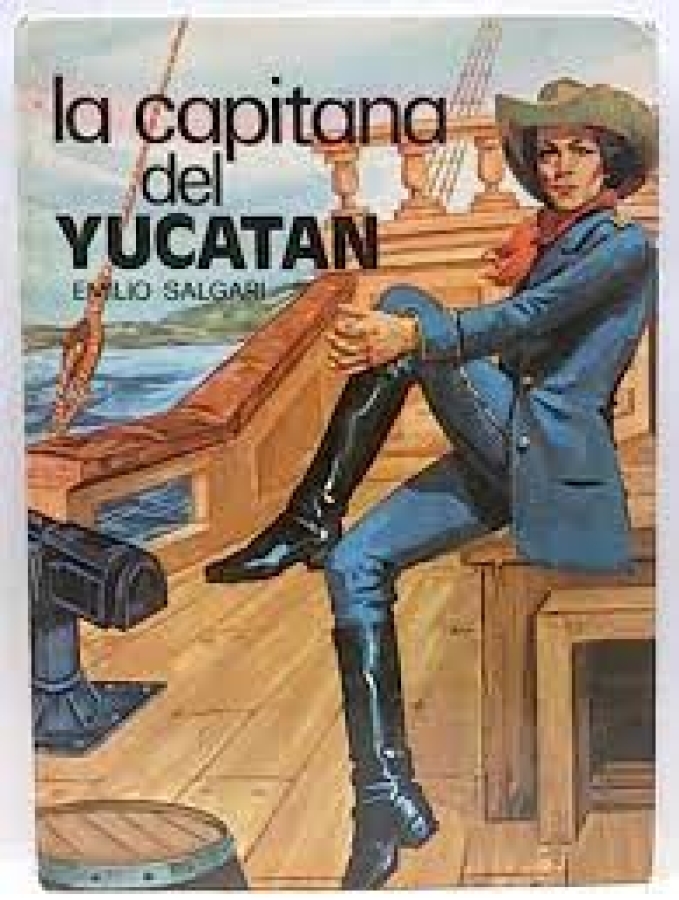
The novel is set in Cuba during the Spanish-American War of 1898, which led to Spain losing its final colonies. A “yacht,” the *Yucatan*, must run the United States naval blockade to bring weapons and provisions to the Spanish troops, who are in dire straits due to the concurrent advance of the pro-independence rebels and the pressure of the mighty American fleet. It is a small vessel, yet a masterpiece of engineering: its engines allow it to reach twenty-six knots, its steel hull is divided into several watertight compartments and fitted with a protective belt made of coconut fibers, rendering it unsinkable. And a marvel of technology! The “yacht” can submerge itself, leaving only its deck visible, so as to appear as a piece of drifting wreckage. Salgari too was dazzled by the wonders of technology, or perhaps sought in this way to emulate the allure of Jules Verne’s *Nautilus*, his direct rival. In command of the *Yucatan* is the Marchioness de Castillo. The Capitana > had a handsome head, crowned with an abundant mane of hair, of a deep, sombre black and wavy like that of Spanish gypsies, (...) she had skin of that lusterless pallor, of a strange hue found only among the Creoles of the Greater Antilles, (...) eyes of a consummate black, (...) long, silky eyelashes, (...) lips as red as a pomegranate. After such a description, we would have expected an enthralling tale like that of *Yolanda, the Daughter of the Black Corsair* or an ambiguous and mysterious one like the story of *Capitan Tempesta* (see reviews on this site); instead, the Marchioness de Castillo remains on the margins, emerging only fitfully and in a supporting role, while the true protagonist is Lieutenant Cordoba, > a sea dog (...) rather short in stature, all sinew and muscle, with an angular face bronzed by the sun of the torrid zone and the brine of the sea air. It is he who leads the *Yucatan* and its crew through a succession of adventures, at sea and on land. In one of these exploits, Cordoba, aboard a small launch, releases torpedoes against a gunboat, blowing it up and clearing the way for the small vessel; in another, the *Yucatan* conceals itself in a sea cave; in yet another, it skillfully slips away amidst a multitude of reefs and shoals. We are on the southeastern coast of Cuba, facing Mexico, riddled with islets and fjord-like sea channels, rich in a luxuriant nature that is consistently depicted in sombre tones, as if to foreshadow the sorrowful conclusion. The sea is inhabited by > splendid jellyfish resembling large lamps of frosted glass, of an exceedingly pale hue ; the flamingos take on a fantastical appearance, with their tails > covered in feathers of a splendid carmine pink, which along the wings turns into a magnificent coral red or fiery red ; in the forests, giant mango trees predominate, with > immense lianas climbing up and down the trunks in a thousand contortions or clinging to an infinity of parasitic plants that formed dense festoons ; and > the air is so heavy with moisture that it corrupts everything , everything spoils, turns moldy, decomposes; over all hangs the terrible yellow fever. Amidst these noxious miasmas, the *Yucatan* runs its final course. The power of the United States is overwhelming! The marvelous vessel cannot be surrendered to the American imperialists; far better to scuttle it with dynamite. > The Marchioness cast a tearful glance upon the smoldering hulk, half-submerged between the water and the sand, and murmured with a sigh: “Our mission is ended!” To a greater extent than in other novels, Salgari the popularizer comes to the fore. Interweaving landscapes familiar to him with the accounts of travelers and geographers (who, in the second half of the nineteenth century, were also possessed of vivid imaginations), the writer depicts the sea and coasts in meticulous fashion, rich in naturalistic and nautical detail. He adopts the same approach in recounting the Siege of Santiago, enumerating American warships and illustrating the various engagements. On one side stand the valorous yet ill-fated Spaniards, and on the other the treacherous Americans, > the financiers' syndicate , the cowardly blacks ( > huge, clumsy hats, gigantic feathers, (...) a frantic trembling) , and the Creoles who lack courage—perhaps, Salgari wonders, owing to the climate or the relentless Spanish oppression. One detects a whiff of racism or, more mundanely, a desire for vindication following Italy's crushing defeat in Ethiopia (the Battle of Adwa took place in 1896). This didactic intent weighs down the narrative pace, fragmented and bogged down by excessive digressions. Moreover, the character ensemble typical of Salgari’s novels, which usually helps leaven the plot, is conspicuously absent: a dark, brooding protagonist flanked by two sidekicks, often lightly ironic and shrewdly pragmatic. Here, Cordoba dominates the scene, a figure far too conscious of his own superiority as an old sea dog to leave room for the other players—even the Capitana herself, who, indeed, professes to be his pupil. Why read it? It is verbose and at times repetitive, yet it offers a compelling glimpse into a little-known chapter of history.
The Turk's Coat
> I wish it were she who wrote about me. To gather thoughts about those years centuries away. To justify my cowardice, my need for certainty... I am a seeker of gold nuggets, I collect precious fragments, intersections of my life with hers, thoughts of her, sudden emotions that interrupted years of my heart's silence, years of absence. I stretch time so as not to reach the epilogue with which I cannot make my peace . The protagonist and narrator, Maria, recounts her life, but above all speaks of her sister, the indecipherable Isabella, with her stark white skin, her > fine hair of an indefinite shade between brown and red, greenish eyes like the bottom of a lake . The sisters possess "opposite natures," yet precisely because of this their bond is profound and troubled, a perpetual pursuit wrought with unspoken words, misunderstandings, and above all, regrets. Childhood sees them closely knit, with Maria fraught with dread over the trouble Isabella might cause—Isabella immediately revealing herself to be adventurous, reckless, and irreverent beside her elder sister, cautious, meticulous, and rational. It is only natural that Isabella should be the first to take an interest in the movements of 1968, dragging into this political chapter a recalcitrant sister and Marco, Maria’s fiancé. Rapidly, the roles are reversed. The mercurial Isabella abandons the revolutionary factions to roam the world, while Maria and Marco become committed activists.Maria’s verdict on those years, so momentous in the history of our country, is merciless. > They did not fundamentally alter the course of my life. They seem distant to me, the words hollow. We wanted to shoehorn the world into a century-old idea. There were no others to be found . Yet for Maria these are momentous years: she marries Marco, has a child, separates, and goes to live on her own. Why, then, is it an insignificant period? The sister's absence weighs heavily, a void she cannot fully bridge through caring for her child, through work and study. And Isabella resurfaces in a singular manner, true to her unpredictable nature. A Turkish man arrives at Maria’s door, sent by Isabella. Mehmet is a man, > built like a wardrobe.. dark eyes and a drooping mustache.. wearing a military overcoat of an undefinable color . A love affair ensues.«I spoke with him as I used to speak with you», Maria will one day say to Isabella, who has just confessed that she too had an affair with the Turk. > Except Mehmet had given himself to both of us by presenting opposite sides of himself. With me he had pretended to be a good husband, telling me I was a strong woman.. and to her, who instead loved taking the plunge, he had offered his experiences and his adventurer’s fantasies . And so the Turk’s coat becomes the metaphor for the relationship between the two women: united yet distant, ever seeking one another out, yet incapable of finding a serene stability in their bond. It takes very little to shatter a fragile equilibrium and lead the two sisters to say and do things they will regret. Isabella returns home pregnant just as Maria is herself expecting a baby girl with Marco, with whom she has reunited. First, Isabella, in a moment of fury toward her sister, causes a car accident that forces Maria into premature labor. Then Maria discovers that Isabella and Marco have shared a kiss. The outrage is such that it drives Maria to write a letter steeped in vitriol: «Stay away from me, you stink, you disgust me». She immediately regrets what she wrote, but fails to reach Isabella, who drowns during a boat trip. > I folded Mehmet’s coat into four and slipped it into a large plastic bag, along with the old clothes... in this anonymous room, on my table, her photographs have multiplied. Now only she lives here; I feel dead. It was not what I wanted . The novel addresses a relationship often left unexamined: that between siblings. Lovers and friends are, in some way, chosen; siblings are found «already given». Yet it is a bond that endures for a lifetime, even if from the intensity of childhood it subsequently wanes into a more distant, often deeply estranged dynamic. «We concealed nothing from one another, at least up to a point». These words, which the author places in Isabella's mouth, encapsulate with great precision the trajectory of a sibling relationship, just as the image of the coat, folded into a plastic bag to be discarded, symbolizes the conclusion—perhaps inevitable—of an «inheritance» of childhood. The new family, formed with a partner, becomes paramount. The prose is spare yet expressive, rich in poetic resonance. The narrative plot is taut, relying more on the description of events and situations than on dialogue—as if to signify the incommunicability that hallmarks the relationships between the characters, particularly between Maria and Isabella. Reflections are entrusted to dreams, introducing occasional yet evocative oneiric vistas. Why read it? A magnificent novel, concise yet intricate.
The Lament of the Linnet
The novel revolves around a question to which the reader cannot find an exhaustive answer: who is the "Cardillo Addolorato", and what role does this omnipresent and obscure figure play among so many characters? And what is the meaning of the verses that recur throughout the tale, up to its seemingly tragic conclusion: «e vola vola vola lu Cardillo! e vola vola vola... oh! oh!»? To answer, one must venture into the reading of the novel, letting oneself be enchanted by the mystery of narration, which, like life, resides in the > freshness, fluidity, flow and precipitous fall, the continuous vanishing and resurrection of its infinite forms . We are at the end of the eighteenth century, in the midst of the Age of Enlightenment. Three friends—Prince Naville, the merchant Nodier, and the artist Albert—arrive from the cold North in Naples, a "strange city, wretched yet rich, softly colored," alternating "days of a purest, glittering azure" with others rainy and somber. The three young men, > radiant with a gaiety, an excitement, a pride justified by their age and, we might add, by being in a city so full of mirages, pay a visit to a well-known glovemaker. It is in the merchant’s house that the events determining the fate of the three friends unfold. First of all, they meet Elmina. "Full, yet delicate forms, stunning arms," a gaze > grave and reserved... a coldness... a distance, an abyss... that could be conquered (thinks Naville)... that could never be bridged , so it seems to Albert. The impression is so breathtakingly intense as to produce "a bewilderment of the soul"—more mundanely, causing the three young men to fall in love suddenly and like a bolt of lightning. Their lives are marked forever. Yet precisely at this moment of enchantment, a disturbing episode occurs. Elmina's little sister compares Albert to "their old goldfinch," left to die of neglect, without fresh water or millet. From a twofold and contradictory emotion, of ecstatic wonder and gratuitous cruelty, unfolds an apparently senseless story. As in an eternal return, the characters remain the same, events seem to repeat themselves identically, yet continually take on new forms and meanings: the only constant is the presence of the Cardillo, the mysterious bird, "entirely invisible and hidden." After all, is it possible to bestow > a legitimate name on the people and things of this world, all so unclear... and slowly slipping away ? Albert marries Elmina, who has undertaken a mission transcending all love and human bonds, even maternal ones: she must care for a child who might be her secret brother, but, naturally, is not. An imp, an evil spirit, or an innocent soul? In this predicament, poor Albert, a fragile and defenseless soul, cannot but succumb. Nodier, for his part, also in love with Elmina, after daydreaming of marrying her, being the pragmatic and superficial man he is, beats an orderly retreat once the incomprehensible mission the girl has set for herself becomes clear. Naville cannot accept this easy way out; he too is infatuated with Elmina, but, an Enlightenment thinker and cosmopolitan, he stubbornly attempts to find an explanation for incredible and mysterious events, to offer Elmina a definitive and fitting arrangement, showering her with gifts that are always refused, planning to marry her and take her away from Naples. All his efforts are futile, not only because events unfold in an increasingly indecipherable manner (characters are never who he thought they were; even the dead resurface to have their say...), but above all because, at decisive moments, the voice of the Cardillo bursts forth, that agonizing refrain: > Oh, had he never abandoned his home and the dull worldly life of the wealthy, solid, cold, reasonable, and thoroughly respectable society into which he was born! A kind of destiny dragged him to Naples, and against it poor Naville desperately fought, only to end up defeated. The prince returns to his homeland, to his majestic palace in Liège. To anyone who "boasted of that famous, though still newborn Progress," the prince—no longer worldly, no longer amused—would ask whether they > had heard the absolute silence of the world, the imperial joy of dawn.... the presence of the avenging Cardillo . Until one evening, just as he is about to set out once more for Naples, the Cardillo is announced to him. The familiar refrain echoed everywhere, and the prince > (blessed) the Cardillo who was arriving, and would finally explain everything to him. The madness and the separation, the grief and this joy that now arrived with him: all calm, cold, infinite . Who, then, is the Cardillo Addolorato? It is the underworld, the magma bubbling beneath ordering rationality. To grasp the meaning of the goldfinch’s voice, one must be a > patient reader, bereft of common sense and endowed instead with a private antenna to catch the glacial silence of the Universe, the quarrels of the underworld’s children, the spitting, the tears, the nein... nein of their imploring . Only in a Naples both fantastical and sorrowful, generous and cruel, could a book narrating the defeat of Reason take place. The novel’s chief virtue is its style, mesmerizing if not easy. The reader is immersed in an intricate syntax, rich in parenthetical clauses, representative of life’s complexity and vagueness. It is a prose that heralds dream, mystery, a world that refuses to be reduced to overly simple and linear narrative schemes. Its flaw lies in the confusion of the plot and character system. At first, the author manages to maintain order and logical progression; beyond a certain point, disorder bursts in victorious. The reader loses their way, and annoyance and tedium set in. Why read it? Its allure lies in the writing, but one must have the patience to press on through the final hundred pages.
The Professor's Briefcase
Let us imagine a young woman, somewhere between her thirties and forties. She was never a brilliant student, she works a monotonous office job, she has had a few romantic relationships that nevertheless came to nothing. She is alone. > All alone I took the bus, all alone I walked the streets, all alone I did my shopping, all alone I went for a drink (...). A cheerful life. Sad. Pleasant. Sweet. Bitter. Harsh. Stimulating. Irritating. Warm. Cold. Lukewarm. In short, how on earth have I lived for so long? One day, by chance, at the bar where she goes to drink (seemingly her only pastime), she runs into her former Japanese teacher. At first, it is a vague sense of feeling at ease, "settled," like buying a book and choosing to leave its wraparound band intact. Then something else takes over. > The teacher and I do not see each other often. It is only natural; we are not together. Yet I never feel he is distant, not even when he is not beside me . Finally, love emerges. > From what point onward, drawing near to him, did I begin to feel the warmth radiating from his body? Through his starched shirt, I perceived his presence. (...) A presence I was never able to grasp firmly. Just when I am about to seize it, it eludes me. When I feel it growing distant, it draws near once more . In a dream, the young woman searches for the teacher, but cannot find him. > Ah, there it is, I have already put him in the box! Now I remember. I shut him in the big box (...) that I keep at the back of the built-in wardrobe. (...) Now I can no longer take him out. Because the wardrobe is too deep . Yet what does the teacher represent, with his briefcase, his voice and his body, his past laden with mysterious meaning? Is he like the moon that must illuminate the path for a young woman who does not know herself? Is he the conscience unwilling to emerge from the depths of the soul? Or, more simply, an older friend to cling to in order to come of age and escape the loneliness of existence? We shall never know, for the novel offers no conclusion. We know only that when the aging teacher passes away, "on evenings like this," the young woman will open the briefcase and look inside. > But there is nothing in the briefcase, only emptiness, an expanding void. A hopeless void that swallows everything . To characterize this tale in some way—one that resists labels nonetheless—we might say that the novel articulates an existential suffering not confined to youth. Across the narrative, we discover that the teacher, too, has suffered from events beyond his grasp, such as his wife’s flight and sudden death. The older companion is therefore not a font of wisdom and certainty; rather, like the young woman, he is a tangle of certainties and doubts, expectations and disappointments. Their relationship, which becomes intimate and not merely spiritual, is the fruit of two kindred spirits seeking mutual support, facing existence together. The meaning of the tale must not be reduced to the trite story of an affair between a young woman and her former teacher. The slow acceptance of their love stems from the fear of opening oneself to the other, of acknowledging that one is a person only through another person. Distinctly Japanese, the novel thereby takes on a universal resonance. The charm of this brief novel lies in its narrative style: delicately ironic, thoughtfully gentle, the two protagonists, the wondrous Japanese landscapes, and ultimately the prose itself lead us softly and pleasantly along a path that might otherwise have proved somber and oppressive. Regrettably, the plot is fragile, often meandering and repetitive. A curious note: reading the novel reveals that Japanese cuisine is not merely sushi and raw fish; one can discover many intriguing recipes. Why read it? Distinctly Japanese, and therefore unique.
The House of Jasmine
> I know a city / that every day fills with sun / and everything is enraptured in that moment (Giuseppe Ungaretti, *Silenzio*, from *L'allegria*). The city is Alexandria, Egypt: > here is the sky, free of black clouds; here are the little white clouds scattered in the air like children skipping with joy across the immensity of space. Thank you, God! Here you are, you who never abandon your son Shagara Muhammad Ali, this strange name that caused him so much trouble during childhood and adolescence, and which your discontented servants still do not know well. God, please let me finish what I am doing... Shagara is a petty crook: he works in a factory, in a dusty office cluttered with paperwork, and is often assigned the task of organizing rallies and trips for workers chanting praise for Sadat, who succeeded Nasser in Egypt. Shagara skims off this assignment, pocketing a portion of the money given to him to pay the workers and bus drivers. Everyone knows it, but it is par for the course in a corrupt country. He moves through a city that is surreal, turbulent, and ever identical to itself, and > that old feeling came back with a vengeance: that I owned it, that I had built it myself, that I had traced its boundaries and erected the buildings along its sides . Is Alexandria real or merely Shagara's delirium? Strange, inexplicable, and unsettling things occur: a corpse was found in a sack, yet when they opened it, a breathtaking woman emerged; drunken dogs wandered all alone, shouting, "to hell with the British Empire on which the sun never sets"; a bird had seized a child in its talons and flown off "toward the seventh heaven where God reigns." And there were other incredible events that left the people stunned, even as they carried on living just as before. Rising prices, rampant corruption, peace with Israel after so much bloodshed, and the arrogance of a technocratic government set fire to the revolt. Alexandria is engulfed by an irrepressible, furious popular uprising. > But why, at this very moment, do I fix my gaze on the faces of women and young girls? (...) Perhaps because things drift past before my eyes and I take no notice at all? What is the source of our indifference? Is it perhaps that mysterious "house of jasmine," repository of enigmas no one can fathom, becoming a metaphor for the dark, unfathomable human soul; or is it rather "that dark mass stretching into infinity"? > That foolish water, for millions of years, knew nothing but low tide and high tide, alone, with itself, never anyone sharing anything with it . Just as the house of jasmine is demolished to make way for a hideous real estate speculation that destroys the splendor and allure of the ancient city, so nothing remains for us but to be annihilated in a bleak existence, shackled to petty bourgeois routines. > Where is God, how could he have abandoned us? He gave us a paradise; how is it possible that it all vanished in such a short time? What a fool I am! So much time has passed and I didn't even notice . Of this splendid novel, one could say anything: surreal, realistic, cruel, and ironic. Undoubtedly, the author chronicles the transformation of Alexandria in the wake of Sadat's savage, uneven modernization—a man lauded by the West, yet bereft of charisma and utterly estranged from the "religious heart" of the Egyptian people. And yet, the novel rises above historical contingency, developing in an admirable and captivating manner a discourse that is at once social and intimate: social, because it reveals how deeply the detachment of a cosmopolitan ruling class wounds a people, only to resort—after so many lofty proclamations—to the heaviest repression (and thus ends Alexandria's great uprising); intimate, because through the metaphor of the house of jasmine and the boundless sea, it speaks to our impenetrable inner world and urges us not to lose ourselves in the mundane, nor in futile invocations of God. Only understanding ourselves can save us from indifference. Reading this novel was an intense pleasure, an immersion into fantasy and sublime impressions, rendered through incisive prose characterized by brief sentences woven into an articulate, fluid syntax. Why read it? To afford oneself pure aesthetic pleasure.
The Balcony-Access Tenement
Amedeo Consonni, the novel's protagonist, has been retired for many years and lives in Milan in a *casa di ringhiera*, built at the beginning of the twentieth century around a rectangular courtyard and now housing twenty flats. It is a «curious microcosm» bearing traces of industrial architecture, today severely deteriorated: crumbling stucco, dilapidated plaster, window frames—traditionally wooden and now replaced by others in anodized aluminum, in silver and brass tones—not to mention the numerous TV satellite dishes mounted on the railings, imparting a sense of globalized «squalor» > . On the surface, Consonni’s life is typical of a retired widower: tidying his small, comfortable flat each day, going to the supermarket and cooking his meals alone, reading the newspaper accompanied by an afternoon nap, exchanging a few words with the neighbors, and looking after his young grandson on Tuesdays and Thursdays. But Consonni harbors a strange hobby: he loves collecting crime news, cutting out any article concerning murders from the papers and archiving these clippings in binders meticulously ordered by crime. Over time, he has begun investigating in the field unbeknownst to the police. Alongside Consonni’s pastime, somewhat perverse yet harmless, Recami depicts the other inhabitants of the tenement: in particular, a family of four (father, mother, and two boys), where the man is frequently drunk and violent, the eccentric and noisy couple next door, and the octogenarian madly devoted to his old car. From reading this detailed and fascinating portrait of this microcosm > one might think we are in the presence of a novel of manners in which the detective plot is merely a device; Consonni’s investigation into a recent, savage, and mysterious crime is intriguing, yet the narrative seems aimed more at describing the character than at offering us the suspense and intrigue expected of a noir novel. When, suddenly, the murder of a female tenant sets off a shocking and astonishing sequence of events, entangling the inhabitants of our microcosm. Without giving away the ending—a genuine plot twist—we can say that the unfolding of events confirms how we Italians, all of us, even children, have, or think we have, something to hide, and in any case want to say nothing to the police. I read the novella in one breath". In the first part, I was captivated by the physical and social setting of the *casa di ringhiera*, almost suspended out of time: one need only think of the minute description of Consonni’s apartment with its nineteenth-century wallpapers, or the rivalries and petty slights over parking in the courtyard. In the second part, the narrative pace gathers speed and we cannot put the book down, eager to read the next episode. The narration is punctuated by suspenseful hints of dramatic twists, skillfully crafted to fuel the desire to press on, much like in a serialized novel. The prose is refined and succeeds in blending everyday speech with dialectal idioms, thereby conjuring the nostalgic atmosphere that pervades the tale. It is a minor gem that marries the novel of manners with noir, alongside a pleasing vocabulary and elegant syntactic construction. Why read it? It is intriguing and well written.
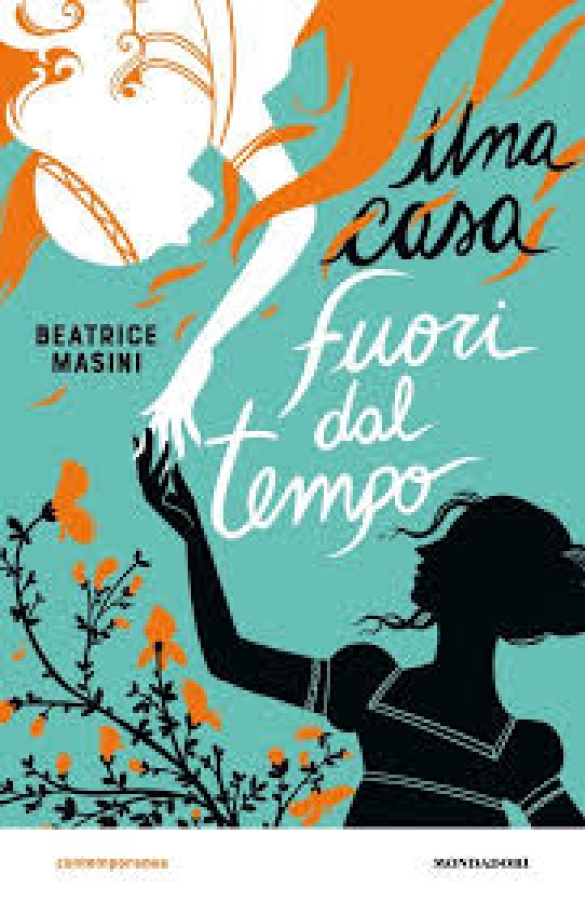
A house out of time
> He sets off between walls, prey to the light..../perhaps it was you, now it is an apparition/or perhaps it is all that knows no peace/ (...) It is a figure, it has no rest.../it is ours, I thought it a chimera (from "S'avvia tra i muri" in the collection *Avvento notturno* by Mario Luzi). These lines come to mind when reading this novel, which speaks of timeless presences, shadows and light dwelling in the realm of the dead during winter and among the living in summer, as in the myth of Persephone. Vera, a timid English girl of the early nineteenth century, certainly could not have expected such an extraordinary experience: becoming friends with Ginestra, whose destiny is to live for eternity like Persephone, poised between the underworld and the world of the living. The story begins in England. Vera is orphaned of both parents and has only an older brother, Caspian, who is passionate about archaeology. Vera studies Italian in the London schools founded by the exiled Mazzini (I appreciated this nod to an important, often forgotten role played by the founder of *Giovine Italia*). Caspian decides to take his sister with him to Pompeii, where he is engaged in the excavations. Vera wanders freely among the stones of the Roman city when Ginestra appears at her side. Just as in Luzi's poem, Vera becomes aware of Ginestra's sudden presence > not by any sound, because she makes none: what makes her turn around is a draft, an air pocket, like when you are swinging too high on a swing. Ginestra is > as tall as she is, (...wears flat sandals of slightly scuffed red leather... , but describing her is pointless; it is better to admire the portrait drawn by illustrator Elisabetta Stoinich of the two girls, together, hands affectionately clasped like two friends, jaunty, full of life—Vera smiling, Ginestra faintly melancholic in her Roman tunic and unruly hair, so alike yet so different from Vera in her composed Victorian attire. Yet why is a faint melancholy sensed in Ginestra? The girl knows she will lose Vera with the coming of winter, just as she will never again be able to live like mortals. There is a turning point in the story: the archaeologists succeed in capturing in a plaster cast the figure of a woman who died in the great eruption of Vesuvius; this woman is Ginestra’s mother. Ginestra's eternal vigil has become pointless; having seen her mother again, she can now leave the realm of the dead. She asks the Goddess for permission to depart the cheerful, vacuous sisterhood of her companions; in exchange for freedom, the Goddess demands Vera. Love prevails, and Ginestra condemns herself to eternal imprisonment. > They slipped away from one another, their clasped hands parted, the weave of their fingers loosened. The earth split before them, driving them apart. (...) Instead of letting Vera fall into the chasm (...) Ginestra looked her in the eyes for a long moment. Returning to cold London, will Vera remember her friend and her sacrifice? Beatrice Masini has written a delicate, subdued, almost evanescent novel. Her passion for Greek mythology and archaeology led her to intertwine Vera's coming-of-age journey—a true rebirth—with the history of the early excavations of Pompeii, suspended between conservation and greed for profit, between new technologies and the grueling, hazardous labor of the workers. One thinks of the evocative figure of little Nico, forced to work while still a child, and the description of the plaster casts, a method widely used in the nineteenth century to both preserve and popularize the works of antiquity. These realistic references frame a story of strong philosophical import: time, > which erodes and leaves nothing intact. Time, which is always hungry, and devours everything. Whereas before -- before, now, after, when it was, when it has been, when it will be -- over there, before, it was, it is all so perfect and polished. Overshadowed by so much metaphysics, the plot ends up crushed, weakened, fragile; the protagonists are not explored in existential and psychological depth, beginning with Vera and Ginestra. The prose is elegant and musical, aptly complementing the faint melancholy of the story. The sentences are concisely flawless, the vocabulary rich yet modern. The reader glides effortlessly through fine Italian prose, but at a certain point is left wondering: where is the fire amid such stylistic virtuosity? Why read it? The plot is fragile, but it makes for an enjoyable read.
The House on the Hill
The Resistance is most often narrated from the perspective of those who took part in the partisan struggle. Pavese’s novella speaks of those who waited, even while caught up in it. > In essence I was asking for lethargy, an anesthetic, the certainty of being well hidden. I was not asking for world peace, I was asking for my own . Thus reasons Corrado, protagonist and first-person narrator, as the surrounding world is swept away by war. He has taken refuge in the hills, which > for me was not one place among others, but an aspect of things, a way of living. (...) I felt no sorrow; I knew that in the night the entire city could go up in flames and people die. The ravines, the villas, and the paths would wake in the morning calm and unchanged . During the day he often goes into town, to a tavern: here there is music, dancing, and badmouthing of fascism. > Each time I swore to remain silent and listen, to shake my head and listen. Yet that cautious equilibrium of anxieties, of waiting, and of futile hopes in which I now spent my days was made for me, I liked it: I would have wanted it to last forever. The impatience of others could destroy it. For a long time I had been accustomed to staying still, to letting the world go mad . Neither the fall of Mussolini and September 8th, nor the rediscovery of a woman from his youth—with whom he perhaps had a son, now twelve years old—are enough to shake him. > Now I was forty years old, and there was Cate, there was Dino. (...) Was I not being futile and boorish this time as well, hovering around her, half bewildered, half humiliated? The fragile and illusory equilibrium is shattered by Cate’s arrest. Corrado escapes by chance and takes refuge in a monastery, where Dino joins him. > What else to do under the empty portico if not savor once again, morning and night, that ancient dread? The monastery is no longer safe, so he decides to seek shelter at his parents’ home in the Langhe. Meanwhile Dino > has left, and in earnest. At his age it isn't hard. It was harder for the others, who nevertheless did it and are still doing it . The journey from Turin to the Langhe takes him into the very thick of the partisan struggle, yet he manages to save himself. > Despite the times, here on the farmsteads the corn has been husked and the grapes harvested. (...) Now that the countryside is barren, I roam it again; I climb and descend the hill, reflecting on the long illusion from which this account of my life began. (...) Here every step, almost every hour of the day, and certainly every unexpected memory, sets before me what I was, what I am and had forgotten. (...) At times, after listening to the useless radio, looking through the pane at the deserted vineyards, I think that living by chance is not living. And I wonder whether I have truly escaped. Can one go on living after a civil war? > One has the impression that the same fate that struck down those bodies keeps the rest of us nailed there to look at them, to fill our eyes with them And why did they die? > I would not know what to answer. Not now, at least. Nor does it seem to me that the others know. Perhaps only the dead know, and only for them has the war truly ended. Corrado’s failure (he could not even protect Dino) culminates in a meditation on the destiny of humankind that transcends the narrative: from the depiction of historical circumstance and internal existential anguish, it ascends to a cosmic dimension, singularly relevant in light of the civil wars that bleed many parts of the world today. From a stylistic standpoint, the novella is an absolute masterpiece: lean, spare, yet capable of evoking the sweep of history and the destiny of its characters. The writer works deftly with the phonetic juxtaposition of words, so much so that one often feels confronted with a poetic composition rather than a prose text. Equally extraordinary is the author’s ability to avoid fracturing the rhythm despite relying predominantly on the period, and thus on short sentences. The use of the comma to create a suspension between subject and verb (granting autonomy to the latter) is a stylistic gem, requiring an exceptional command of syntax, vocabulary, and the Italian language in general. The fusion of American narrative with classicism yielded exceptional results, rarely matched in Italian literature. Why read it? It is a masterpiece and a meditation on war.
The Cases of Inspector Croce
In the prologue, Ricardo Piglia cites a note by Karl Marx on evil, as > the fundamental principle that makes us social creatures, (...) here lies the true origin of all arts and sciences, and from the moment evil should cease, society would necessarily decay, if not perish altogether . If we consider the history of Argentina—a history the author traverses skipping here and there—violence, the extermination of native peoples, repeated military coups, Peronist populism and ruthless neoliberalism, police repression culminating in the *desaparecidos*, are not anomalies but elements inherent to a capitalist society; and only through a rational approach can a plausible explanation be found. To achieve this end, Ricardo Piglia invented Commissioner Croce, a "brilliant investigator" bearing the name of an Italian Hegelian philosopher, Benedetto Croce. Is it a coincidence? Certainly not, considering that "the true destiny of a Kantian is the police academy," even if > no one is master of their own thoughts. There is no such thing as one's own ideas; thinking is either appropriate or it is not appropriate and also "if we do not destroy thoughts, thoughts destroy us." To range freely, Piglia does not develop a single plot, but relies on short stories, which the author seems to present as random, included without a logical thread. In reality, perhaps stretching the author's intention, we can group them into several strands. *The Film*, *The Exception*, *The Impenetrable*, *The Promise* > , are stories that deal with salient moments in Argentine history. Take *The Impenetrable* > where Croce is tasked with solving the disappearance of engineer Panizza, a well-known industrialist with an obscure past. Croce travels up the Río de la Plata, which was easy for him because he had spent many summers on the vast lagoon (...) to escape routine and lead a philosophical life." And when he meets him, Panizza utters enigmatic words (such as "the organization of time, and not the invention of the steam engine, is the key to capitalism > ) only to slip away for good. Who is Panizza? Is he one of the many Europeans who fled after the Second World War and do not want to be found? And what of the commissioner's weeping at the end of the story *The Film* > , when Croce discovers that the blonde girl starring in the pornographic film is Evita Perón, that woman whom so many had loved as a virgin > . Other stories represent the essential traits of Argentine society: melancholy ( *The Music*), superstition as in *The Astrologer* and in *Tigre*, virility as in the paradoxical and indecipherable *Mrs. X*, the love of risk as in *The Gambler* > . And finally, Piglia dwells on the crime genre, revealing his predilection for detective stories in the vein of Agatha Christie and for the bewildering mysteries of Poe. The stories are a manual of instructions and reflections, from which we discover that Croce's method operates "through metaphorical analogies, combines poetic intuition with mathematical precision" (*The Lecture*, *The Resolution*, and *The Method*). In the background, there is always Argentina: > the streets are deserted, there isn't a soul anywhere, there's no one at the port, everything is dead, something demented, acres and acres of countryside and behind it there is nothing, stray dogs, bones in the sun, and only wind, dust, and solitude. (...) We have been defeated so many times that now we no longer change . One would need to know Argentina and its history to truly appreciate these stories; and yet, these short tales arouse a certain envy, imagining what our own Noir—so successful today—could be if it retraced our recent past, fostering the transmission of Memory. From a narrative perspective, the reading brings to mind Dino Buzzati's *Sixty Stories* (see review on this site): the same sense of paradox and the very same resigned disillusionment. Considering that *The Cases of Commissioner Croce* is Piglia's final book, written when he was already suffering from advanced ALS, we find ourselves before a truly poignant testament, coupled with the desire to bequeath a literary approach and convey a passion for the crime genre. It is a struggle to finish reading; at times the stories are rambling, with numerous narrative digressions, and at times too paradoxical—as happens with Buzzati—making it difficult to remain engaged. Why not read it? It is interesting, but prolix and fragmentary.
Cassandra in Mogadishu
> In Somali, *jirro* means "illness"—literally so. (...) But for us, *jirro* is a vaster word. It speaks of our wounds, our pain, our post-traumatic, post-war stress. *Jirro* is our broken heart. Our life in precarious balance between hell and the present. This book speaks of this illness, both physical and spiritual, searing and nostalgic; and it does so through an autobiographical lens, constructed > in constant motion. The past is never still; it follows our transformations , as Scego writes in her afterword. The author imagines a dialogue with her niece living in London, and the plot is punctuated by Somali keywords, which, beginning with *Jirro*, progress through a series of stages encompassing personal, familial, and collective history: events, relationships, physicality, memories, prophecy. There are two pivotal events: 1971, when her parents fled Somalia following Siad Barre's coup d'état, and 1991, when Somalia collapsed into the chaos of gang warfare. > "No road will lead us back home, my daughter," she (Halima, Scego's mother) says, with a harshness I had never heard in her before. > The roads have been cut off. The houses have caved in on themselves. We have become beasts. And Mogadishu has been buried by its own inhabitants beneath an endless heap of corpses . Somalia at war, yet ever-present in the heart, tears at the relationship between mother and Igiaba. One day in 1989, her mother crosses Rome for a prospective job as a domestic worker, only to be rejected because she is Black. > She screams in the silence. (...) And with that voiceless scream, with that timeless humiliation, the Mogadishu skyline creeps into a mind flooded with nostalgia. Arriving there, at the center of her sighs, to comfort her. She returns to Somalia; she vanishes for two years without word, swallowed up by the civil war. For Igiaba, still an adolescent, this abandonment has a devastating impact: she begins to suffer from bulimia nervosa. > Dagalka wabu dilai je'eelka. War kills love. (...) I vomit the war. Until every dream inside me is erased. Until every self inside me is erased. Like those relatives of my mother lost in the haze of their discontent. And in the *Jirro* that gave them no respite. Upon her return, Halima begins to speak to her daughter, > woman to woman. If before she had told her of her childhood, in the countryside herding sheep, she now recounts her real life. > The trauma of having lost the homeland—she her country of birth, I my country of origin—united us in mourning. (...) She wanted, on an unconscious level, (...) to pass her life on to me. Because it was no longer just a family story. Halima recalls how she was infibulated, and naturally > she spoke of Dad. She constructed his legend. (...) She, a switchboard operator, and he, a remarkably handsome man, the mayor of a city that smelled of spices. Then, wrapped in her white robe, every now and then (...) she sought me out with her gaze. And in that locking of eyes, I the daughter, she the mother, we thought of the refugee. Of the exile we had traversed together. That eye condition haunting Igiaba today, as she approaches menopause, having neither children nor a husband—does all of this stem, perhaps, from having somatized the rupture of her life, she an Italian in love with Rome, she the daughter of a ruined Somalia? Could the tragedy of colonized peoples, shattered and consigned to oblivion, the sufferings of the world's migrants, the wars, the massacres, the women and children raped and slaughtered—could all of this be a portent of a fate that awaits us too, the wealthy, comforted by our fine laws and air conditioning? A friend suggested Igiaba read Euripides' *The Trojan Women*. At its core is Cassandra, who says: > I hold aloft the torch, I celebrate, I flood the temple with light—behold—with this lamp of mine. Like Cassandra, we too (a torn humanity) carry the torch. (...) Bearing it is our burden. Scego's novels share a common thread: the intertwining of personal stories and overarching history, and the premise that one can only discover oneself, and others, through the unraveling of this entanglement within one's own consciousness. It is therefore indispensable for the author to craft complex narratives with numerous parallel plotlines in a strongly political, rather than psychological, context. In *Oltre Babilonia* (2008), the point of synthesis is language, set in that Arabic school where people of diverse backgrounds study this "Esperanto"; in "*Adua* > of 2015, the author speaks of a betrayal, of a beloved Italy that casts out the migrant, and finally, in that blend of reality and imagination that is *Una linea di colore* > of 2020, two women who actually lived are synthesized into an invented character who bears the wounds of emigration and slavery (see the reviews of these books on this site). In *Cassandra a Mogadiscio*", Scego shifts perspective; more than ever, she speaks of herself, confessing her own physical and psychological fragilities. The brilliant and personable writer, encountered at so many *Internazionale* festivals, reveals herself to be a tragic figure, evoking and internalizing existential and planetary grief: a contemporary Ungaretti. Is she speaking of Somalia? No, she is speaking of her beloved country, Italy, on the brink of fracturing; of her Rome, at the mercy of verbal and physical violence; of her cherished language, Italian, which now seems destined to regress into its ancient local dialects. In short, by narrating her family and her country of origin, Scego reflects upon herself as an Italian. Where is the Promised Land? Or was Ungaretti's merely a desperate utopia? Scego's strength remains her writing; even in simple, immediate Italian, the author evokes sensations that leave a mark on the reader: they are often short, unexpected sentences, not always woven into the narrative thread, as if Scego allowed herself to be carried away by emotion rather than plot. The latter is a weakness; the narrative's richness is not effectively distilled into a synthesis easily traceable by the reader. Contributing to this narrative confusion are the literary devices the author seems so fond of; here, it is the dialogues with her niece and the structuring of chapters around keywords, which often fail to encapsulate the chapters' actual contents. Moreover, in digging as never before into her innermost self and foundational relationships—particularly with her mother—the lack of psychological depth becomes apparent. Scego's works, like those of many non-Western writers, are choral stories, introjections of universal suffering rather than introspections into personal sentiment. Why read it? One discovers an unfamiliar Scego; the reading, however, is demanding.
Dinner with the Commendatore
The author imagines a retired opera impresario deciding to set pen to paper so that it might be known who he truly was: > curious about the travails of others... a marmoreal commendatore of an era now bygone . Before his passing, the *commendatore* supposedly managed to compose three stories, which recount actual episodes from his life. In *The Green Jacket*, the impresario has engaged a brilliant conductor for Verdi’s *Otello*. > a man of genius (but) so vain that he is constantly preoccupied with the impression, indeed the effect, he produces on anyone who approaches him . During rehearsals, everything went smoothly until the timpani entrance, when the conductor suddenly asked to halt the performance, pleading a sudden indisposition. The impresario nevertheless managed to draw from him a confession of the true reasons behind the interruption, as well as the musician's decision to break his contract. During the Second World War, the conductor—then young and not yet famous—had taken refuge in a mountain village in Central Italy, where he had befriended the orchestra's timpanist: “a modest, quiet, middle-aged little man with dull eyes,” who had, however, passed himself off as a renowned maestro, earning the esteem and admiration of the local villagers. Yet the young conductor, far more gifted and accomplished than the poor orchestral player, had not disclosed his true identity, presenting himself instead as a humble bank clerk. But why dissemble? > Lightheartedly, out of curiosity, out of habit, I had strayed down the hazy path of jesting.... and seeing that plump little man, with his comical green jacket and skipping gait, coming toward me in the refectory, I had looked above all at the jacket and not at the man . Yet it was not merely shallowness that led him to this futile deception; there was also “an exquisitely subtle, heightened pleasure in no longer being myself.” But in doing so, he had betrayed friendship—the sincere bond between two men brought together at a difficult juncture in their lives. And now the conductor, celebrated yet conceited, prefers flight to confronting the poor player, who remains, conversely, steadfast in his role and his dignity, a modest artisan of music. In the second story, *The Father of the Orphans*, the impresario pays a visit to a former colleague who had abruptly abandoned the business to run an orphanage. When asked the reasons for such a drastic decision, the colleague tells him a moving story: he had met a sick child on a train and had been deeply affected; yet, out of indolence or the press of work, he had delayed offering help, and by the time he finally resolved to do so, he discovered that the child had died because the family had been unable to afford the necessary medicine. A beautiful tale, were it not for the fact that the impresario accidentally uncovers the true story: the colleague had been involved in a homosexual relationship with a young man, who in turn had fathered a child with a ballerina. Though pleaded with for help, the colleague had refused and had, moreover, cast the young man aside out of fear that his irreproachable bourgeois life might be shattered by scandal. > He had repented of many sins, but not of the single mortal one he had committed. He had made a thousand sacrifices, but not that one without which all the others were worthless: the sacrifice of his own vanity to love . The impresario wishes to force him to acknowledge his abjection, but is ultimately overcome by distaste for a hysterical scene, by the weariness of stripping a man of his mask. In the third story, *The Window*, the impresario goes to visit an old English friend with whom he has long been in love. He hopes they might spend the years of their old age together, only to discover that the woman has always loved a scoundrel, a good-for-nothing who deserted her many years ago. The impresario manages to expose the true character of this dandy, but to no avail. Even when confronted with the most glaring evidence, the woman reaffirms her love. For the impresario, it marks the disillusionment of a myth, of a lifelong dream: > when I thought of Twinkle as I had left her twenty years before and as I had always remembered her—forthright, witty, and of tastes so simply noble.... looking around me, I could hardly believe my eyes. And yet, her long solitude, teeming with fantasies and remorse, explained even this corruption to me . With his simple, elegant, and witty style, Soldati confronts the complexities of the human soul, tracing them back to everything within us that is ambiguous and uncertain. The mask behind which we hide is not an artifice, but an intrinsic part of our consciousness. The stories are compact and lean, sustained by a deft, swift narrative structure. The protagonists and settings are sketched with a few vivid strokes, attentive to detail (the hands, the attire, the decor), so as to recall, with delightful surprise, the nineteenth-century novel. Why read it? These are magnificent stories, written with grace and fluidity.

The Centre-Forward Was Assassinated Towards Evening
The novel chronicles the exploits of Pepe Carvalho, a cross between Marlowe and Nero Wolfe, hired to protect a footballer from Barcelona’s leading club, who is thought to be under a death threat. In reality, the detective plot serves as a backdrop to the depiction of a Barcelona milieu in the midst of a construction boom and urban transformation: the characters navigate a landscape in which old Francoist values are dissolving and new ones tied to rampant capitalism are emerging. Counterbalancing the decay of society and the prevailing violence are the small daily pleasures (eating) and the values of friendship, which represent humanity’s final anchors. The book’s greatest strength lies precisely in its portrayal of Barcelona and the characterization of its figures, whereas occasionally certain digressions of an almost philosophical nature slow the narrative pace. The style is richly articulated, bearing the clear influence of the great masters of American crime fiction and Simenon.
What is to be done?
Chernyshevsky was a nineteenth-century Russian revolutionary, a forerunner of the major ideologies and political currents that led to the October Revolution of 1917. An economist, philosopher, and writer, he was imprisoned at the age of thirty-four in 1862 and remained incarcerated until 1888. Written during his early years of imprisonment by a young idealist, the novel bears an overwhelming moral and political imprint, one that compromises its strictly narrative component. The theme remains strikingly timely: women’s freedom and equality. Vera (meaning "faith" in Russian) lives in a narrow-minded bourgeois family and is destined for a marriage of convenience with a wealthy, vulgar suitor. In a splendid depiction provided by one of Vera’s dreams at the end of the book (an extraordinary foreshadowing of Nietzsche’s oneiric style), Queen Astarte commands the young woman, portrayed as "a reclining woman," to submit to her lord. > Brighten his leisure hours. Love him, for he bought you; and if you love him not, he will kill you . But Vera replies that it is not she > depicted in this scene. Back then I did not exist. That woman was a slave. where equality is lacking, there is no place for me . And indeed, Vera rejects her destiny, rebels against her family, and marries a young doctor. It is no mere rebellion of a resolute adolescent. Vera knows full well that she has emerged from "a damp and dark cellar" to liberate other women, who "still lie captive and infirm." Now independent, Vera sets up a sewing workshop, where the seamstresses not only share profits and decide on business matters and organizational structure for themselves, but also dedicate themselves to their own education and the emancipation of women. The marital relationship between Vera and her husband is modeled on friendship, devoid of emotional and sexual ties. > Listen carefully now: this is how we shall live (...). First of all, we will have two rooms, yours and mine: in a third room we will dine, and receive our mutual friends. Secondly, I shall not enter your room (...) nor will you enter my room . Later in the final dream, Vera imagines this female figure being represented by another queen, Virginity. > Man’s primitive brutality was gradually tamed by womanly beauty.(...) Man loved the pure, inaccessible virgin. Yet woman did not yet possess a consciousness . It appears to be a tranquil situation, but a deep unease pervades Vera. It is a dream that reveals this. The young woman imagines that an artist forces her to read her diary. > It spoke of the two of us (Vera recounts to her husband) and how fond we are of each other, and then all of a sudden, at the touch of his hand, vile words appeared, saying that I did not love you . Vera certainly cannot follow the third queen, Aphrodite, who beckons toward an apparent freedom, pursued as it is by "trafficking in pleasure." She must experience true love, founded upon an equality of intellect, feeling, and sex between man and woman. She falls in love with a friend of her husband, Kirsanov: their affair is fraught, as both wish to disavow it and remain faithful—she to her bridegroom, he to his friend. The suicide of Vera’s husband enables their love story to materialize, bringing about "equality between the two beings who love each other." Thus speaks the fourth queen in Vera’s dream. > Once the equality of the sexes is recognized, man no longer regards woman as his property. They love each other because they wish to do so . (...) If you wish to express in a single word what I am, call me equality. The overriding reliance on dialogue between the characters, particularly between Vera, her husband, and Kirsanov, gives the impression of being faced with a Socratic dialogue, reinforcing the philosophical and moralizing character of the writing. It is always Vera who steers the reasoning, while the two men are stereotypes, figures flattened by the woman's personality. Vera is a complex character; at first, she is simply a young woman still uncertain and frightened; she pragmatically seizes the opportunity of a liberating marriage; with typical youthful confidence, she faces a relationship devoid of that gentle, assiduous caress, the need to cradle oneself voluptuously in a feeling of tenderness«. Then, she experiences »the imperiousness of that gentle feeling > , even if she cannot bring herself to call it love. Her husband’s suicide devastates her, but she overcomes it, defining the ensuing guilt as a pointless melodrama". A little selfishness does no harm! In the end, she becomes a woman thoroughly conscious of her own worth and aspirations. It may be that Chernyshevsky identified with Vera, and that the book is therefore a *Bildungsroman*, or the swan song of a lost youth. From a literary standpoint, it is a mediocre tale; the dialogue-driven narrative style and the glut of reflections, digressions, and declarations make it bombastic, repetitive, and prolix. Only the dreams carve out an innovative rupture within a traditional narrative structure that is ill-suited to plumbing the depths of its characters and situations. Why not read it? It is boring.
What of the Night
It is a book to be read in a single breath. The setting is 1960s Turin, during its phase of intense industrialization and the expansion of Fiat. Initially, the characters move independently of one another: a pencil vendor, who turns out to be an undercover *carabiniere* tracking down drug-refining laboratories; a young woman of the Turin bourgeoisie whose lover is a mysterious accountant, later revealed to be a bookkeeper for the Mafia; the editorial staff of a publishing house (the occasion for a parody of intellectuals), interested in publishing strange cassette recordings of dialogues by a parish priest who professes heretical ideas and has brainwashed a group of parishioners; a police precinct investigating an alleged assault on the priest; and a Fiat engineer concerned with inventory management. All these characters happen to cross paths at the heretical priest’s mass, during which the priest himself is killed in a bomb attack. A complex and arduous investigation ensues, marked by two further killings: those of the pencil vendor and the Fiat engineer. The story concludes with the uncovering of a fraud perpetrated against Fiat, masterminded by a senior corporate executive, with the priest, the engineer, and the parishioners serving as the material executors. The book is highly complex and multi-layered, yet possesses several remarkable facets: a compelling plot rich in twists and turns; a tight narrative pace that rarely lapses into the superfluous; and the overlapping of storylines and themes—the love affair between the young woman and the mob accountant, the world of Fiat with its corporate hierarchy and rituals, the police milieu and its frictions with the *carabinieri*, the religious realm with its age-old nightmares (the Gnostic sects), and the emotional solitude of Commissioner Santamaria and, more broadly, of all the "adult" characters in the book. In the background emerges an Italy in transition, where traditional values—and even petty thievery itself—are swept away by industrialization and the attendant urban sprawl: it is no coincidence that the novel is predominantly set on the periphery, within an urban and social fabric increasingly degraded and disrupted. Yet will this society be worse than the one that preceded it? The authors seem not to think so: Thea, this young bourgeois woman, prefers her liaison with a mafioso to the social circle of her own class, and her mother considers that this might well be better than marrying a corrupt, paranoid Fiat engineer. The rigid strictures of a hypocritical society are shattered, and only in this way do the characters find their destiny, and love, even if outside conventional bounds. There is, moreover, another theme that surfaces only at the novel’s conclusion. The senior Fiat executive is exposed because he forgets that he is constantly shadowed by two police bodyguards assigned to ensure his safety. The loneliness of power and its indifference toward the humble are also the undoing of those at the summit of society, who deem it thoroughly pointless even to notice others. Is democracy an inevitable process?
Chi dice e chi tace
The novel is set in Scauri, a town in the province of Latina, where the author was born and raised. > Along the promenade, the beach resorts gleamed in the golden light of sunset. (...) Young couples walked linked together, two women, both wearing chenille tracksuits, walked briskly...(...) The plaster on the houses struggled against the sea salt, danceable music drifted from the Bussola, and men smoked and drank beer, cradling their bellies. (...) Affixed to the walls of the railway workers' club were a faded photograph of Gramsci, a reconstructed portrait of Berlinguer, the front page of the inaugural issue of *l'Unità*... It is in this insignificant and sleepy town on the Lazio coast that Vittoria takes up residence, living in a villa with a young woman. > Eyes not light in color but filled with light, she wore a straw hat that had seen better days, loose trousers, a white cable-knit sweater, (...) Vittoria looked as if she had stepped out of the pages of *Oggi*. (...) She looked like an Arab princess on a Tuscan country estate. Who was Vittoria? Lia seeks to answer this question when the woman's lifeless body is found in the house’s bathtub. In an indifferent and gossipy environment, Lia seems the only one concerned with the causes of death (suicide or murder?) and, above all, with who Vittoria truly was: why she had abandoned Rome and why she was cohabiting with a young woman who certainly could not have been her daughter. And Lia discovers that Vittoria is like > Greek; she had left few traces, and to arrive at a meaning—assuming there was one—one had to proceed by recombining the elements, conscious that a margin for interpretation would always remain or, in the worst-case scenario, that none of the combinations would make sense. It is clear that Chiara Valerio has deeply loved and endured ancient Greek! Beneath the veneer of a noir story, Lia ventures into the labyrinth of that mystery residing within us all—indecipherable, yet one we endeavor to bring order to. To this inner conflict that animates literature, as Ungaretti used to say, the author attempts to provide a resolution through an overly rational approach, turning it into a philosophical or mathematical puzzle that conceals the fear of straying from well-defined and reassuring prevailing values. And what if Lia had been romantically attracted to Vittoria? Along a promenade that is not that of Scauri, perhaps on the banks of the Nile or in a desert oasis, > I saw Vittoria. (...) I drew closer and asked her. Why? Vittoria smiled, (...) took my face in her hands, kissed me. I even closed my eyes. In the dream, I was happy. Another sound, a voice, two voices. I broke my lips away from Vittoria’s and looked around. My daughters were running toward me.... For me, it was an arduous read, abandoned and then taken up again out of a determination to see it through to the end and uncover the enigma and the myth of Vittoria. The two facets overlap: on the one hand, unveiling what lies behind this woman of the respectable Roman bourgeoisie; on the other, understanding why, in the small, provincial setting of Scauri, Vittoria turned into an idealized, mythologized reference point. These would have already been two complex themes to sustain in tandem, vacillating between noir and social novel; yet Valerio also wished to delve into Lia’s lived experience, without, however, fully laying bare her psychology, her frustrations, and her transgressive yearnings. Everything remained on the surface. The prose accentuates the reader's strain: the stark, apodictic sentences, the repeated use of full stops to conclude verbless clauses, the frequent shifts in narrative point of view—I, she, and you—the numerous digressions, the overcrowding of characters, and the sudden shifts in narrative trajectory are stylistic traits that heighten the narrative's fragmentation and disrupt the discursive flow. Chiara Valerio possesses an angular, essayistic style, whereas the strongest passages are precisely those where one glimpses oneiric elements and a subtle nostalgia for her Scauri. Why read it? The figure of Lia is interesting, but it is a taxing novel.
Chicago
The book is a collection of stories of Egyptians working and studying in Chicago, at the medical school. In some cases, they are individuals getting on in years, who have established themselves and seemingly integrated into American society. In others, they are young researchers who have received a scholarship from the Egyptian government and whose career success, therefore, depends upon the authorities of their homeland. They must strive relentlessly to achieve outstanding academic results, but they must also be exceedingly careful not to adopt critical or merely irreverent attitudes toward the Egyptian regime—at that time, Mubarak's. The stories unfold autonomously, interweaving only intermittently. Shaima is a deeply devout young woman who, > despite her exceptional scientific gifts, possessed an abysmal ignorance regarding the tools required to seduce a man . Already in her thirties, she meets an Egyptian colleague, falls in love with him, and discovers the pleasures of sex by his side. This affair seems headed toward a happy ending until Shaima finds herself pregnant and, confronted with the young man's terrified refusal (a child would disrupt his academic career), is forced to have an abortion, squarely against her religious convictions. Prior to moving to America, Marwa married a young man who appeared brilliant and respectable. In truth, her husband turns out to be a sordid individual: greedy, authoritarian, treacherous, with perverse and violent sexual inclinations, and, to top it all, an informant for the Egyptian secret service. Marwa wishes to divorce him but faces her parents' opposition; shrewdly, she engineers a situation whereby separation becomes inevitable: the husband is willing to surrender her to a powerful intelligence figure simply to secure an academic career compromised by his utter incompetence as a researcher. If the young are forced to navigate—some naively, others cunningly—the narrow confines granted by a repressive and hypocritical society, the adults themselves do not escape this fate. Saleh chose to flee Egypt, abandoning the woman he loved, whose harsh reproach still haunts him after so many years: "It is truly a pity that you are a coward!" the young woman exclaimed as she bid him farewell. Saleh married an American woman, but it was a marriage of convenience; so much so that his longing for the motherland eventually becomes uncontrollable, even taking on fetishistic dimensions, such as donning his old Egyptian clothes. He wishes to redeem himself by proving to his beloved that he is a brave man who takes risks for his people's suffering. He fails, because deep down he remains a coward, and so he takes his own life. Rafat, too, married an American woman, with whom he had a daughter. In a dramatic confrontation between father and daughter (in a last-ditch effort to save her from drug addiction), the girl violently unmasks the sham upon which Rafat has rested his entire life: > you are a fraud (she shouts at him), a failed actor playing a moronic role that convinces no one. What are you? Egyptian or American? Naghi is an idealist, receptive to the new experiences afforded him by American society, convinced of the need to fight for his country's freedom and democracy. He refuses to conform, often exposing himself to danger in the treacherous milieu of Egyptians abroad. He meets a Jewish girl and begins a romantic relationship marked by passion, affection, and mutual discovery. He is visited by an agent of the Egyptian intelligence services, who warns him to abandon his revolutionary pretenses and lets him know that they possess video footage of his fiery trysts with the young Jewish woman. Who could have planted a hidden camera in his apartment? Paradoxically, Naghi accuses his lover—so entrenched are the mistrust and the barriers dividing the two peoples. > However strong your love may be (the girl says), you will never forget that I am Jewish. I can be as honest with you as I like; your trust in me will always remain fragile . Naghi, too, an aspiring poet, cannot escape the fate of pretense and suspicion bred by a repressive society. All these stories develop in parallel, generating a kaleidoscope of lives, voices, and imagery so dense that discerning a unified narrative thread proves arduous. The vignettes of Egyptian culture, crafted with subtle irony, the deft sketches of characters and their circumstances, along with the detailed depiction of the erotic inclinations of individuals and couples, form a trap that entraps the reader within minutiae, obscuring the overarching import of the novel. There is unquestionably a critique of Egyptian society. Yet the book’s true significance likely resides in the unhappiness engendered by society’s repressive structures. There exists an indissoluble link between the social and institutional order (the absence of democracy) and individual destiny, reaching even into the realm of intimate, familial emotions. That this is not merely a feature of the Egyptian world becomes apparent in the only storyline whose characters do not hail from the North African country. Graham is a sixty-year-old professor, libertarian and eccentric. He meets Carol, a Black woman, with whom he shares a wonderful romance. Yet Carol, because she is Black, cannot find work, ends up modeling, and is coerced into yielding herself to a prominent corporate executive. They love each other, yet social segregation tears their relationship apart—for there is no escaping the devastating fallout of an unequal society, however formally democratic it may be. Aswani is a skillful writer, yet a narrative structure premised on multiple, parallel plotlines cannot be sustained indefinitely without weighing down the prose and dissipating it into too many tributaries. Moreover, there is no overarching plot to draw together the threads of the novel, leaving the narrative ultimately verbose and underwhelming. Why read it? It remains an assemblage of pleasant, intriguing vignettes.
The Childhood of Jesus
In *Age of Iron* (among the reviews), the mother abandoned by her daughter and condemned to solitude cries out in despair, “let me go to myself, (...) it is a hard task, but I am learning.” In *Disgrace* (also among the reviews), the protagonist, a pompous intellectual, moves toward death: > lying on a plastic chair amid the stench of chicken feathers and rotting apples, he feels his interest in the world drain away drop by drop . And what if, instead, we refused to accept death, even if it assumes the shape of Paradise? An adult and a child find themselves in an imaginary world where kindness and friendship prevail, in which everything flows ever identical to itself, where everyone has forgotten their past. > Nothing is missing. The nothing that you think is missing is an illusion. You are living in an illusion. For the protagonist > this life is too placid for his taste, it lacks too much in ups and downs, in drama and tension, it is too much, in fact, like music on the radio. *Anodina*, “is that the Spanish word?” The story itself is nothing but a narrative. Our history is not real. What, then, is our life? A tale? In short, accepting Paradise can only be done by losing oneself. As Dante says in Canto XXXIII of *Paradiso*, > As he who seeing in a dream,/that after the dream the passion impressed/remains, and the other returns not to the mind,/such am I, for almost wholly ceases/my vision, and yet still distills/within my heart the sweetness born of it (lines 58–62). That is to say, only if I surrender to a mystical intuition of God can I dissolve into Paradise and attain a peace, serene and eternal, even if monotonous. Had I continued reading, perhaps I would have understood the role of the child (Jesus accompanying the incredulous Joseph?); I must confess that I abandoned the book by virtue of every reader’s right to drop a story if it is not to their liking. What troubled me was the abstractness of the dialogues and the repetitiveness of the plot. It almost seems as though the author were conversing with Saint Thomas or some other theologian, using the characters not as living subjects rich in emotion, but as feeble stand-ins for concepts. Then again, we are in Paradise. Coetzee has convinced us: with death, it is better to vanish into nothingness. Why not read it? Abstract, boring, and inconclusive.
The Chimera
> Before me, on my desk, as I write, lies a color photograph... The photograph of Antonia , or rather of one of the many Madonnas, all so alike, painted by an itinerant painter in the early years of the seventeenth century. > Those eyes, black as night and bright as day; that mole on her upper lip; those full, red lips, and then that rebellious curl escaping from the drapery onto her left cheek .... it was a faithful copy of the portrait of Antonia, the fifteen-year-old witch of Zardino. We may assume it was this photograph of an adolescent girl—«a state of grace, even before an age»—that prompted Vassalli to narrate > a grand tale, of a girl who lived between 1590 and 1610..., and of the people who were alive alongside her, during the very years she lived, and whom she knew; of that era and of those places . The places are Novara and a small village, now vanished. Zardino > was a village like those others visible down there, a little to the left and slightly beyond the second overpass; beneath the greatest and most imposing mountain in this part of Europe, Monte Rosa. (...) A chimera! From up there, from the summit of the chimera today one sees > a hazy plain with a few scattered trees and a highway emerging from the mist ; back then, in the seventeenth century, one gazed upon > a landscape of vineyards and woods stretching toward the marshes and the riverbanks; of meadows and *baragie* (wastelands, heaths) (...); of fields of maize, wheat, and rice paddies and a settlement which > between the houses was grey, cramped, primitive, and yet, in the fair season, all abloom with bindweed and climbing wild roses . In this era and in these places Antonia spent her brief life: abandoned at birth, having survived infancy, adopted by a peasant family of Zardino whose modest prosperity aroused envy and rancor, the girl was too beautiful, proud, and independent not to become the focus of gossip and spite among the village crones: she, «a foundling», what did she think she was, a fine little lady! Perhaps she might have grown into womanhood, married, and had children, had circumstances not dragged her toward a ruthless death. She becomes infatuated with a «camminante», that is, one of those «anarchists of the countryside» who wandered in hatred «of all servitude». Enamored precisely of his free spirit, of his tales of travel and cities, Antonia commits the imprudence of meeting him at night, at dusk, beneath an ancient oak tree that local lore held to be a haunt of evil spirits, the dwelling place of the Devil. A fanatical young priest denounces her to the Holy Office, accusing her of witchcraft. As chance would have it, a power struggle is underway between the Inquisitorial Court and the Bishop’s Curia, and poor Antonia becomes the unwitting victim of this political clash. A scorching heat, a prolonged drought, and the dread of epidemics fuel the search for a scapegoat: and who better than a wretched peasant girl, far too reckless and spirited? > The flames crackled high, night became bright as day, tongues of fire merged into a single blaze. (...) The witch’s hair could be seen vanishing into nothingness and her mouth opening in a soundless scream. (...) Antonia was no more. The crowd’s jubilation erupted. (...) Then, at last, the celebration began . In the preface, entitled «Nothingness», Vassalli offers us a metaphysical interpretation: > to search for the keys to the present, and to understand it, one must step out of the noise: go to the depths of night, or to the depths of nothingness . If one steps away from the clamor and passion of our time, one realizes that history, and our very existence, are nothing more than a purposeless, meaningless flux—nothingness, precisely. Why was Antonia sent to the stake? Why was she not granted the right to live? To prevent time from closing in upon us, to keep nothingness from reclaiming us, perhaps only a God could intervene, but > he is the echo of all our vain shouting. (...) He who knows the before and the after and the reasons for everything, and yet, alas, cannot tell them to us for this single, utterly futile reason: that he does not exist. With all due respect to the author, we must say that the novel’s enchantment does not reside in its philosophy of history; what captivates are the characters and the setting. To be sure, they have all vanished, yet to us readers they still appear so profoundly alive in their feelings, in the petty and momentous motives that stir them and drive them to love, to believe, to survive, even through suffering. And what of Antonia, a seventeenth-century figure yet so modern in her naive yearnings and wonder? Here she is arriving in Zardino, still a child. > The foundling, huddled between two sacks, watched it (the Novara countryside) flow past her wide-open eyes; and who knows what crossed her mind, seeing for the first time the mountains reflected and shattered in the mirrors of the rice paddies, and the long rows of pollarded willows, and all the rest. (...) Perhaps, indeed probably, she was thinking of nothing; letting herself be lulled by the swaying of the cart and distracted by the novelty and variety of the sights (...) a heron standing motionless in the midst of a paddy, a flight of ducks... Never mind metaphysics—this is true love for one’s protagonist! Vassalli is a great writer from a stylistic standpoint as well. The syntax is rich and articulate, marked by a masterful use of punctuation. The detailed descriptions of the landscape, the nuanced depiction of characters—even the most odious among them, such as the executioner or the grand inquisitor—and the deft deployment of adjectives are all elements that render the narrative fluid and engaging. Its only limitation, perhaps, is the excessive reliance on quotations from historical documents, almost as if striving to confer reliability upon the narrative. Why read it? Beautiful, enjoyable, compelling, and profound.
To each his own
The book, set in a small Sicilian town, recounts a murder and the investigation undertaken by a provincial teacher, "out of curiosity and boredom," who discovers the true killer and is murdered as a result. Beyond the setting—characteristic of a society dominated by *omertà*, hypocrisy, and deceit in human relations—the most compelling aspect lies in the figure of the protagonist, Professor Laurana: simultaneously curious and naive, he inhabits a world of his own, outside the conventions of the small community. In reality, he harbors no intention of denouncing the killer; rather, what drives him, and ultimately seals his doom, is an "Enlightenment" faith in knowledge and the pursuit of new emotions. Essentially alienated from the society in which he lives, he fails to grasp its rules, making entirely fitting the book's closing words: "he was a fool." The spare, vigorous style, which leaves no room for rhetoric or baroque redundancies, makes the work an exemplar for all of Italian literature.

Wild Swans: Three Daughters of China
The book traces the history of China from 1909 to 1978: from feudal and imperial China to the end of the Cultural Revolution, through the Japanese invasion and the struggle for independence, the civil war between the Communists and the Kuomintang, Mao's victory and the birth of the People's Republic, the long years of perpetual revolution waged by the Red Guards, and the ensuing social upheavals. These dramatic events are recounted from the perspective of three women: the grandmother, still a prisoner of traditional society; the mother, who embodies the figure of the emancipated Chinese woman; and finally the daughter, Jung Chang, protagonist and narrator, an expression of the new China. The narrative concludes with Chang’s departure for America. It is a vast historical fresco, so detailed as to become a sort of reportage (neither essay nor novel), with the consequence of flattening individual lives and fragmenting major political and social events, rendering them inexplicable. Summarizing the book is pointless; it is far more worthwhile to dwell on certain fundamental themes. What does it mean to live inside a grand myth that dissolves slowly yet inexorably? The young Chang grew up in the cult of Mao, and until the very end attempts to salvage his figure. > What had turned people into monsters? Why all that useless brutality? It was then that my devotion to Mao began to waver. (...) Doubts about Mao’s infallibility began to creep into my mind, but at that stage, like other people, I blamed mostly Mao’s wife and the Cultural Revolution Authority. Mao, the deified emperor, was still above suspicion . Then, she somehow justifies him. > Mao found the idea of peaceful progress suffocating: he was a restless military leader, a warrior-poet, and he needed action—violent action . And finally, she reaches a definitive turning point: her certainties collapse, shattering her very bond with China. > Now I asked myself: if this is paradise, what then is hell? (...) somewhere in the world there really did exist a place laden with even greater suffering. (...) It was in that frame of mind that I composed the poem. I spoke of the death of my indoctrinated and innocent past as dead leaves torn from a tree by a whirlwind and carried away into a world of no return. What also fractures her deep devotion to Mao is the conflict between familial bonds and communal values. Chang’s mother risked her life for the liberation of China and for the communist ideal, yet because of her independent nature and her regard for life’s authentic values, such as friendship, she is singled out for public disapproval. When she asks what matters she must seek instructions on from the Party, she is answered: “All of them.” There is no individual space. > My mother was eighteen, had just married, and was full of hopes for a new life, yet she felt miserable. (...) She found she could not blame the Party, which seemed to her to be in the right, so she blamed my father—first for getting her pregnant, and then for failing to support her when she was attacked and rejected . Chang’s decision to leave China is also an escape from the fate of her mother, who had so thoroughly internalized the Party’s authority that she failed to realize that the appeal to communal values was hypocritical and absurd, serving only to justify absolute power. In Chang’s detachment from her native country, in her rejection of her homeland and her idealization of the West, her father also plays a part—a man whose devotion to communism is absolute, a man “faithful above all to the revolution.” Yet when he was forced to burn his books, he broke down into a > heart-wrenching, faltering, and wild weeping, the crying of a man unaccustomed to shedding tears . The only response is affection—a “bourgeois” weakness condemned by the Party. > I was so terrified that at first I dared not do anything to comfort him. In the end, I put my arms around him from behind and held him tight, but I did not know what to say. (...) After the bonfire, I had a distinct feeling that something in his mind had changed : Madness is the only outcome of a life wholly consecrated to political faith. The long historical sweep has a happy ending for Chang (she wins a scholarship and is able to go to America), but ends poorly for China: a place no longer loved by the young woman. It would have been a compelling theme had it not been handled by a hybrid book: it is not a work of history because history, to be useful, can only be studied “from above,” so as to provide an overarching view; nor is it a novel, because that would have required a narrative style richer in language and imagery, demanding a deeper exploration of the characters’ feelings and interpersonal relationships, paring back the minutiae rather than merely describing, striving instead to convey and articulate the cultural and social climate. In short, one cannot speak of a place if one no longer loves it. One cannot write history from a microcosm. Why not read it? It is long, flat, prolix; it does nothing to help understand China’s recent history.
The Black Swan
> I went on living and writing. Without enthusiasm, living and writing. (...) With supreme indifference, I watched my young female colleagues, laden with charm and sacred zeal, pass me by without even elbowing me. I myself stepped aside to make way for them . This opening of the novel leads the naive reader to believe they are facing the story of a girl, with “a face like so many others,” searching for herself in the Milan of the 1980s—an up-and-coming, aggressive city greedy for money. A suspicion should arise from the young woman’s improbable name: Arlette, the byline of an advice column in a periodical titled *Dialoghi dʼamore*. All the same, the novel’s clever literary construction would seem promising: the present is narrated by Arlette, while the events that led to today—the 1940s and 1950s—are written in the third person, thereby distinguishing Arlette’s discovery of her life as the fruit of the past from the objective narration of the facts and figures that shaped that past. As one reads on, one realizes that this initial impression is an illusion: we are faced with a missed opportunity. The plot is so far-fetched as to become banal. The setting is the Lombard upper-middle class, forever teetering between Milan and Switzerland. At the beginning of the 1940s, Edison is a shrewd, unscrupulous entrepreneur; with the money of his wife, whom he cheats on repeatedly and openly, he has built a publishing empire. He has an affair with a young female writer, who leaves him when Edison refuses to publish a novel of hers. The wife, instead of following the mistress’s example and leaving her husband, bears it patiently: for the love of her children, like any good mother? out of self-interest, like any good daughter of the bourgeoisie? We will never know, for the novel utterly lacks any character depth. Edison’s wife has a brief affair as well, though not with an ordinary person—none other than a monsignor. When we return to the present, we learn that Arlette is the daughter of Edison’s mistress and has had an affair with Edison’s son. Don’t panic! We are not dealing with incest, because Arlette was fathered by another man; even if Casati Modignani has a penchant for the sordid and the morbid (in one episode, children peek through a peephole at women urinating), there is a limit for a respectable bourgeois writer! From Arlette’s love affair a baby girl was born, heiress to the great publishing empire following her father’s suicide, committed, of course, in an exceptional setting: a suite at the Grand Hotel in Rimini. This brief synopsis offers a taste of a story fraught with intrigue—the kind that ought to surprise us, but instead falls completely flat, because after just a few pages the naive reader realizes that anything is possible. Boredom sets in; but what irks most is the worldview: the male figures are mature, wealthy, powerful men; the female figures are fragile women resigned to a subordinate role, constantly in search of a lover or husband who can provide security and, naturally, a comfortable life. Are there no young men to fall in love with? Marriage is a peaceful harbor, where one sees not > glittering rainbows, but (...) the sweet naturalness of two spouses tested by a life lived together . One dreams of an ordinary life, far from the intrigues of a bourgeoisie ravenous for power and money, while still enjoying its perks. There is nothing wrong with writing about the upper-middle class; what rankles, perhaps, is the shallowness with which the author handles dramatic and momentous events, such as the Second World War and the Resistance—the latter’s depiction steeped in platitudes. What cannot be excused, however, is the vacuity of the characters and the thinness of the settings (the descriptions of drawing rooms and gardens resemble those of interior decorators, cold and impersonal). Casati Modignani cites a nineteenth-century poet and educator: > so on the ocean of life we pass and speak to one another. A look and a voice. Then darkness once again . That may be true, but one must give voice to people, to characters; one must speak of their feelings and their stories, not merely ones fashioned out of intrigue, power, luxury, and money. Why avoid it? It is truly dreadful! Insignificant, tedious, and superficial.
Five Novellas
The book comprises five novels (*La strada che va in città*, *È stato così*, *Valentino*, *Sagittario*, and *Le voci della sera*) and four short stories (*Unʼassenza*, *Casa al mare*, *Mio marito*, *La madre*). Written over a thirty-year span, from 1933 to 1961, they mirror the author’s literary and existential evolution, from youth to full maturity. As the writer herself remarks in the 1964 preface, one confronts a stylistic pursuit in which the effort “to no longer write by chance... pretending to know,” led to the discovery > that I still ran the risk of being haphazard. Because it was not a flaw of adolescence, but rather a flaw of my spirit.. I was adept at pretending to love what was in truth indifferent to me . Yet this 1964 note seems itself to be an artifice, for across all the writings in this collection there emerges such a *mal de vivre*, such an acute pessimism regarding the female condition, that it would be disquieting if these existential states were merely a simulation, a matter of “guesswork.” And indeed, the collection also bears witness to a life's trajectory, from the awareness of unhappiness to indifference. To consider solely the three principal novels: in the first (*La strada che va in città*, 1941), the protagonist is an adolescent girl living in the countryside alongside her siblings and her cousin Nini. The city is a place to escape a monotonous life and discover love. The girl is courted by Giulio, yet deep down she is in love with her cousin Nini. Adolescence comes to an abrupt end when the protagonist discovers she is pregnant with Giulio’s child and, though aware she does not love him, agrees to marry him. Yet she longs to return to the time before, when she could > run off to the city every day, and look for Nini and see if he was in love with me, and go to the pine grove with Giulio too, but without having to marry him. Yet all of this was over and could never begin again . With that same passive resignation, she receives the news of Nini’s suicide, and over time “it became harder and harder to think of him.” The second novel (*È stato così*, 1947) is the most unsettling. It opens with the protagonist shooting her husband dead. What follows is the account of how this murder came to pass. A young schoolteacher meets Alberto, an older man, unhandsome but intriguing. > I wondered if he was in love with me and if I was in love with him, and I no longer understood anything. He never spoke words of love to me, and I certainly never spoke to him of that either . Yet she marries him, only to discover that her husband has had a mistress for many years and frequently goes away with her for long periods. The protagonist accepts this life > because I had never been capable of living and now it was certainly too late to learn , but the death of the daughter born of the marriage and her husband’s cold reaction unleash a despair that had been repressed too many times. She can no longer live with this man, nor will she ever know other men, and so “I shot him in the eyes.” In her 1964 notes on this novel, dedicated to her husband, Ginzburg seems almost to downplay its dramatic impact, asserting that “the gunshot was born of chance”—it might just as well not have been there, even though it is precisely the murder that gives meaning to the tale. Does the writer wish to disown a deep and intimate unhappiness by pretending to write by chance? And why, moreover, dedicate to her husband a piece of writing in which resentment and disillusionment resonate so powerfully? In the third novel (*Le voci della sera*, 1961), the narrative moves away, at least ostensibly, from the themes of grief and sorrow, sliding toward the dilemmas of indifference and incommunicability. The protagonist chronicles the Balotta family saga and their gradual dissolution. The various members of a once-vigorous lineage wearily pursue entrepreneurial schemes that never materialize and contract drab, unhappy marriages. The protagonist, too, conducts a relationship with one of the scions, but in secret, like clandestine lovers. When they decide to come out into the open to marry, they stop speaking to and seeking out one another, because > everything has been spoiled... because we have begun to bury our thoughts, deep down, deep down inside us. Then, when we start talking again, we will say only useless things... it means being unhappy, but making sure not to say so to each other, in order to live . Nothing remains but incommunicability, aptly conveyed by the senseless dialogues—full of banal, trivial matters—of the protagonist’s mother, with which the novel concludes. From her earliest work, Ginzburg’s writing is spare, essential, and incisive, and thus strikingly innovative compared to the bombastic, redundant style of the early twentieth century. As one advances through the collection, certain attempts to make the narrative more airy and descriptive become apparent, but the author inevitably returns to concision: her sentences are no longer, however, “a whip-crack and a slap,” as in *La strada che va in città*, but turn into tightly wound dialogues with a distinct theatricality, almost Pirandellian. It is as though the author had attempted an opening, only to withdraw once more into a world where only vacuous communication is possible. Natalia Ginzburg’s narrative overpowers, invading with its “absolute, inexorable, and mortal awareness” of an inescapable unhappiness, of a life that must have endured a profound sorrow, well concealed beneath an intellectually and socially brilliant existence. It is an affliction marked by a deeply feminine character. The female protagonists, who are always the first-person narrators, are plain and ordinary; they cross paths with shallow, selfish men, and their very motherhood is experienced as an obligation, an accident, which often comes to an ill-fated end. The female condition appears as a prison and a foreordained fate within a petty-bourgeois milieu. Why read it? These are literary works of great beauty, bearing witness to a feminine dimension of grief.
Two Women
For Moravia, *La Ciociara* > was his tribute as a novelist to the Resistance as a collective act . The setting is Ciociaria, southeast of Rome; the historical context is the period between October 1943 and June 1944, when this region was thrown into turmoil by the protracted stalemate in the Allied advance, caused by the Cassino defensive lines and the failure of the Anzio landings in January 1944. The narrator and protagonist of the novel is Cesira: raised in Ciociaria, she married a Roman shopkeeper, a man who despises her, calling her «la burina». And indeed, Cesira is coarse, plebeian, and rural, yet strong and pragmatic, a formidable, seasoned worker. Her life revolves around the home, the shop, and her daughter Rosetta. This is how her mother describes her at the beginning of the story: > she had a face like a little sheep, with large eyes, an expression sweet and almost poignant ; later she will have to admit > that this perfection was fragile and almost artificial, like that of a flower grown in a hot-house . For Cesira, the war is far away ( > those sons of whores, let them butcher each other all they want, what do we care about their war? ). And as another character will say, > war is only bad for fools. (...) Let the Germans come, let the English come, let the Russians come, what must matter above all to us shopkeepers is still the shop, and if the shop is doing well, all is well . Cesira thinks the same way; indeed, she enriches herself through the black market throughout the war years. After September 8th, Cesira finds herself flush with cash but devoid of provisions, forced to starve. She decides to leave Rome and head to Ciociaria, to stay with her parents. The train takes the two women as far as Fondi, where the railway line ends. They find lodging with a shady family, whom they quickly abandon after Rosetta is subjected to the indecent advances of a petty Fascist hierarch. They flee, then, into the mountains, to a wretched shepherd village where numerous families who fled Fondi have taken refuge. In the extensive pages dedicated to the shared life of the evacuees and peasants, Moravia draws on his personal experience, to the extent that events and figures mirror those in his diary from those terrible days, when he was forced, alongside Elsa Morante, to seek shelter in Ciociaria. The narrative, fluid yet prolix, is skillfully driven forward, thriving on the contrast between the harrowing realities of war (desolation, bombings, roundups, violence) and the splendid indifference of nature, which follows, immutable and cynical, the eternal cycle of the seasons. The tale seems suspended, awaiting the arrival of the Allies, who are expected to bring «abundance». Enter Michele. a young intellectual, steadfast in his ideas and courageous in his conduct. Unlike Rosetta, who owes her innocence to ignorance, Michele is keenly aware of what is transpiring, of the Nazi-Fascist oppression that affects not only the insular world of the evacuees, but all of Italy, driven toward general material and moral ruin. A positive figure, he is trapped, as it were, in the life of the displaced, in the wretched and indolent day-to-day existence of waiting, focused solely on surviving somehow. Finally, the Allies arrive; it ought to be liberation, but instead the situation deteriorates rapidly. Some German soldiers take Michele away and subsequently execute him when the young man stands up in defense of a peasant family: Michele dies a hero. The two women, alone and isolated, are caught off guard by a group of Allied soldiers, who rape Rosetta. The rape changes the girl; once so innocent, she declares to her astonished mother: > him or someone else, it makes no difference to me. (...) I want to make love because it's the only thing I like and feel like doing. And from now on, I will always be like this . The rape, Michele's death, and the war profoundly alter Cesira as well: once a confident woman, she becomes uncertain, tormented, so much so that her sleep is plagued by nightmares, as though only the oneiric world might allow her to regain her original solidity; in one of these dreams, she imagines that Rosetta has married and that «she unbuttoned her bodice and gave her breast to the baby», but was it Rosetta or that poor madwoman she had encountered wandering the countryside amid the desolation of war? Whatever his intentions, the author fails to convey the tragedy of war for civilians, and this for two reasons. First of all, a pervasive pessimism regarding human nature prevails, leading to the passive acceptance of events, to resignation rather than rebellion, to submission—an attitude certainly not redeemed by the final chapter, in which grief would seem to restore perspective to Rosetta and Cesira. It is a hypocritical and sickly-sweet appendix, calculated to avoid an ending too cynical to find favor with readers. Secondly, Rosetta's metamorphosis from a good girl into a «whore» is implausible (is a rape overcome so easily?), smacks of the morbid, and mirrors a typically male conception of female sensuality. In short, the gang rape is treated as an initiation, an abrupt way of discovering the «ugly things» of the world. On the other hand, > she had now developed a taste for what the Moroccans had forced upon her . From a cathartic turning point, rape becomes the inexorable fate of all women. One cannot be accused of being politically correct in stating that this Cesira-Moravia worldview is intolerable, in addition to draining all tension from the entire narrative. The plot is admirably constructed, the characters are well drawn, and the writing is fluid, effortless, and accomplished with its airy phrasing. The reader is led by the hand up to the rape, foreshadowed throughout the narrative by subtle hints and fleeting episodes; when it occurs, it seems inevitable. Moravia confirms his immense gifts as a writer. Why read it? Cesira is a victim, and her story is emblematic of what befalls civilians in all wars.
The City of Marvels
The novel recounts the history of Barcelona between 1888 and 1929: a span of time bounded by two world's fairs, which witnessed the urban and social transformation of the city. Mendoza—a Catalan journalist, though not an advocate of independence—narrates Barcelona’s changes through the eyes of a wretched country boy who comes to Barcelona to work on the construction of the facilities for the 1888 Exposition; a young man who, after a brief period in the service of the labor movement, becomes an unscrupulous and somewhat criminal businessman. This is how the author introduces Onofre Bouvila: > short in stature, with broad shoulders, (...) pale and coarse features, ruffled black hair. His clothes were patched, disheveled, and none too clean. (...) There is something in his gaze that makes one uneasy. Yet, there is nothing to fear, > another little sardine that the whale (Barcelona) will swallow without even noticing. It will not be so. Onofre will rise rapidly through the ranks of the anarchist union thanks to his dedication and leadership qualities. He could continue his political activism, likely ending up in prison, certainly remaining poor and exploited. Instead, without apparent regret, he becomes the bodyguard of a speculator who uses Onofre as an unscrupulous enforcer, useful in a city swept up in real estate speculation, corruption, and graft, with a burgeoning bourgeoisie ready to do anything to enrich itself. Like a sort of Catalan *Mastro-don Gesualdo* (see the review of Verga's novel on this site), Onofre climbs the social ladder, cultivates the right connections with the high bourgeoisie, marries a scion of a prominent Barcelona family, and becomes a powerful, immensely wealthy man, devoid of moral qualms, ever determined on his path to success. What drives him? One day, early in his social ascent, he visits a fortune-teller to learn his future. The cards' answer is vague, as always; but the woman sees that neither happiness nor wealth is in store for him: what Onofre pursues is revenge. His father, a businessman, a braggart and a bungler, was humiliated in life; Onofre wants to redeem him by proving that the son will not only become rich and powerful, but will bring to its knees the very bourgeoisie that had so despised and cast out his father. Is he like *The Count of Monte Cristo* or a banal representative of the corrupt system that shaped Barcelona? We will never know; the author does not delve into Onofre’s soul, a character who remains forever in the foggy shadows of a tumultuous city, the true protagonist: in effect, Barcelona has devoured the sardine, even though Onofre believes he commands it. And perhaps, precisely to desperately assert his supremacy, for the 1929 Exposition Onofre commissions the construction of a helicopter—a prodigious contrivance at the time—and in this craft disappears into the sky before a stunned crowd and under the incredulous gaze of Alfonso XIII and the dictator De Rivera. Is it an escape? Has he ascended to Heaven? Or did the helicopter simply explode, killing Onofre? The author does not say, leaving it to us to find the ending to an extraordinary life. What is certain is that by the end of 1929 De Rivera would be forced to resign, and the following year Alfonso XIII would abandon the throne, ushering in the Republic. An era has ended for Spain and Barcelona; another history begins. As often happens with modern novels, the book is lengthy and rambling. The finest section is the first, in which the author recounts Onofre’s arrival in Barcelona, his living conditions, the squalor, the toil, and the odd characters who frequent the boarding house where the boy finds lodging. Particularly intriguing is the figure of Dolfina, a comrade in struggle, always accompanied by a wild, aggressive black cat; a girl who becomes the naive Onofre's first love, in courting whom he already exhibits that cynicism and determination that will accompany him throughout his life: he kills the black cat, eliminating it because it is an obstacle, just as he will dispose of anyone who stands in the way of his goals, irrespective of emotional ties. In the atmospheric construction one senses Charles Dickens (see the reviews of *David Copperfield* and *Oliver Twist* on this site), even if Mendoza treats it all with an ironic and detached touch, free of moralizing. It is a pity that this narrative style dissolves over the course of the novel, along with the ability to construct characters—who grow increasingly banal—forfeiting the historical-sociological approach that had so sharply delineated the opening section. Why is Barcelona the city of marvels? Certainly not for its corrupt system, of which Onofre is merely an exponent; Barcelona is an astonishing city because it has continually reinvented itself in an endless process of creative destruction, fighting, however quixotically, against Madrid and circumstances that were often hostile to it. Mendoza seems to suggest that the total annihilation of the city in the early eighteenth century, at the end of the War of the Spanish Succession, wiped the slate clean and helped foster a future-oriented cultural and social climate, ever poised to overhaul the city from an urban, architectural, and economic standpoint. Why read it? It is historically interesting, but too long.

The Cities of the World
Journey, flight, and the quest for change constitute the themes of this novel, set in the arid Sicilian landscape and amid a thousand cities—real in name, yet fantastical and imaginary in their depiction. Two shepherds, father and son; a girl on the run, who finds refuge with an aging itinerant prostitute; two young newlyweds, perpetually traveling for reasons impossible to know; a father seeking to abandon his son in a welcoming city. Contrasting these characters forever in transit is an apparently motionless setting, yet one in truth awaiting profound social and economic shifts: an old woman, awaiting a death long in coming, observes the countryside and neighboring towns through a telescope, hoping for a transformation that might upend society. The characters cross paths throughout the narrative, but there is effectively no unifying thread other than the journey across these many cities. This is a distinctive novel, one that leaves a longing for change and a sense of freshness, born precisely of the presence of the young who are, despite it all, searching for something in the future.
The Clan of the Cave Bear (Ayla, figlia della terra)
The novel is the first in a successful saga centered on a Sapiens woman in a Europe of millions of years ago, when our species coexisted for a long period with Neanderthal man. In the aftermath of an earthquake, young Ayla is left abandoned, indisputably doomed to die. She is taken in by a Neanderthal tribe. Custom would dictate that an individual of the “Others” be killed because > any deviation from usual behavior could unleash the wrath of the spirits. And the little girl is truly different: > she was barely four years old, (...) but walked upright on strong, muscular legs, (...) her low forehead sloped back into a long, wide head that rested on a short, thick neck , she could articulate sounds, she could even laugh. Those who save her are two prominent figures of the Clan: Iza, the medicine woman, and Creb, the shaman. They are moved by a mingled sense of curiosity and solidarity. They are fully aware that Ayla will grow up in a suspicious, if not openly hostile, environment, and will have to learn to behave like the Clan people: adopt the proper posture of a Neanderthal female, respect rigid social roles, master sign language, and suppress any urge toward spoken speech. > There will be time, Iza thought, to teach her manners. She was already beginning to think of the child as hers. (...) Creb was silent, full of thoughts. > Being accepted into the Clan does not change who she is. She was born of the Others, how can she learn all the knowledge you have? You know she has no memory . She lacks the Neanderthals' past, that body of knowledge and values accumulated over millennia that constitutes the backbone of their society. For instance, tradition dictates that females must not hunt, a social function reserved exclusively for males, upon which they have built their power. Restless, inquisitive, and undisciplined, Ayla secretly learns to hunt with a sling, and excels at it. It is the first, but certainly not the last, deviation from the rules. Each time, Ayla’s generosity, her evident desire to integrate into the Clan, and the widespread belief that she is protected by a superior Spirit lead the tribe to forgive her, eventually coming to see her as one of their own. Ayla experiences an inner conflict between integrating into the community and being free, being herself, no longer oppressed by a claustrophobic society. What holds her back is her affection for Iza and Creb, who took her in against everyone’s judgment. Despite her efforts, Ayla has an implacable enemy: Broud, the future leader of the Clan. He is antagonized by the falsely submissive demeanor of this woman of the “Others,” irritated by her growing popularity, and challenges her very inclusion in the Clan as contrary to tradition. He is driven by a mixture of power urges, obtuse adherence to tradition, and an unconfessable attraction to Ayla. As with all males driven into a corner, only rape remains. Broud violates Ayla, who becomes pregnant and gives birth to a boy bearing the traits of both *Homo sapiens* and Neanderthal man. He is a monster! shouts Broud; he must be put to death according to the rules. Yet this does not happen; on the contrary, the Clan females who have just given birth make themselves available to nurse Ayla’s son, after her own milk dries up. Female solidarity proves stronger than tradition! Nearing death, Iza reminds Ayla that one day Broud will be leader, and then > I don't think you should live with this Clan when Broud becomes leader. (...) I think it would be better if you left. Decreed dead while living by Broud, isolated and marginalized, Ayla has no choice but to take the path toward other lands, in search of the “Others.” The author skillfully draws upon anthropology to reconstruct the social mechanisms of the Clan, which are depicted in minute detail. One might easily object that Neanderthal society could have been profoundly different from the primitive societies of *Homo sapiens*. It is an accurate observation, yet irrelevant to the reading of the novel, whose central theme is the welcoming of the other. It must be said that integration fails: despite all efforts, Ayla remains one of the “Others,” yearning for freedom, an innovator and explorer (the pages depicting young Ayla discovering the forest are evocative); the Clan people attempt to include Ayla, but cannot bring themselves to rebel against Broud—they cannot break the rules or defy tradition. The message is pessimistic: in light of contemporary conflicts, will we ever be capable of welcoming those who are different from us? Perhaps, if we liberate ourselves from Memory. The novel is long and prolix, alternating moments of tension with lengthy stretches that add little to the narrative. Constructed around an intricate cast of characters, the storytelling scatters into a sea of names, losing focus on the protagonists and on the depiction of the setting, both social and natural. One reads on, constantly expecting something novel, such as the encounter with the “Others”; instead, nothing disruptive occurs, and the conclusion feels predictable. The prose is straightforward, elegant, and lexically rich: fine English. Why read it? It is very long, but worthwhile in the end.
The Clandestine
In the Resistance (the war of liberation between 1943 and 1945), the decision to take up arms against Nazi-Fascism rarely arose from a deliberate, mature reflection; more often than not, it was an act of unconscious bravado, oblivious to the risks being run. As Luigi Meneghello wrote in *I piccoli maestri*, it was > a cry, (...) a collective (...) intoxicating feeling: one sensed the overwhelming power of things that rise from below, spontaneous things . Mario Tobino, too, explores the choice of the partisan struggle in depth, doing so in his signature style, that of one who "studies men and loves them." Anselmo is a young medical officer, recently returned from Libya. > He was still dazed by the war, the soldiers’ groans still in his ears, having been a spectator to cruel deeds. Like the protagonist of Cesare Pavese’s novel (*La casa in collina*), he yearns for "a lethargy, an anesthetic," in order to > rediscover the goodness, the tenderness that, beyond all ugly violence, must still exist in the world . One day, after September 8, a woman stops him in the street. > I was waiting for you, I wanted to ask you, since you fought in the war. (...) Who did this? Who are we with now? What did they make us believe? Whose fault is it? And all those who died, poor souls? (...) I saw them die, it was all for nothing... replies Anselmo, and "felt he was stupidly on the verge of tears." For the young man it is a jolt, an awakening; he must shake off his torpor, spring into action. In his hometown, Viareggio (called Medusa in the novel), a group of youths has established an underground organization: they style themselves Marxist-Leninists, profess to be communists, even though they have never read Marx or Lenin and have not yet had any contact with the resurrected Communist Party (though they yearn for it ardently). Then there is an old admiral who longs to act; he was retired by the Regia Marina for his anti-fascist stance. yet he is fueled by a boyish urge to fight, to show the Fascists and the Germans what he is made of. Anselmo soon becomes the liaison officer between "the clandestines" and the admiral; he is entrusted with delicate and difficult missions, which he always manages to carry out exceedingly well, thanks to his poise and his gift as a subtle weaver of human relationships. Tobino guides us through the early steps of the partisan struggle as though it were an escapist novel; perilous situations, recounted nonetheless in an exhilarating, ironic vein, intertwine with the depiction of the growing bond forged among the young conspirators—youths not yet adults, of profoundly different temperaments, varying social backgrounds, and unequal levels of education, yet forever animated by a zest for life and a mutual understanding that transcends their shortcomings and divergent dispositions: action leads to friendship, and friendship to unity. The clandestines, just like the admiral, live on the brink of the abyss as though it were a game—risky, certainly, but undoubtedly bound for a happy ending. The cruel face of war emerges, belying our wish for a serene adventure: this is not the cinema, as one of the book’s protagonists daydreams! Searches, roundups, and arrests begin. Anselmo takes part in the killing of a Fascist in La Spezia; he himself kills a squadrista who had brutally murdered the admiral. They must leave Viareggio and head into the mountains to fight the partisan war, where Anselmo will meet his death. > He closed his eyes (...) and at once dreamed he was in a wood dense with foliage; he lay stretched out, fledgling birds flew around him, brought their beaks close, opening them as if laughing, like children content after a meal . Anyone expecting Fenoglio’s *Il partigiano Johnny* cannot help but be disappointed: here there are no solitary heroes. The novel is constructed linearly, without bombast, an open chronicle rich in endless possibilities, capable of humor because it is lucid, transparent, and yet affectionate toward its characters—even toward the Fascists. > But why do the Fascists do this? Anselmo asked himself in a murmur . The resolve of the "clandestines" takes shape from events; it is events that make them adults, mature them politically, turn them into fighters, convinced all the same that, just as ships can sail through calm waters as well as rough seas, even among the trees, where > death whined, (...) there was nevertheless happiness, gladness, in the face of the present solitude . Why read it? A splendid book by a regrettably forgotten author.
The cold eye of Heaven (Farley)
When drawing near to the end of life, one feels the urge to retrace one's existence through memory. Great men may indulge the illusion of leaving behind a remembrance through a biography teeming with characters and events: a grand narrative, of sorts, of their role in history. But when one is an ordinary man leading a banal existence, what meaning is there in chronicling one’s life? Nothing remains but that remembrance which sees us "in the fixity of a portrait," the fruit of a mingling of real facts and imagination (see Salvatore Satta's *The Day of Judgment* on this site); or, to put it in the words of Italo Svevo, > the most intense life is summarized by the most rudimentary sound, that of the wave of the sea, which, from the moment it forms, changes at every instant until it dies (see *Zeno's Conscience* reviewed on this site). Christine Dwyer Hickey undertakes a venture even more daring than that of Zeno and Satta. On the surface, the author retraces Farley's existence as though it were a reverse chronicle of the most significant events of his life as an unassuming clerk: now in his seventies and alone, he anxiously waits to catch sight of his young neighbor who might "make him feel a little younger, just a little less old"; he frets over purchasing a suit suitable for his employer's funeral—a funeral to which, moreover, he has not been invited; we see him at his retirement reception wondering whether he will miss anything about office life, with > the stupid wisecracks and the arrogance of youth, the Monday morning trivialities and the smell of cheap aftershave, the too many annoyances and the senseless spites, the teachers' pets and those who couldn't care less about anything Moving back through time, we see Farley caring for his mother, who always favored his intellectual, selfish, and absent brother; then with his mistress (his employer's wife), making the reckless decision to finance the firm he works for without demanding any formal record of the loan; and further back still, the devastating grief over the loss of his wife, the choice to go to work in order to marry, abandoning dreams of travel, the news of his father’s death when he was just twelve, and finally, at five years old in a hospital, the futile wait for his parents to visit. To be sure, Farley is the quintessential petit bourgeois; if he has flattened into a routine devoid of ambition and dramatic turns, it is ultimately his own fault: he has always made the least demanding choices, placing himself almost willingly at the disposal of others—be it his employer, his wife, his mistress, or his mother, his brother, and even the girl next door, yearned for in the erotic remnants of a poor old man. Yet if we place Farley "comfortably reclining in a Club armchair," as Svevo would have said, we realize how Farley's life revolved around a single waiting: that for his father. Take, for instance, two passages from the novel. Farley is five years old; his mother and brother finally arrive at the hospital, and he asks where his father is. Is he out fishing? To the woman's reply that he is at work and could not come to see his son, Farley perceives > the sound of gently flowing water. He sees himself now on a riverbank. (...) He is wearing the waders that reach up to his thighs: boots he recognizes from a box on a shelf as belonging to his father. (...) He is alone. Alone on the bank. A man, a boy, a child, a baby, a man again, all of a sudden . Now he is old, at the end of the book. He watches his neighbor run to catch the bus, but cannot recognize the face. > Then his own father invades his mind. Face unfortunately clear. Died of a heart attack.. (...) In any case, certainly a bastard who never had the time or a word for anyone. A snarler. He snarled at the newspaper, snarled at the radio, snarled if you spoke to him while he was having lunch . And at the funeral, so many fine speeches about a man he and his brother had never known. > A great conversationalist. An intelligent man. (...) Passionate about fly-fishing . The novel is a masterpiece. It is not merely the clever device of a reverse narrative. In each of the events of his life, Farley moves like Bloom in Joyce's *Ulysses*: a rambling yet captivating journey through the streets and shops of Dublin, among minor characters who evoke the sense of a solitary yet superficially sociable life (Farley is always in control of himself), among lateral, seemingly marginal reflections. What emerges is a sprawling path of the protagonist's streams of consciousness and of how the arduous manifestation of the self is rooted in places and relationships, rather than abstractly on a psychoanalyst's couch. Moreover, the prose is magnificent and vibrant: a deluge of marvelous words, of untranslatable phonemes in which one takes pleasure through the ear rather than the eye, of a lexicon crossbred with everyday speech, set within an overwhelming syntactic architecture—even if not immediately transparent to the Italian reader, and undoubtedly difficult to render into our language. Why read it? It is splendid; the author is Joyce and Rushdie combined.
Guilt
Is it possible to escape anguish merely by rummaging through one's own mind, pursuing a > lucid madness of constructing possibilities that are terrible because they are plausible, plausible because possible, possible because thought, thought because present somewhere, in the mind... (like) a Prometheus naked, flushed, dripping, bound by imagination with steel ties to the highest, most exposed peak overhanging the abyss ? Or is an event necessary—even a traumatic, violent one—that forces one out of their nightmares, to rediscover friendship, to reinvent “tenderness and assaults” from “drapes and gutted mattresses”? This novel recounts a rebirth into a new life. In a Marecchia described as a wild land, a “black and barren wasteland,” Estefan is an adrift, disoriented nineteen-year-old, like so many young people. He carries a deep sense of guilt. When he was still a child, his little brother died beside him during the night, without him noticing. Could he have saved him? Or was it he who killed him? From that moment on, Estefan became the > shittiest son, cat in the headlights, punchbag for boxers... better not to exist, sometimes, for others. Better, sometimes, not to exist at all . And ever since, a nightmare has haunted him: he imagines standing at the edge of a pit whose depth reveals no distinct contours and whose colors he cannot grasp, yet he glimpses “children, swings, slide, shrieks, tears” and, above all, > Cardboard-cutout killer Mom... Terrifying Mom, Mom with artery-colored lips, so very thin. Thin enough to cut. She is dressed in torn black poppies.. (and) she laughs, and it is an ugly laugh, a laugh that seems hauled up by powerful hooks that could tear Mom's whole face to shreds . One could easily, and superficially, say that Estefan needs the affection of his parents, and especially of his mother. Yet reality is not so simple, for the loss of the little brother shattered a once-peaceful family, destroyed their relationships, and burdened Estefan with the guilt of having survived. The narrative recounts Estefan’s disordered, aimless life amidst car races, joints and alcohol, nightclubs, constantly away from home and defiant toward school, locked in a perpetual, muted conflict with the adult world. There is, however, a deep friendship—the one with Martino, another troubled youth, who alternates between apparent docility and sudden outbursts of violence. He too carries a wound from childhood: he was raped by his uncle as a young boy (honestly, a useless redundancy for narrative purposes). One evening, wandering through the “wild” Marecchia, Estefan stumbles upon the isolated farmhouse of an old farmer who lives with his granddaughter, a girl orphaned since birth. Her mother was an addict who died giving birth to her. Estefan’s tribulations among the farm animals and his encounter with the little girl are among the story’s most successful passages. Yet the author fails to break free from her indulgence in introspective, hallucinatory references, falling once more into the trap of disturbing imagery without surrendering to the sweetness of the fable. The dung, the hay, the farmyard animals, the equipment become, for both protagonist and author, a > non-place. A place of thought where time is smashed to pieces. There’s the fossil combine harvester, the hay and the spiders, the chicken, and who knows what else. Microbes and bacteria raining down, cobwebs of embarrassing perfection, and a delirium of light play to be savored in silence. Here past and present interpenetrate... (but) the future is fucked . The story is, however, more tenacious than the penchant for self-destructive delirium. An affectionate and singular friendship develops between Estefan and the child: a bond that endures even when guilt resurfaces. Indeed, through a series of coincidences, the girl’s grandfather, having gone out into the night to search for her, kills himself with a gunshot. Estefan flees in desperation after making sure the girl is in good hands. During his flight, he suffers a very serious accident. We find him in the hospital, alone and with “pain occupying his mind,” but Martino and the little girl are there waiting for him. > The boy (Martino) takes his fingers in his own. Estefan opens his eyes, focuses. And it doesn’t seem real to him; for the first time, he does not miss the white . In the acknowledgments, the author observes how > writing this book meant giving meaning to many events for me; it was a painful and magnificent process . Undoubtedly, this internal journey came at the expense of overall lucidity, the plot, and character development. The reader appreciates the narrative premise and the contours—however sketchy—of the characters and setting, but cannot help lamenting the lost opportunity, what the novel could have been had the author refrained from chasing the nightmares and deliria of the mind. The writing is redundant with adjectives and imagery, almost baroque and often cryptic. It needs to be rewritten. Why not read it? Chasing the abysses of the mind is, in the end, boring.
As God commands
A poor book, certainly not on the level of his previous ones. A group of friends live in the provinces, revolving around a young boy who inhabits a bleak and squalid environment. The characters and their stories are pushed to the point of absurdity. The boy's father is a Nazi fanatic, obsessed with brute strength yet fundamentally good-natured and deeply devoted to his son; another friend is an alcoholic, recently separated from his wife, who dies attempting a bank robbery; yet another is mentally disabled and, in a fit of madness, murders a girl before taking his own life. The underlying theme of the book is the strong bond between father and son: an affection that manages to survive and grow even in a squalid environment and among characters seemingly governed by absurd myths. Another positive character is a social worker who helps the boy and eventually finds love. As Francesco Troiano wrote > Ammaniti paints, beyond the plot, the portrait of a country devastated by vulgarity and consumerist flattening: the men have dyed hair and the women designer sunglasses, they vacation at Valtur holiday villages or at the Coral Bay in Sharm el-Sheikh, buy their mobile phones at "Cellulandia," and shop at the "Quattro camini" shopping center > . All around, the misery of those who did not make it, depicted nonetheless without indulging in facile sympathy: the ferocity, perhaps not entirely conscious, of the poor explodes—as it already did in *Io non ho paura* > —in devastating and unpredictable ways that leave no room for justifications of any kind . It is a treacle of episodes, sentiments, and social themes that lapses into the tedious and the predictable.
Through the eyes of the enemy
This book collects four lectures delivered by Grossman between 2004 and 2006. Two of them concern the nature of writing, while the others address the "appalling, ambiguous, and complex" situation of Israel. What unites the reflection on literature with that on politics is the writer's mission: for Grossman, it consists of refusing the > surrender of the possibility of understanding what I truly think... So that, perhaps, it would be better not to think, not to know, to entrust the task of thinking, acting, and establishing moral norms to those who certainly know better than I do . Grossman shares the view expressed by Vargas Llosa in the preface to *Aunt Julia and the Scriptwriter*: literature originates from the writer's dissent from the world, from > what he would like to suppress, add, or correct in life . The starting point is, however, an inward search that recalls Pamuk, for whom > being a writer means being aware of the secret wounds we carry within us (*My Father's Suitcase*). Indeed, for the Israeli author, > the primary impulse that triggers and drives writing is the desire to invent and tell a story, and to know oneself. Moreover, the more I write, the more I realize the power of a second impulse, which cooperates with and completes the first: the desire to know one's fellow man from the inside, from within... to feel what it means to be another person . And thus the fundamental motive > is the yearning to voluntarily remove what defends me from the other , in order to overcome > the effort we make not to expose ourselves completely to the other... to preserve... the framework in which our multiform and erratic psyche is contained, and at times imprisoned . The pivot of this transition from the self to others is constituted by characters. > Writing a novel means, to a large extent, being fully responsible for a few dozen characters . To explain this statement, especially pertinent in light of the descriptive and psychological poverty of so many modern novels, Grossman relies on an apt metaphor. The writer is like someone who keeps dozens of people imprisoned in a cellar. > Every now and then he would do well to have a chat with them... try to defuse tensions... listen to their stories and memories, remind them of everything that is still left to dream of, to mourn, so that for a moment they forget the suffocating pit in which they find themselves . From this focus on characters arise the tasks that Grossman assigns to politics. > If there is one thing I would hope politicians and leaders might sooner or later learn from literature, it is precisely this way of dedicating oneself to a situation, and to the people trapped within it , to no small degree because of the traps those very politicians and leaders helped create. The mention of political responsibility leads directly to the lectures addressing Israel's dramatic situation. One cannot help but admire Grossman’s courage, but also his dignity, in directly calling out the Israeli government's culpability in pursuing an aggressive policy that is distorting the very foundations of the State of Israel, its institutions, and the rule of law itself, setting in motion an apparently irreversible process of "disorientation and dismemberment... of the public, social body." Yet Grossman’s most compelling reflection concerns an aspect seldom emphasized: the gradual disappearance of the > model of the universal, cosmopolitan Jew, who aspires to fulfill an intellectual and moral mission , supplanted by utilitarianism, brute force, and aggressive competitiveness. If the land of Israel was meant, in the ideals of Zionism, to end the Diaspora and render the Jewish people finally "equal" to other nations, fear and hostility toward others (first and foremost toward the Palestinians) perpetuate the psychological and spiritual patterns of the Diaspora—this time in an aggressive key. From oppressed, the Jewish people become the oppressor. It is futile to look in Grossman's lectures for the lightness and subtle irony of Pamuk or Vargas Llosa. This is not merely the author's style, which is invariably solemn, intricate, and meditative. It is the tragedy of the man—as an individual (above all, as a father mourning the loss of his son), as an Israeli witnessing the unraveling of his own people, and as a Jew confronting the betrayal of millennial values—that prevents Grossman from casting aside dark and tragic undertones. The anguish oozing from every word, the philosophical edge of his considerations, and the sense of an inescapable fate that can be counterbalanced only by utopia make for a heavy and demanding, at times repetitive, read. Only at certain moments does one emotionally empathize with the writer. It occurs when, in his magnificent commemoration of Rabin, he asks with dignity not to be judged with pity and indulgence as though driven by a "feeling of anger and vengeance" over the terrible tragedy of his son's death. Even grief can be wielded by power to silence dissent and critique! Why read it? The reflections on the writer and on literature are particularly compelling.
With the Worst Intentions
The book is set within the affluent Roman bourgeoisie (*pariolina*) of the 1970s and 1980s. A Jewish family, the Sonninos, leads an extraordinarily luxurious and lavish life, even as they weather periods of great prosperity, bankruptcy, and eventual financial recovery. The patriarch, grandfather Bepy, lives in absolute dissoluteness, shaping—for better or worse—the fate of his entire family, his children and grandchildren alike. The Sonninos' story intersects with that of the Cittadinis, whose patriarch, Nanni, was once Bepy's business partner before steadily amassing an even greater fortune, ennobling himself through marriage to a princess. Nanni, too, has dictated the lives of his kin: a son who commits suicide, an alcoholic grandson, and a granddaughter, Gaia, with whom Bepy’s grandson, Daniel, is in love. A primary narrative thread running through the book is the saga of the two families, almost a Roman *Buddenbrooks*. Yet these family chronicles merely serve as an occasion to depict paradoxical characters and settings—in the vein of Jeffrey Eugenides’s *Middlesex*—and to stage Daniel’s personal search for lost time, vaguely reminiscent of Proust. The theme of Jewish identity is also present, with touches and echoes of Woody Allen. It is, therefore, a book heavily indebted to other literary influences, and the style itself calls to mind Saul Bellow or *Barney’s Version*. The pacing and structure are engaging at first, only to grow increasingly tedious, repetitive, and predictable. The excessive reliance on the interrogative form and the jumble of idioms and languages fracture the narrative, which is sustained neither by a thorough depiction of its context (the portrayal of the Roman bourgeoisie comes across as superficial and in some respects inauthentic, given the protagonist's cosmopolitan background) nor by an incisive analysis of the characters, their feelings, and their emotional and spiritual evolution. Perhaps the most genuine aspect of the novel is its portrait of youth: an intellectual, ironic take on the coming-of-age tropes of Moccia.
The Confessions of an Italian
Carlino is the natural son of the young Countess of Fratta and grows up in the household of his aunt and uncle, left to the care of the servants and regarded as a «second-class relative». At the castle of Fratta also lives his cousin, a girl younger than Carlino, named Pisana. From his boyhood, Carlino falls in love with Pisana, an increasingly vivacious and unpredictable girl who shares a conflicted relationship with him: she seeks his protection and affection whenever she needs it, only to wound his feelings by keeping company with other boys and treating him poorly. The novel (late 18th to mid-19th century) is the chronicle of this love, accompanied by the nostalgia for a childhood that was poor and neglected, yet happy and carefree. The political events (the old provincial feudal society, the decline of Venice, the Napoleonic era, the Restoration, etc. ) are important, yet remain peripheral to this troubled but profound bond that unites Carlino and Pisana. The two come together and part ways, only to reunite in an ongoing struggle of emotions and reciprocal roles that transcends all the upheavals surrounding them, in which they are deeply immersed. Two themes emerge, typically Romantic yet remarkably relevant today: nostalgia for childhood: > we were happy without effort, happy without knowing it... for me, it is true, there was also the spit to turn; but I forgive even the spit, and would gladly turn it once more to regain the innocent bliss of one of those blessed evenings, at Martino’s knee, or beside Pisana’s cradle . Yet the memory of childhood and of loved ones slowly fades across a long life: > beloved and melancholic shadows of those I loved, you live on in me... youth remained alive in the man’s mind; and the old man gathered without a curse the experience of his manhood . A pervasive sadness therefore dominates, a resignation born of the realization that everything vanishes, just like great love: > forgive me for having loved you in my own way, Pisana says on her deathbed, for having sacrificed you to a strange and inconceivable whim of mine, for having sought in your life nothing but an opportunity to indulge my strange fantasies!... You were not supposed to understand me, you were supposed to hate me, and yet you endured me! . The incomprehensibility of love, of the affection that binds two people and compels them to care for one another despite everything. And the novel closes precisely with an ode to his love for Pisana: > I glimpse you, bluish and compassionate, in the dying ray of the moon (we are in the height of Romanticism)... we hoped and loved together... without you, what would I ever have been? . Another theme of the novel is the transition from aristocratic to bourgeois society, the hopes for a free Italy, and the mounting disillusionment with this design. Yet another theme is undoubtedly the pessimism regarding the Italian spirit, its structural inability to be a free and «ethical» people. These are, as noted, peripheral backdrops, contexts within which the true central threads of the novel unfold. If it is true, as Goffredo Bellonci observes, that this is not merely the novel of Pisana—in that the author intends to depict the journey toward a growing consciousness of the individual and of a people discovering within itself the strength for rebirth—it is equally true that the web of human feeling is what confers modernity and enduring relevance upon the novel. The novel is very long and prolix. The first two hundred pages (childhood at the castle of Fratta) are very fine: swift, fresh, spirited, and ironic. They are read in a single breath. Thereafter, the novel adopts an uneven pace, frequently slow and ponderous, at times superfluous. The reader gets lost and struggles to read on.

Confessions of Felix Krull, Confidence Man
What mystery lies behind this novel that accompanied Thomas Mann throughout his entire life? Begun in 1910 and later abandoned, it was taken up again in 1954, a year before the author's death. Thomas Mann imagines a singular character—an enchanter or mere charlatan—recounting his life, and does so beginning with an emblematic episode of his youth. Still a boy, he is taken by his father to the circus, where he marvels at the performance of a renowned clown, whose demeanor, even through varied situations, whether scandalous or comic, > preserved a grace free from all vulgarity and neglect... free and witty, radiating the joy of life, if one can denote by this expression that exquisite and painful sense of envy, nostalgia, hope, and need for affection ignited in the human soul at the sight of what is beautiful and blithely perfect . At the end of the show, the father takes the child backstage to meet the famous clown, and before the boy appears a "revolting sight": a vulgar man, smothered in hideous little pustules, in an atmosphere heavy with ointments and stage paint. > But did the adults, the worldly people who surrendered so willingly, indeed so passionately, to his charms, not know they were being deceived, or, by tacit agreement, did they simply refuse to regard that deception as deceit? Perhaps that was it, when one thinks about it: at what moment does the firefly reveal its true nature—when it glides through the summer night as a poetic spark, or when it squirms in the palm of our hand, reduced to a wretched insect? The theme is thus that of man's dual personality, of his ambiguous and perpetual disguise, whereby one assumes the guise of whatever pleases: life is a deception practiced upon others and upon oneself. Felix Krull is the son of a petty German industrialist, a fraudulent producer of counterfeit sparkling wine. Graceful without being handsome, > fair and dark at once, with the light of blue eyes... the veiled charm of the voice, the silky sheen of the hair , Felix would gladly have prolonged the indolent rhythm of his adolescence, had he not been forced, at the age of nineteen, to seek employment following his father's bankruptcy and suicide. A family friend secures him a post at a grand hotel in Paris. Here the young man leads a dual existence: lift boy and apprentice waiter during working hours, an elegant and refined Parisian in his leisure time, living off the money of the hotel's wealthy female guests, upon whom he bestows his amorous favors. He had attained his deepest aspiration, "permutability": merely by changing his attire and his hair, he could be, at will, either servant or gentleman. It is a life that suits him, until a wealthy young man, infatuated with an operetta singer, proposes that Felix take his place on a voyage around the world, forced upon him by his parents in the hope that he might forget his scandalous mistress. It is the great leap: > I was seized with a thrill of joy at the thought of the reconciliation between being and semblance that life was willing to grant me, of the appearance that it wished to add to being . One might expect a Pirandellian situation; instead, Thomas Mann leads us through philosophical and sociological digressions that overlay the narration of the principal stages of Felix's social conquest. The first leg of the journey is Lisbon, where the protagonist is readily embraced by high society. What attracts him in particular are the wife and daughter of the Director of the Science Museum: the former a buxom and rigid noblewoman ("not pretty, but handsome"), the latter a young maiden, "with lips proudly compressed," possessing the typical austerity of the South. It is the "double image" of feminine allure: haughty nobility alongside graceful, callow youth. Felix would like to savor both; he even dreams of marriage, but it is the noblewoman who urges him not to "seek fortune in childish fancies" and instead allow himself to be swept away by the "whirlwind of primeval forces" unleashed by a regal, mature bosom. And here the first part of Felix Krull's memoirs breaks off, leaving us to assume that the young man abandons any pretensions to a solid bourgeois horizon—which is, in any case, precluded by living under an assumed identity—to press on with his life as an adventurer and a swindler. Yet we shall never know, for the account of Felix's life remains unfinished. The novel is divided into two parts. Up until the substitution between Felix and the wealthy youth, we recognize the style of the great Thomas Mann: the narrative unfolds linearly, the treatment of episodes and characters is brilliant, even mildly ironic, and the "caprices" (the digressions, the chronological disruptions, the analytical elaborations) are functional to an overall understanding. In the second part, the structure of the narrative becomes rambling and disordered. It is unquestionably clever to relate and gloss the events through the letters of the putative son, Felix, to the putative parents—who are, moreover, bewildered by what is recounted, suspecting, quite rightly, that it is a figment of the imagination. This literary device demonstrates Mann's mastery, yet it fails to restore the novel to even a minimum of compactness and lucidity. It seems as though the author is chasing, with the last vestiges of his strength, the completion of a work very dear to him. Yet his momentum gets the better of him, and an excess of themes and reflections crowd together without order. Why not read it? It is simply not worth the trouble.

The Conquest of America
The book takes as its subject the Spanish conquest of Central America in the sixteenth and seventeenth centuries, a conquest narrated through the trajectories of five figures: Columbus, Cortés, Las Casas, Durán, and Sahagún. To each of these figures, the author matches a distinct stance toward the conquest: in Columbus, the prevailing approach is that of discovery, which leads him to pay close attention to nature and the environment, alongside a fundamental indifference toward the indigenous population, who are essentially assimilated into nature; in Cortés, the spirit of conquest prevails, and with it, knowledge of the language and mentality of the indigenous population in service of military objectives. Cortés quickly grasps the symbolic world of the Aztecs and the Maya, deploying it to great effect to reinforce and project the Spaniards’ invincibility. Indeed, the author argues that one of the reasons for the rapid unraveling of the Aztec empire lies precisely in a belief system rooted in the inevitability of the future—a destiny that could not be altered and could only be deciphered through a series of “signs.” Cortés therefore investigates the indigenous population precisely to comprehend their spiritual world and its corresponding “signs,” thereby turning them to his advantage through a shrewd politics of communication. From this perspective, Cortés emerges as a precursor of semiotics; in Las Casas, a Dominican friar, the guiding thread is love for the indigenous population, grounded in an egalitarian conception and the conviction that the Amerindian people already embodied Christian values and were therefore “good,” in stark contrast to the cruelty of the Spaniards. As the author notes, the Dominican friar’s approach relies on evaluative categories rather than on an understanding of Aztec customs and culture. > If the prejudice of superiority is unquestionably an obstacle on the path to knowledge, one must recognize that the prejudice of equality represents an even greater obstacle, for it leads to identifying the other purely and simply with one’s own ideal of oneself (or with one’s own ego) ; in Durán, a Dominican friar raised in America, the spirit of inquiry emerges, albeit within a mestizo vision of relations with the indigenous population. The later Las Casas, following the famous Valladolid debate against another priest who argued for the inferiority of the indigenous peoples and the right to enslave them, had already discovered the relativity of various ideal positions and the disappearance of any privileged vantage point, thereby renouncing the right to assimilate the Indians. Durán believes that knowledge of the language and culture of the indigenous peoples is the essential instrument for converting them to Christianity. This study leads him toward a kind of cultural hybridization that manifests itself in various, sometimes singular ways: the conviction that the indigenous peoples had already been the recipients of Christian preaching, making their deities akin to the Christian God; the belief that he is fulfilling the role of a historian chronicling a history of heroes (that of the Aztecs); and a narration of the conquest that mirrors bewilderment at the collapse of such a well-organized empire; in Sahagún, a Franciscan friar who wrote no fewer than twelve books in Nahuatl and Spanish detailing the civilization of this people. The author is the forerunner of modern scholars, managing to describe without imposing any interpretation. Of great interest is the comparison between the description of a human sacrifice by Durán and that by Sahagún, which distinctly highlights the latter’s cold, detached account. Sahagún employs questionnaires whose structure reflects his conception of what a civilization can be. In his work, too, knowledge reflects value judgments. The book is deeply complex and multifaceted, yet ultimately seeks to address several fundamental questions: Is it possible to know the other? Is it possible to safeguard difference within equality? Is it possible to avert massacre—both cultural and physical—at the hands of the conqueror? To these questions, the author cannot provide an exhaustive answer; yet the book traces a plausible trajectory, from discovery through massacre to cultural hybridization and relativism, asserting that one must begin from mutual knowledge, which in turn is mediated by communication (the knowledge of language and of “signs”).
To conquer the red spring
Written in the days immediately following April 25, 1945, this book is an autobiographical novel, a recollection of > things experienced, and still alive within, before time has calmed the turmoil of emotions ( Giorgio Amendola, introductory note to the 1975 edition). Lajolo, *nom de guerre* Ulisse, took part—out of genuine conviction—in all the Fascist wars. July 25, 1943, the day of Mussolini's resignation, catches him stunned. > It is the end... people shout with joy... a cold sweat is on my brow, the regulation shirt chokes my throat like a noose.... now begin the long days of sadness . What is to be done? On the one hand, his personal history impels him to commit to the Salò Republic; on the other, he feels inside > something irreconcilable (that) told me not to accept. I did not yet quite know how to discern what it was.... but I understood, however vaguely, that in that place I would be on the wrong path, I would do no good for the country... (and) I would walk out into the countryside. The crusted, parched earth seemed to have retreated into itself, jealous and fearful of being laid bare . For a man of action like Lajolo, spiritual torment cannot last long, nor is it resolved through meditation. It will be the youths of his village (Vinchio d’Asti) and his homeland (the Langhe) that guide his choice of path. > Those boys of mine, who in the dark had all risen at the call, ready to lay down their lives, had told me that this was the true patriotic spirit... (they are) the very same boys who had set off so many times to wage war . > My land! I could not betray it, for I felt it deep within my flesh. My land, with its villages and low, multicoloured houses, with weathered and gleaming roofs, and farmsteads whose vegetable patches are enclosed by slender cane thickets... perhaps never so much as in these times had I known my land so intimately . And it is precisely this solidarity among combatants, punctuated by a meticulous roster of partisan comrades' names, along with the imagery of the “dear Asti land,” that constitute the novel’s distinctive virtues. The author cannot dwell on them for long, as the action unfolds in a crescendo of intensity and drama leading up to the terrible winter of 1944–45. In those months, the Nazi-Fascists mount their fiercest effort to crush the partisan forces, who had succeeded in establishing what came to be known as the Republic of Monferrato in the areas surrounding Asti. It is a manhunt, partisan by partisan, which also unleashes brutal reprisals against the civilian population. Lajolo, by then one of the leaders of the Resistance, hides with a few comrades in burrows and farmhouses concealed in the scrub. The narrative calls to mind the pages of *Partigiano Johnny*, likewise set in the Langhe during the same period. Yet Lajolo’s account is cool, spare, meticulous, and for that very reason moving and compelling. Fraternity with his comrades always prevails in Lajolo—a bond steeped in admiration, affection, and understanding, even toward those who, at a certain point, take flight At times rhetoric surfaces, only to be decisively driven back by a dry style, almost akin to a military report. Lajolo, moreover, is acutely aware that he is fighting a civil war. > Such are the mournful thoughts that the cruelty of civil war unlocks in the heart, when you are forced to wage war among your own homes . And then harrowing questions arise. > Why, I ask myself, have they learned to suffer, why after so many years of war did they feel the need to fight once more? During the partisan war, Lajolo becomes a communist. Fortunately for us, the author devotes little space to political debate, just as he rarely dwells on his ideological maturation. When he does, the narrative swiftly slides into platitudes, read and heard countless times before. To us, disillusioned and pessimistic, what strikes is the immense hope animating the protagonists’ ideal world. The certainty with which they envision the future gives pause: a profound transformation in culture, ethics, and social structure. What are we to make of this steadfast assertion: > no one will daze us with words ever again. We have learned to judge by facts, dispassionately, sifting everyone and everything through the sieve of our conscience . Why read it? A recollection of the Resistance written “in the heat of the moment,” devoid of rhetoric.
The context
The book recounts the story of Inspector Rogas, who is called upon to investigate the murders of a series of magistrates. The inspector identifies a lead (a wrongly convicted man exacting revenge), but is diverted by his superiors toward a politically motivated track. Pursuing this line, he discovers a plot to assassinate an opposition politician in order to thwart a potential alliance between ruling and opposition forces. Shadowed, a staged crime scene is orchestrated in which the inspector has supposedly killed the opposition leader, only to be slain himself. A friend of the inspector approaches the new head of the opposition to disclose the truth, but is persuaded to back down for the sake of “social peace”. Written in 1971, the book bears the heavy imprint of the era of the Historic Compromise and terrorism; it reflects all too heavily the political dilemmas of that historical juncture, rendering the narrative sluggish, prolix, and largely unengaging. The author’s fundamentally pessimistic outlook regarding any genuine prospect of change in our country is reaffirmed, yet the narrative drive of his other novels is absent, and the underlying irony drowns in tedious philosophizing.

Conversation in Sicily
A young worker experiences a feeling of profound dissatisfaction with his life: > the quiet of non-hope. To believe mankind lost and to have no desire to do anything to the contrary, no desire to lose myself, for instance, along with it . This dissatisfaction («these abstract furies») is an intimate matter, but also an awareness of cosmic grief. The young man seeks to escape it through a journey that might constitute both a return to his childhood and, at the same time, an exploration of self, a reflection upon the prevailing values and ideas in society. The journey is structured around several key moments: the acquaintances made on the train, where people are archetypes of social roles; the arrival in the village; the conversation with his mother; the rounds made with his mother among the village houses to administer injections; the encounter with the knife-grinder and the drunken bout in the tavern; the brother killed in the war; and finally «the synthesis» of the entire novel by the village's bronze monument. The development of the themes, the frequent shifts in style and narrative rhythm (at times cinematic, at others lyrical and evocative, rich in symbolism and allegory) make it extremely difficult to provide a single, definitive interpretation, as demonstrated by the critical reception, where each commentator seems to be discussing a novel entirely different from the one read by the others. There are undoubtedly several interpretive keys: the relationship with parents and the native land, the depiction of a crisis of values that finds no answer in political and social forces (personified in the knife-grinder, the upholsterer, and the innkeeper), existential despair, which is not resolved by a return to the maternal womb, and a stylistic search for a cinematic approach to writing. It is probable that the novel is a bit of all of this, so much so that it takes the shape of an open and dynamic system that cannot be enclosed within a single interpretation. I like to think that the true interpretive key to the novel is the context, that Sicily, > a small, huddled Sicily, of medlars and roof tiles, of holes in the rock, of black earth, of goats, with a music of reproaches, receding behind us, and turning into cloud and snow, high above . That setting which frames the continuous rhythm of life («the round of injections»), of illness and death, which make all men alike and equal before suffering and a common destiny. > It was night over Sicily and the calm earth: the outraged world was covered in darkness, men had lamps beside them shut up with them in the rooms, and the dead, all the slain, had sat up in their graves, meditating. I thought, and the great night within me was night upon night. Those lamps below, above, and that cold in the darkness, that ice of star in the sky, were not a single night, they were infinite; and I thought of my grandfather’s nights, my father’s nights, and the nights of Noah; the nights of man, naked in wine and defenseless, humiliated, less a man than a child or a dead man . And so the true theme is, perhaps, identification and the sense of belonging to a collective dimension, constituted by humankind. The central character is that of the Great Lombard, who feels and expresses a yearning for great duties, to do something for humanity. Yet no one knows what to do, and so the worker concludes: > I do not weep within myself. I do not weep in this world... And he walked out of the house, on tiptoe . The novel features deeply evocative pages and reaches its stylistic and narrative peak in «the round of injections» and more generally in the first part: the train journey and the arrival at the village. At other times an intellectualistic approach prevails, which also leads to a fragmentation of the narrative, rendering it at times redundant and prolix.

The Boarding School
The novel is the concluding chapter of a trilogy: *The Road of the Donbas* (2009), *Mesopotamia* (2014), and *The Orphanage* (2017). Just as in Cesare Pavese's novel *The House on the Hill* (see the review on this site) Corrado sought "a stupor, an anesthetic, a certainty of being well hidden" so as not to become embroiled in the Resistance, so Pasha, the protagonist of *The Orphanage*, responds to those advising him to flee that "he was just a teacher, a simple teacher (...) nothing more than a teacher, the rest mattered little to him. Where was he supposed to go, who would be waiting for him, what was there to fear, everything would be fine, he was just a teacher > . And he remained with his elderly father without even following the news on television while war flared in the Donbas between Ukrainians and Russians. No one knows how it happened that the bowels of the earth burst open, spitting out that black grime, (...) everything will catch fire like in a medieval city: house by house, street by street, a matter of a few days, and then there will be nothing left > . What shakes him from his torpor is the remorse over having allowed his sister's son to be shut away in a boarding school; he wants to go and retrieve him, even if he must cross the front line, amidst the fighting. He sets out on a journey, a peregrination that continually brings him back to the very same places, as though he were not advancing in any particular direction, but pacing in circles like a circus bear. (...) For three days I have been walking alongside people I do not even know. As if a spring were pushing me from behind, preventing me from stopping. And the spring pushes them too, in the same way, far from home. Even though at least half of them no longer have either a home or a family. They wander along the ring road without any chance of escaping it. They go round in circles around their own city. And I, too, circle with them, I do not know why > . In a landscape devastated by bombs and violence, where there is mercy for no one, Pasha's wandering becomes a pilgrimage outside of time and space (the 2014 Donbas war): it is like journeying through a nightmare, woven from a medley of characters, destruction, death, and memories of the past. Is it a dream or reality? Why did that soldier, a former pupil of his, spare him? Why did they kill the boarding school’s caretaker, the only teacher who had not fled, staying behind to protect the institution’s young residents? Why will he, so timid and clumsy, be saved? The illustrious doctor asked him to attend to a wounded man, an adolescent of twenty. > Soon he will be gone; now he will close his eyes and it will all be over. (...) Suddenly Pasha senses another presence beside him, unfamiliar, standing there waiting, pertinacious. (...) Who is it waiting for? Whom has it come for? Surely for me, Pasha imagines. It is this presence that hasn't let me out of its sight for three days, it is what gives off this heavy smell of wet dog, it is hunting me, it is taking aim at me. (...) At that moment the wounded man squeezes his hand. (...) He senses that death is bypassing him, moving away and drawing near the other. (...) Don't look, he tells himself, you must not look, just run, run as fast as you can, while you still have the strength and the time, run and do not look back... Giovanna Brogi, the fine translator from Ukrainian, interprets the novel in her afterword as a coming-of-age journey for Pasha, who reflects on his own identity—linguistic included—becomes conscious of his own pusillanimity, and realizes he must choose where to stand. This interpretation clashes with the metaphysical darkening that shrouds the entire narrative, where there is no prospect of salvation or rebirth. Consider a passage near the end, rich in symbolism that contrasts with the tale's apparent hyperrealism. We left Pasha in his flight from death. > There is such an abundance of white that it seems as though all colors have been exhausted. (...) White fields and the black asphalt of the road along which he tries to flee, which ought to save him. (...) And he clearly discerns the dark dogs against the white background. (...) They are drawing closer and closer, fierce and fearless; they know the victim cannot escape, has no way out—there it is, just a few leaps ahead, one more moment, a few more seconds, and you will be able to pounce, sink your teeth into its throat as it tries to break free, to cheat fate . All that remains for Pasha is compassion, the Latin *pietas*, expressed in the final pages by his no longer adolescent nephew: the boy's recognition of his uncle's fragility, perhaps, saves Pasha. The essentiality of the prose, the sparse diction, the driving rhythm accompanied by prolonged suspensions, the narrative ability to shift from an intense realism to an oneiric symbolism are the hallmarks of this masterpiece, a welcome surprise in an often banal literary landscape. Could it be that the stark, essential conditions of existence forge works of true value—something impossible when a soft, parlor-room everyday life prevails? Might European literature need war in order to be reborn? Why read it? It is compelling from a historical perspective, but above all, its literary style is captivating: a masterpiece.
The Courage of the Robin
> There is no naivety in those who think that a people can truly exist only if there is something, such as a book, to recount them to others . So explains the typesetter Ruben to the young Saverio, urging him to chronicle Carlomagno and its people. We do not know where this village was; perhaps it lay in the Apuan Alps, but it was certainly a community of quarrymen—hard, wild, stubbornly attached to their own brand of Christianity, woven of legends, communal values, and freedom of conscience. And this is what the novel is about: *The Courage of the Robin*. > I would like permission, Your Lordship, to go wherever I please, for I would bother no one, small as I am . Thus the robin asked the king of the woodland birds; and in reply the kestrel broke one of his legs, forcing him to fly with only one wing. Yet the little robin did not surrender, and > flew higher and higher, and a little beyond the place they had assigned to him , until > from above, he began to bombard the head of the king of birds with droppings . To tell of this imaginary village, and of the freedom professed there, the author takes the long way round—perhaps overly so. Saverio lives in Alexandria, Egypt, and is the son of an anarchist baker who, like all his friends, considers Ungaretti to have been an arch-fascist. Upon his father's death, Saverio discovers a collection of poems, *Il porto sepolto*, and is particularly struck by these verses of Ungaretti: > The poet arrives there/And then returns to the light with his songs/And scatters them/Of this poetry/I am left with/That nothing/Of inexhaustible secret . What did the poet wish to express? And why was his father reading this book? A shallow youth and an idler, from that moment on he is seized by a mounting restlessness that not even a journey into the desert can quell. He wants to know his father's village, Carlomagno itself. He travels to Italy and visits Rome, "in the grip of a sensation of fairytale overabundance." He crosses paths with Ungaretti. > The old man, but how old he was! Looking at him so close, he seemed older than a stone. (...) the blazing eyes of a Zulu idol, (...) he seemed unreal to me, made of air like the jinn . The great poet seems to recognize him and slips him a scrap of paper, written in archaic and garbled Italian, stating that a certain Pascal, a "perfidious Lutheran," was burned at the stake. Pascal was his surname; could it refer to an ancestor of his? Saverio fails to reach Carlomagno because the police expel him from the country. He returns to Alexandria and undertakes ever deeper and more perilous dives; perhaps he imagines he will find the buried port of which Ungaretti speaks. Struck by an embolism, he is admitted to a clinic, where he lies for months in an abulic state, stripped of strength and will. To provoke a reaction, he is coaxed into recounting his life, as well as the dreams of his restless nights. And thus, everything we come to know is a story within a story, > a dreamt story, fabricated out of whole cloth, a story from five centuries ago in a place lost to the world . In a Europe devastated by the wars of religion between Catholics and Protestants, Pascal, an aging soldier of fortune, finds himself in Carlomagno, where he is chosen as a husband by Sua (a strange custom, yet the world was turned upside down in that remote and singular village). Sua intends to write the history of Carlomagno; she wishes to be its poetess. She urges her husband, ordinarily cautious and shrewd, to undertake a journey to procure the means to print a book. They secure a Bible in Italian, translated by a Calvinist, read it in secret, and eventually arrive in Val Pellice, the valley of the Waldensian heretics. Yet when they return to Carlomagno, the Inquisition has arrived, determined to normalize the village and its people. Pascal is accused of heresy and dragged to the stake; Sua, pregnant, escapes on her mother's back, "on the back of a demon, make of it what you will." And Sua was able to print her book, and Saverio dreamt it and recounted it, so that it might serve as a "combat robin." Everything was set in motion by a poem, and an obscure one at that. A few words brought to the surface an awareness, a breath of freedom, an irresistible urge to discover one's roots, however tragic. Among the many themes it addresses, the countless evocations, the excessive digressions, the novel speaks of the power of storytelling, of the book written and recounted; and in doing so, it transports us into a free world, into that Protestant Italy that could have been an opportunity for our country, had it not been smothered, condemning us to a destiny of indolence, ignorance, and hypocrisy. It is, therefore, a political book nestled within the shell of a fable. The dream is the finest part of the novel, perhaps also because the author treads on familiar ground. The prose is consistently refined and effective; nevertheless, the narrative is rambling, all too often a bloated potboiler. Maggiani tried to say too much, and in doing so spoiled the core essence, formed by the dream and the imaginary village of Carlomagno. Why read it? It enlivens us with a Protestant spirit.
The Corsairs of Bermuda
The book belongs to the Bermuda cycle. The context is the American War of Independence (thus the mid-eighteenth century) and the protagonist is Sir William, an English nobleman of French descent who has become a privateer to fight his half-brother, the cruel Marquis Halifax, who seeks to take his beloved from him. Unhappy love and the grand poetry of the sea seem to be the novel’s points of reference: > ah! that night! embraced on the sand dunes, we listened to the sonorous rhythm of the waves. It is a divine music, a music worth all those created by instruments of brass, of copper, of bronze . And at the beginning, one witnesses a naval battle, just as in Salgariʼs finest novels. Subsequently, the plot takes another direction. The beloved is held prisoner in Boston, a city in British hands and under siege by the Americans. Sir William, together with his stalwarts, Testa di Pietra and Piccolo Fiocco, infiltrates the besieged city, and they attempt to free the woman. A series of adventures follows, but in the end, the cruel Marquis of Halifax manages to escape with Sir Williamʼs beloved. The narrative pace is sluggish, weighed down by the constant exchange of jokes and banter between Testa di Pietra and Piccolo Fiocco: dialogues dominate, relegating the action to the background. On the other hand, the novel’s true protagonist is Testa di Pietra, his cunning, his peasant wisdom, his nostalgia for his native land. Brittany. Yet Salgari fails to depict sentiment. Deprived of action and of characters who are both brooding and heroic, the narrative loses its allure and turns tedious. Why not read it? The sea, love, and tragic destiny are nowhere to be found: the true Salgari, then, is absent.
The Black Corsair
We are in the seventeenth century, the age of pirates, > folk made up mostly of misfits, soldiers, and sailors greedy for plunder , roaming the Caribbean Sea > to lay their hands on the rich mines from which Spain drew rivers of gold . Among these “sea robbers” was also an Italian nobleman, the Count of Ventimiglia, the Black Corsair: > he was dressed entirely in black.... even that man’s appearance held, like his attire, something funereal, with that pale, almost marmoreal face . The story begins with the news of the hanging of the Red Corsair, the Black Corsair’s brother, who met the same fate as the other two brothers, all treacherously murdered at the hands of Duke Wan Guld. The Black Corsair resolves to retrieve his brother’s body to give it a proper burial. The expedition to Maracaibo, where the Red Corsair was hanged, serves as a preamble to the book’s central themes: plot twists, duels, cunning, and heroic deeds, framed by a lush and wondrous nature, with vignettes of a typical colonial town inhabited by Spanish merchants and cavaliers. Men fight and kill, yet there is no hatred between pirates and Spaniards: there is only one true enemy, Duke Wan Guld: the treacherous Fleming. We arrive at a turning point in the novel. Having recovered his brother’s body, the funeral takes place aboard the *Folgore*, the Black Corsair’s ship: > the sea still flared around the ship, murmuring dully.... those swells held strange whispers at that moment. Now they seemed the moans of souls, now hoarse sighs, now faint laments . Before a crew moved yet terrified by the ghosts of the dead brothers, the Black Corsair breaks the funereal silence with a terrible oath: > may my soul be damned for eternity, if I do not slay Wan Guld and exterminate his entire family as he has destroyed mine! . Destiny is sealed: there is no longer room for other choices, for an alternative will. The Black Corsair’s life can follow only the path carved out by this oath. The Black Corsair seeks vengeance, yet instead—and unpredictably—encounters love. The *Folgore* comes across a Spanish ship, captured after a bloody battle, where the pirates take a young woman captive, > a beautiful figure of a maiden, tall, slender, supple, with delicate skin of a faintly rosy white . What a contrast between the lugubrious appearance of the Black Corsair and the fair radiance of the maiden! From the outset, one understands that love has blossomed, but this love carries tragedy in its wake. Salgari leaves us in suspense; he does not immediately reveal who the maiden is, yet it is clear that the Black Corsair knows that > the dead can leave the deep chasms where they rest and rise to the surface to shatter any hopes of happiness. For her part, the young woman senses that the traitor upon whom that “funereal gentleman from overseas” seeks vengeance might well be her father. The reader must wait a little longer. The pirates set out to conquer Maracaibo, and then the Black Corsair pursues Wan Guld through the forests and swamps of Central America. Nature, splendid yet merciless, becomes the novel’s protagonist for numerous pages. The adventurous, exotic Salgari writes here some of his finest pages. Wan Guld manages to flee, but unfortunately a Spaniard reveals to the Black Corsair that the maiden is the daughter of the treacherous Fleming. The Black Corsair does not abide by the maxim observed by the pirates, who never demand that their women account for what they have done in the past, but only for what they will do in the future. For the Black Corsair, the past is locked within his inhuman oath: the maiden is cast adrift in a longboat: "the wind blew hard then, and vivid lightning flashed in the depths of the sky, while the roar of thunder joined the crashing of the waves... as the longboat drifted ever farther away... amid the moans of the wind and the roar of the waves, dull sobs could be heard at intervals... Look up there! (says faithful Carmaux) the Black Corsair is weeping! *The Black Corsair* is Salgari’s masterpiece and, without doubt, one of the finest books in Italian literature, not merely of adventure fiction. Only an elitist critical tradition, such as the Italian one, could fail to grasp the novel’s complexity. It is an adventure book, and something more besides. First and foremost, it is an explosion of fantasy, a relish for the marvelous and the gruesome that only the imagination can achieve. One need only consider the rich, meticulous description of the natural setting, the attention to garments—all embroidered, laden with lace, and overflowing with color—and the gruesome, brutal battle scenes. Fantasy also constitutes an escape from an existential anguish, which lies at the foundation of the Black Corsair’s persona. Life’s vicissitudes bring only grief, affections are a source of suffering, and one must flee a reality that yields neither happiness nor peace. In some way, a demon drags man toward his sorrowful fate, and so it is better, while there is still time, to take refuge in the imagination. Why read it? It is an adventure book, Romantic yet also modern in its message of sorrow and anguish.
Short Circuit
The book consists of a series of short stories dealing with foreign migrants in Italy. In the first, *The Turban*, a Sikh arrives in our country fleeing poverty and finds work on a farm in Tuscany. A process of rapprochement begins, both cultural and personal, between the landlady and the immigrant, leading the former to the discovery of a world and the latter to gradually assimilate into the customs of our country: discarding the turban and shaving his beard represent the visible manifestation of the rupture with his country of origin. In the second story, *Short Circuit*, a power outage in a Roman neighborhood allows the protagonist to discover a camp of Romanian migrants in an abandoned field adjacent to the apartment building. They are the cause of the short circuit, having illegally tapped into the electrical grid; the repairs will also entail the destruction of the squalid dwelling (a hovel without running water or sanitation) in which these poor people lived. The third story, *School Bus*, is undoubtedly the finest, as it joins the theme of immigration with that of childhood. A young girl has a Filipino girl as her babysitter. Usually, it is her mother who walks her to the school bus, a yellow bus. One day, however, the mother falls ill, and it is the Filipino babysitter who takes the girl to the stop and, despite her protests, puts her onto another bus, a blue one. The child thus ends up spending several days at a different nursery school, with different teachers and classmates. She desperately tries to tell her mother about the mistake, but she is not believed; on the contrary, she stokes growing concern in her parents over these fantasies and alleged lies. Eventually, the mother realizes the mistake, but the Filipino girl's blunder has allowed the child to discover a new world. The fourth story, *Suspicions*, centers on two migrant women, a Ukrainian and a Filipina, who care for two elderly women, both in wheelchairs. Due to a momentary lapse of attention by the two young women, a fatal accident occurs: both elderly women die, triggering a police investigation that will ultimately exonerate the caregivers. Finally, the last story, *The Seagull*, takes its title from Chekhov's work of the same name. The narrative is profoundly bleak: a Ukrainian woman, involved with an Italian man, longs to be reunited with her son, who stayed behind in her country of origin. She receives a marriage proposal from an elderly man for whom she works as a caregiver. His children object and cast her out, leaving her without a job. Furthermore, her Italian partner reacts violently, and she decides to leave him, finding herself alone once more. The stories trace a progression both stylistic and thematic. In terms of narrative rhythm and linguistic structure, the author gains ever greater confidence, moving from a style still hesitant and reliant on reflections to increasingly effective narrative modes that allow the meaning of events to emerge from the storytelling rather than from commentary. Likewise, the author moves from discovery to a growing awareness of a desolation and loneliness that is no longer sociological, but existential. In the first story, the cultural and social question still prevails, albeit informed by a writerly sensibility. > The reason I hold back the questions on the tip of my tongue is not merely the difficulty of communicating, but rather the conviction of intruding, with an overly casual and blatantly Western indiscretion, upon his private world, light-years removed from our own, and therefore virtually ungraspable . By the end of the book, the answer to this search for communication is loneliness, which nonetheless envelops both migrant and Italian alike. > You remember words Chekhov? Trigorin says he feels like fox that dogs run after, so feel I. I run, run, run, and dogs run even inside legs. And Masha says that when love enters inside heart, better no, better chase away, better forget. I better without, I better alone . Yet perhaps the answer is to be sought in the openness to discovery that animates the child in *School Bus*: the Filipino girl's mistake allows her to discover two profoundly different nursery schools, one modern and one of a traditional-religious cast, yet the girl likes them both, and her true concern remains her mother's affection. Why read it? It is an ostensibly slender book, yet genuinely profound. It is a pleasure to read and holds within it a veritable minor masterpiece: the story of the little girl with the *School Bus*.

Zeno's Conscience
We are in Trieste between the late nineteenth century and the early years of the twentieth. The author imagines that a psychoanalyst publishes "out of revenge" the memoirs of one of his patients, who broke off treatment and told a pack of lies. The novel thus adopts the narrative form of an autobiography. "Lying comfortably in a club armchair," Zeno attempts to recall the most significant events of his existence, mindful that > the most intense life is recounted in synthesis by the most rudimentary sound, that of the sea wave, which, from the moment it forms, changes at every instant until it dies . The effort to return to the past is not a chronological journey, but rather a lingering over the crucial moments of life. Indeed, the narrative structure follows the shifting viewpoints from which Zeno observes his own biography. The first chapter centers on smoking—or rather, the last cigarette, that perpetually broken resolution to abandon the habit. The reader immediately encounters the subtle, paradoxical irony that permeates the entire book, but also confronts the novel's central theme: the dread that > finding myself racing through time, I could no longer be reached by love and, more broadly, by what one would wish to be. Returning to the past resurrects the chasm between one's aspirations and what has been attained. A persistent sense of guilt emerges, for which a plausible justification must be found. The awareness of having "lived in vain," as Leopardi put it, "shall embitter me," feeding a mixture of melancholy and anguish. Remembrance is > sweet in itself; but painfully the thought of the present intrudes, an idle yearning for the past, sorrowful though it was, and the saying: I was (*Le ricordanze*). The subsequent chapters develop the same theme within an increasingly complex and articulated narrative framework. Zeno investigates his own psyche in relation to the primary figures of his life. In the second chapter, "death of the father," Zeno is unable to offer the filial affection he desires because his father’s disappointment over his son’s blatant ineptitude as a businessman is too profound. In the third chapter, "marriage," the protagonist fails to attain love, embodied by the beautiful Ada, and marries—without knowing why—Augusta, the plain sister. In the fourth chapter, "wife and mistress," Zeno is neither a good husband nor a good lover, while in the fifth chapter, "partnership," it is friendship that is lost. Zeno, who nevertheless tried in every way to help Guido, Ada’s husband, proves incapable of averting his financial ruin and suicide, to the extent of being accused by Ada, his eternal love, of having betrayed his friend. The autobiography could well conclude at this point. Instead, the doctor’s assertion that Zeno is cured—because he has realized that in his unconscious he loved his mother and hated his father (the famous Oedipal dynamic)—triggers a rationalistic reaction from Zeno, who candidly confesses that he has lied all along, readily offering a justification: > (the doctor) studied nothing but medicine and therefore does not know what it means to write in Italian for those of us who speak, but do not know how to write in, dialect.... if he only knew how we favor recounting all those things for which we have a phrase at hand, and how we shun those that would force us to consult a dictionary . In truth, if we adopt an outside perspective rather than Zeno’s, events could be interpreted quite differently from the protagonist’s view. Zeno is a good son who strives to remain close to his father; he is a good husband despite a few dalliances; he cares for his children; he is generous, ready to help his mistress and a friend in distress; he even reveals himself to be an astute businessman when forced to be one. All his existential dilemmas arise from how he experiences life within his consciousness rather than from actual lived reality. It will take the war to tear away the veil of ignorance Zeno harbors about his own life and to reveal that the protagonist can face adversity and even turn it to financial advantage. Is the book, then, merely facile irony directed at psychoanalysis, and more broadly at psychology?—disciplines that seem intent on contriving problems where a rationalistic approach to life would offer a workable, serene solution. In reality, the novel can be read in concentric circles, moving from external reality to the unconscious and vice versa: the depiction of the deep self’s impact on human consciousness, a true exception to the prose of existence. There exists an interpretive key to every consciousness, which the author must concede, his rationalistic approach notwithstanding. For Zeno, this interpretive key seems to reside in the good–bad dichotomy, nurtured by an episode from his childhood. > I watched without great pain the torture inflicted upon Guido by the balance sheet I had drawn up with such care, and a curious doubt came over me, followed immediately by a most curious memory. the doubt: was I good or bad?... I saw myself as a child, dressed (I am certain of it) still in short skirts, looking up to ask my smiling mother: am I good or bad?.... Oh, incomparable originality of life! How wondrous that the doubt it had once inflicted on the child in so childish a form had not been resolved by the adult who had already marked the midpoint of his life . Why read it? It is a remarkably dense, complex book, brimming with insights. It must be read, though not before falling asleep.
The Quince of Istanbul
The quince is > the only fruit that with time can make its fragrance grow stronger rather than languish. It is ugly, full of bumps, but with time it grows rounder, softer, more beautiful and feminine . The tale is the chronicle of a tenacious love, for a land and for a woman. The land is Bosnia, “the land of long loves and long grudges.” The woman is Masa, “a Tatar face, eyes like black grape berries.” Fate has it that the woman’s fiancé is arrested just days before the wedding. Masa, > flowing dark copper hair, stubborn as a partizanka and strong-willed as a Bosniak woman , waits for her man for ten years (in fact, in the meantime she marries and has two daughters, but it is an interlude of no consequence in the tale, whose purpose remains baffling). When the man returns, after a few days he is killed by a grenade, and then > for Masa the beautiful... an affair ended that had lasted ten years of waiting—if you catch my drift—and ten days of leave . It is at this point in the story that Max steps in, an Austrian engineer who falls in love with Masa and through her with Bosnia and Sarajevo, because > nowhere can you better understand the destiny of Europe... where the last illusion (of great universal brotherhood) had died, toward the houses around the airport riddled with the marks of Armageddon . Yet Max’s great love for Masa is also destroyed, this time by the tumor that will lead to her death. At the news of Masa’s loss. Max becomes convinced that > only one thing could have halted that cursed fate: it was the fruit he was supposed to fetch, and perhaps had not fetched in time, the mysterious zuta dunja, the yellow wonder of the imperial city. And instead Masa, the belle of Bosnia, with eyes like black grape berries, had died aman aman without ever receiving that quince awaited from Istanbul . And so Max sets off on foot in search of the quince. At this point, the story becomes so muddled that all we can say is that Max dies mysteriously in an Istanbul hotel. It often happens that a writer who is very accomplished in one literary genre seeks to test himself against domains, narrative structures, and modes of writing that are not congenial to him, with failure as the result. Consider Ken Follett, who with *Eye of the Needle* had written a fine thriller, only to then devote himself to massive historical novels, through which it became abundantly clear that he was neither Tolstoy nor Victor Hugo. Such is the case with Rumiz, an excellent journalist who set out to tell a story, already muddled in its own right, in the form of a long ballad. What came out of it is a verbose, fragmented, tedious, irritating singer-songwriter ballad. Relying on suggestive impressions and evocative effects may work well for a song consisting of a few stanzas, but enduring all this for some two hundred pages is truly too much. The truth is that not everyone knows how to craft an epic poem! Why skip it? It is irritating, superficial, and dull.
The Crisis of the European Mind
The book traces the development of ideas from 1680 to 1715, a period in which, as the author states > a crisis occurred in the European mind: between the Renaissance, from which it directly derived, and the French Revolution, which it prepared, there was none more important in the history of ideas. Man, and man alone, was becoming the measure of all things . The first part of the book deals with the dismantling of the past, in particular the development of opinions directed against religion. The chapter titles are emblematic of the object of this destructive fury: major psychological shifts, and against rational beliefs. The author dwells both on the great figures (such as Pierre Bayle, Leibniz, Bossuet) and on the cultural currents underlying the major philosophies, such as the denial of miracles, oracles, and witchcraft. What emerges is an incredible fresco of personal histories, of interrelations among figures, of an extraordinary dissemination of books and journals, of a cosmopolitan world whose origins lie in the revocation of the Edict of Nantes, through which the Protestants were expelled from France. In truth, the Reformation lies at the foundation of the new thought, and heretical philosophers, particularly Spinoza, are its inspirers. Of particular interest is the figure of Richard Simon, who seeks to read sacred texts literally and grasps all their contradictions. As Simon says, > I am convinced that one cannot read the Bible fruitfully without first knowing what pertains to textual criticism. As Hazard puts it, they were born rebels…. curt, presumptuous, they likened all of history to a sheet of paper full of bad creases: those creases had to be smoothed away, and a return made to the blank page, that was all!... the world was full of errors, generated by the deceptive faculties of the soul, warranted by unchecked authorities, spread under favor of credulity and indolence…(they) had first and foremost to make an immense clean sweep > . The second part of the book concerns the construction of the future, and specifically the path that will lead to the predominance of Reason, that is, of the scientific method. Here too, the author dwells on the contribution of great men—first and foremost Locke, Newton, once again Leibniz, and Vico—but above all he explores the subterranean changes, what Hazard calls imaginative and sensory values: the picturesque, the psychology of uneasiness, and so forth. What emerges is a fresco rich in suggestiveness, succeeding admirably in depicting the contemporaneity between high thought > , which seeks to trace reality back to a rational approach, and subterranean currents that preserve magical elements within society. Modernity is thus born two-faced, but its engine is fueled by uneasiness, by the desire for exploration, by the pursuit of a happiness that can no longer be deferred to the hereafter. A philosophy that renounces metaphysics and deliberately restricts itself to what it can immediately grasp within the human soul. A morality that fractures into multiple moralities: the recourse to social utility, just to choose one. The right to happiness, to happiness on earth…. Science, which will ensure the indefinite progress of man and therefore his happiness > . Tolerance as a virtue (one need only think of Locke’s *Epistola de Tolerantia*) and then the first traits of Romanticism found in Locke’s concept of uneasiness: and it will not perhaps be useless to observe that uneasiness is the chief spur exciting men's industry and activity > . Uneasiness consists in the longing for what we lack, but also in the hope and confidence of being able to obtain it. What remains of this bubbling of ideas today? The critical spirit has been extinguished in a flood of empty words, the scientific method has shattered into methodologies and techniques; man has consequently lost faith in the future, and the magical > , irrational beliefs have regained vigor. Uneasiness has turned back upon itself. What must be done? Cast books to the nettles (as Olmi’s film *Cento Chiodi* seems to suggest) and plunge into empathy with others and with nature? Or calmly pick up the threads of an interrupted discourse, restoring faith in the scientific method? As Vico said, yet in such a dense night of darkness…. there appears this eternal light, which never sets, of this truth…: that this civil world has been made by men, whence its principles can, because they must, be refound within the modifications of our very own human mind".

A Heart So White
The novel opens with a mystery (the suicide of the presumed first wife of the father of Juan, the protagonist and first-person narrator) and closes with the resolution of the enigma, which I shall not disclose so as not to deprive the reader of the surprise. Between these two poles of the narrative, the secret unfolds slowly, for deep down it is always known, or suspected: like Lady Macbeth in Shakespeare’s tragedy, Juan would like to remain innocent, not to know, even though he is ashamed of having “a heart so white.” Indeed, the episodes resurfacing in the protagonist’s mind seem to prophesy the unraveling of the mystery. It is a succession of events, real or imagined; an increasingly tangled sequence as it churns within the consciousness: during the honeymoon in Cuba, the mulatto woman glimpsed through the hotel window (while the young bride lies ill in bed) mistakes him for the lover who never arrives and screams at him > I'll kill you ; the grandmother recounting to Juan, while still a child, the legend of a snake said to swallow young brides; the long account of his friend Berta, who seeks casual encounters and forces him to watch videotapes of a certain Bill, who does not reveal his face and makes obscene requests, readily accepted because > the ideal condition is that of waiting and ignorance ; even the girl at the stationery shop who captivated the adolescent Juan, because it made him > happy to contemplate the abstract future, everything was postponed, she was there afternoon after afternoon, always locatable, and there was no reason to materialize the future and make it cease being the future. Were the theme that of how we refuse to acknowledge the “truth,” the novel would oscillate between Teju Cole’s refined *Open City*, in which the protagonist analyzes his own life while failing to remember an ignoble episode from his youth because he does not want to know, and Salvatore Satta’s fascinating narrative, *The Day of Judgment*, where the only hope is “to create ghosts for oneself, to cling to” (see the reviews on this site). In reality, there is more. In one of the most intriguing chapters, Juan, in his work as an interpreter, must translate the conversation between two statesmen: one Spanish, the other British. Weary of the dialogue's laborious progress, he decides to invent what the two are saying to each other, leading them to speak of their feelings, even their most intimate ones. > Telling deforms, telling facts deforms facts and alters and almost negates them, everything that is told becomes unreal and approximate, albeit truthful. (...) The only truth is that which is unknown and untransmitted, concealed and uncontrolled; perhaps that is why people tell so much and tell everything, so that nothing ever actually happened, once it has been told. And so, when at the end of the novel Juan sees and overhears the conversation that reveals the secret—and does so only through the crack of a door—the revelation drives him to recount, desperately hiding the truth in a din of words and images, so that the mystery may be “as pictures and nothing more,” as Shakespeare puts it. In the novel's appendix, Marías emphasizes that only literature and the arts can narrate the vast shadowland of our existence. Yet, while in *Tomorrow in the Battle Think on Me* this approach had cast a kind of spell within which the characters moved along a structured plot, here Marías has surrendered to a muddled stream of memories, to the allure of perpetual return, to the passage of time in which not even words offer so much as a tenuous anchor (see the reviews of the aforementioned book and of *The Man of Feeling* on this site). Quoting Ungaretti, one might say that the mystery within us is unspeakable, but it is literature's task to give order to its expression, lest we lose ourselves in a multitude of vowels and consonants, of syllables and elegant syntactic structures. Why read it? It is prolix, but interesting.
The Heart of Things
The novel is set in the early twentieth century, at the close of the Meiji Restoration or Renovation: the prolonged era between 1867 and 1912 that began with the reassertion of imperial power over the Tokugawa Shogunate. This historical anchor serves not only to contextualize the narrative—centered on the ambiguous and complex relationship between two generations—but also to underscore its contemporary relevance; much like today, we find ourselves in a period of transition in political and social structures, as well as in consciousness and sensibilities. A young student meets an older man, identified only by the appellation of "master." He is captivated by him—drawn to his taciturn, gruff demeanor, his solitary lifestyle detached from society and fellow human beings, and his ever-cryptic musings on love, honor, and money. In an ambiguous fashion, the master exerts a kind of blackmail over the young man: the foreboding expectation of betrayal. > I am a lonely man, but in a sense, aren't you as well? (...) In meeting me, you probably feel a certain loneliness. But because I lack the strength to help you break free from it, you will now turn elsewhere and no longer come to see me. (...) "You may think I might drift away," (the young man replies). (...) The master seemed not to be listening to me. "Yet you must be careful, for there is guilt in love. If you stay with me, you will find no satisfaction, but neither will you run any danger." Few clues offer a glimpse into what lies behind the master’s misanthropy: he regularly visits the grave of a friend whose death reportedly transformed the man’s character, without the reasons or background of this change being disclosed. Following his graduation, the young man returns to his parents’ home while waiting to find employment. His father is gravely ill, already nearing the end. > My melancholy tended to shift alongside the shifting shrill of the cicadas, as though the destiny enveloping me were moving by degrees through a vast cycle of different existences. The young man is torn between filial affection and duty, which urge him to remain at his father's bedside, and the longing not to sever ties with the master. > To me, the master was a shadowed figure, and I would not have been satisfied until he revealed himself entirely. A lengthy letter, preceded by urgent telegrams, drives the young man to commit an unforgivable act: he abandons his dying father to rush to Tokyo to the master. What does the master write in this sort of ethical testament? It is as though the young man had fulfilled a hermeneutic function. > I would rather see my past erased along with my life than offer it to someone who does not desire it. In truth, had it not been for someone like you, my past would never have been known to anyone, even indirectly. To you alone, then, among millions of Japanese, do I intend to recount my past, because you are sincere. There is no need to delve into the master's expansive confession, which unburdens his guilt onto the young man’s fragile shoulders. Suffice it to say that he acted dishonorably—he who considered himself steeped in virtue. He drove a friend to suicide by laying bare the contradictions between the friend's spiritual aspirations for an ascetic life and his romantic longing for a young woman, who was also loved by the master. > And so, despite my earnest desire to pursue an honest life, I strayed from it. I was a fool, if you will, a cunning and arrogant man. (...) Inside me arose, like a vortex, the feeling that I had won by cheating, and that I had been defeated as a human being. In the fine preface, expressively titled "Soseki: Solitude as Art," Gian Carlo Calza retraces the author's personal and literary biography, defining *Kokoro* (*Il cuore delle cose*) as "a faithful account of the author's own life or destiny." When one considers that none of the novel's protagonists bears a name, and that already in a 1905 work (*I Am a Cat*, see review on this site) Sōseki had played upon two characters (the feline narrator and the tedious English teacher) to depict the different facets of a single personality, one might suggest that the young student, the master, and the friend represent distinct vantage points for probing the author’s character: the youth embodies the fragility of a hope-filled youth; the suicidal friend signifies the search for spiritual anchors in an era of transition; and finally, the master is Sōseki himself, now disillusioned, locked in individualism and a pessimistic vision of life and Japan. If we step away from the author's biography and make a bold leap into contemporary Italy, the relationship between the young man and the master seems to keenly capture the intergenerational crisis afflicting our country. We, the "baby boomers," are the bad mentors who dispense nuggets of wisdom and fine rhetorical phrases, yet like Sōseki's master, we are dishonest because we are manipulative—shielded by our pensions, our conduct far removed from our pompous pronouncements. The young are the student: naive, filled with aspirations, fleeing from the false guides in whom they no longer believe! This modern transposition is also hinted at by the theatrical adaptation of *Kokoro* (*Il cuore delle cose*) in Kenzaburō Ōe's work (see the review of *The Changeling* [*La foresta d'acqua*]), where the master is viewed as a "false educator" by the high school students attending the performance. In an elegant and lucid manner, the author investigates the psychological and moral entanglement between the master and the young man, as well as between the former and his suicidal friend. The narrative unfolds slowly, at times repetitively; the extended letter bears too heavily the hallmarks of a soliloquy to escape being prolix. Why read it? It prompts numerous reflections on the present.
Cyclops
The novel opens with a historical premise: a ship with a mysterious cargo sinks off the coast of Cuba. Immediately thereafter, the scene shifts to a Florida beach in the 1980s. A blimp, > motionless in the tropical air, poised and tranquil, like a fish suspended in an aquarium , awaits an American tycoon to embark on a search for the alleged treasure that sank to the ocean floor with the shipwreck. > What no one knew, or could possibly suspect, was that Raymond LeBaron and his friends aboard the *Prosperteer* had vanished into a mystery that went far beyond any search for treasure. From this moment onward, an incredible and convoluted series of events begins to unfold. After five hundred pages, unraveling the narrative threads is no easy task; let us attempt it. LeBaron is part of a secret circle of capitalists that has established a base on the Moon, where the Soviets have also landed; the latter will attempt to storm the American outpost, only to be wiped out by the valiant defenders in a battle fought on the surface of our satellite—and all this unbeknownst to the President of the United States! LeBaron and his men were not killed in the blimp's crash, but were taken prisoner by the treacherous communists at a secret base in Cuba; what is more, the Soviets intend to eliminate Fidel Castro, who wishes to break free from the Soviet Union. Such a tangle of events already demands a hero to unravel it, and that hero is Dirk Pitt, a sort of Sandokan at the very center of Cussler's literary output. In this novel, we first meet him in a gripping scene on a Florida beach, where our hero prevents the wind-tossed blimp from wreaking havoc among the poor holidaymakers, caught between fascination and terror: > the multicolored sails of the "windsurfer" fleet flashed across the blue-green water like a crazed prism. We then find Pitt, presumably weary after this heroic escapade, > among three dozen gleaming vintage cars, an antique airplane, and a late-nineteenth-century railway carriage. Pitt barely has time to gaze fondly upon a fabulous sports coupé, destroyed by an explosion and which he intends to restore to its former elegance and beauty, when he receives a phone call from LeBaron's wife asking him to help her find the hidden treasure. And yet more adventures follow until our American Sandokan leads "the good guys" to foil the plots of the villainous and bumbling Soviets, even uncovering the mysterious cargo. Overwhelmed, yet glad for such superficiality after having read László Krasznahorkai's *The Melancholy of Resistance* (see the review on this site), I set the book aside, certain that I will not read another by this author. There are thrillers, and then there are thrillers. To judge the novel, however, we must look to the myriad American films that pack cinema halls and flicker across our television screens. The sheer crowding of characters and subplots masks the thriller writer's struggle to lend depth to stories and protagonists. In this novel, Pitt seems indifferent to the charms of the sole female figure, the beautiful widow; there is only a brief and chaste love scene, while he displays empathy and solidarity toward his fellow adventurers in a distinctly camaraderie-driven style. He is not, therefore, a true Sandokan—dark and melancholy because his beloved is his enemy's daughter. To the author's credit, it must be said that the violence is restrained, perhaps because the novel was written in the 1980s. From a stylistic point of view, the novel is well written. The descriptions are particularly striking in their precision and detail. The finest scenes are those on the water, confirming the author's love for this environment. Why read it? It can provide a moment of diversion if one is weary of dense reading. But only once!