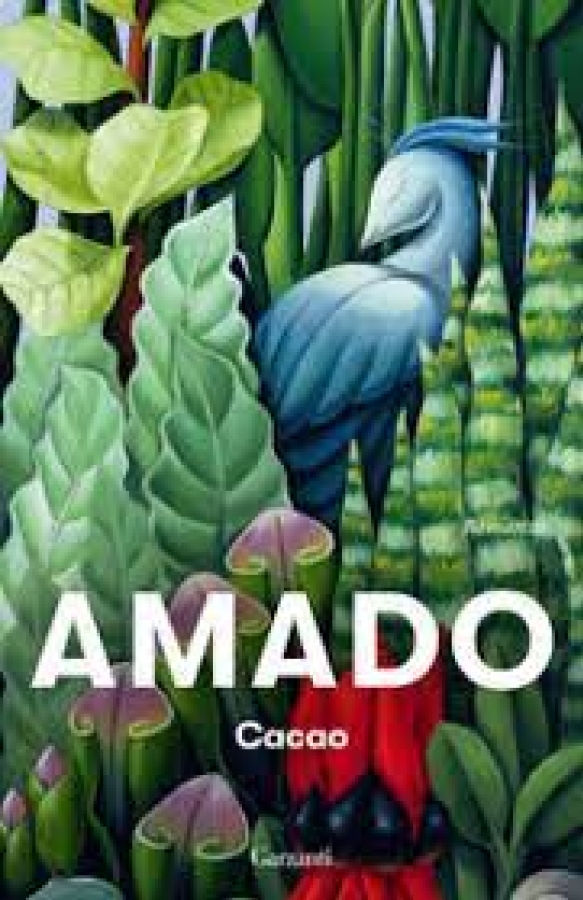
Finished reading on: June 15, 2023
Cacao
AI Translation Notice: This review was translated from the original Italian using artificial intelligence. Book quotes and excerpts are translated interpretations and will not match the author's original English phrasing or official published translations.
This short novel recalls a novella by Giuseppe Verga: La Varanisa (see the review of Le novelle on this site). The Sicilian writer admirably synthesizes the peasant condition by describing the feet of a wretched girl:
those feet accustomed to walking in the snow and on rocks scorched by the sun, to tearing themselves on thorns, or hardening on stones, could have been beautiful
. In the same way, Amado repeatedly emphasizes the large feet produced by the harvesting and processing of cocoa on the vast Brazilian fazendas.
The cocoa was dumped into the troughs to ferment for three days. (...) Then, freed from its pulp, the cocoa was put out to dry in the sun in the drying trays. There too we danced on it and sang. Our feet grew broad, our toes splayed. (...) Jaca! Jaca! The children climbed the trees like little monkeys. The jackfruit fell—thud!—and they pounced on it. (...) Their broad feet were like those of adults, their bellies swollen, huge, from the jackfruit and the dirt they ate
. The young Amado chronicles the lives of day laborers on the vast cocoa plantations:
that yellow fruit, with sweet seeds, which made them prisoners of a life of dried meat and jackfruit
; "a proletarian novel" imagined as written by a young man reduced to poverty by the greed of a capitalist uncle; exploited and humiliated in factory labor, he pursues a nebulous destiny of redemption among the field hands, among the affittati, forced to work like slaves for the great landowners. What drives him? To belong among the wretched of the earth, to break radically with the ambiguities of the bourgeoisie in order to discover that the future lies solely in solidarity among the poor, in their desperate and resolute resistance to exploitation and abuse of power. The narrative bears the stamp of the social novel: a sort of Brazilian Émile Zola, Amado intends to describe coldly—"naturally," as Boccaccio might say—the peasant condition and the transformation of the young narrator and protagonist into an experienced and wretched field hand. The stages of this transformation, both physical and mental, are marked by the grand themes of humanity: the environment, magnificent and violent; communal life, complete with its festive moments; friendships and loves; revulsion toward the ruthless, greedy master and his arrogant, amoral family; the gradual awakening of class consciousness; and ultimately, taking a definitive stand. The protagonist courts the owner’s daughter, who wishes to marry him.
We will do what cannot be undone. (...) You will become a master. I bowed my head to stare at the ground. I was piling up leaves with my hand. (...) No, Maria. I will keep working. If you want to become the wife of an affittato
. One must not be deceived by the spare, almost investigative style. A certain sense of the fantastical, the unreal lingers, fed by an ambiguous relationship with cocoa, as though amid such wonder social redemption were inevitable.
Darkness enveloped everything. Guitars wept, birds chirped. The golden cocoa fruits and the serpents. Stars shone in the sky. The lanterns along the road looked like souls taking flight. Night on the fazenda is sad, gloomy, painful. It is at night that people think...(...) We looked at the cocoa plantation and could find no answer.
The question that naturally arises upon reading Cacao is whether the human condition of the poor is not fundamentally the same across all latitudes. What difference is there between the characters of this novel and the protagonists of Verga’s I Malavoglia, Zola’s Earth and Germinal, or Steinbeck’s The Grapes of Wrath (see the reviews on this site)? Always the same desperate struggle for survival under the rapacious, ruthless weight of the rich? There seems to be no hope, leaving the intellectual with nothing but a resigned detachment: at times adopting a socialist rhetoric (see the "manifesto" section of The Grapes of Wrath), in other cases merely describing while invoking literary justifications, as with Verga’s verismo, and in still others withdrawing into a melancholic irony, as in Jorge Amado’s later books. It is as if the writer and the poet have accepted defeat, entrusting journalism with the task of reminding us, without exaggeration, that social suffering exists in the world, and not merely bourgeois torments.
I read the book after the great lexical and imaginative binge of Grande Sertão: Veredas (see the review on this site), which makes Amado’s essential, linear style feel like fresh air—like plunging into clear waters over a sandy bed, free from the lights and shadows of deep, reef-strewn seas. The sentences are short, the adjectives few; the charm of the narrative relies on the events themselves, as if they spoke on their own. Yet, what nostalgia for the writing of João Guimarães Rosa!
Why read it? A great social novel.