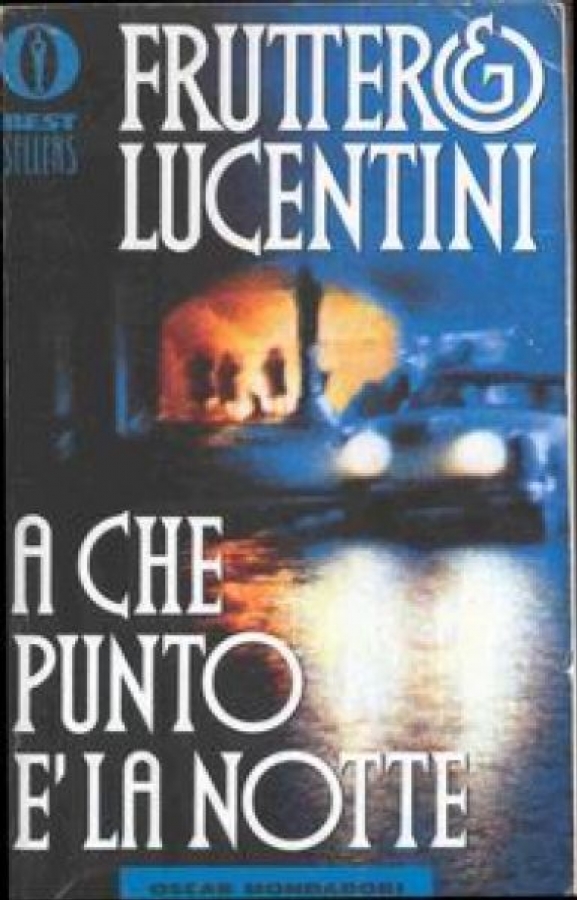
Finished reading on: August 13, 2006
What of the Night
Title of the original version reviewed: «A che punto è la notte»
AI Translation Notice: This review was translated from the original Italian using artificial intelligence. Book quotes and excerpts are translated interpretations and will not match the author's original English phrasing or official published translations.
It is a book to be read in a single breath.
The setting is 1960s Turin, during its phase of intense industrialization and the expansion of Fiat.
Initially, the characters move independently of one another: a pencil vendor, who turns out to be an undercover carabiniere tracking down drug-refining laboratories; a young woman of the Turin bourgeoisie whose lover is a mysterious accountant, later revealed to be a bookkeeper for the Mafia; the editorial staff of a publishing house (the occasion for a parody of intellectuals), interested in publishing strange cassette recordings of dialogues by a parish priest who professes heretical ideas and has brainwashed a group of parishioners; a police precinct investigating an alleged assault on the priest; and a Fiat engineer concerned with inventory management.
All these characters happen to cross paths at the heretical priest’s mass, during which the priest himself is killed in a bomb attack.
A complex and arduous investigation ensues, marked by two further killings: those of the pencil vendor and the Fiat engineer.
The story concludes with the uncovering of a fraud perpetrated against Fiat, masterminded by a senior corporate executive, with the priest, the engineer, and the parishioners serving as the material executors.
The book is highly complex and multi-layered, yet possesses several remarkable facets: a compelling plot rich in twists and turns; a tight narrative pace that rarely lapses into the superfluous; and the overlapping of storylines and themes—the love affair between the young woman and the mob accountant, the world of Fiat with its corporate hierarchy and rituals, the police milieu and its frictions with the carabinieri, the religious realm with its age-old nightmares (the Gnostic sects), and the emotional solitude of Commissioner Santamaria and, more broadly, of all the "adult" characters in the book.
In the background emerges an Italy in transition, where traditional values—and even petty thievery itself—are swept away by industrialization and the attendant urban sprawl: it is no coincidence that the novel is predominantly set on the periphery, within an urban and social fabric increasingly degraded and disrupted.
Yet will this society be worse than the one that preceded it? The authors seem not to think so: Thea, this young bourgeois woman, prefers her liaison with a mafioso to the social circle of her own class, and her mother considers that this might well be better than marrying a corrupt, paranoid Fiat engineer.
The rigid strictures of a hypocritical society are shattered, and only in this way do the characters find their destiny, and love, even if outside conventional bounds.
There is, moreover, another theme that surfaces only at the novel’s conclusion.
The senior Fiat executive is exposed because he forgets that he is constantly shadowed by two police bodyguards assigned to ensure his safety.
The loneliness of power and its indifference toward the humble are also the undoing of those at the summit of society, who deem it thoroughly pointless even to notice others.
Is democracy an inevitable process?