Finished reading on: October 08, 2012
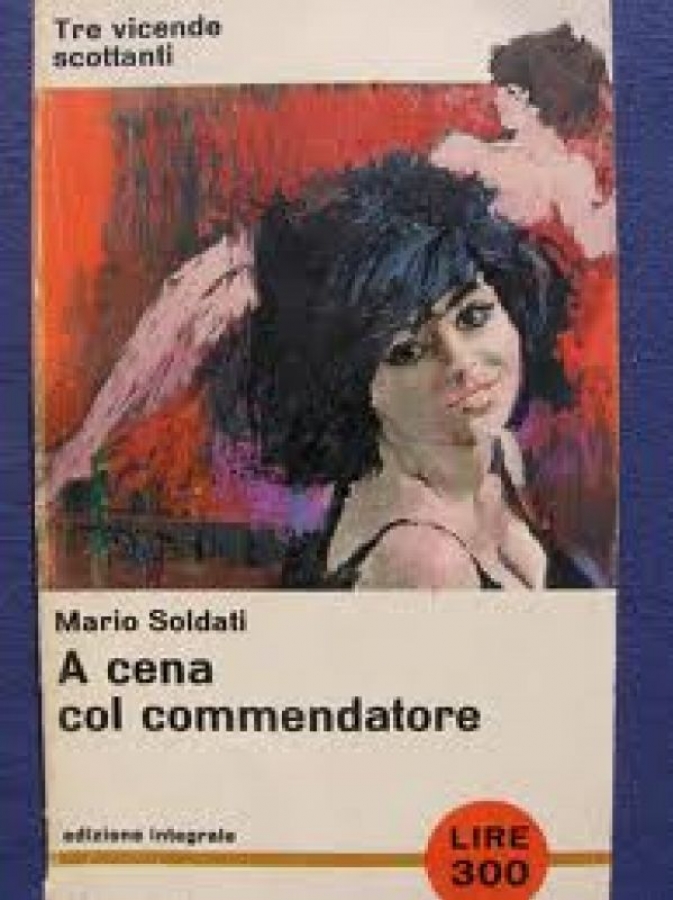
Dinner with the Commendatore
Title of the original version reviewed: «A cena col commendatore»
AI Translation Notice: This review was translated from the original Italian using artificial intelligence. Book quotes and excerpts are translated interpretations and will not match the author's original English phrasing or official published translations.
The author imagines a retired opera impresario deciding to set pen to paper so that it might be known who he truly was:
curious about the travails of others...
a marmoreal commendatore of an era now bygone
.
Before his passing, the commendatore supposedly managed to compose three stories, which recount actual episodes from his life.
In The Green Jacket, the impresario has engaged a brilliant conductor for Verdi’s Otello.
a man of genius (but) so vain that he is constantly preoccupied with the impression, indeed the effect, he produces on anyone who approaches him
.
During rehearsals, everything went smoothly until the timpani entrance, when the conductor suddenly asked to halt the performance, pleading a sudden indisposition.
The impresario nevertheless managed to draw from him a confession of the true reasons behind the interruption, as well as the musician's decision to break his contract.
During the Second World War, the conductor—then young and not yet famous—had taken refuge in a mountain village in Central Italy, where he had befriended the orchestra's timpanist: “a modest, quiet, middle-aged little man with dull eyes,” who had, however, passed himself off as a renowned maestro, earning the esteem and admiration of the local villagers.
Yet the young conductor, far more gifted and accomplished than the poor orchestral player, had not disclosed his true identity, presenting himself instead as a humble bank clerk. But why dissemble?
Lightheartedly, out of curiosity, out of habit, I had strayed down the hazy path of jesting....
and seeing that plump little man, with his comical green jacket and skipping gait, coming toward me in the refectory, I had looked above all at the jacket and not at the man
.
Yet it was not merely shallowness that led him to this futile deception; there was also “an exquisitely subtle, heightened pleasure in no longer being myself.” But in doing so, he had betrayed friendship—the sincere bond between two men brought together at a difficult juncture in their lives.
And now the conductor, celebrated yet conceited, prefers flight to confronting the poor player, who remains, conversely, steadfast in his role and his dignity, a modest artisan of music.
In the second story, The Father of the Orphans, the impresario pays a visit to a former colleague who had abruptly abandoned the business to run an orphanage.
When asked the reasons for such a drastic decision, the colleague tells him a moving story: he had met a sick child on a train and had been deeply affected; yet, out of indolence or the press of work, he had delayed offering help, and by the time he finally resolved to do so, he discovered that the child had died because the family had been unable to afford the necessary medicine.
A beautiful tale, were it not for the fact that the impresario accidentally uncovers the true story: the colleague had been involved in a homosexual relationship with a young man, who in turn had fathered a child with a ballerina.
Though pleaded with for help, the colleague had refused and had, moreover, cast the young man aside out of fear that his irreproachable bourgeois life might be shattered by scandal.
He had repented of many sins, but not of the single mortal one he had committed.
He had made a thousand sacrifices, but not that one without which all the others were worthless: the sacrifice of his own vanity to love
.
The impresario wishes to force him to acknowledge his abjection, but is ultimately overcome by distaste for a hysterical scene, by the weariness of stripping a man of his mask.
In the third story, The Window, the impresario goes to visit an old English friend with whom he has long been in love.
He hopes they might spend the years of their old age together, only to discover that the woman has always loved a scoundrel, a good-for-nothing who deserted her many years ago.
The impresario manages to expose the true character of this dandy, but to no avail.
Even when confronted with the most glaring evidence, the woman reaffirms her love.
For the impresario, it marks the disillusionment of a myth, of a lifelong dream:
when I thought of Twinkle as I had left her twenty years before and as I had always remembered her—forthright, witty, and of tastes so simply noble....
looking around me, I could hardly believe my eyes.
And yet, her long solitude, teeming with fantasies and remorse, explained even this corruption to me
.
With his simple, elegant, and witty style, Soldati confronts the complexities of the human soul, tracing them back to everything within us that is ambiguous and uncertain.
The mask behind which we hide is not an artifice, but an intrinsic part of our consciousness.
The stories are compact and lean, sustained by a deft, swift narrative structure.
The protagonists and settings are sketched with a few vivid strokes, attentive to detail (the hands, the attire, the decor), so as to recall, with delightful surprise, the nineteenth-century novel.
Why read it? These are magnificent stories, written with grace and fluidity.