Finished reading on: August 07, 2022
Mussolini Canal
Title of the original version reviewed: «Canale Mussolini»
AI Translation Notice: This review was translated from the original Italian using artificial intelligence. Book quotes and excerpts are translated interpretations and will not match the author's original English phrasing or official published translations.
But look here, my good sir, the two of us cannot go on like this. (...) I haven’t quite grasped what you need, but (...) if I say they did something, they did it, and that is that; you have to believe me, otherwise we might as well drop it. I’m not inventing anything. At most, my memory might fail me
. Imagining a dialogue with an interlocutor, Pennacchi adopts a colloquial tone to narrate the saga of the Peruzzis, sharecroppers from the Rovigo area forced to abandon their land under a crushing burden of debt, who travel to the Agro Pontino to colonize the areas reclaimed by the Fascist regime. It is an expansive narrative spanning from the end of the nineteenth century to the early 2000s: a sprawling feast of history and family tribulations that one would wish were a continuation of Riccardo Bacchelli’s The Mill on the Po, but unfortunately is not (see the review of Bacchelli’s novel on this site). The Peruzzis are a prototypical large peasant family: anchored by the central figure of the mother and an extensive brood of restless sons and daughters for whom suitable husbands must be found. While in the others the inherited “fury” is tempered by deference to social conventions and expedient cohabitation (with the landlord, the authorities, and fellow peasants), Pericle, the favored second son, cannot contain himself, especially after his experience on the front lines of the First World War. He rebels against the agricultural workers' leagues that still dominated the countryside, throws in his lot with the squadristi to the point of murdering an anti-Fascist priest, and, having fallen in love with Armida, a captivating beekeeper, takes her as his own and marries her despite her initial rejection. His active adherence to Fascism enables Pericle to appeal to a powerful gerarca to secure a settlement for the family in the Agro Pontino. The Peruzzis' establishment in the still-marshy terrain, the discovery of a different rural reality (with the crucial role played by the cattle), and the founding of Littoria are the most compelling parts of this long novel, not least because it is evident that Pennacchi possesses a thorough knowledge of the region's history, and especially of its reclamation canals, including the Canale Mussolini. Had he explored the colonization of the Agro Pontino more deeply through the perspective of a peasant family, the novel would have attained significant social weight; instead—who knows why?—the author felt compelled to traverse the entirety of modern Italian history: the Ethiopian War, the North African campaign, the partisan resistance, and so forth. The conversational register degenerates into a soliloquy of banal, inaccurate ruminations, a cloud of dust into which Pennacchi dumps his entire ideological baggage; despite the social and political upheavals, the Peruzzis remain frozen like “marble statues,” forever unchanged and deferential to ancestral codes. Even when Armida betrays Pericle, everything is smoothed over beneath the protective wing of the great matriarch, ever vigilant in safeguarding the family’s unity. One detects a sort of nostalgia for a harsh yet orderly world; but perhaps this is merely the reader's yearning to find some genuine sentiment within a narrative that seems to serve only as a pretext for verbose outpourings.
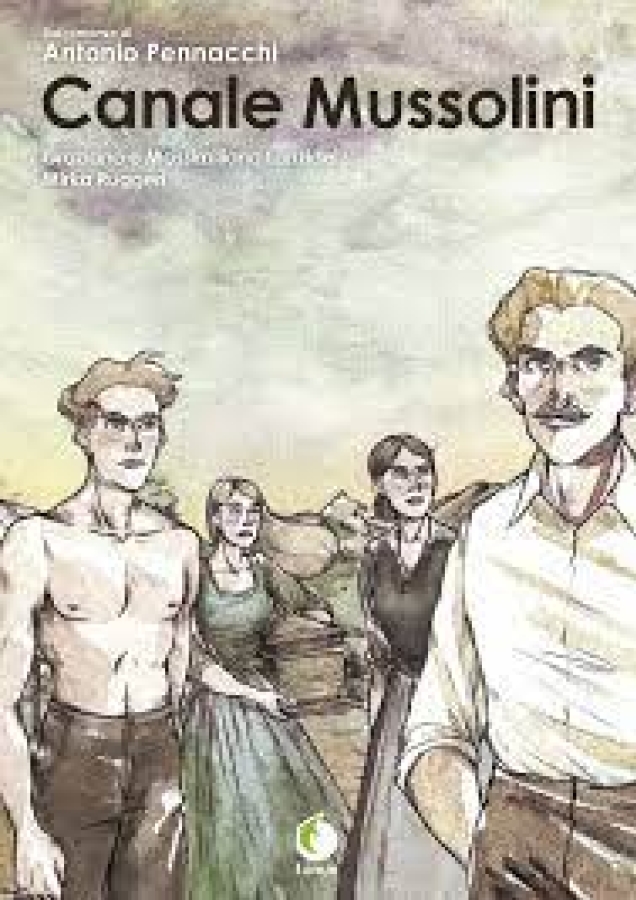
The novel has been adapted into a graphic novel by Graziano and Massimiliano Lanzidei alongside Mirka Ruggeri. Setting aside the draughtsmanship, which I am not qualified to appraise, the translation into “comic” form injects dynamism into the plot, bringing several figures into sharper relief: Armida (the carnal passion kindled by her young nephew, the maddened swarm of bees as misfortune gathers), Adelchi, transformed by the Ethiopian War into a racist Fascist, and the young Pericle and Iseo, the designated casualties of an uncritical, opportunistic adherence to Fascism. The graphic novel redeems the book, yet it accentuates the characters’ rigidities—perhaps deliberately—while the Agro Pontino fades, the pencil failing to conjure the atmosphere of the reclaimed lands, much as the author's own pen fails to do.
Why skip it? It is verbose; you are better off buying the “comic.”