Finished reading on: August 23, 2015
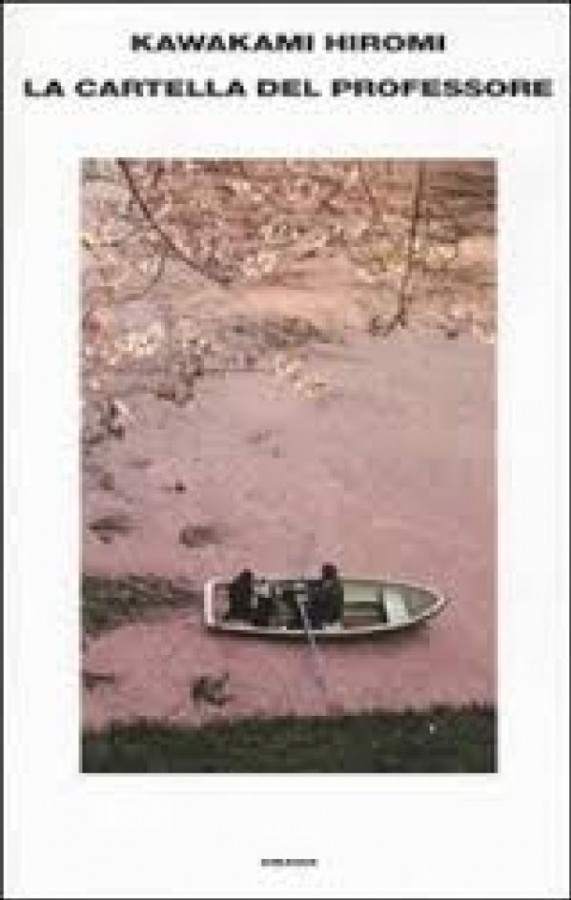
The Professor's Briefcase
Title of the original version reviewed: «La cartella del professore»
AI Translation Notice: This review was translated from the original Italian using artificial intelligence. Book quotes and excerpts are translated interpretations and will not match the author's original English phrasing or official published translations.
Let us imagine a young woman, somewhere between her thirties and forties.
She was never a brilliant student, she works a monotonous office job, she has had a few romantic relationships that nevertheless came to nothing.
She is alone.
All alone I took the bus, all alone I walked the streets, all alone I did my shopping, all alone I went for a drink (...).
A cheerful life.
Sad.
Pleasant.
Sweet.
Bitter.
Harsh.
Stimulating.
Irritating.
Warm.
Cold.
Lukewarm.
In short, how on earth have I lived for so long?
One day, by chance, at the bar where she goes to drink (seemingly her only pastime), she runs into her former Japanese teacher.
At first, it is a vague sense of feeling at ease, "settled," like buying a book and choosing to leave its wraparound band intact.
Then something else takes over.
The teacher and I do not see each other often.
It is only natural; we are not together.
Yet I never feel he is distant, not even when he is not beside me
.
Finally, love emerges.
From what point onward, drawing near to him, did I begin to feel the warmth radiating from his body? Through his starched shirt, I perceived his presence.
(...) A presence I was never able to grasp firmly.
Just when I am about to seize it, it eludes me.
When I feel it growing distant, it draws near once more
.
In a dream, the young woman searches for the teacher, but cannot find him.
Ah, there it is, I have already put him in the box! Now I remember.
I shut him in the big box (...) that I keep at the back of the built-in wardrobe.
(...) Now I can no longer take him out.
Because the wardrobe is too deep
.
Yet what does the teacher represent, with his briefcase, his voice and his body, his past laden with mysterious meaning? Is he like the moon that must illuminate the path for a young woman who does not know herself? Is he the conscience unwilling to emerge from the depths of the soul? Or, more simply, an older friend to cling to in order to come of age and escape the loneliness of existence? We shall never know, for the novel offers no conclusion.
We know only that when the aging teacher passes away, "on evenings like this," the young woman will open the briefcase and look inside.
But there is nothing in the briefcase, only emptiness, an expanding void.
A hopeless void that swallows everything
.
To characterize this tale in some way—one that resists labels nonetheless—we might say that the novel articulates an existential suffering not confined to youth.
Across the narrative, we discover that the teacher, too, has suffered from events beyond his grasp, such as his wife’s flight and sudden death.
The older companion is therefore not a font of wisdom and certainty; rather, like the young woman, he is a tangle of certainties and doubts, expectations and disappointments.
Their relationship, which becomes intimate and not merely spiritual, is the fruit of two kindred spirits seeking mutual support, facing existence together.
The meaning of the tale must not be reduced to the trite story of an affair between a young woman and her former teacher. The slow acceptance of their love stems from the fear of opening oneself to the other, of acknowledging that one is a person only through another person.
Distinctly Japanese, the novel thereby takes on a universal resonance.
The charm of this brief novel lies in its narrative style: delicately ironic, thoughtfully gentle, the two protagonists, the wondrous Japanese landscapes, and ultimately the prose itself lead us softly and pleasantly along a path that might otherwise have proved somber and oppressive.
Regrettably, the plot is fragile, often meandering and repetitive.
A curious note: reading the novel reveals that Japanese cuisine is not merely sushi and raw fish; one can discover many intriguing recipes.
Why read it? Distinctly Japanese, and therefore unique.