Finished reading on: October 26, 2015
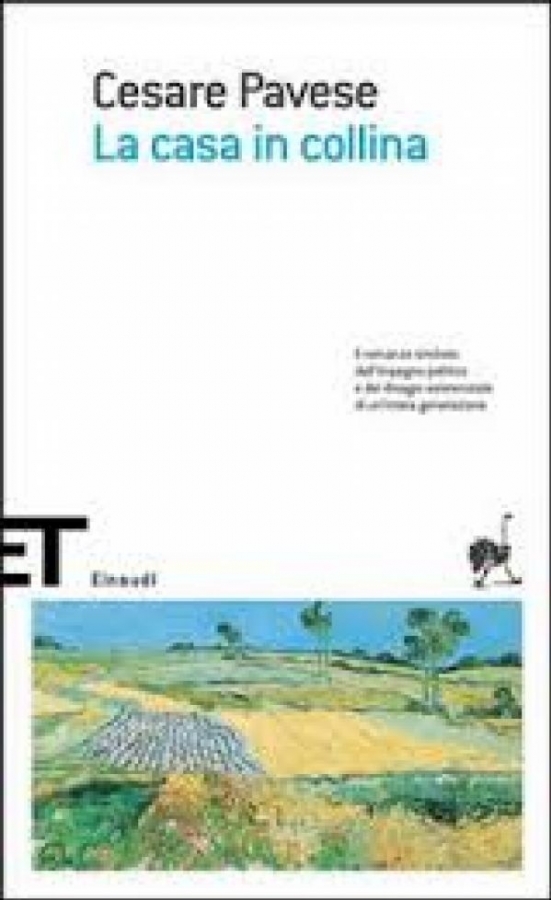
The House on the Hill
Title of the original version reviewed: «La casa in collina»
AI Translation Notice: This review was translated from the original Italian using artificial intelligence. Book quotes and excerpts are translated interpretations and will not match the author's original English phrasing or official published translations.
The Resistance is most often narrated from the perspective of those who took part in the partisan struggle.
Pavese’s novella speaks of those who waited, even while caught up in it.
In essence I was asking for lethargy, an anesthetic, the certainty of being well hidden.
I was not asking for world peace, I was asking for my own
.
Thus reasons Corrado, protagonist and first-person narrator, as the surrounding world is swept away by war.
He has taken refuge in the hills, which
for me was not one place among others, but an aspect of things, a way of living.
(...) I felt no sorrow; I knew that in the night the entire city could go up in flames and people die.
The ravines, the villas, and the paths would wake in the morning calm and unchanged
.
During the day he often goes into town, to a tavern: here there is music, dancing, and badmouthing of fascism.
Each time I swore to remain silent and listen, to shake my head and listen.
Yet that cautious equilibrium of anxieties, of waiting, and of futile hopes in which I now spent my days was made for me, I liked it: I would have wanted it to last forever.
The impatience of others could destroy it.
For a long time I had been accustomed to staying still, to letting the world go mad
.
Neither the fall of Mussolini and September 8th, nor the rediscovery of a woman from his youth—with whom he perhaps had a son, now twelve years old—are enough to shake him.
Now I was forty years old, and there was Cate, there was Dino.
(...) Was I not being futile and boorish this time as well, hovering around her, half bewildered, half humiliated?
The fragile and illusory equilibrium is shattered by Cate’s arrest.
Corrado escapes by chance and takes refuge in a monastery, where Dino joins him.
What else to do under the empty portico if not savor once again, morning and night, that ancient dread?
The monastery is no longer safe, so he decides to seek shelter at his parents’ home in the Langhe.
Meanwhile Dino
has left, and in earnest.
At his age it isn't hard.
It was harder for the others, who nevertheless did it and are still doing it
.
The journey from Turin to the Langhe takes him into the very thick of the partisan struggle, yet he manages to save himself.
Despite the times, here on the farmsteads the corn has been husked and the grapes harvested.
(...) Now that the countryside is barren, I roam it again; I climb and descend the hill, reflecting on the long illusion from which this account of my life began.
(...) Here every step, almost every hour of the day, and certainly every unexpected memory, sets before me what I was, what I am and had forgotten.
(...) At times, after listening to the useless radio, looking through the pane at the deserted vineyards, I think that living by chance is not living.
And I wonder whether I have truly escaped.
Can one go on living after a civil war?
One has the impression that the same fate that struck down those bodies keeps the rest of us nailed there to look at them, to fill our eyes with them
And why did they die?
I would not know what to answer.
Not now, at least.
Nor does it seem to me that the others know.
Perhaps only the dead know, and only for them has the war truly ended.
Corrado’s failure (he could not even protect Dino) culminates in a meditation on the destiny of humankind that transcends the narrative: from the depiction of historical circumstance and internal existential anguish, it ascends to a cosmic dimension, singularly relevant in light of the civil wars that bleed many parts of the world today.
From a stylistic standpoint, the novella is an absolute masterpiece: lean, spare, yet capable of evoking the sweep of history and the destiny of its characters.
The writer works deftly with the phonetic juxtaposition of words, so much so that one often feels confronted with a poetic composition rather than a prose text.
Equally extraordinary is the author’s ability to avoid fracturing the rhythm despite relying predominantly on the period, and thus on short sentences.
The use of the comma to create a suspension between subject and verb (granting autonomy to the latter) is a stylistic gem, requiring an exceptional command of syntax, vocabulary, and the Italian language in general.
The fusion of American narrative with classicism yielded exceptional results, rarely matched in Italian literature.
Why read it? It is a masterpiece and a meditation on war.