The Family Idiot
In the final years of his life, Immanuel Kant suffered from dementia: expelled from the university, isolated from society, the great philosopher penned thousands of pages in a delirious attempt to arrive at the truth of reality, rather than stop at its interpretation. With an inspired intuition, the author imagines that “Herr Professor”—as he was called by his children and students—met the same fate as Kant: losing his cognitive faculties and sliding into dementia after years of rigorous, frigid teaching of history and philosophy, strictly within the rigid, rational frameworks of Marxism. To care for his ailing father, the son leaves Rome to return to Viareggio; among his father's papers, he discovers a manuscript recounting, in the form of a novel, the “Three Days of Viareggio,” a violent popular uprising in May 1920 that was bloodily suppressed by the Italian government. These are notes written in a muddled hand, forcing the son into an arduous transcription. What comes as a surprise, given the father's unyielding Marxism, is the exaltation of anarchism and the title of the narrative: “*indifeso fervore*”—a celebrated verse by Sandro Penna, a poet whose transgressive poetry was worlds apart from the moral outlook of “Herr Professor” as his son had known him. Who truly was “Herr Professor”? This father forever poised to disapprove of his son, from the way he played tennis (more concerned with keeping his hair tidy than moving on the court) to his decision to drop out of his Philosophy degree to become a translator—and, to make matters worse, from English, a language his father despised. It could have been the occasion to turn Dementia—the cognitive and physical decline of a man—into an opportunity to rediscover his figure and his life, to know him better, and even to finally decipher oneself within one of the fundamental relationships of our existence. Instead, as the author states in the afterword: “I cannot help putting the bookish before the real. May reality not hold it against me if it always comes in second.” The father’s illness, the return to Viareggio, and the departure from Rome serve merely as pretexts for witty dialogue between characters, for subtle ironies regarding the social and cultural dynamics of our society, and for digressions—at times interesting, but more often useless and redundant. A grating, overly intellectualized framework pervades the entire narrative, stripping it of psychological depth and rendering it prolix and rambling. The novel can serve as a starting point for a broader reflection on Italian literature. We often witness authors who enjoy considerable visibility and garner favorable reviews from critics and avid readers alike. *L'idiota di famiglia*, for instance, was featured on *Petrarca*, a prominent television program dedicated to culture and books in particular. One might think of novels vastly different from one another yet consistently showered with accolades, such as *Alma* by Federica Manzon, *Almarina* by Valeria Parrella, *La Ferocia* by Nicola Lagioia, or *Con le peggiori intenzioni* by Alessandro Piperno (see the reviews of the cited books on this site): all acclaimed, yet fragile in plot and prose, and above all trapped within pre-established literary formulas that neither reflect Italian sociological reality nor genuinely probe the feelings and psychology of their characters. An oscillation between nostalgia and pessimism prevails, the plots are frequently insubstantial, and the characters easily slip into stereotypes. One has to wonder whether, in these assessments, membership in certain publishing circles takes precedence over genuine narrative quality. By dint of such “niche” novels, there is a risk that our literature will drift toward irrelevance, dragging the language down with it. Why avoid it? This novel is irritating.
The Secret of the Hudson Queen
It is singular to review this novel immediately after reading Emilio Salgari's *La perla sanguinosa* (see the review on this site): a curious coincidence, almost as if pearls were inherently the bearers of adventure and misfortune. And indeed, when Sally Jones and the Chief find a pearl necklace hidden in a secret compartment within their ship’s steering wheel, Sally, with the wisdom of an intelligent ape, experiences > an unpleasant sensation in the pit of my stomach. (...) The pearls of the necklace (...) seemed to emanate a faint, mysterious light from within. Unlike Salgari’s fantastical setting, here the pearls lead us into the "underworld" of seafaring cities: violent and perilous slums for our ape, seemingly fragile and defenseless. The narrative resumes from the point where we left it in the previous novel (see the review of *The Murderer’s Ape* on this site); yet here the element of surprise is missing because we already know Sally, and we are deprived of both the charm of a seafaring, piratical Lisbon and the savor of noir intrigue. The story unfolds in Glasgow. Sally and the Chief set off in search of the pearls' presumed owner, the orphan Rose, abandoned as a child by her father, who wished to bequeath the jewel to her as a form of redemption. They find themselves plunged into the underworld of the English city: the Chief is forced to captain a ship smuggling alcohol to America, while Sally is held hostage by a criminal gang. Harassment, clashes between underworld syndicates, violent nightlife, and even boxing bouts follow in rapid succession, sweeping up the poor, frightened Sally, who becomes an object of curiosity, derision, and exploitation. Sally is guarded by Bernie the Butcher: a hulking, rather dim-witted young man notorious for his sudden, uncontrollable rages, himself the victim of mockery and abuse at the hands of the other criminals, and even his own sister. It is the friendship between Sally and Bernie that forms the crux of the story. Sally has numerous opportunities to escape, yet she stays to help poor Bernie, not wanting to leave him alone, determined to defend and save him. Faced with the blaze consuming the house in which his sister might perish, Bernie gathered momentum to throw himself into the fire as well, and then > I wrapped my long arms around him, (...) immediately took him by the arm and led him back onto the bridge, away from the burning building. The wise and gentle Sally discovers herself no longer fragile, but a mother figure to the hulking Bernie. How far removed we are from the mysterious and melancholic atmosphere of *The Murderer’s Ape*! All the enchantment of the previous novel has dissolved into a verbose plot, where the twists fail to lend rhythm to the narrative. One plods along, hoping to recover the characters, the drama, and the writing that had once held us so spellbound. It is a futile quest; only the friendship between Sally and Bernie rescues the work from utter disappointment, yet it is a relationship merely sketched, lacking in depth, that fails to truly engage. Why not read it? It is boring.
The Loser
>. If one wishes to attempt to understand this tale, delirious in so many ways, it is best to go to YouTube to watch and listen to Bach's *Goldberg Variations*, played on the piano by the "legendary" Glenn Gould. One must do so because Bernhard speaks of "genius" and of what happens to anyone who encounters a personality unreachable in artistic stature: one cannot help but be a "loser." >. The first-person narrator, Wertheimer, and Glenn find themselves in Salzburg as pupils of a renowned piano teacher. The first two are young virtuoso pianists who could have enjoyed successful concert careers; yet the encounter with genius proves fatal, for both realize they can never measure up to the "legendary" Glenn, that they would never be capable of playing the *Goldberg Variations* as their friend does. Both—the narrator and Wertheimer—abandon music: the former even gives away his splendid Steinway and retreats to Madrid to write about Glenn, caught in a frantic and inconclusive revision of the great pianist's work; the latter shuts himself away in a solitary hunting lodge, strumming an out-of-tune piano. Upon hearing of Glenn's sudden death, Wertheimer kills himself. The narrator seeks to understand the deeper reasons behind his friend's suicide. Had he always been unhappy, like those depressives who carry within themselves the "pain of living"? Is it the fate of "losers"—>? Or was >? To fathom the mystery behind his friend's suicide, the narrator has Wertheimer's final dwelling opened—the place where he had holed up—and discovers a worthless grand piano, >, upon which rests the sheet music for the *Goldberg Variations*; and the narrator, too, longs to return to the piano after years away, to measure himself against genius, and perhaps he as well will lose himself in the attempt to emulate the legendary Glenn. After reading this tale, one might exclaim: "Long live mediocrity!" What suffering lies in every artist who cannot emulate genius! Perhaps Francesco Petrarch's depression stemmed from his jealousy of Dante, as his friend Boccaccio affectionately pointed out to him; and for this reason he attempted, with the *Triumphs* and *Africa*, to write two epic poems that would rival the supremacy of the *Divine Comedy*—and dramatically failed. And what of Dante, who in Canto XXV of the *Inferno* hurls a challenge at Ovid, claiming his own superiority in the poetic invention of metamorphoses: "Let Ovid now be silent of Cadmus and Arethusa, / for if him into a serpent and her into a fountain / he turns in verse, I envy him not" (lines 97–99). To console ourselves, nothing remains but to cage great men >. For the legendary Glenn, the sentence is a YouTube video: having fled the concert stage for an isolated country house, he will be condemned to be listened to for eternity as a pianist "imprisoned" by his own renown; we, mediocre men, shall be truly free because we are anonymous. The plot of the tale is non-existent; it resembles a soliloquy, with a fluid yet at times nonsensical syntax, marked by a cadence reminiscent of theatre rather than prose: everything has unraveled, nothing makes sense, one can only recount the recurrence of thoughts and memories—even then with profound doubts, under the rhetorical refrain "so he said, I thought." Why not read it? It is tremendously exhausting. It can sit nicely on a bookshelf to make a fine show of our culture.

The Double: A Petersburg Poem
Yakov Petrovich Golyadkin is a respected civil servant. Dostoevsky introduces him in his tidy and modest dwelling on a morning brimming with expectations for our "hero": > the dingy, smoke-grimed greenish walls of his little room, the mahogany chest of drawers, the Turkish-style divan of red oilcloth with greenish little flowers, looked upon him with familiarity. In front of the mirror, on this exceptional day for him, > it would really be a fine thing," Golyadkin said under his breath, "it would really be a fine thing if I weren't in proper order today, if, let's say, some novelty had cropped up, a nice, completely untimely pimple, for instance. Our hero must be flawless; he is invited—or believes himself to be—to the birthday of the only daughter of State Councillor Berendeyev. Yet amidst this prevailing euphoria, Dostoevsky immediately gives us several signs that something is amiss: as he steps into *a light-blue carriage for hire*, his servant exchanges > knowing glances with the coachman and several loafers, (...) barely suppressing the coarsest laughter; having climbed into the carriage, our hero > shuddered (...) and hastily, almost terror-stricken, shrank into the darkest corner of the carriage; finally, we discover that Golyadkin, the staid civil servant, is in the care of a doctor who urges him not to shun a carefree life, not to be an *enemy of the bottle*. We are therefore hardly surprised when our hero is turned away by the doorman and denied entry to the birthday of the powerful councillor's daughter. He is not a welcome guest! Through a subterfuge, Golyadkin manages to slip into the reception, where, in a state of delirium, he behaves so unseemly that he is shown the door. But is it reality or a hallucination born of an already diseased mind? This serves as the prelude to the entrance of a new character: the double, the slimy, disgusting, cunning Golyadkin number two. At first, the double displays a humble attitude toward "number one," *hanging on his every glance*, but soon grows increasingly arrogant, currying favor with our hero's superiors. What is more, he mocks him in front of their younger colleagues. > After tickling him a little, (...) causing great amusement among the young people surrounding them, Mr. Golyadkin number two, with disgusting brazenness, decisively gave a tap to the protruding belly of Mr. Golyadkin number one, accompanying the gesture with the most venomous and suggestive of smiles, saying: "having fun, little brother?" What is the double referring to? As Dostoevsky will make explicit in *Notes from Underground* (see the review on this site), there is within us, deep in our soul, a malice that leads us to commit wicked acts, and which can also drive us to madness. Only in a dream does our hero manage to glimpse a petty act, > a piece of cowardice seen, heard, or committed by himself not long before, an unbecoming behavior: > a well-known young lady, (...) a little German girl, to whom the double can freely allude, > wheedling around Golyadkin, smiling at him affably, and displaying, in that way, false cordiality toward him. For our hero, it comes as a relief when he sees the doctor arrive: > tears streamed from Mr. Golyadkin's eyes. "in that case I am ready... I submit entirely and entrust my fate (to the doctor)," (...) a tremendous and deafening cry of joy burst from the chests of all those surrounding him and, with the cruellest resonance, rippled through the waiting crowd. (...) The slimy twin of Mr. Golyadkin (...) blew little kisses to Mr. Golyadkin; but then he began to show signs of flagging and appeared less and less frequently, until he disappeared completely. A psychiatrist might say that we are confronted with a schizophrenic personality in a state of mounting impairment, with a splitting of the self. A psychoanalyst, long before Freud, might discern the ego's fear of meeting its double, of uncovering the evil harbored within, behind the veneer of bourgeois respectability—a rejection of the cogs of the Russian Empire's oppressive bureaucracy. And so Golyadkin's madness, the conjuring of his disgusting, slimy double, is nothing less than a desperate act of revolt, one that can only lead to the asylum, deviant as it is from the reigning norms. And Dostoevsky is the bard of Petersburg society. > Oh, if only I were a poet! A poet, naturally, equal to Homer and Pushkin, for with a less sublime talent it is impossible to step forward. Could it be that for us contemporaries, too, nothing remains but madness in the face of such a suffocating world—yet where is a Dostoevsky? The pace is brisk and lively, calling to mind for the reader the splendid *The Village of Stepanchikovo and Its Inhabitants* (see the review on this site). Already a great writer, Dostoevsky leads us by the hand through the tale of the protagonist's madness—at first incredulous, with gentle, ironic touches, then in an increasingly overt manner. To be sure, the narration of madness coils in upon itself, and how could it be otherwise, given that only through the repetition of events and emotional states can one dig deep beneath the surface? The concept of the double is brilliant because it establishes another point of view, a perspective both external and internal at once—a truly innovative narrative device found in few novels, such as Natsume Soseki's *I Am a Cat* (see the review on this site), though undeniably with a vastly different rhythm. Why read it? Intense and disquieting at once.

The Village of Stepanchikovo and Its Inhabitants
The first-person narrator is a young man living in Petersburg > with nothing to do, (...) convinced that in short order (he would) accomplish truly remarkable, even grandiose things. He is supported by an uncle, a wealthy landowner in distant Stepanchikovo. Their correspondence is sparse, but of late the young man has been urged to join his uncle through rambling, incoherent letters, beneath which lies an entreaty to marry the young governess—an unhappy, beautiful, and educated girl. Our young man decides to comply with these requests, out of a blend of curiosity and affection. He finds himself amidst a > bizarre collection of characters, a tight-knit community revolving around a shrewd, charismatic manipulator—what we would call today a "guru"; hence the modern resonance of the tale. Foma Fomich > was short, fair-haired and grizzled, with a hook on his nose and fine wrinkles all over his face. (...) He would read aloud books on the salvation of the soul, speak with eloquent tears of the various Christian virtues, (...) recount his life and his exploits, (...) and was a master at passing judgment on his neighbor. Having lived in squalor, all his life he had been forced to wander from one landowner’s estate to another, playing "the buffoon." In Stepanchikovo, at long last, he was able to practice his arts as a fabulist, indulge his vanity, and redeem himself from the humiliations suffered for so long. His technique consists in exploiting the weaknesses of others, shifting from an aggrieved, haughty victimhood to sermons extolling his own virtues while decrying the depravities of others. Suffice it to say, he finds fertile ground. The uncle, a former hussar colonel, is good-natured, honest, and trusting, yet he is carrying on an affair with the young, destitute governess: he wishes to marry her off to his nephew in order to continue the liaison. The girl’s father displays a dignified indifference, but in truth aims to marry his daughter to the aging, wealthy landowner. Then there is Tatiana, a wealthy, somewhat nymphomaniacal spinster; the household hopes she will marry the uncle to unite their fortunes, but a few dandies are scheming to abduct her to get their hands on her money. Then there is the general's widow, with her entourage of devout and venomous young ladies: hysterical fits, fainting spells, and seizures occur whenever Foma’s position is called into question, whereupon, deeply offended, he declares he is leaving, going into exile. Naturally, he never will. > Foma occupies two large, splendid rooms. (...) Absolute comfort surrounded the great man. The fresh, colorful wallpapers, the shimmering silk curtains at the windows, the rugs, the pier glass, (...) everything bore witness to the tender solicitude of the master and mistress of the house toward Foma Fomich. And what of our young man? He postures as a "scientist," "philosopher," "know-it-all": he observes the dynamics of these human beings, growing indignant only in fits and starts when he sees his uncle trampled by this rogue. The narrative moves swiftly, paced like a theatrical play: brisk dialogue, sharp humor, caricatures, stereotypical "masks" of human pettiness. One senses a disdain for the provinces and for the peasant world in particular—exemplified by that poor serf, constantly abused by Foma because he keeps dreaming of "a white bull" rather than "refined ladies and gentlemen taking tea." In a crescendo worthy of a comedy of errors, Foma seems on the verge of losing his grip, yet with a dramatic reversal the sly, adept manipulator reasserts his dominion over the inhabitants of Stepanchikovo. It is the fate of great authors that their broader oeuvre is overshadowed by their undisputed masterpieces. When Dostoevsky is mentioned, one immediately turns to works such as *Crime and Punishment*, *The Idiot*, and *The Brothers Karamazov* (see the review of *The Idiot* on this site). Across the Russian writer’s vast output there is much else of enduring worth. Consider *The Adolescent*, so strikingly contemporary in its scrutiny of the protagonist's relationship with his father (see the review on this site). *The Village of Stepanchikovo and Its Inhabitants* is unanimously labeled a comic work, thereby missing the novel's distinctive qualities. It is a study of Power, and of the profound motivations that underpin it: it is not money (Foma rejects a handsome offer to quit the estate), nor is it even the taste for raw dominion or the authority to make critical decisions (on the contrary, Power evades decision-making). What drives Foma is sheer vanity—a narcissistic hunger to occupy center stage, to revel in his own rhetoric, to be revered and flattered. Its contemporary relevance is glaring in an age of Power that seeks only to generate talk about itself in a media frenzy. The inhabitants of Stepanchikovo may be an isolated community in the Russian countryside, but they speak volumes about sycophancy and the vacuity of the human soul. The writing and plot are effervescent, departing stylistically from the major novels: there is no psychological introspection, nor are the relationships between characters probed in depth. It is without question a coming-of-age novel, in which the great writer hones his craft in dialogue construction, paying scant attention to setting, and above all neglecting the narrator, behind whom Dostoevsky himself lurks. Why read it? It is entertaining and profound.
The Iliad
*The Iliad* unfolds over a brief period of time, yet it captures the most salient events of the Trojan War. The incipit is the quarrel between Agamemnon and Achilles over the possession of an enslaved woman, yet in truth, Achilles is calling Agamemnon’s authority into question. The hero resolves to withdraw from the fighting, triggering a sequence of clashes that, despite alternating fortunes, steadily tilt toward the defeat of the Achaeans, culminating in the Trojans setting fire to one of the Greek ships. The assembly of Achaean chieftains repeatedly dispatches embassies to Achilles urging him to rejoin the fray; instead, Patroclus, the hero’s dearest companion, enters the combat and is slain by Hector. Achilles rejoins the war to avenge Patroclus, unleashes wholesale slaughter, and kills Hector. Priam nevertheless succeeds in assuaging Achilles’ wrath and recovering Hector’s body to grant him a proper burial. The plot is relatively simple, yet it is complicated by the presence of multiple narrative tiers: each theme develops across three planes: the community of the gods, the community of men, and individual emotions, the latter perpetually subordinated to the will and unyielding codes of the community, even before the dictates of divinity. The first theme is the struggle for the governance of the community, and consequently, for power. The epic opens precisely with the conflict between Agamemnon and Achilles, yet the striving for the assertion of authority remains a constant. One need only consider Hector's decision not to withdraw behind the walls of Troy and instead fight on open ground solely to assert his authority against Polydamas, who was counseling him to do so: > now, while the son of devious-plotting Cronus has granted me to win glory by the ships, driving the Achaeans back to the sea, fool, you must not utter such advice among the people; no Trojan will obey you, I will not allow it . Yet this very clash for power is equally present among the gods: Poseidon remarks to Hera, who is fearful that Achilles might succumb to a god, > let us go and sit apart, rather, upon the lookout... if then Ares begins the strife, or Phoebus Apollo, or if they hold Achilles back, straightway then from our side will a clash of war arise; and very soon, methinks, beaten, they will return to Olympus, back among the other gods, vanquished by force beneath our hands . The same theme of power emerges distinctly in the assembly of Book XIX, wherein Achilles wishes to rejoin the battle immediately to avenge Patroclus and grant him a worthy burial, while the other chieftains insist that Achilles formally accept Agamemnon’s gifts, thereby affirming the latter’s authority. The second theme is, naturally, war: the most predictable and indeed the most tedious of themes, save for the battle among the gods, which reaches conspicuous peaks of comedy and mockery of the divinities. The martial accounts fragment and seem designed merely to exalt the stature of the heroes and the fallen. The third theme is composed of familial sentiments: affection for friends, filial love, reverence for elders, the grief over the loss of loved ones. This is the theme closest to modern sensibilities, where the epic modulates into pathos in certain passages: the exchange between Hector and Andromache, Thetis’s love for Achilles, and the latter’s agony over Patroclus: Hector > placed his son in his wife's arms: and she drew him to her fragrant bosom, smiling through her tears; her husband was moved to pity as he beheld her, and caressed her with his hand ... yet the community's laws hold greater sway than individual sentiments, > go now, return home, and attend to your own tasks, the loom and the distaff; and bid the handmaidens set about their work; for war shall be the business of men, of all men and of me above all, as many as were born in Ilium (Book VI). Into these themes interweave other narrative threads (parentheses within the epic), such as the magnificent Book XVIII (the forging of Achilles’ armor) and Book XXI, particularly the defense of the Trojans by the river Xanthus and its defeat by fire. On the whole, the epic is tedious and fragmented, and certainly falls short of the *Odyssey*.

The Impostor
From 1975 to 2005, Spain was deceived by a great impostor. Enric Marco, the obscure owner of an auto repair shop, fabricated a past as an anti-Francoist, claiming he had been deported for it to the Flossenbürg concentration camp alongside eight thousand other Spanish Republicans sent to Germany to die in the extermination camps. Capitalizing on the halo bestowed upon him by his forged past, Marco served first as secretary general of the Confederación Nacional del Trabajo, and later as president of the Amical de Mauthausen. Thanks to an obscure historian, Marco's colossal lie was uncovered just days before he was due to speak at a ceremony in Mauthausen before the Spanish prime minister. Vargas Llosa dubbed Marco «appalling and brilliant». When Cercas meets the man for the first time, he cannot help but cry out > a horror! A genuine horror!. What held him back from writing a book about him were not merely the outrages committed by Marco, from the grief inflicted on other deportees and their relatives to the countless young people who had listened to him, captivated and trembling; Cercas feared becoming ensnared in the tentacles of the sublime liar, wondering whether he was willing > to write a book about Enric Marco without making a pact with the devil. (...) why not attempt to redeem the great impostor and the great damned soul, that consummate scoundrel who has already been condemned more than enough?. Those who have read *Soldiers of Salamis* (see the review on this site) know that Cercas tends to exploit these hesitations of his about excavating the «truth». Here too, Cercas overcomes his moral scruples, easily forgetting what Primo Levi once said—that to understand is already to justify; with the usual dedication of an investigative journalist, he sets out to reconstruct the murky events and insidious deceptions that led Marco to dominate the national stage during the post-Franco years. We leave it to the reader to delve into the details of a convoluted story that traverses Spain's recent history. Let us simply say that Cercas traces the root of Marco's success to a blend of small truths, historical facts, personal charisma, and brazen lies. It is true! Marco was indeed a villain; yet just as Limonov was for Carrère and Don Quixote for Don Alonso Quijano (see the reviews of both books on this site), Marco > gave himself (...) a new identity and a new, heroic life, (...) having passed the zenith of life, he wants to go on living when it is no longer his turn to live, or rather he wants to live on, against everything and everyone, all that he had not lived until then. Is he not like a writer permitted to lie in order to tell the truth? Poor Cercas! Little does he know that this indulgence toward deceit is a breach into which Marco will ruthlessly wedge himself, recalling that the final character in *Soldiers of Salamis*, the obscure soldier-hero, was merely a fiction of the writer; a fiction with which Cercas deceived countless readers who, after reading the novel, wrote to the nursing home in Dijon where the author had claimed the obscure hero lived. And therefore Cercas, too, is an impostor: > you are a player and a liar, possessing all my flaws and none of my virtues, and I am your reflection in a dream, or in a mirror. (...) This is the truth, Javier. The truth is that you are me. The novel's focal point is the interview that the author declares to be imaginary, for once. In a lengthy dialogue between Marco and Cercas, the latter's certainties crumble before the relentless arguments of the impostor, intoxicated by the role of inquisitor assigned to him by the Spanish author. The only explicitly fictional pages seem to upend the entire narrative. Where lies the boundary between invention and truth in historical memory? And why should lies not be accepted if they serve to illuminate the dark chapters of history, forging conscientious minds? But in doing so, as in *The Brothers Karamazov*, are we left merely to bow before the mystery of the past, hoping it to be a just and righteous mystery? (see the review of *The Brothers Karamazov* on this site). The novel's fundamental merit lies precisely in Marco's story, which tells itself, so incredible it is. Cercas layers over it a meandering and prolix plot, one that often turns in on itself, weighed down by digressions that make for heavy reading. Offsetting the narrative's convolutions is the author's characteristically fluid, lucid phrasing: a prose style that smacks perhaps a bit too much of journalism. Why read it? The story is intriguing.
At the ass end of the world
Eight years have passed since the end of the Portuguese Colonial War, which devastated Angola between 1961 and 1975: Salazar’s Portugal on one side, and the Angolan liberation movements on the other. The protagonist, who is also the first-person narrator, meets a woman in a bar, just as he has done so many times before, > when the bar is a shipwrecked Titanic, (...) a submerged Spanish galleon, populated by the drifting corpses of the crew, illuminated obliquely by a sublunary glow, corpses floating without clinging to their chairs, in mid-water, waving boneless arms in a calm of seaweed . We know little of this woman, but she undoubtedly knows how to listen, for our protagonist begins recounting his twenty-seven months of war, in «the ass-end of the world», dying > not from the death of war, which suddenly deprives us of our brains with a flash of an explosion and leaves in its wake a disjointed desert of moans and a chaos of panic and gunfire, but from the slow, afflicted, agonizing torment of waiting: the waiting of months, the waiting for landmines along the track, the waiting for malaria, (...) the waiting for the secret police jeep that passed by every week, (...) bringing along three or four prisoners who dug their own graves, huddled inside them, closed their eyes, and collapsed beneath the bullets as a soufflé collapses in the oven, with a red flower whose petals bloomed upon their foreheads ; a war that made one vomit and reply in > a child’s gentle voice Don’t waste your time on me because I am so tired of this war that not even bombs will get me out of here ; a war impossible to forget, so much so that > the moment her knees softly part, her elbows clutch my ribs, and her reddish pubis unfurls its fleshy petals with the moist surrender of warm, soft valves, I will enter her, do you understand?, like a humble, mangy cur dozing in a stairwell, in search of an impossible comfort on the hard wood of the steps, because the soldier of Mangando and all the soldiers of Mangando and Marimbanguengo and Cessa and Musuma and Ninda and Chiume will leap to their feet inside me in their lead coffins, wrapped in fluttering, bloody bandages, demanding from me, with the resigned lamentations of the dead, what fear kept me from giving them: the cry of revolt... The protagonist thus recounts his experience, yet we should not expect a mere report or an indictment: the cruel and cowardly devastation of war lays bare the poverty of our soul, its cowardice, its ideological and emotional void, while simultaneously revealing the futility of so many words, uttered by those who have never felt upon their own skin «the furious and piercing fear of dying», by those who can afford to > be competent, serious, wise, social-democratic, sardonic, carrying in their suitcase along with their books the facile cunning of the latest paper truth . The experience of war is a rupture between before and after, a descent into the depths of the soul, a spiritual death that strips away our capacity to love. Nothing remains but fleeting moments of tenderness, through which two lonely beings conjure up «a diaphanous peace of childhood». To be appreciated to the fullest, this book ought to be read aloud, like a long poem. If one had the patience to do so, one would discover the masterful cadence of the words and their evocative power, finding oneself in an oneiric yet terribly real world, where sensuality, nostalgia, despair, and death intertwine, unearthing the monsters of our childhood and our existential solitude. > Were we, for example, anteaters, you and I, (...) perhaps we could understand each other in a complicity of restless snouts sniffing together along the concrete for the nostalgias of nonexistent insects; perhaps we would unite, under cover of darkness, in couplings as bleak as Lisbon nights. (...) Perhaps, after feeling myself all over, I will find that I am suddenly a unicorn, perhaps I will embrace her, and perhaps she will flutter her astonished arms like a butterfly pinned to a needle, thick with tenderness. (...) And in this way we would have recovered something of childhood that belongs to neither of us and insists on sliding down the chute in a laughter whose muffled echo reaches us, now and then, in a kind of rage . Why read it? It is a great book, about war and human solitude.
Travels with Herodotus
Kapuscinski is a great reporter who has written numerous travel books. In this case, he recounts how he became a reporter and describes some of his journeys to China, India, and Africa. Above all, however, he speaks of his great literary love, Herodotus. Whenever he travels, he carries Herodotus’s *Histories* with him. Kapuscinski’s travels are simultaneously real journeys and voyages into the world of Herodotus, to the point that it becomes difficult to distinguish present reality from that of Herodotus’s era. > The more time I spent reading Herodotus, the more I felt a sense of friendship and almost affection toward him. It became increasingly difficult for me to do without not so much the book as its author . He fascinates him > for his way of being and relating to others: a person who, wherever he goes, immediately becomes a gathering point . What does Herodotus say to the modern world? > For Herodotus, the world’s cultural plurality is a living, pulsating fabric where nothing is given or established once and for all, but is continually transformed, creating new relationships and contexts . And then > a journey does not begin at the moment we set out, nor does it end when we reach our destination. In reality, it begins much earlier and never truly ends, since the reel of memories continues to play inside us even after we have stopped . > History is an uninterrupted succession of presents, and therefore the world is not the exclusive property of the living, in which the dead hold no market shares . Reading Herodotus allows the author to express his feelings about the world and about history: diversity; travel not as escapism, but as a means of knowing and listening to others; history not as a description of past events discarded in the trash, but as an immanent presence «so that the deeds of men may not be forgotten in time».
The invention of solitude
This is a book about memory, which is like > a place, a sequence of columns, cornices, porticoes. The body inside the mind, going from one place to another, and the sound of our footsteps as we walk, moving from one place to the next . The occasion to address memory arises from the death of the author’s father (the first part of the book): a man who had always lived a solitary life, not physically, but because he was somehow detached from everything taking place around him. The writer recounts his father’s life, evoking various episodes and tracing back as far as the murder of his grandfather by his father’s mother. What emerges is how memory constitutes an assemblage of fragments and images one strives to preserve: “the anecdote as a form of knowledge.” Can writing about a loved one bring them back to memory, enabling us to know them better and to know ourselves better? The book is also the search for a father never truly known to the depths of his being, the chronicle of a profound nostalgia, but also of a discovery. > The rampant, totally mystifying force of contradiction. I understand now that each fact is cancelled out by another fact, that each thought brings with it another and opposite thought. Impossible to say anything without reservation . Like all of Auster’s books, it is written in an elegant and lucid English, set within a paradoxical context that delves deep into emotions and states of mind, verging on philosophy.

Invisible Man
> All my life I had been looking for something, and everywhere I turned someone tried to tell me what it was. It took a long time and great, painful disappointments of my expectations to realize... that I am nobody but myself! But first I had to discover that I am an invisible man! . The protagonist is a young Black man from the American South. Intelligent and brilliant, he wins a scholarship to a college funded by philanthropists of the respectable white bourgeoisie, where the future leaders of the Black class are educated. The points of reference are, therefore, white values and a social hierarchy that consistently relegates Black people to a subordinate position. The protagonist yearns to integrate, even as he carries within him the last words—still incomprehensible to him, yet prophetic—spoken by his grandfather on his deathbed: "live with your head in the lion's mouth." One day, while chauffeuring a wealthy donor of the college, the protagonist gets lost in the town's outskirts and inadvertently embroils his powerful guest in a sequence of encounters that lay bare the hypocrisy of a social peace between whites and Blacks that cannot exist so long as squalor and segregation prevail. In the novel's finest pages, both in rhythm and irony, the wealthy white benefactor finds himself face-to-face first with a Black man who has raped his own daughter, and then with a cast of bizarre characters in a brothel. And then comes another prophecy, one that ought to shake the young protagonist: an old Black man, speaking to the rich white man, reveals to the youth that he is precisely what whites desire: > you see he has eyes, ears, and a broad African nose, but he doesn't understand the simple facts of life. Already he has learned to repress not only his emotions, but his humanity as well. He is invisible, the living personification of the Negative, the most perfect realization of your dreams, sir. The mechanical man! . The incident leads to the young man's expulsion from college, prompting him to move North, to Harlem. There he finds employment at a paint factory and is forced to witness firsthand the deep fractures within Black society, between petty departmental foremen who wield their authority with spite and a labor union that views the young Southerner as a scab driving down wages for the Northern working class. Following an industrial accident, the young man is dismissed and taken in by a Black woman. The account of the factory episodes and the discovery of Harlem are likewise magnificent pages, strikingly powerful. The protagonist is a gifted orator, and as he wanders through Harlem, he draws the attention of a political group, the Brotherhood, which recruits him into its ranks to harness his talents. It would seem the young man has finally found a compass. Yet he remains merely what others—in this case, the party—want him to be. The initial signs of conflict between his individuality and the organization's discipline emerge in the reprimands he receives from the Brotherhood's steering committee regarding his speeches, which are nonetheless wildly successful: they are deemed insufficiently scientific, overly impassioned and stirring, unaligned with party prescriptions, and liable to inflame the masses. The friction culminates when the killing of a former Brotherhood militant by a policeman ignites an uprising among Harlem's Black populace. Indeed, at the victim's funeral, the protagonist delivers a brilliant speech that is severely condemned by the steering committee. The riot degenerates into violence, looting, and clashes; the young man takes refuge in a subterranean recess of the city, where he realizes that the Brotherhood deliberately orchestrated the revolt to prove that only a "scientific"—and de facto accommodationist—approach with whites is viable. The protagonist understands that he has been exploited by the party and that, once again, "I had simply been a material, a natural resource to be used." With one departure from the past: > I now recognized my invisibility. I believed in hard work, progress, and action, but now, after having been for society and then against it, I no longer assign myself a role or a limit, and such an attitude is strongly against the trend of the times. Yet my world has become one of infinite possibilities. Do I speak for you? . The book is one of the classics of American literature. It is anchored in its historical context—the emancipation of Black people—with references drawn unambiguously from African American culture: the novel can be read as a literary extension of the blues, marked as it is by numerous poetic passages of unmistakable musicality. The theme of invisibility, however, remains universal: which of us is truly visible to those who look upon us? The book is magnificent and enthralling in its first part, up to the events involving the Brotherhood: the writer's mastery in depicting the diverse episodes and figures, shifting from a "learned" style to vernacular African American speech, yields miniature masterpieces that foreshadow subsequent authors such as Fante and Morrison. The second part is prolix, overly encumbered by political concerns (the critique of the party), and consequently slow, repetitive, and given to philosophizing. Why read it? For two reasons: the theme of invisibility as an existential condition of modern man, and its literary style—a classical English that is simultaneously rooted in its specific context, that of African American society.
I'm Not Scared
The novel revisits the theme of the author's previous book: the squalor of the domestic and social environment set against the innocence of childhood. Michele lives in a small village, and during an outing with friends, he discovers a child who has been kidnapped and imprisoned by a group that includes his own father. A spiritual and psychological journey thus unfolds, throughout which Michele achieves autonomy from his parents, culminating in a desperate dash to save the abducted child from the threat of murder by his captors. He manages to save him, but is shot by his father, and «now it was dark again and there was Papa and there was me». Unlike in the previous book, the contradiction between familial and clan ties (ever defined by affection and protection) and the immorality of the kidnapping—a collective act implicating the entire village—becomes far more evident. It falls upon a young boy, Michele, to reorder his hierarchy of values, even at the expense of family bonds. It is thus a portrait of Italian society that transcends its immediate setting (the small village) to become emblematic of a broader cultural climate. The sun-drenched landscape and vast horizons, paired with the claustrophobic confinement of the spaces (splendidly rendered by the author), are an integral part of the narrative, articulating the contrast between a closed, desolate world and the yearning for greater freedom and clarity of emotion and values. It acutely reflects a society, and its individuals, poised between a hollow present and a future of greater substance. With this novel, the writer has achieved a greater tightness of style and narrative rhythm, producing a work that is deeply evocative as well as a compelling read. It is undoubtedly a novel of exceptional narrative and thematic caliber.
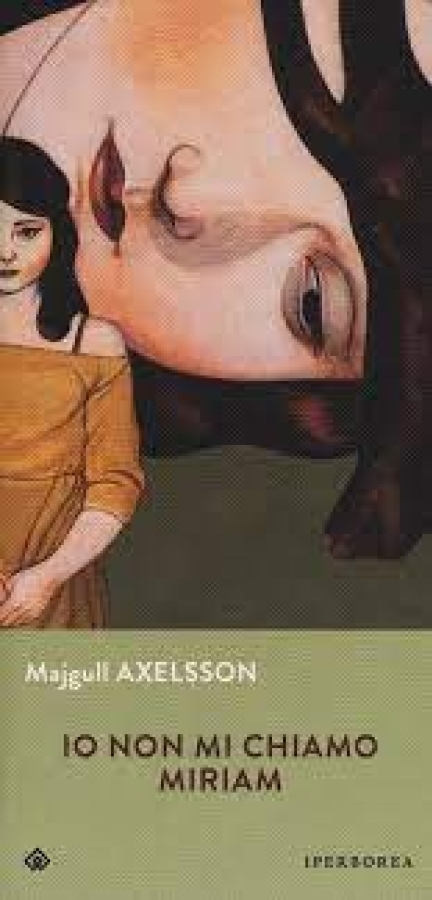
My Name Is Not Miriam
> She sees herself sitting in her lovely living room, in the lovely villa Olof inherited, with the lovely furniture she bought because he earns well. (...) The plaid skirt turns into a striped prisoner's dress, the stockings vanish and her shoes slide into nothingness, the parquet floor beneath her feet suddenly becomes raw concrete, (...) and Miriam screams, screams and hears herself screaming, clapping her hands over her mouth to force herself silent. It is not merely that memories of Ravensbrück and Auschwitz continually resurface; Miriam carries the weight of a lie, and of betrayal. To everyone, even her son and granddaughter, Miriam is a Jewish woman who found refuge within hospitable, orderly Swedish society; in reality, she assumed the identity of a dead girl who bore a brand similar to that of Malika, her young Romani self; no one would have welcomed the deportee Malika, belonging as she did to a people considered the lowest among all the world's pariahs (thieves, perjurers, child-abductors, violent, and so forth). She is eighty-five years old when she is gifted a bracelet—a piece of Gypsy craftsmanship. > Tears well up in her eyes, forcing her to blink them away, and words flash through her mind, (...) then she lets those words rise to her lips. The truth, instantly retracted, sets in motion a narrative that unfolds along two parallel strands: the long walk with her granddaughter, who seeks to probe what lies behind her grandmother’s cryptic declaration, and the inhumanity of the concentration camps, which must be banished from the soul if one is not to be overwhelmed. > You cannot talk about everything! (Miriam cries) You have to understand that. Not if you are eighty-five years old and belong to the wrong race, (...) Do you understand or not? It really happened. It was all real. It was another world, and I do not want to go back there. And so Auschwitz bursts into her mind—where her cousin was murdered immediately, where her little brother was used as a human guinea pig, and where the Romani people revolted, only to be exterminated en masse in the gas chambers; then the Ravensbrück labor camp, where, alongside the ruthlessness of the female guards, she—so mistrustful—encountered friendship and solidarity. Yet the dead always return; they stand behind doors easily pushed open. > All right, then. Let them come. She may be old, but she is still capable of slaying a few ghosts of the past. (...) Yes, it is her, it really is Anuscha (the murdered cousin). She is ten years old and nothing bad has happened yet. (...) When she reaches for the handle her hand moves clumsily and tears lurk in her throat, but then the door opens, swings wide, and Else appears (her friend from the concentration camp). She is still tall and thin as a rake, but she looks healthy and full, wearing clothes that are intact. (...) We are destined to lose everything, even the people who matter most to us. And so she no longer tries to hold back her weeping; reaching toward the fifth door, she lets the tears flow. Inside, Didi awaits her (the little brother reduced to a guinea pig). (...) She is a traitor. (...). Hence her shame. She betrayed the dead. She betrayed her people and her language. (...) On one side are them. Yet on the other remain those she never betrayed. Anuscha. And Didi. (...) I still miss you, every single day. As Elsa Morante writes in *Menzogna e sortilegio* (see the review on this site), > the past and the future are two realms of mist and vertigo, which the living can explore only through imagination and memory. What purpose is served by plumbing this palace of death? > No, said her father in a voice that came from a distant place. No, do not remember. Forget and look forward. To do this, one must deceive and betray. And Morante once more: > a lucid insomnia takes hold of me, and in this hushed, depopulated room, from now on I shall interrogate nothing but my true memory. Keeping her secret her entire life, shrinking from the temptation to reveal the truth, is the only way to safeguard her grief: the immense suffering born of the loss of her loved ones, and, bound up with them, her belonging to a people—the Romani—despised and trampled upon. The narrative structure follows a circular arc: the author returns repeatedly to the same themes, situations, and characters, pursuing a social and introspective investigation through successive approximations. The section dealing with life in the concentration camps relies on documentary sources and often takes on the qualities of a chronicle; perhaps it could not have been otherwise, given that the author is not recounting a true story, nor did she experience the camps firsthand. Interviews with survivors allow her to lend depth to the narrative, particularly when depicting the daily lives of the female inmates and the relationships woven among them. Elsewhere, as in the depiction of the Romani uprising, the prose falls flat and predictable. By contrast, the section concerning Miriam’s life in Sweden strikes a different chord: fiction grants the storytelling room to breathe, taking on color and substance because the author knows this social and cultural landscape intimately. A subtle irony emerges regarding Swedish customs, brought into relief by Miriam’s mimetic gifts: a young woman adept at reading body language, vocal inflections, and the behavior of a people—the Swedes—otherwise so utterly foreign to her. What causes disarray is the relentless shuttling between present and past, between reality and remembrance; perhaps a more linear narrative structure would have served the reader better. Why read it? An important, groundbreaking book that reaches far beyond the conventional history of the Holocaust.
I am god
> Wars end. Hate lasts forever. Hatred harbored for years had driven a man to litter a city with bombs. Hatred had driven another to detonate them . The consequences of that insane game that is war provide the ideal backdrop for a thriller. The novel’s premise is the return of a Vietnam veteran, surviving yet monstrously disfigured by napalm, the incendiary weapon widely used by the Americans during the war. As one would say today in polite terms, it was "friendly fire" that reduced the man to the horrific state in which he finds himself: taken prisoner by the Viet Cong and used as a human shield, he was struck by units of his own army, despite their having clearly recognized him. Hatred and vengeance are unleashed against his own fellow citizens, as he confides to his only friend: > I believe it would take the lives of many men to feel the pain I felt in those few months in the hospital . Many years must pass until a series of explosions strikes New York, claiming numerous victims. The investigation is assigned to a young detective, Vivien, who is partnered with Russell, a failed writer from a wealthy family who has come into possession of information crucial to identifying the culprit. As is typical in thrillers, the novel unfolds along two parallel narrative threads: the unraveling of the police investigation, full of plot twists and intricate developments, and the personal lives of the two protagonists, who ultimately fall in love. Among the story’s many offshoots, there is also a priest who reportedly took the killer's confession regarding the murders: the conditional mood is necessary here, as this very confession is the novel's pivotal juncture, one that might allow an attentive reader (certainly not the undersigned, who failed to grasp it) to deduce the killer's identity. The novel is undoubtedly the finest Faletti has written: the story is well-constructed, the plot rich with incidents and characters that nonetheless weave smoothly into the overarching narrative. The prose is even and composed, simple yet effective at the same time. If a criticism must be made, it concerns the novel’s finale, which, as is often the case with thrillers, is insufficiently developed and arrives devoid of tension and suspense. Perhaps the author should have devoted greater care to the conclusion, even at the expense of trimming some of the book’s redundant passages. Why read it? It reads exceedingly well, and the narrative commands the reader's attention.
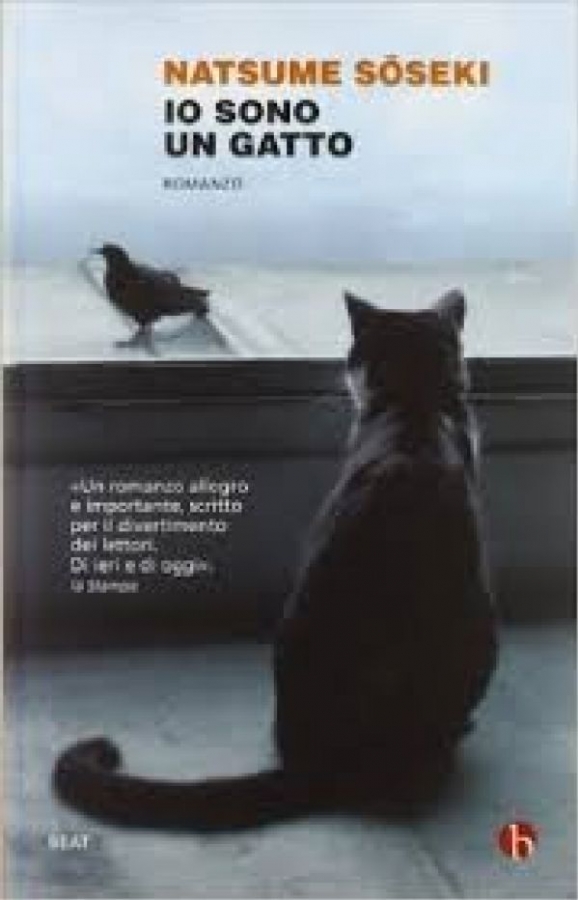
I Am a Cat
The protagonist and narrator of this novel is a cat: a stray taken into the home of a teacher, unloved yet tolerated out of sheer inertia. This is how our hero defines himself: > I do not grow fat because I eat no delicacies, but I am in passable condition and get by day after day without limping . Like all of his kind, our cat’s stillness and indolence conceal great wisdom, a profound capacity for reflection on the events of the human world. And this is why whoever were to read > the book distractedly, convinced that it was a work of little value, will suddenly realize they are faced with something very different, something that seems facile but is as profound as the doctrine of Buddha, and will no longer dare read it sprawled on the tatami with legs askew, skipping lines . We are in Japan at the beginning of the twentieth century, during the war with Russia, which would end in the resounding victory of the nascent Japanese empire. It is a long transitional phase, from the traditional, insular culture of the shoguns to an opening toward the Western world, its literature, and its science. Gathered at the teacher’s house in endless, pointless chatter are various intellectuals: the skeptic, witty and superficial; the young physicist, lost in scientific research whose purpose eludes comprehension; the Zen philosopher, yearning for a spirituality no longer truly felt; and finally, the young businessman, eager to strike it rich. At the center is the teacher: misanthropic, closed like «an oyster», selfish, spending all his time in his study, officially to read the countless books he purchases by squandering his modest teacher’s salary > But what is he doing, lying face down on this blanket with a long past, his chin resting on his hands, a cigarette between his fingers? Nothing, he just lies there idling. It is possible that in his dandruff-sprinkled head reflections on the grand schemes of things turn like a wheel of fire, but observing him from the outside, you would never tell. Yet, the cat is immensely grateful to the teacher, for he allows him to witness an emblematic cross-section of human society; a gathering of fabulists, to be sure, but one that provides our hero with «a thousand experiences», and us readers with pearls of wisdom. For instance, the cat visits a public bathhouse, where all men appear equal in their nudity, and suddenly there emerges a > a giant. Nietzsche’s superman. The king of demons, The commander-in-chief of brutes. (...) And on my way, I reflect. Among those men naked as worms, who in their effort to become all equal stripped off their trousers, haori, and hakama, an equally naked hero emerged who imposed his authority upon the others. I deduce from this that human beings may strip down as much as they like, they will never achieve equality . And what of narcissism? Observing the teacher looking in the mirror and lamenting his face, so disagreeable, the cat reflects that > when one is dissatisfied with oneself, when in the grip of discouragement, there is no more effective remedy than looking in the mirror. One gains an immediate and clear perception of beauty and ugliness. One marvels at having lived up to that moment showing such a face to the world. And this sudden awareness is a precious moment in a person’s life. Nothing is more useful to the human being than the perception of their own stupidity . We all know that cats are very patient; but everything has its limits! In the face of senseless babble, the vacuity of words, the poverty of feelings, and a background noise in which traditional philosophies (Buddhism and Confucianism) as well as Western thought dissolve, even a feline can take no more; and so he gets drunk and lets himself die. > Enough now, let it go as it will. I am tired of fighting... (...) Little by little I feel better. (...) Where I am. what I am doing, is completely indifferent to me. I only know that I feel good. (...) I sweep away sun and moon, pulverize heaven and earth and enter the mystery of eternal peace, I am dying, And dying I achieve peace. (...) I give thanks. I give thanks . At a certain point in this long novel, a doubt arises, at once fascinating and unsettling: could the cat and the teacher be parts of the very same person? The sage and the dullard? The engaged and the indifferent? And could this tale, written not long before his death, be Soseki’s spiritual testament? If this were the case, the book takes on an extremely modern, almost psychoanalytic mantle, a fresco of the complexity and ambivalence of the human soul, a precursor to those ambiguous and evanescent traits that would accompany great Japanese literature. The book is decidedly boring. There is no plot; the characters are stereotypes, the dialogues are protracted and serve merely as pretexts for musings; the cat’s digressions are more compelling, yet to be grasped in their fullness they would require a profound knowledge of Japanese history and culture. The translation is of a very high caliber, elevating the prose, which is the novel’s sole redeeming feature; the explanatory notes are meticulous and exhaustive, enriching our knowledge of Japanese society and inviting us to study it. Why not read it? It is boring.
I Kill
The novel concerns a string of murders committed in Monte Carlo by a psychopath who slaughters a series of celebrities in the grip of a vengeful delirium, seeking to restore a face to his brother, born ill-fated and murdered by their father. An American agent finds himself heading the investigation amidst a tangle of subplots and plot twists. It is a quintessential genre novel, echoing the style and narrative pace of books by Ludlum, Le Carré, and the like: a detective story that relies neither on setting (here reduced to the bare essentials) nor on in-depth character development, nor, ultimately, on suspense. Instead, it relies on narrative velocity and, in this case, on pleasant, lucid prose. It is a good book, perhaps overly long (as novels of this genre tend to be), redundant (for instance, from the discovery of the killer’s identity up to his apprehension), hurried (in how the protagonist uncovers the killer’s identity), and ultimately rather implausible regarding the final confrontation between the protagonist and the “villainous” general. Other passages firmly capture the reader's interest and attention: the initial murder aboard the boat, the phone calls to the radio station, the French commissaire’s search in Aix-en-Provence, and, finally, the killer's capture. At last, Italian literature too has entered a literary genre that has enjoyed—and continues to enjoy—immense success both abroad and in Italy.

The Island of the Idealists
> Many years ago, on a tiny island in an Italian lake, lived several people whom the present story concerns . Carla > already had hair turned very grey, in this nineteen-thirty, but her face was sweetly fresh, youthful, and getting to know her explained the style of her novels . Her father, old Antonio, often reprimanded her because he disapproved of his daughter's books, despite their great success; he also criticized his son Celestino, “too tall and big and strong.” > You are all intellect, just as famous tenors are all voice. As for the rest, you have nothing; you lack even common sense. There were other guests as well: a cousin and his wife, Jole and Vittorio, poor and young relatives, Giovanni the caretaker and two maids, and the dog Pangloss, whom Celestino desperately tried to teach to recognize numbers. Nothing ever happened. > It was a land, exceedingly rare, devoid of events. One merely lived, and that was already much; (...) yet this story would not exist had a certain event not occurred, beginning on a certain May evening of that year. Two petty rascals arrive on the island seeking refuge, having lived off hotel thefts, gambling, and small-time scams. Guido and Beatrice make no secret of being pursued by the police; yet Celestino decides to welcome them, partly already intrigued by the woman—of a soft, serene, and at times coarse sweetness—and partly because he has an objective: to teach the pair to be honest. Celestino devises a scientific curriculum; after all, as old Antonio remarks, > here things are taken too seriously. Eternity, truth, infinity, mathematics . As was to be expected, the program fails miserably: Guido and Beatrice steal money and jewelry, then, once discovered, depart to resume their usual life. “A year has passed, everything seems as before: but it is not true.” The island is quarantined due to scarlet fever, brought by a young orphan taken in by the family; Guido and Beatrice reappear on the island, but struck by a tone markedly different from the previous time. > The clothes they wore immediately revealed their decline, their misfortune. They must have gone through a truly bad stretch, and they stood before him (Celestino), without shame, but also without bravado. Their manners were no longer as easy as before; they stood almost awkward and conscious of their awkwardness, yet without any will to resist their dejection . This time, Celestino's program seems easier: before him are two pupils, humble, resigned, willing to learn moral values and an honest trade. There is something more: the generosity of Carla and Celestino turns first into compassion, then affection, and ultimately love—Carla for Guido and Celestino for Beatrice. And so we might say that it is neither science nor virtue that transforms humanity, but love. It would make for a fine ending, romantic and reassuring, were it not for another occurrence: Jole and Vittorio, who have spent four years on the island, have systematically stolen from the family that took them in; once discovered, they abandon the island with the stolen goods only to betray everyone, denouncing Guido and Beatrice to the police and plunging old Antonio into legal trouble for having harbored two fugitives. I refuse to reveal the ending. It is a fable, written with elegant lightness, which conveys three important messages: it is futile to retreat into an island of mediocre security, for events are larger than we are and sweep us away; scoundrels hide behind respectable and friendly figures, in a kind of “inverted world”; and finally, without empathy (pity, solidarity, fellow-feeling), one gets nowhere. These are timely messages: I leave it to the reader to judge. The novel bears the date 1942; in truth, it was never published, although it was likely commissioned by the *Corriere della Sera*. This partly explains the fragility of the plot, slender and predictable, and the superficiality of the characters, merely sketched and more stereotypical than fully realized figures (Celestino above all); the narrative also marks a watershed between the numerous stories published up to 1940 (romance fiction bearing the imprint of the fascist climate) and the great postwar detective novels: the author is on his way toward a new, more incisive style. Why read it? Elegant, steeped in sweet melancholy.
Istanbul
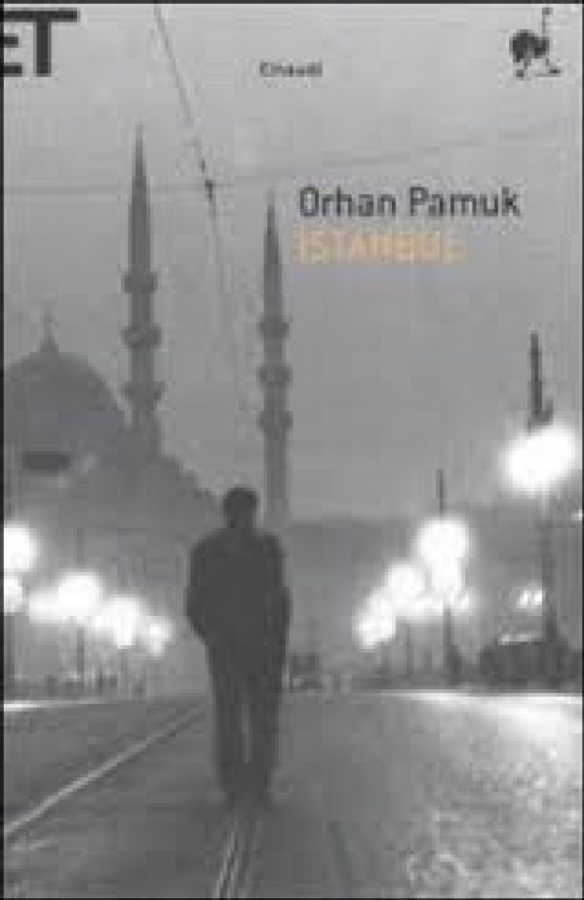
> I know that my inspiration draws strength from my attachment to the same house, the same street, the same view, and the same city... this bond of mine with Istanbul means that the fate of a city can become a person’s character . In this book, Pamuk recounts how he became a writer, yet in doing so he cannot help but speak of his Istanbul—the city of the 1950s and 60s, in full decline, not by chance narrated and photographed in black and white. So tight is the interweaving of the city’s history, enshrined in the “details of the past,” and the history of his own identity as a writer and an individual, that it becomes evident how the convulsive transformation of Istanbul has inexorably aged Pamuk himself, leaving him no longer an interpreter of the contemporary era. The novel has no plot in the strict sense, but is rather an assemblage of microcosms, episodes, reflections, and impressions. To give a general coherence to the narrative, three narrative threads can be identified. First and foremost, the biographical thread speaks of childhood and adolescence, of the extended Pamuk family, of the houses, and of the parents’ marital crisis. Pamuk’s formative journey does not involve the written page. There are neither reckless, childish attempts at writing nor great books that “changed a life.” The books read and reread by the young Pamuk are “the collection of facts and curiosities,” preferably enriched with drawings and photographs, that form > a seductive, terrible, and at times disgusting compendium of curiosities, events, and bizarre characters . From here, the transition to painting is natural: it allows one to contemplate and depict the panorama of Istanbul, initially “unanimously deemed beautiful,” later marked by the signs of decline. > I would draw the small mosques, the ruined walls, the Byzantine arches of which only a part remained visible, the overhanging wooden houses, and the modest dwellings . In painting, Pamuk discovers the pleasure of artistic creation. > Only now did I realize, through a more complex and astute spiritual leap, the desire to escape from myself.... sometimes I lost control of the drawing... and something would sweep me along impetuously, lifting me pleasantly: only when it ended, like a wave that dissolves as it breaks against the rocks, after freeing myself from wonder and sadness, could I rest a little . To understand why Pamuk decides to become a writer, abandoning the faculty of architecture and his passion for painting, one must turn to the second narrative thread: the survey of the great Turkish and Western writers who wrote about Istanbul. It is necessary to know this literature to appreciate the pages dedicated to it. One grasps, nonetheless, how Pamuk looks at his city through the words of Western observers, to the extent that the latter’s descriptions of Istanbul seem like > a personal memory. Naturally, this is also aided by the fact that Istanbul’s population has tenfold increased in the meantime, and certain avenues and squares, despite remaining entirely unchanged, now seem like completely different places due to the crowds. I always feel nostalgia for the years when the city was solitary and empty . One always returns to Istanbul, to > this mingling of history with ruins, of ruins with life, and of life with history . The third narrative thread consists of the description of the city, the contemplation of the Bosphorus, and wanderings among > the remnants of the old urban fabric made of wood and stone . Whoever has had the opportunity to lose themselves in the Armenian and Greek quarters or to walk down from Taksim toward the shores of the Bosphorus can appreciate what Pamuk writes and understand that > perhaps we love the place where we live only because we have no other choice, just as with family. Yet we must discover where and why to love it . It is futile to hope to find in the book a guide for a stay in Istanbul. Too distant and confined is Pamuk’s city compared to today’s—multiform, youthful, dynamic, and gigantic. The book speaks of the profound bond we all share with the places of our lives, which we often take for granted, as an obvious given. It is a reciprocal relationship, one that must be defended and built day by day, sustained by the daily effort to > attune one’s state of mind to the panoramas the city offers. And such an endeavor, if undertaken with naturalness and sincerity, leads one to unite, within memory, the city’s images with one’s deepest and most sincere feelings—with sorrow, with sadness, and from time to time with happiness, the joy of living, and optimism. If we learn to look at a city this way, and if we live in it long enough to find the opportunity to forge a lasting bond between its views and our truest, deepest feelings, after a while... the streets, the images, the landscapes of our city are transformed, one after the other, into realities that evoke certain feelings and states of mind within us . Why read it? Let us set Istanbul aside; let us speak of the bond with our own city, and of memories, and of feelings.
Italy in Giallo
The daily newspaper *La Stampa* offered alongside the paper a series of noir short stories: Macchiavelli, De Silva, Fois, Lucarelli, Manzini, Carlotto, Simi, Robecchi, Malvaldi, Fantini and Pariani, Cassar Scalia, Pastor, Recami, de Giovanni, De Cataldo, and Savatteri. It was an excellent initiative: it provided a survey of the principal Italian writers of the genre. What emerges is that Italian noir is setting-driven, the setting constructed around a character, generally a police inspector; the plot remains in the background and is often predictable. Among Northern authors, the context is realistically raw, a mirror of an amoral Italy devoid of prospects; where the South is concerned, the setting is transfigured into a fantasy of escape from the desolation of Southern society—an aspiration rendered dreamlike by the coquettish use of dialect, in the style of Camilleri. I shall focus on a few of these stories. Maurizio de Giovanni's *La febbre* takes us to Naples, and its very title recalls Matilde Serao's *Il Paese di Cuccagna* (see review on this site). The fever is the lottery game, and the victim is the *assistito*, the medium who provides numbers received from the beyond. One cannot help but feel sympathy for an inspector so intimately affected by the victim’s fate. > In the image that presented itself to my soul's gaze, and whose suffering my soul shared, the blood ran down like a long, unbroken tear, staining the cheek, the neck, and the front of the dressing gown . The story is steeped in Neapolitan spirit: airy, refined in language and syntax, with a well-constructed plot, the brief tale of the *assistito* invites us to explore further works by de Giovanni. In *Romanzo Criminale* (see review on this site), Giancarlo De Cataldo had offered a bleak, resigned fresco of Italy and of Rome in particular, leaving the characters in the background as mere criminal stereotypes. In the story bearing the emblematic title of *Medusa*, the protagonist is the heart of the narrative. Now an elderly, retired teacher renowned for her strictness, Professor Blasi spent her life in a peculiar relationship with a homosexual baron. And when the latter was murdered, > at the Caffè Centrale they spoke of nothing else. And they spoke of it in the Salento manner, with little or no pity , but while > the baron, deep down, could be forgiven anything: he was born that way, and that was how he was bound to end up. But as for her, oh no, that pointless obstinacy of hers would be held against her for eternity . It must be acknowledged: De Cataldo is a cut above other Italian noir authors, in both style and substance. Imagine an elderly man in a Milan "with that yellow sky that boded no good"—what can he possibly think when his doorbell rings? In this little gem, *Ottobre in giallo a Milano*, Francesco Recami weaves a surreal yet plausible tale. The elderly pensioner strikes an intruder, who claims to be a police inspector, with a monkey wrench; gripped by panic over what he has done, rather than turning to law enforcement as a dutiful citizen should, he dumps the bleeding, unconscious body in front of the emergency room with the help of a rogue acquaintance, and then takes refuge in the underbelly of society aided by a scoundrel nephew—part pusher, wholly greedy. What will become of our old man in a Milan, > where it looked as though a nuclear bomb had gone off, or at least that's how they color post-atomic skies in the movies ? I had first encountered Recami in another story, *Progresso-Audace 3-22* (see review on this site under *Il Calcio in giallo*), and had appreciated his elegant depiction of our era's disturbing paradoxes: I believe it would be worthwhile to explore this author through full-length novels. How I enjoy Gaetano Savatteri! The plot is insubstantial, but there is irony to spare! As in *La segreta alchimia* (see review on this site under *Viaggiare in giallo*), the protagonist is an unemployed journalist, relentlessly teased by a devoted friend and an architect who might be his girlfriend, enraptured by works of art, splendid and superfluous. The town is Gibellina, where the Belice earthquake produced a reconstruction made of rationalist urban planning and monuments by celebrated artists; a pity that the landscape is a desert, a surreal abandonment, left behind by inhabitants fleeing to the North and abroad. The subtle irony, the affectionate depiction of the setting, the rhetoric of institutional rituals—the annual conference, the buffet, and the museum visit—the characters confined to their roles: these are all the foundation of a social and political critique, presented with a light touch and therefore never banal. It is a story well worth reading. Why read these stories? They are compelling and thoroughly enjoyable.