Finished reading on: June 10, 2026
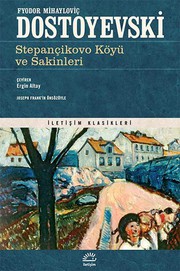
The Village of Stepanchikovo and Its Inhabitants
Title of the original version reviewed: «Il Villaggio di Stepàncikovo e i suoi abitanti»
AI Translation Notice: This review was translated from the original Italian using artificial intelligence. Book quotes and excerpts are translated interpretations and will not match the author's original English phrasing or official published translations.
The first-person narrator is a young man living in Petersburg
with nothing to do, (...) convinced that in short order (he would) accomplish truly remarkable, even grandiose things.
He is supported by an uncle, a wealthy landowner in distant Stepanchikovo. Their correspondence is sparse, but of late the young man has been urged to join his uncle through rambling, incoherent letters, beneath which lies an entreaty to marry the young governess—an unhappy, beautiful, and educated girl. Our young man decides to comply with these requests, out of a blend of curiosity and affection. He finds himself amidst a
bizarre collection
of characters, a tight-knit community revolving around a shrewd, charismatic manipulator—what we would call today a "guru"; hence the modern resonance of the tale. Foma Fomich
was short, fair-haired and grizzled, with a hook on his nose and fine wrinkles all over his face. (...) He would read aloud books on the salvation of the soul, speak with eloquent tears of the various Christian virtues, (...) recount his life and his exploits, (...) and was a master at passing judgment on his neighbor.
Having lived in squalor, all his life he had been forced to wander from one landowner’s estate to another, playing "the buffoon." In Stepanchikovo, at long last, he was able to practice his arts as a fabulist, indulge his vanity, and redeem himself from the humiliations suffered for so long. His technique consists in exploiting the weaknesses of others, shifting from an aggrieved, haughty victimhood to sermons extolling his own virtues while decrying the depravities of others. Suffice it to say, he finds fertile ground. The uncle, a former hussar colonel, is good-natured, honest, and trusting, yet he is carrying on an affair with the young, destitute governess: he wishes to marry her off to his nephew in order to continue the liaison. The girl’s father displays a dignified indifference, but in truth aims to marry his daughter to the aging, wealthy landowner. Then there is Tatiana, a wealthy, somewhat nymphomaniacal spinster; the household hopes she will marry the uncle to unite their fortunes, but a few dandies are scheming to abduct her to get their hands on her money. Then there is the general's widow, with her entourage of devout and venomous young ladies: hysterical fits, fainting spells, and seizures occur whenever Foma’s position is called into question, whereupon, deeply offended, he declares he is leaving, going into exile. Naturally, he never will.
Foma occupies two large, splendid rooms. (...) Absolute comfort surrounded the great man. The fresh, colorful wallpapers, the shimmering silk curtains at the windows, the rugs, the pier glass, (...) everything bore witness to the tender solicitude of the master and mistress of the house toward Foma Fomich.
And what of our young man? He postures as a "scientist," "philosopher," "know-it-all": he observes the dynamics of these human beings, growing indignant only in fits and starts when he sees his uncle trampled by this rogue. The narrative moves swiftly, paced like a theatrical play: brisk dialogue, sharp humor, caricatures, stereotypical "masks" of human pettiness. One senses a disdain for the provinces and for the peasant world in particular—exemplified by that poor serf, constantly abused by Foma because he keeps dreaming of "a white bull" rather than "refined ladies and gentlemen taking tea." In a crescendo worthy of a comedy of errors, Foma seems on the verge of losing his grip, yet with a dramatic reversal the sly, adept manipulator reasserts his dominion over the inhabitants of Stepanchikovo.
It is the fate of great authors that their broader oeuvre is overshadowed by their undisputed masterpieces. When Dostoevsky is mentioned, one immediately turns to works such as Crime and Punishment, The Idiot, and The Brothers Karamazov (see the review of The Idiot on this site). Across the Russian writer’s vast output there is much else of enduring worth. Consider The Adolescent, so strikingly contemporary in its scrutiny of the protagonist's relationship with his father (see the review on this site). The Village of Stepanchikovo and Its Inhabitants is unanimously labeled a comic work, thereby missing the novel's distinctive qualities. It is a study of Power, and of the profound motivations that underpin it: it is not money (Foma rejects a handsome offer to quit the estate), nor is it even the taste for raw dominion or the authority to make critical decisions (on the contrary, Power evades decision-making). What drives Foma is sheer vanity—a narcissistic hunger to occupy center stage, to revel in his own rhetoric, to be revered and flattered. Its contemporary relevance is glaring in an age of Power that seeks only to generate talk about itself in a media frenzy. The inhabitants of Stepanchikovo may be an isolated community in the Russian countryside, but they speak volumes about sycophancy and the vacuity of the human soul.
The writing and plot are effervescent, departing stylistically from the major novels: there is no psychological introspection, nor are the relationships between characters probed in depth. It is without question a coming-of-age novel, in which the great writer hones his craft in dialogue construction, paying scant attention to setting, and above all neglecting the narrator, behind whom Dostoevsky himself lurks.
Why read it? It is entertaining and profound.