Omero
Books by this author (2)
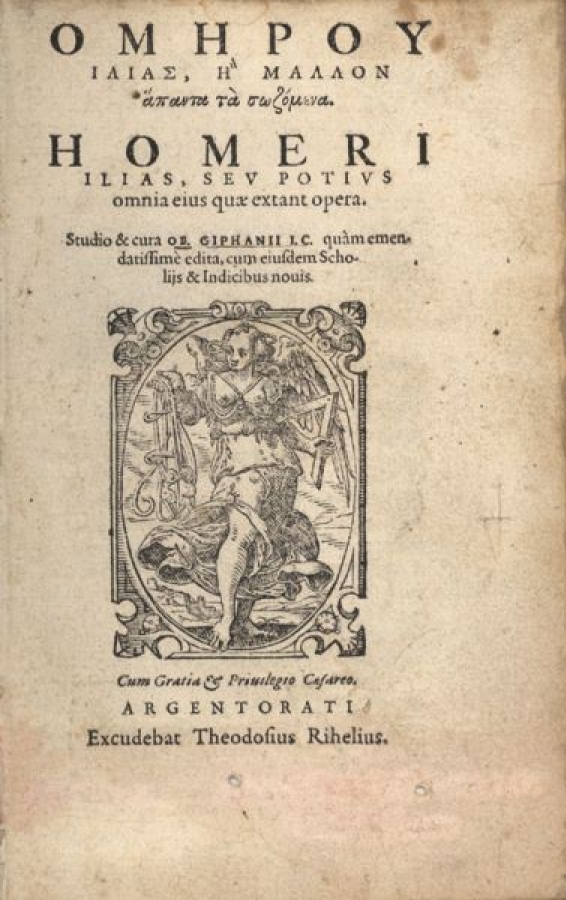
The Iliad
*The Iliad* unfolds over a brief period of time, yet it captures the most salient events of the Trojan War. The incipit is the quarrel between Agamemnon and Achilles over the possession of an enslaved woman, yet in truth, Achilles is calling Agamemnon’s authority into question. The hero resolves to withdraw from the fighting, triggering a sequence of clashes that, despite alternating fortunes, steadily tilt toward the defeat of the Achaeans, culminating in the Trojans setting fire to one of the Greek ships. The assembly of Achaean chieftains repeatedly dispatches embassies to Achilles urging him to rejoin the fray; instead, Patroclus, the hero’s dearest companion, enters the combat and is slain by Hector. Achilles rejoins the war to avenge Patroclus, unleashes wholesale slaughter, and kills Hector. Priam nevertheless succeeds in assuaging Achilles’ wrath and recovering Hector’s body to grant him a proper burial. The plot is relatively simple, yet it is complicated by the presence of multiple narrative tiers: each theme develops across three planes: the community of the gods, the community of men, and individual emotions, the latter perpetually subordinated to the will and unyielding codes of the community, even before the dictates of divinity. The first theme is the struggle for the governance of the community, and consequently, for power. The epic opens precisely with the conflict between Agamemnon and Achilles, yet the striving for the assertion of authority remains a constant. One need only consider Hector's decision not to withdraw behind the walls of Troy and instead fight on open ground solely to assert his authority against Polydamas, who was counseling him to do so: > now, while the son of devious-plotting Cronus has granted me to win glory by the ships, driving the Achaeans back to the sea, fool, you must not utter such advice among the people; no Trojan will obey you, I will not allow it . Yet this very clash for power is equally present among the gods: Poseidon remarks to Hera, who is fearful that Achilles might succumb to a god, > let us go and sit apart, rather, upon the lookout... if then Ares begins the strife, or Phoebus Apollo, or if they hold Achilles back, straightway then from our side will a clash of war arise; and very soon, methinks, beaten, they will return to Olympus, back among the other gods, vanquished by force beneath our hands . The same theme of power emerges distinctly in the assembly of Book XIX, wherein Achilles wishes to rejoin the battle immediately to avenge Patroclus and grant him a worthy burial, while the other chieftains insist that Achilles formally accept Agamemnon’s gifts, thereby affirming the latter’s authority. The second theme is, naturally, war: the most predictable and indeed the most tedious of themes, save for the battle among the gods, which reaches conspicuous peaks of comedy and mockery of the divinities. The martial accounts fragment and seem designed merely to exalt the stature of the heroes and the fallen. The third theme is composed of familial sentiments: affection for friends, filial love, reverence for elders, the grief over the loss of loved ones. This is the theme closest to modern sensibilities, where the epic modulates into pathos in certain passages: the exchange between Hector and Andromache, Thetis’s love for Achilles, and the latter’s agony over Patroclus: Hector > placed his son in his wife's arms: and she drew him to her fragrant bosom, smiling through her tears; her husband was moved to pity as he beheld her, and caressed her with his hand ... yet the community's laws hold greater sway than individual sentiments, > go now, return home, and attend to your own tasks, the loom and the distaff; and bid the handmaidens set about their work; for war shall be the business of men, of all men and of me above all, as many as were born in Ilium (Book VI). Into these themes interweave other narrative threads (parentheses within the epic), such as the magnificent Book XVIII (the forging of Achilles’ armor) and Book XXI, particularly the defense of the Trojans by the river Xanthus and its defeat by fire. On the whole, the epic is tedious and fragmented, and certainly falls short of the *Odyssey*.
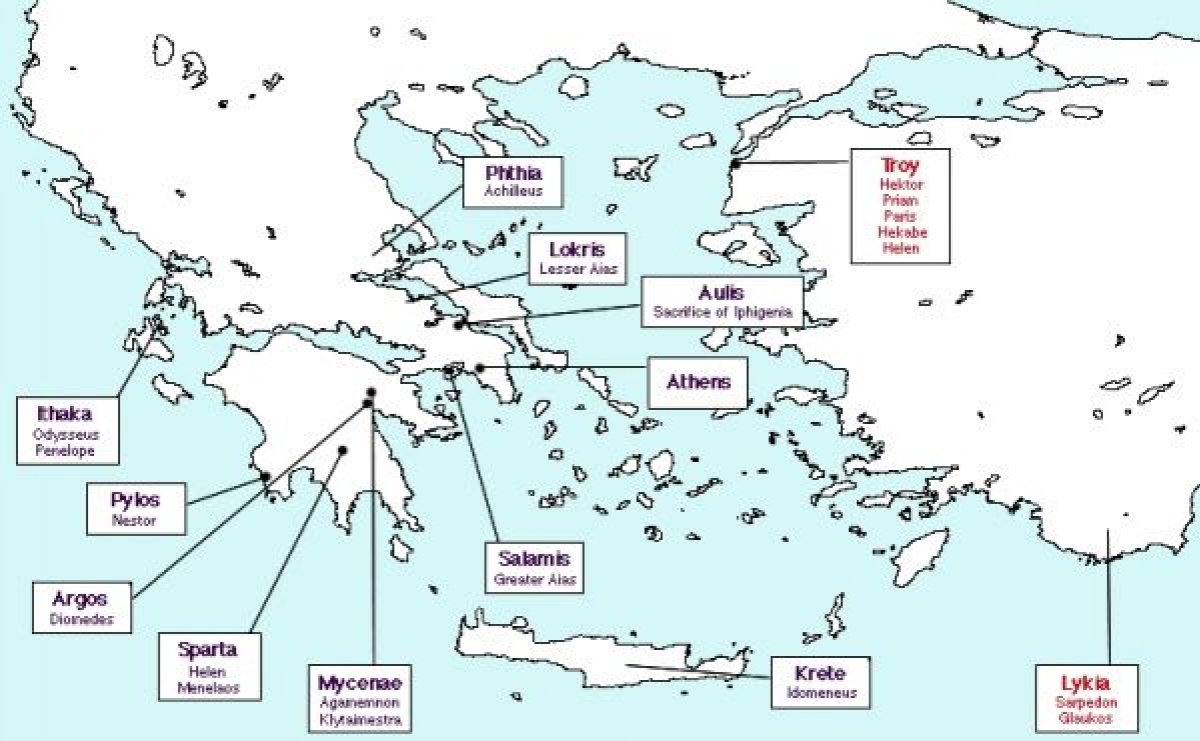
Odyssey
The book centers on Odysseus’s return to his home and is structured into four parts: the preamble, in which a council of the gods, on Athena’s proposal, resolves to allow Odysseus to resume his journey home by ordering Calypso to release the hero; the decision of Telemachus, Odysseus’s son, to rid himself of the suitors, who continue to frequent the palace and squander his father’s estate. After a futile appeal to the people to aid him in the struggle against the suitors, Telemachus journeys to other rulers to learn of his father’s fate and to discover whether it is possible to overcome the state of uncertainty in which he finds himself and give his mother in marriage, taking full possession of his inheritance; Odysseus’s journey to the Phaeacians, with the storm scene and the encounter with Nausicaa (the most beautiful pages of the poem) and the recounting of his adventures; the arrival home, the gradual unveiling of his identity, and the slaughter of the suitors. By many authors, the *Odyssey* is interpreted as the return of Ulysses (and thus of the traveler) and as an exaltation of his intelligence and cunning. In truth, it is a highly complex poem in which different narrative themes unfold and contrasting personalities are set against one another. A first theme is undoubtedly that of travel, and above all, of the sea. It is no coincidence that the most mesmerizing pages of the poem are those of Book V, which recounts the storm and the shipwreck of Odysseus: > A towering wave surged down upon him, with terrible fury, and sent the raft spinning round. Far from the raft he was hurled, and the rudder slipped from his hands: clean down the middle snapped the mast beneath the horrific blast of clashing winds, and far off into the sea fell sail and yardarm. Long did he remain submerged, unable to rise swiftly to the surface beneath the onslaught of the mighty wave... at last he surfaced, spewing from his mouth the bitter brine that streamed in rivulets from his head . > To the castaway, and more generally to the guest, shelter and hospitality must ever be offered : so speaks Nausicaa to her handmaidens in Book VI: > Halt, handmaidens: whither do you flee at the sight of a man? Do you take him perchance for an enemy?... Yet this is a wretched castaway who has come upon us, and we must tend to him: from Zeus come all strangers and beggars; and a gift, however small, is dear . The theme of hospitality is one of the dominant threads of the *Odyssey*, corresponding precisely to the collective feeling of a people of seafarers who are acutely aware of how quickly fortune, and wealth, can change. A second theme is constituted by the complex personality of Odysseus, well epitomized by Athena’s words in Book XIII: > Shrewd and cunning indeed would be he who could surpass you in all manner of deceit, even were it a god who encountered you. Audacious, fertile contriver, never sated with wiles, will you not even now, in your own homeland, cast aside your guile and those lying tales that have been dear to you since infancy? Come, let us speak no more of this, for we both well know the art of cunning . Ulysses is a consummate weaver of tales, and it is telling that his famous adventures are not related by the poet, but are recounted by Odysseus himself to the Phaeacians. Are they true occurrences or fairy-tale fabrications, like those he spins with such ease to the swineherd Eumaeus, to his wife, and to his own father? But who is Odysseus—a perpetual wanderer, a man by now accustomed only to fighting and traveling? It is extraordinary that at the very moment he reveals himself to Penelope, instead of embracing her and expressing his love, he must at once inform her of the prophet Tiresias’s prediction, according to which he is destined to leave Ithaca once more to undertake a new voyage and ultimately perish in the sea. There seem to be in Odysseus no feelings toward his son, his wife, and his father, who nevertheless suffered so deeply: the sole moment of genuine tenderness appears to be directed toward his mother, in the splendid verses of Book XI: > And thrice I sprang forward, my heart urging me to embrace her; thrice from my hands, like a shadow or a dream, she slipped away: a sharper agony pierced me to the core, and addressing her I spoke winged words: Mother mine, why do you flee when I yearn to hold you? . A third theme is represented by Telemachus and the intricate process through which, having grown up without a father, he is forced, in spite of himself, to become an adult. How different he is from his father!. He is full of uncertainty, of doubt, torn between love for his mother and the desire to reclaim his estate and his independence. The youth’s doubts render him a modern character, precisely because he is rich in intimate contradictions—the fruit of the conflict between his role (that of prince), his affection toward his mother, and the fact that he does not measure up to his father’s strength: he cannot string the bow! > By Zeus, not I... do hinder my mother’s marriage; indeed, I bid her marry whomsoever she pleases, and I offer her countless gifts. Yet I dare not drive her from the house against her will with a peremptory command: may a god forbid it! (Book XX), but then he must assert himself over his mother herself and finally become an adult: > Mother mine, as for the bow, no one among the Achaeans has more mastery over it than I... come, return to your chambers and attend to your own tasks, the loom and the distaff... Astonished, she returned to her chambers, keeping the prudent counsel of her son close to her heart (Book XXI). A fourth theme is embodied by the figure of Pallas Athena, who constitutes the true protagonist of the epic. Not only is Odysseus’s release from Calypso owed to the goddess, but above all, it is her constant counsel and guidance that allow Telemachus and Odysseus to act with due circumspection. We are not dealing with miraculous and incredible deeds (with marvels), but underlying the entire poem is the theme of intelligence and independence of judgment, personified precisely by Athena. In an article in *La Repubblica* of November 25, 2006, Book XXIII is commented upon, in which Penelope recognizes Odysseus. The woman seeks a secret sign to confirm that the man is truly Odysseus, for the waiting has been too long and she must be certain, > because Penelope believes in only one form of knowledge: that of secret signs, grounded in her own memory and that of Ulysses . To Telemachus, who accuses her of having "a heart harder than stone," Penelope replies: > My child, the heart within my breast is struck dumb: I can speak no word to him, nor question him, nor look him in the face. Yet if he is truly Odysseus returned to his homeland, oh, full well and easily shall we recognize one another: for we have secret signs between us, known to ourselves and to no one else . And when Odysseus gives her the sign (the bridal bed carved out of a great olive tree that cannot be moved because of its roots), Penelope recognizes her husband and "straightway her knees and heart gave way," and then both rediscover their former love: > and upon him fell an even greater urge to weep; he wept as he held close his bride, dear to his heart and faithful;... so longed-for was her husband to her gaze that she would not unloose her white arms from his neck .