Finished reading on: July 28, 2026
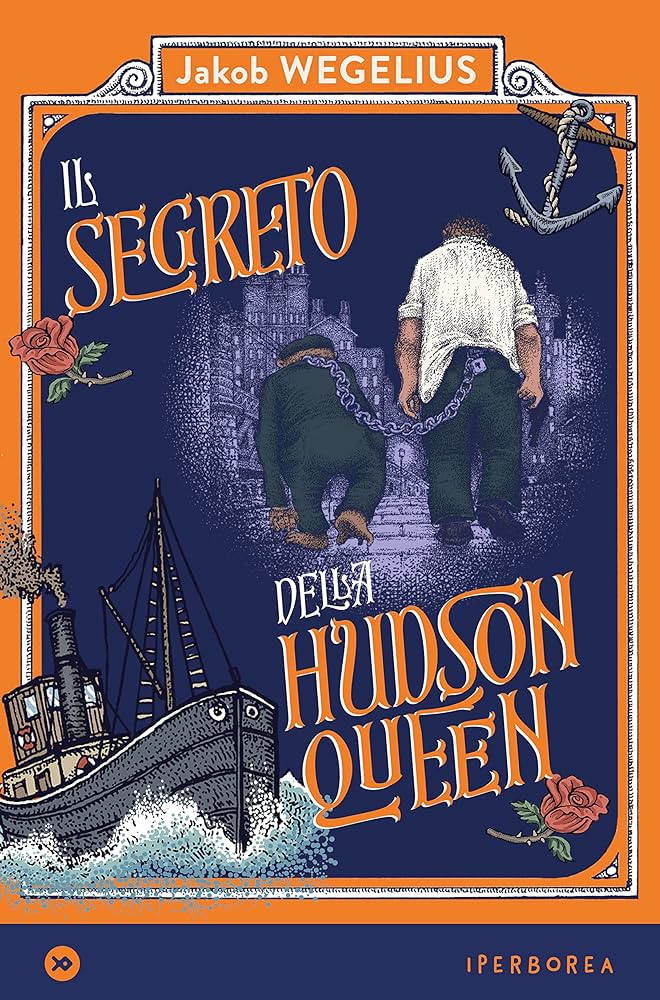
The Secret of the Hudson Queen
Title of the original version reviewed: «Il segreto della Hudson Queen»
AI Translation Notice: This review was translated from the original Italian using artificial intelligence. Book quotes and excerpts are translated interpretations and will not match the author's original English phrasing or official published translations.
It is singular to review this novel immediately after reading Emilio Salgari's La perla sanguinosa (see the review on this site): a curious coincidence, almost as if pearls were inherently the bearers of adventure and misfortune. And indeed, when Sally Jones and the Chief find a pearl necklace hidden in a secret compartment within their ship’s steering wheel, Sally, with the wisdom of an intelligent ape, experiences
an unpleasant sensation in the pit of my stomach. (...) The pearls of the necklace (...) seemed to emanate a faint, mysterious light from within.
Unlike Salgari’s fantastical setting, here the pearls lead us into the "underworld" of seafaring cities: violent and perilous slums for our ape, seemingly fragile and defenseless. The narrative resumes from the point where we left it in the previous novel (see the review of The Murderer’s Ape on this site); yet here the element of surprise is missing because we already know Sally, and we are deprived of both the charm of a seafaring, piratical Lisbon and the savor of noir intrigue. The story unfolds in Glasgow. Sally and the Chief set off in search of the pearls' presumed owner, the orphan Rose, abandoned as a child by her father, who wished to bequeath the jewel to her as a form of redemption. They find themselves plunged into the underworld of the English city: the Chief is forced to captain a ship smuggling alcohol to America, while Sally is held hostage by a criminal gang. Harassment, clashes between underworld syndicates, violent nightlife, and even boxing bouts follow in rapid succession, sweeping up the poor, frightened Sally, who becomes an object of curiosity, derision, and exploitation. Sally is guarded by Bernie the Butcher: a hulking, rather dim-witted young man notorious for his sudden, uncontrollable rages, himself the victim of mockery and abuse at the hands of the other criminals, and even his own sister. It is the friendship between Sally and Bernie that forms the crux of the story. Sally has numerous opportunities to escape, yet she stays to help poor Bernie, not wanting to leave him alone, determined to defend and save him. Faced with the blaze consuming the house in which his sister might perish, Bernie gathered momentum to throw himself into the fire as well, and then
I wrapped my long arms around him, (...) immediately took him by the arm and led him back onto the bridge, away from the burning building.
The wise and gentle Sally discovers herself no longer fragile, but a mother figure to the hulking Bernie.
How far removed we are from the mysterious and melancholic atmosphere of The Murderer’s Ape! All the enchantment of the previous novel has dissolved into a verbose plot, where the twists fail to lend rhythm to the narrative. One plods along, hoping to recover the characters, the drama, and the writing that had once held us so spellbound. It is a futile quest; only the friendship between Sally and Bernie rescues the work from utter disappointment, yet it is a relationship merely sketched, lacking in depth, that fails to truly engage.
Why not read it? It is boring.