Finished reading on: February 28, 2017
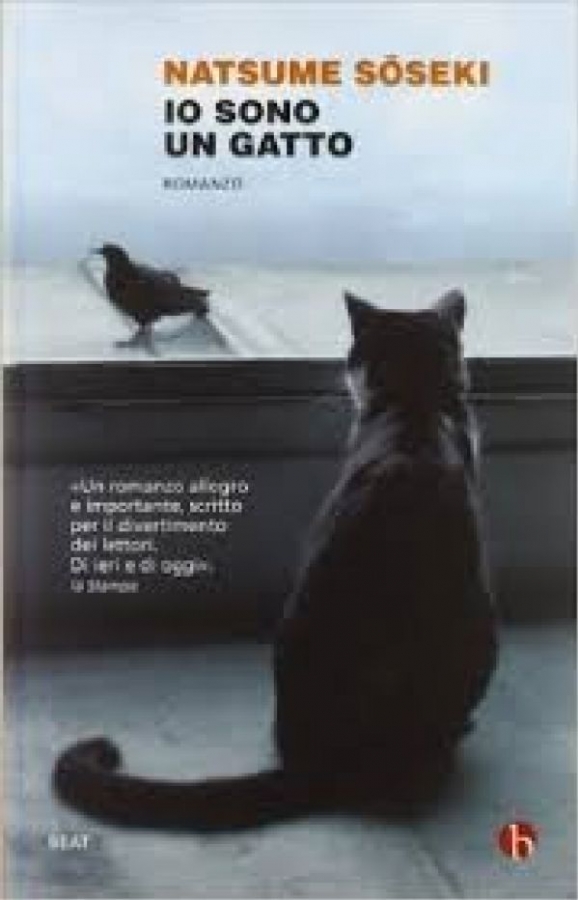
I Am a Cat
Title of the original version reviewed: «Io sono un gatto»
AI Translation Notice: This review was translated from the original Italian using artificial intelligence. Book quotes and excerpts are translated interpretations and will not match the author's original English phrasing or official published translations.
The protagonist and narrator of this novel is a cat: a stray taken into the home of a teacher, unloved yet tolerated out of sheer inertia.
This is how our hero defines himself:
I do not grow fat because I eat no delicacies, but I am in passable condition and get by day after day without limping
.
Like all of his kind, our cat’s stillness and indolence conceal great wisdom, a profound capacity for reflection on the events of the human world.
And this is why whoever were to read
the book distractedly, convinced that it was a work of little value, will suddenly realize they are faced with something very different, something that seems facile but is as profound as the doctrine of Buddha, and will no longer dare read it sprawled on the tatami with legs askew, skipping lines
.
We are in Japan at the beginning of the twentieth century, during the war with Russia, which would end in the resounding victory of the nascent Japanese empire.
It is a long transitional phase, from the traditional, insular culture of the shoguns to an opening toward the Western world, its literature, and its science.
Gathered at the teacher’s house in endless, pointless chatter are various intellectuals: the skeptic, witty and superficial; the young physicist, lost in scientific research whose purpose eludes comprehension; the Zen philosopher, yearning for a spirituality no longer truly felt; and finally, the young businessman, eager to strike it rich.
At the center is the teacher: misanthropic, closed like «an oyster», selfish, spending all his time in his study, officially to read the countless books he purchases by squandering his modest teacher’s salary
But what is he doing, lying face down on this blanket with a long past, his chin resting on his hands, a cigarette between his fingers? Nothing, he just lies there idling.
It is possible that in his dandruff-sprinkled head reflections on the grand schemes of things turn like a wheel of fire, but observing him from the outside, you would never tell.
Yet, the cat is immensely grateful to the teacher, for he allows him to witness an emblematic cross-section of human society; a gathering of fabulists, to be sure, but one that provides our hero with «a thousand experiences», and us readers with pearls of wisdom.
For instance, the cat visits a public bathhouse, where all men appear equal in their nudity, and suddenly there emerges a
a giant.
Nietzsche’s superman.
The king of demons, The commander-in-chief of brutes.
(...) And on my way, I reflect.
Among those men naked as worms, who in their effort to become all equal stripped off their trousers, haori, and hakama, an equally naked hero emerged who imposed his authority upon the others.
I deduce from this that human beings may strip down as much as they like, they will never achieve equality
.
And what of narcissism? Observing the teacher looking in the mirror and lamenting his face, so disagreeable, the cat reflects that
when one is dissatisfied with oneself, when in the grip of discouragement, there is no more effective remedy than looking in the mirror.
One gains an immediate and clear perception of beauty and ugliness.
One marvels at having lived up to that moment showing such a face to the world.
And this sudden awareness is a precious moment in a person’s life.
Nothing is more useful to the human being than the perception of their own stupidity
.
We all know that cats are very patient; but everything has its limits! In the face of senseless babble, the vacuity of words, the poverty of feelings, and a background noise in which traditional philosophies (Buddhism and Confucianism) as well as Western thought dissolve, even a feline can take no more; and so he gets drunk and lets himself die.
Enough now, let it go as it will.
I am tired of fighting...
(...) Little by little I feel better.
(...) Where I am.
what I am doing, is completely indifferent to me.
I only know that I feel good.
(...) I sweep away sun and moon, pulverize heaven and earth and enter the mystery of eternal peace, I am dying, And dying I achieve peace.
(...) I give thanks.
I give thanks
.
At a certain point in this long novel, a doubt arises, at once fascinating and unsettling: could the cat and the teacher be parts of the very same person? The sage and the dullard? The engaged and the indifferent? And could this tale, written not long before his death, be Soseki’s spiritual testament? If this were the case, the book takes on an extremely modern, almost psychoanalytic mantle, a fresco of the complexity and ambivalence of the human soul, a precursor to those ambiguous and evanescent traits that would accompany great Japanese literature.
The book is decidedly boring.
There is no plot; the characters are stereotypes, the dialogues are protracted and serve merely as pretexts for musings; the cat’s digressions are more compelling, yet to be grasped in their fullness they would require a profound knowledge of Japanese history and culture.
The translation is of a very high caliber, elevating the prose, which is the novel’s sole redeeming feature; the explanatory notes are meticulous and exhaustive, enriching our knowledge of Japanese society and inviting us to study it.
Why not read it? It is boring.