Giorgio Scerbanenco
Books by this author (4)
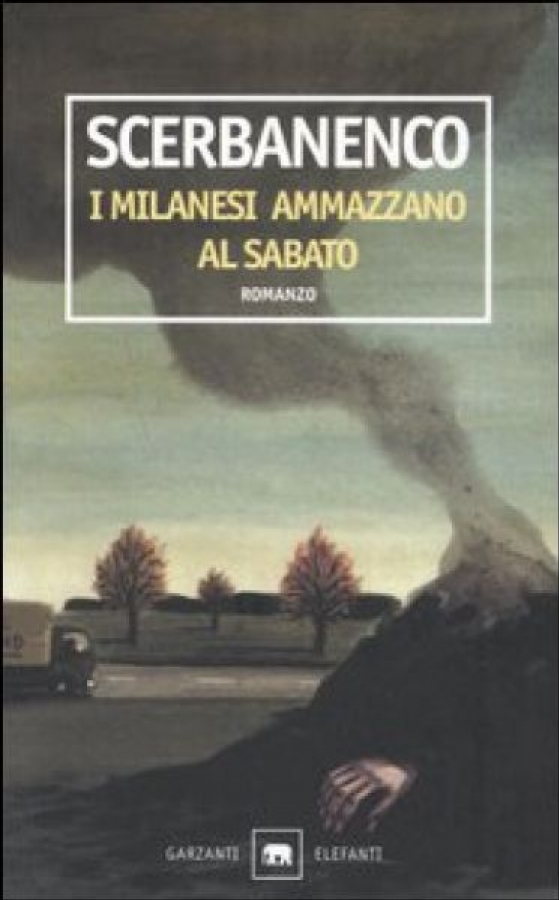
The Milanese Kill on Saturday
The novel is set in 1960s Milan. A police inspector is called to investigate the disappearance of a young woman, strikingly beautiful yet mentally impaired. He discovers her body, burned at the side of the road, and uncovers a prostitution ring. Through a series of inquiries into the criminal underworld and brothels, he identifies the killers, but arrives too late: they have already been murdered by the girl’s father. The latter, a decent man, is driven to commit a crime by the sluggishness and incompetence of the police in solving the case. It is a heavy, thoroughly bitter noir: a violent, unscrupulous city and a negligent police force. The story is well constructed, with an engaging narrative pace, even if the plot twists feel somewhat predictable. The author’s interest seems to lie more in the depiction of the milieu than in the construction of the plot.
The Boys of the Massacre
It is chilling to read this novel in light of a recent news story, in which a boy stabbed his French teacher, unleashing upon her a hatred and violence one would never wish to see harbored in an adolescent. We are in the 1960s, in an “old and poor Milan,” yet already convulsed by traffic that was “unpleasant, irritating; drivers glared at one another with hatred, the traffic lights were always red, (...) and outside nothing could be seen, only the fog.” In this city so different from today's, a heinous crime has been committed: eleven boys have raped, beaten, tortured, and ultimately murdered a frail night-school teacher. True, they are already petty criminals: some the children of “honest parents,” others with fathers in prison and mothers working as prostitutes, but all of them known to the police for acts of violence, petty theft, and alcohol abuse. For the chief inspector, it is a straightforward case: they are all guilty, and the essential thing is to get rid of this “rabble” as quickly as possible, handing the matter over to the investigating magistrate, the reformatory, and prison. Not so for Duca Lamberti, the protagonist of Scerbanenco’s detective novels (see the review of *Venere Privata* on this site): an unusual policeman for whom “truth was the only thing that mattered (...), even if, in the end, it was of no use.” It arouses his suspicion that they all say the exact same thing: “namely, that they hadn't done anything, that they had been forced to stand in a corner while the others did everything.” It is too clever a defense, and maintained by all of them, as though prearranged. “This line of defense was concocted before the crime, and by someone smarter and not drunk like those boys,” Duca Lamberti concludes. From here unfolds a police investigation made not of deft, subtle reconstructions designed to trap the suspects and force them into confession; nor does the inquiry dissolve into sociological analyses or excuses to narrate the protagonist's life. Everything remains in the background. Only occasionally are there brief brushstrokes of a Milan that longed to remain that of the late nineteenth century, with its taverns, still *trani* and not yet bars, where the drunkards “still fell asleep, as in the days of Porta, their heads resting on their arms, and there were the aging prostitutes, (...) and there was the tired, kind flower seller, limping gently. (...) The row of parked cars stretching the entire length of the street took nothing away from this innocence: they were the intruders.” And feelings appear fleetingly, timid, conveyed through small gestures: “‘Sleep,’ she said, ‘and keep me warm.’ They would make love another time, she knew. He warmed her, but did not sleep; he tickled her neck with his stubbly, unshaven cheek, and his breath was a warm whisper on her breast that kept her from sleeping.” Duca Lamberti’s approach stems from the empathy he feels for these boys, or at least for some of them. He attempts to forge a relationship of care with them, encouraging them to open up not out of fear of the police, but so that they might understand the evil they have committed—an evil devastating first and foremost to themselves. Not that he fully succeeds: the first boy, frail and young, a homosexual, kills himself, destroyed by guilt; the other, fourteen-year-old Carolino Marassi, an orphan and petty thief, comes close to being killed. Duca Lamberti makes mistakes; he is often depressed when confronted with such cruelty, and dispirited when Carolino runs away, betraying the trust placed in him. “‘He’s a good boy,’ Duca said, ‘but you’ve never been in a reformatory or in prison or an orphanage, and you cannot understand what freedom means to a boy like that.’” Confined to a literary genre, Noir, traditionally regarded as second-rate, Scerbanenco is rarely counted among the great Italian writers of the second half of the twentieth century. Perhaps his dry, concise, unadorned style, often mistaken for literary poverty, contributed to this as well. Far from it: Scerbanenco’s style is the result of a deliberate pursuit of essentiality, mirrored in a plot admirably stripped of redundancy, as well as in his prose and vocabulary. There is no need for distractions or idle digressions: the story and the “boys of the massacre” speak for themselves. They reveal more about our society, and about abandonment, than any number of sociological analyses or moralistic reflections. The writer’s sole task is to recount their despair, shouldering its weight. Why read it? A splendid noir, an intense social novel.
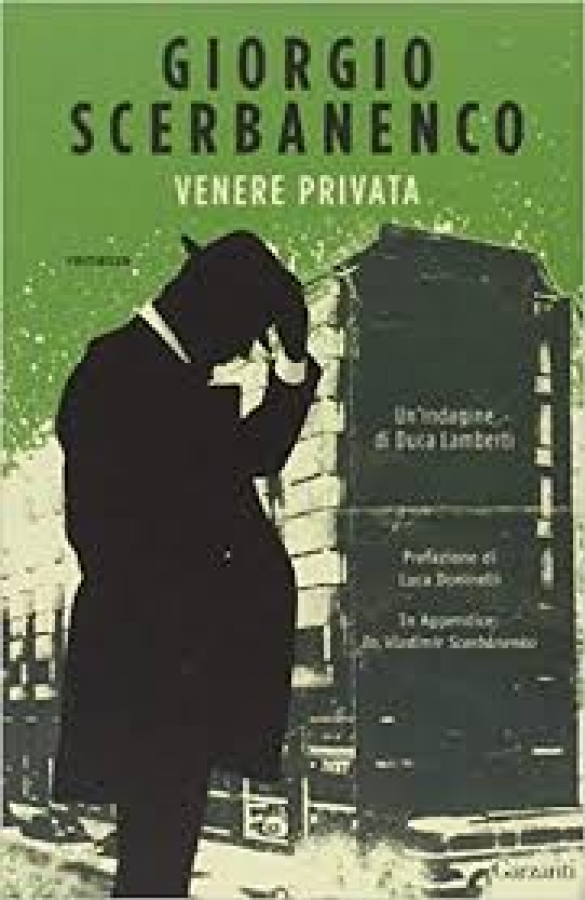
A Private Venus
Duca Lamberti is a physician struck off the medical register for having ended the life of a terminally ill patient; he has been released from prison and is offered a singular job: to rid the young scion of a prominent industrialist, Davide Auseri, of his alcoholism. > It was a sweet face, like a page’s, yet virile, untouched as yet by alcohol.(...) What expression did that face have? He searched for it, and then remembered what expression it was: that of a boy taking an important exam, unable to answer a question—an expression of anguish and timidity, and a few pathetic attempts to appear natural . Though perplexed, Lamberti accepts the assignment because > he is the prince of social redemption ventures, the duke, ah, what humour: freeing humanity (...) from the scourge of alcoholism; freeing humanity from the fear of death . There is also a second motive, lurking deep within the soul, in that interior world from which we always seek to escape: > the onslaught of thoughts, of memories, but when the tide rolled in, it submerged him and battered him far more than he had ever feared. All right, move on, he had gotten everything wrong . The first part of the novel seems redundant compared to a "noir > , which tells of the Milan of prostitution, immoral blackmail, and the ruthless violence inflicted upon naive, fragile girls. The premise frames the figure of Duca Lamberti, a former physician turned makeshift investigator, who finds in the police inquiry the solution to the causes of young Davide's alcoholism and, simultaneously, discovers a purpose for his own life. Thus emerges a character plunging into the abyss of an upwardly mobile, wealthy, and seemingly happy Milan. Everything was going filthily wrong in ways the placid, efficient Milanese (...) could not imagine, even if every day in the *Corriere* they read major stories of that kind; yet to them they belonged to a fourth dimension of an Einstein of crime, even more incomprehensible than the Einstein of physics." At this point the "noir > , whose plot we will certainly not recount, let alone its conclusion, can begin. Scerbanenco brings Raymond Chandler to mind (see the review of *The Long Goodbye*). As with the great American writer, the noir is a "non-noir" > . The order that characterizes the detective novel is absent; we are not in the presence of a solid plot that resolves into a triumph of good over evil. Everything remains opaque. Consider the novel's heroine: Livia Ussaro. Duca is drawn to her ( distinguishing marks: the way she looked at him was not in the least fair > ), yet he exposes her to the point where the girl will be scarred by the criminals, and Lamberti waits, failing to intervene to save her. "Enough now," he too thought of Livia, or was it a prayer, more than a thought. (...) "Do we really have to stay right here and wait > . (...) Shut up, shut up, why did he always have to get involved in dead-end situations, in eternal principles. (...) When someone had a sick head like his, he knew no bounds . As Luca Doninelli writes in the preface, in Duca Lamberti there is a melancholy > that stems from a gaze more disenchanted (I would even dare say: more cynical) than that of the criminals. (...) He is not good, thank God: he merely sees further, and is not afraid to look. He sees as far as there is to see. The charm of the novel lies in the writing: reading just a few pages is enough to be captivated by the elegance of the language and the melancholic sweetness of Scerbanenco’s Italian. I highly recommend the account of the poor girl’s entrapment, a victim of criminal machinations. As the poet says, speaking of the sad fate of a spider lured by a swallow, > the festively adorned stars,/call to him softly,/and let fall traces/visible to weeping,/while they veil the snowy/enchantment of their faces . (Enrico Cavacchioli, *Il ragno*). With the same poetic register, Scerbanenco conjures a muted atmosphere, a sadness that overwhelms and fascinates us. (The review of *L'isola degli idealisti* can be read on this site). Why read it? Let us be enthralled by the writing.

The Island of the Idealists
> Many years ago, on a tiny island in an Italian lake, lived several people whom the present story concerns . Carla > already had hair turned very grey, in this nineteen-thirty, but her face was sweetly fresh, youthful, and getting to know her explained the style of her novels . Her father, old Antonio, often reprimanded her because he disapproved of his daughter's books, despite their great success; he also criticized his son Celestino, “too tall and big and strong.” > You are all intellect, just as famous tenors are all voice. As for the rest, you have nothing; you lack even common sense. There were other guests as well: a cousin and his wife, Jole and Vittorio, poor and young relatives, Giovanni the caretaker and two maids, and the dog Pangloss, whom Celestino desperately tried to teach to recognize numbers. Nothing ever happened. > It was a land, exceedingly rare, devoid of events. One merely lived, and that was already much; (...) yet this story would not exist had a certain event not occurred, beginning on a certain May evening of that year. Two petty rascals arrive on the island seeking refuge, having lived off hotel thefts, gambling, and small-time scams. Guido and Beatrice make no secret of being pursued by the police; yet Celestino decides to welcome them, partly already intrigued by the woman—of a soft, serene, and at times coarse sweetness—and partly because he has an objective: to teach the pair to be honest. Celestino devises a scientific curriculum; after all, as old Antonio remarks, > here things are taken too seriously. Eternity, truth, infinity, mathematics . As was to be expected, the program fails miserably: Guido and Beatrice steal money and jewelry, then, once discovered, depart to resume their usual life. “A year has passed, everything seems as before: but it is not true.” The island is quarantined due to scarlet fever, brought by a young orphan taken in by the family; Guido and Beatrice reappear on the island, but struck by a tone markedly different from the previous time. > The clothes they wore immediately revealed their decline, their misfortune. They must have gone through a truly bad stretch, and they stood before him (Celestino), without shame, but also without bravado. Their manners were no longer as easy as before; they stood almost awkward and conscious of their awkwardness, yet without any will to resist their dejection . This time, Celestino's program seems easier: before him are two pupils, humble, resigned, willing to learn moral values and an honest trade. There is something more: the generosity of Carla and Celestino turns first into compassion, then affection, and ultimately love—Carla for Guido and Celestino for Beatrice. And so we might say that it is neither science nor virtue that transforms humanity, but love. It would make for a fine ending, romantic and reassuring, were it not for another occurrence: Jole and Vittorio, who have spent four years on the island, have systematically stolen from the family that took them in; once discovered, they abandon the island with the stolen goods only to betray everyone, denouncing Guido and Beatrice to the police and plunging old Antonio into legal trouble for having harbored two fugitives. I refuse to reveal the ending. It is a fable, written with elegant lightness, which conveys three important messages: it is futile to retreat into an island of mediocre security, for events are larger than we are and sweep us away; scoundrels hide behind respectable and friendly figures, in a kind of “inverted world”; and finally, without empathy (pity, solidarity, fellow-feeling), one gets nowhere. These are timely messages: I leave it to the reader to judge. The novel bears the date 1942; in truth, it was never published, although it was likely commissioned by the *Corriere della Sera*. This partly explains the fragility of the plot, slender and predictable, and the superficiality of the characters, merely sketched and more stereotypical than fully realized figures (Celestino above all); the narrative also marks a watershed between the numerous stories published up to 1940 (romance fiction bearing the imprint of the fascist climate) and the great postwar detective novels: the author is on his way toward a new, more incisive style. Why read it? Elegant, steeped in sweet melancholy.