Finished reading on: March 25, 2020
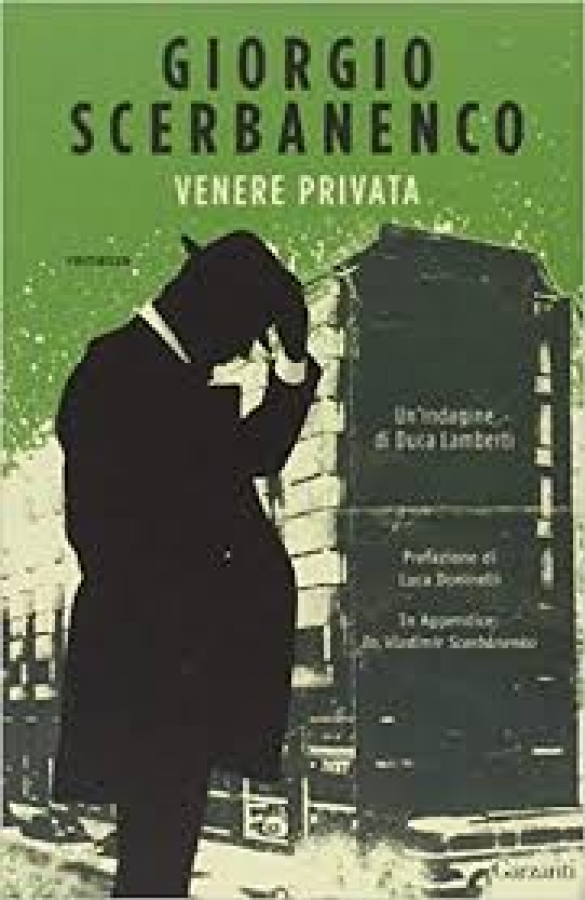
A Private Venus
Title of the original version reviewed: «Venere Privata»
AI Translation Notice: This review was translated from the original Italian using artificial intelligence. Book quotes and excerpts are translated interpretations and will not match the author's original English phrasing or official published translations.
Duca Lamberti is a physician struck off the medical register for having ended the life of a terminally ill patient; he has been released from prison and is offered a singular job: to rid the young scion of a prominent industrialist, Davide Auseri, of his alcoholism.
It was a sweet face, like a page’s, yet virile, untouched as yet by alcohol.(...) What expression did that face have? He searched for it, and then remembered what expression it was: that of a boy taking an important exam, unable to answer a question—an expression of anguish and timidity, and a few pathetic attempts to appear natural
. Though perplexed, Lamberti accepts the assignment because
he is the prince of social redemption ventures, the duke, ah, what humour: freeing humanity (...) from the scourge of alcoholism; freeing humanity from the fear of death
. There is also a second motive, lurking deep within the soul, in that interior world from which we always seek to escape:
the onslaught of thoughts, of memories, but when the tide rolled in, it submerged him and battered him far more than he had ever feared. All right, move on, he had gotten everything wrong
. The first part of the novel seems redundant compared to a "noir
, which tells of the Milan of prostitution, immoral blackmail, and the ruthless violence inflicted upon naive, fragile girls. The premise frames the figure of Duca Lamberti, a former physician turned makeshift investigator, who finds in the police inquiry the solution to the causes of young Davide's alcoholism and, simultaneously, discovers a purpose for his own life. Thus emerges a character plunging into the abyss of an upwardly mobile, wealthy, and seemingly happy Milan.
Everything was going filthily wrong in ways the placid, efficient Milanese (...) could not imagine, even if every day in the Corriere they read major stories of that kind; yet to them they belonged to a fourth dimension of an Einstein of crime, even more incomprehensible than the Einstein of physics." At this point the "noir
, whose plot we will certainly not recount, let alone its conclusion, can begin.
Scerbanenco brings Raymond Chandler to mind (see the review of The Long Goodbye). As with the great American writer, the
noir is a "non-noir"
. The order that characterizes the detective novel is absent; we are not in the presence of a solid plot that resolves into a triumph of good over evil. Everything remains opaque. Consider the novel's heroine: Livia Ussaro. Duca is drawn to her (
distinguishing marks: the way she looked at him was not in the least fair
), yet he exposes her to the point where the girl will be scarred by the criminals, and Lamberti waits, failing to intervene to save her.
"Enough now," he too thought of Livia, or was it a prayer, more than a thought. (...) "Do we really have to stay right here and wait
. (...) Shut up, shut up, why did he always have to get involved in dead-end situations, in eternal principles. (...) When someone had a sick head like his, he knew no bounds
. As Luca Doninelli writes in the preface, in Duca Lamberti there is a melancholy
that stems from a gaze more disenchanted (I would even dare say: more cynical) than that of the criminals. (...) He is not good, thank God: he merely sees further, and is not afraid to look. He sees as far as there is to see.
The charm of the novel lies in the writing: reading just a few pages is enough to be captivated by the elegance of the language and the melancholic sweetness of Scerbanenco’s Italian. I highly recommend the account of the poor girl’s entrapment, a victim of criminal machinations. As the poet says, speaking of the sad fate of a spider lured by a swallow,
the festively adorned stars,/call to him softly,/and let fall traces/visible to weeping,/while they veil the snowy/enchantment of their faces
. (Enrico Cavacchioli, Il ragno). With the same poetic register, Scerbanenco conjures a muted atmosphere, a sadness that overwhelms and fascinates us. (The review of L'isola degli idealisti can be read on this site).
Why read it? Let us be enthralled by the writing.