Finished reading on: May 03, 2026
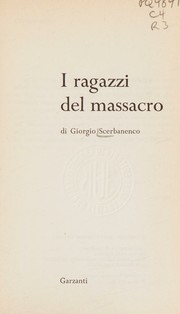
The Boys of the Massacre
Title of the original version reviewed: «I ragazzi del massacro»
AI Translation Notice: This review was translated from the original Italian using artificial intelligence. Book quotes and excerpts are translated interpretations and will not match the author's original English phrasing or official published translations.
It is chilling to read this novel in light of a recent news story, in which a boy stabbed his French teacher, unleashing upon her a hatred and violence one would never wish to see harbored in an adolescent. We are in the 1960s, in an “old and poor Milan,” yet already convulsed by traffic that was “unpleasant, irritating; drivers glared at one another with hatred, the traffic lights were always red, (...) and outside nothing could be seen, only the fog.” In this city so different from today's, a heinous crime has been committed: eleven boys have raped, beaten, tortured, and ultimately murdered a frail night-school teacher. True, they are already petty criminals: some the children of “honest parents,” others with fathers in prison and mothers working as prostitutes, but all of them known to the police for acts of violence, petty theft, and alcohol abuse. For the chief inspector, it is a straightforward case: they are all guilty, and the essential thing is to get rid of this “rabble” as quickly as possible, handing the matter over to the investigating magistrate, the reformatory, and prison. Not so for Duca Lamberti, the protagonist of Scerbanenco’s detective novels (see the review of Venere Privata on this site): an unusual policeman for whom “truth was the only thing that mattered (...), even if, in the end, it was of no use.” It arouses his suspicion that they all say the exact same thing: “namely, that they hadn't done anything, that they had been forced to stand in a corner while the others did everything.” It is too clever a defense, and maintained by all of them, as though prearranged. “This line of defense was concocted before the crime, and by someone smarter and not drunk like those boys,” Duca Lamberti concludes. From here unfolds a police investigation made not of deft, subtle reconstructions designed to trap the suspects and force them into confession; nor does the inquiry dissolve into sociological analyses or excuses to narrate the protagonist's life. Everything remains in the background. Only occasionally are there brief brushstrokes of a Milan that longed to remain that of the late nineteenth century, with its taverns, still trani and not yet bars, where the drunkards “still fell asleep, as in the days of Porta, their heads resting on their arms, and there were the aging prostitutes, (...) and there was the tired, kind flower seller, limping gently. (...) The row of parked cars stretching the entire length of the street took nothing away from this innocence: they were the intruders.” And feelings appear fleetingly, timid, conveyed through small gestures: “‘Sleep,’ she said, ‘and keep me warm.’ They would make love another time, she knew. He warmed her, but did not sleep; he tickled her neck with his stubbly, unshaven cheek, and his breath was a warm whisper on her breast that kept her from sleeping.” Duca Lamberti’s approach stems from the empathy he feels for these boys, or at least for some of them. He attempts to forge a relationship of care with them, encouraging them to open up not out of fear of the police, but so that they might understand the evil they have committed—an evil devastating first and foremost to themselves. Not that he fully succeeds: the first boy, frail and young, a homosexual, kills himself, destroyed by guilt; the other, fourteen-year-old Carolino Marassi, an orphan and petty thief, comes close to being killed. Duca Lamberti makes mistakes; he is often depressed when confronted with such cruelty, and dispirited when Carolino runs away, betraying the trust placed in him. “‘He’s a good boy,’ Duca said, ‘but you’ve never been in a reformatory or in prison or an orphanage, and you cannot understand what freedom means to a boy like that.’”
Confined to a literary genre, Noir, traditionally regarded as second-rate, Scerbanenco is rarely counted among the great Italian writers of the second half of the twentieth century. Perhaps his dry, concise, unadorned style, often mistaken for literary poverty, contributed to this as well. Far from it: Scerbanenco’s style is the result of a deliberate pursuit of essentiality, mirrored in a plot admirably stripped of redundancy, as well as in his prose and vocabulary. There is no need for distractions or idle digressions: the story and the “boys of the massacre” speak for themselves. They reveal more about our society, and about abandonment, than any number of sociological analyses or moralistic reflections. The writer’s sole task is to recount their despair, shouldering its weight.
Why read it? A splendid noir, an intense social novel.