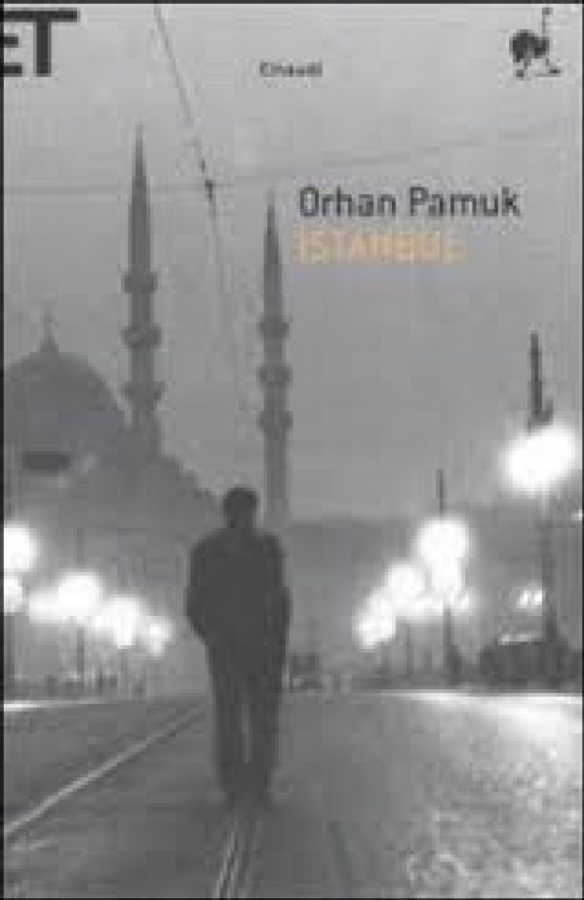
Finished reading on: June 14, 2014
Istanbul
AI Translation Notice: This review was translated from the original Italian using artificial intelligence. Book quotes and excerpts are translated interpretations and will not match the author's original English phrasing or official published translations.
I know that my inspiration draws strength from my attachment to the same house, the same street, the same view, and the same city...
this bond of mine with Istanbul means that the fate of a city can become a person’s character
.
In this book, Pamuk recounts how he became a writer, yet in doing so he cannot help but speak of his Istanbul—the city of the 1950s and 60s, in full decline, not by chance narrated and photographed in black and white.
So tight is the interweaving of the city’s history, enshrined in the “details of the past,” and the history of his own identity as a writer and an individual, that it becomes evident how the convulsive transformation of Istanbul has inexorably aged Pamuk himself, leaving him no longer an interpreter of the contemporary era.
The novel has no plot in the strict sense, but is rather an assemblage of microcosms, episodes, reflections, and impressions.
To give a general coherence to the narrative, three narrative threads can be identified.
First and foremost, the biographical thread speaks of childhood and adolescence, of the extended Pamuk family, of the houses, and of the parents’ marital crisis.
Pamuk’s formative journey does not involve the written page.
There are neither reckless, childish attempts at writing nor great books that “changed a life.”
The books read and reread by the young Pamuk are “the collection of facts and curiosities,” preferably enriched with drawings and photographs, that form
a seductive, terrible, and at times disgusting compendium of curiosities, events, and bizarre characters
.
From here, the transition to painting is natural: it allows one to contemplate and depict the panorama of Istanbul, initially “unanimously deemed beautiful,” later marked by the signs of decline.
I would draw the small mosques, the ruined walls, the Byzantine arches of which only a part remained visible, the overhanging wooden houses, and the modest dwellings
.
In painting, Pamuk discovers the pleasure of artistic creation.
Only now did I realize, through a more complex and astute spiritual leap, the desire to escape from myself....
sometimes I lost control of the drawing...
and something would sweep me along impetuously, lifting me pleasantly: only when it ended, like a wave that dissolves as it breaks against the rocks, after freeing myself from wonder and sadness, could I rest a little
.
To understand why Pamuk decides to become a writer, abandoning the faculty of architecture and his passion for painting, one must turn to the second narrative thread: the survey of the great Turkish and Western writers who wrote about Istanbul.
It is necessary to know this literature to appreciate the pages dedicated to it.
One grasps, nonetheless, how Pamuk looks at his city through the words of Western observers, to the extent that the latter’s descriptions of Istanbul seem like
a personal memory.
Naturally, this is also aided by the fact that Istanbul’s population has tenfold increased in the meantime, and certain avenues and squares, despite remaining entirely unchanged, now seem like completely different places due to the crowds.
I always feel nostalgia for the years when the city was solitary and empty
.
One always returns to Istanbul, to
this mingling of history with ruins, of ruins with life, and of life with history
.
The third narrative thread consists of the description of the city, the contemplation of the Bosphorus, and wanderings among
the remnants of the old urban fabric made of wood and stone
.
Whoever has had the opportunity to lose themselves in the Armenian and Greek quarters or to walk down from Taksim toward the shores of the Bosphorus can appreciate what Pamuk writes and understand that
perhaps we love the place where we live only because we have no other choice, just as with family.
Yet we must discover where and why to love it
.
It is futile to hope to find in the book a guide for a stay in Istanbul.
Too distant and confined is Pamuk’s city compared to today’s—multiform, youthful, dynamic, and gigantic.
The book speaks of the profound bond we all share with the places of our lives, which we often take for granted, as an obvious given.
It is a reciprocal relationship, one that must be defended and built day by day, sustained by the daily effort to
attune one’s state of mind to the panoramas the city offers.
And such an endeavor, if undertaken with naturalness and sincerity, leads one to unite, within memory, the city’s images with one’s deepest and most sincere feelings—with sorrow, with sadness, and from time to time with happiness, the joy of living, and optimism.
If we learn to look at a city this way, and if we live in it long enough to find the opportunity to forge a lasting bond between its views and our truest, deepest feelings, after a while...
the streets, the images, the landscapes of our city are transformed, one after the other, into realities that evoke certain feelings and states of mind within us
.
Why read it? Let us set Istanbul aside; let us speak of the bond with our own city, and of memories, and of feelings.