Finished reading on: May 21, 2026
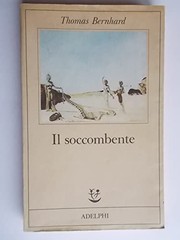
The Loser
Title of the original version reviewed: «Il soccombente»
AI Translation Notice: This review was translated from the original Italian using artificial intelligence. Book quotes and excerpts are translated interpretations and will not match the author's original English phrasing or official published translations.
<<As soon as he sat at the piano, Glenn would instantly shrivel up, I thought, and then he looked like a beast, but looking at him more closely he seemed a cripple, and looking at him even more closely he appeared as that handsome and intelligent man he actually was>>. If one wishes to attempt to understand this tale, delirious in so many ways, it is best to go to YouTube to watch and listen to Bach's Goldberg Variations, played on the piano by the "legendary" Glenn Gould. One must do so because Bernhard speaks of "genius" and of what happens to anyone who encounters a personality unreachable in artistic stature: one cannot help but be a "loser." <<There is nothing more dreadful than to see a human being who is so magnificent that his magnificence annihilates us, and while we observe this process and endure it and in the end can do nothing but accept it, (...) but then there is nothing left to be done, it is over for us>>. The first-person narrator, Wertheimer, and Glenn find themselves in Salzburg as pupils of a renowned piano teacher. The first two are young virtuoso pianists who could have enjoyed successful concert careers; yet the encounter with genius proves fatal, for both realize they can never measure up to the "legendary" Glenn, that they would never be capable of playing the Goldberg Variations as their friend does. Both—the narrator and Wertheimer—abandon music: the former even gives away his splendid Steinway and retreats to Madrid to write about Glenn, caught in a frantic and inconclusive revision of the great pianist's work; the latter shuts himself away in a solitary hunting lodge, strumming an out-of-tune piano. Upon hearing of Glenn's sudden death, Wertheimer kills himself. The narrator seeks to understand the deeper reasons behind his friend's suicide. Had he always been unhappy, like those depressives who carry within themselves the "pain of living"? Is it the fate of "losers"—<<they do their utmost to tyrannize the world around them and gradually kill off the people who associate with them, I told myself>>? Or was <<Wertheimer unable to see himself as a unique being in the world, whereas in fact this is how each of us can and must allow ourselves to see ourselves if we do not wish to fall prey to despair>>? To fathom the mystery behind his friend's suicide, the narrator has Wertheimer's final dwelling opened—the place where he had holed up—and discovers a worthless grand piano, <<an atrociously out-of-tune piano>>, upon which rests the sheet music for the Goldberg Variations; and the narrator, too, longs to return to the piano after years away, to measure himself against genius, and perhaps he as well will lose himself in the attempt to emulate the legendary Glenn.
After reading this tale, one might exclaim: "Long live mediocrity!" What suffering lies in every artist who cannot emulate genius! Perhaps Francesco Petrarch's depression stemmed from his jealousy of Dante, as his friend Boccaccio affectionately pointed out to him; and for this reason he attempted, with the Triumphs and Africa, to write two epic poems that would rival the supremacy of the Divine Comedy—and dramatically failed. And what of Dante, who in Canto XXV of the Inferno hurls a challenge at Ovid, claiming his own superiority in the poetic invention of metamorphoses: "Let Ovid now be silent of Cadmus and Arethusa, / for if him into a serpent and her into a fountain / he turns in verse, I envy him not" (lines 97–99). To console ourselves, nothing remains but to cage great men <<in our bookcases, from where, condemned to ridicule forever, they gaze at us wide-eyed, so he said, I thought>>. For the legendary Glenn, the sentence is a YouTube video: having fled the concert stage for an isolated country house, he will be condemned to be listened to for eternity as a pianist "imprisoned" by his own renown; we, mediocre men, shall be truly free because we are anonymous.
The plot of the tale is non-existent; it resembles a soliloquy, with a fluid yet at times nonsensical syntax, marked by a cadence reminiscent of theatre rather than prose: everything has unraveled, nothing makes sense, one can only recount the recurrence of thoughts and memories—even then with profound doubts, under the rhetorical refrain "so he said, I thought."
Why not read it? It is tremendously exhausting. It can sit nicely on a bookshelf to make a fine show of our culture.