Go to hell, Dante!
Vasco Guidobaldi, scion of an ancient and wealthy Florentine family, is a spoiled, arrogant, and selfish adolescent, accustomed to always having his way—at home, at school, and with his friends. Having recently lost his mother, his father has retreated into deep isolation; beneath the veneer of a carefree boy lies acute suffering, a blend of remorse and resignation. He vents his rage through Fortnite, a video game, a virtual battlefield where he often emerges victorious. > To clearly separate my real life from Fortnite there is no river, there is no mountain, but only an imaginary frontier that I often cross without realizing it....) I like the game, because the adrenaline rushing into my gut drives away the lion gnawing at my heart, just as hatred does when I play Fortnite. At least for that hour. When, out of nowhere, a new player bursts into Fortnite and wipes the floor with Vasco; calling himself Dante, he issues a warning: > you were not made to kill the B.R.U.T.E./but ever to succumb to Dante's might./Soon you shall know why I have come . Perhaps too early for the narrative's suspense, we discover that this new competitor is none other than Dante Alighieri himself, descended to Earth at the behest of Vasco's mother, who worries for her son. > In that fair heaven of blessed souls/a gentle shade approached me/with the elegance of fairies./(...) be his guide as Virgil was to me, /teach him love and wisdom,/as though he were your son and not mine. (...) This thing drives me wild with joy, but also just drives me mad. It’s as if I saw her through unbreakable glass; our hands can draw close, but never truly touch . And while it is predictable that maternal love works the miracle of redemption, there is genuine interest in the inversion of Dante’s character: from an unwitting traveler journeying toward beatitude through the grace of Virgil and Beatrice, he here becomes the Guide himself along an adolescent's path. His relationship with Vasco, to whom he is both mentor and friend, humanizes the great poet, so often depicted as haughty, aloof, and prematurely aged. It would have been a fine lesson for so many tedious Dantists and pedantic schoolmasters, yet this brilliant intuition is left undeveloped by the author: much like Manzoni’s Unnamed (see the review of *I Promessi Sposi* on this site), Vasco undergoes an effortless conversion, turning into a well-behaved boy—studious, gentle, ready to offer solidarity and love. Three hundred useless pages follow. We are presented with a coming-of-age novel in which quintessentially youth settings—video games, soccer, and rap music—are effectively blended with the *Divine Comedy*, retold in this manner for a teenage audience. The author is clearly an attentive reader of Dante Alighieri, perceptive of the profoundly contemporary resonances of his poem, as when he puts these words into the poet's mouth: > Learn that love is not coin. /A thousand kisses will not make you rich/if with your feelings you remain a miser.(...) I, instead, loved as the sun teaches/who never laid a hand upon the moon/(...) At every dusk, he yields the sky to her . One feels the full presence of *Paradiso*, where love for Beatrice, and for the supreme Good, allows Dante to «trasumanar» [transhumanize] and renders him «one who sees in dreaming» (Canto I, line 70 and Canto XXXIII, line 58 of *Paradiso*). Once again, as in *Harry Potter* (see the review of *Harry Potter and the Philosopher's Stone* on this site), the transition from adolescence to adulthood requires the intervention of an external force endowed with magical powers, precluding any autonomous development of consciousness—unlike what occurs in *Treasure Island* (see the review of *Treasure Island* on this site). Considering that this book is addressed to young readers, one must regretfully note how, once more, the message remains paternalistic and overprotective, ultimately failing to foster any genuine individual growth. Why not read it? It is boring.
My Father's Suitcase
> The culprit is not just that book, the book that deceived my son, but all books pouring from the printing presses; they are all enemies of our time, of our life . So speaks the protagonist’s father in the novel *The New Life*, referring to the book whose pursuit forms the core of the son’s whirlwind journey across Turkey. And in another passage of the same novel, Pamuk clarifies how > a good book is a piece of writing that explains things that do not exist, a sort of absence, a kind of death. But it is futile to search outside the book for the country that lies beyond words . These are bleak and despairing reflections that seem to lead, by way of literature, to loneliness, to the incommunicability between people and between them and objects, to a world where one shuts oneself away, "hiding the keys" (from *The Black Book*). Can narrative be joined with life, or is this possible only in the immobility of the mannequins so brilliantly fabulated in the final chapter of *The Black Book*? It is with the hope of clarifying what Pamuk truly thinks that one approaches the reading of this short volume, which collects several lectures by the author. And once again, Pamuk surprises us. In his Nobel lecture, the author addresses the theme of literature by recounting an emblematic episode from his life—a kind of metaphor, yet real. He relates how his father had kept in a small suitcase some pages written during a youthful stay in Paris. For a long time, Pamuk was afraid to open the suitcase > and read his notebooks because I knew he would not have tolerated the hardships I had endured, that it was not solitude he loved, but mingling with friends, the crowd, salons, jokes, company... In truth, I was angry with my father because he had not lived as I had, had not suffered anxieties, and had spent his life happily, laughing and joking with the people he cared for... (and only sometimes) my father would stretch out on the sofa before his books, let the volume or magazine in his hand drop, and lose himself for long stretches in his thoughts, in dreams . In the differences between the father, reconciled with the world, and the son, at odds with himself and his surrounding context, lies unhappiness—or rather, the pursuit of an unattainable happiness: > to be a writer is to acknowledge the secret wounds we carry inside us, wounds so secret that we ourselves are barely aware of them, patiently exploring them, studying them, illuminating them, and making these wounds and pains a part of our writing and our identity . Writing is like a medicine that "tastes of ink and paper"; if unable to take it, > I feel unhappiness turning me into a kind of concrete man . Shutting oneself in a room to write is > managing to find the hope to get through the day, or rather being happy and rejoicing if the book or page that takes you into a new world is good . Novels > are shaped to carry with happiness the dreams novelists wish to dream. Just as they bestow happiness upon the good reader, they offer the good writer a solid and secure new world where he can escape and be happy at every hour of the day . Writing and reading are an escape from reality into a world created by ourselves, > patiently, as if digging a well with a needle, it then appears to me more real than anything else . > Now I understand that thousands of miniaturists, in delicate secrecy drawing the very same patterns for centuries, had drawn the secret and delicate transformation of the world into another world (from *My Name Is Red*). Literature is a continual return to the same tender and nostalgic dream: yearning to be happy without truly transforming the world. Why read it? It clearly illuminates Pamuk’s thought.
The Old and the Young
The year 1893, in which much of the novel unfolds, was fraught with grave events for Italy, and for Sicily in particular. The government was embroiled in the Banca Romana scandal. In Sicily, the revolutionary outburst of the Fasci Siciliani movement, which had rallied a large part of the subproletariat (peasants and sulfur miners), was bloodily repressed by an army corps dispatched from the mainland. The dread of social revolution forged an alliance between the Bourbon loyalists and the patriotic factions of the island’s ruling class, as well as between the latter and the northern bourgeoisie. It was a decisive year for the history of the Mezzogiorno, sounding the death knell for the lingering hopes of a southern renaissance fostered by the Unification of Italy. Against this backdrop, Pirandello, still under the sway of *verismo*, penned an ostensibly historical novel, yet one deeply woven with memories of his native soil and family, steeped in a bitter sense of dejection that only estrangement from the affairs of life can render bearable. The novel is divided into two parts. The first, undeniably the more accomplished, is set in Agrigento, which, > in the wretched remnants of its ancient life gathered up there, rose silent and astonished, a survivor in the void of eventless time, in the neglect of a shelterless squalor . The gulf between past grandeur and present decay is conveyed not merely by the landscape, but also by the clash between the old and the young. The former are emblematically embodied by Prince Ippolito (an unyielding Bourbon loyalist) and Mauro Mortara, an aging Garibaldian soldier who subsists on the glorious memory of Risorgimento exploits. While the old remain entrenched in the roles thrust upon them by history, moving with steadfast conviction, the young are instead adrift, weighed down by a present life ever further removed from Risorgimento ideals, at a loss as to which values might offer them roots. Between the old and the young stir the opportunists—those who, out of self-interest or sheer indolence, capitalize on the moral decay of Italian society. There exists, furthermore, another faction, which has grasped “the vanity of time” and retreated into isolation on the fringes of madness. As the reading progresses, one becomes keenly aware of the narrative’s contemporary resonance. Are we reading of nineteenth-century Sicily, or of contemporary Italy? Is the rift between the old and the young the eternal generational conflict, or rather the consequence of a dispiriting, desolating inheritance bequeathed by past generations to their successors? > What could youth do, if the grasping, fearful, overbearing jealousy of the old crushed it so, with the weight of the basest prudence and of so many humiliations and disgraces? If to youth fell the furious, silent expiation of all the errors and unworthy compromises, the mortification of every pride, and the spectacle of so much ugliness? Yet so long as the social order remains immutable, each can comfortably enact the role assigned to them or assumed by choice: the revolutionaries can shout slogans against the powerful, the latter can hatch illicit schemes and villainies, the old can cling to their values, while the young let themselves be swept along and, ultimately, ruled by the opportunists. It is a comedy whose tragic nature stems not from the characters’ awareness, but from the desolation of the landscape and the blinding poverty of the common people. What a stark contrast between Pirandello’s prose, which betrays an intimate communion with his land, and that of Camilleri, where Sicily is reduced to mere folklore and facile irony! This, too, bears witness to our country's decline. Social revolution and political upheavals forcefully intrude upon the play of fictions. The second part of the novel, largely set in Rome, charts the disintegration of roles and the necessity for each individual to confront the truth. All the characters find themselves in the predicament of Corrado Selmi, a Risorgimento hero turned hollow, corrupt deputy: > the candid, light smile that had accompanied every act of his life had turned into that grim, hard, bitter grimace. Once again, he felt afraid of himself: afraid of gaining a precise awareness of a certain dark, hideous thing that had suddenly lodged itself deep within his being, throwing him into disarray, leaving him with the impression of being torn apart inside, irreparably . And each reacts according to their own strength, stripped of all pretense: Corrado Selmi takes his own life. In a desperate bid to dissociate himself from the deceits of the powerful Flaminio Salvo, the decent yet submissive Aurelio Costa is slaughtered by the sulfur miners alongside Nicoletta Capolino, who had hitherto been a social climber, eager to trade her feminine charms for success. Dianella, the sole daughter of the wealthy Flaminio Salvo, descends into madness at the sight of her father’s depravities. Lando, Prince Ippolito’s son, concedes in the face of the violent uprisings that his socialist ideals were nothing more than intellectual yearnings. Even Flaminio Salvo confesses that his greed has culminated in nothingness, in vanity. Who, then, holds the truth? Perhaps Don Cosmo, Lando’s uncle, was right when he remarked: > It will pass, the corners of his mouth drawn down, his brow rippled as if by waves of thoughts pushed back by the ebb of his disconsolate wisdom, and with those eyes that seemed to banish and scatter into the vanity of time all the bitter and vexing contingencies of life. It will pass, my dear friends... it will pass . Pirandello the novelist is entirely subordinate to Pirandello the playwright. This trait is particularly pronounced in the second half of the book, where the narrative erupts into rigorous, tight, impassioned dialogues between characters who seem to perform upon a stage. In the first part, while one cannot speak of Pirandello as a *verista* or a social writer in the vein of Zola, the prose succeeds admirably in conveying the tragic essence of Sicily—a profound, infinite sorrow for a desolate land once resonant with life and culture. Why read it? It remains an acutely relevant book, for it portrays the Italy of today as well.
The Old Man at the Sea
> I was heading to the beach, (...) minding my own business, when suddenly everything came to a halt: the wind, the sea, the shrubs, the beating of heart and flutter of eyelashes, (...) and in that moment of disoriented stillness the only thing moving was a small figure outlined in gold: not a body, not a pirouette of dust, not a flicker of light, but a presence that dashed along the wood of the step and slipped into the sand just ahead. For the first-person narrator, the eighty-two-year-old on vacation by the sea, this small figure > emerged from deep within my body , like the "chimera" celebrated by Mario Luzi? ("she sets out between the walls, is prey to the light... / perhaps it was you, now it is an apparition"). Or is she instead one of Giorgio Caproni's girls? ( > girls barely visible / yet acutely sensitive / in the black air that shines / gleaming like a pupil ). Starnone's answer is not unequivocal; he leaves us in suspense. > Of what I know and do not know (...) that I should attempt to write. But it is difficult; it would take energy and confidence, not this present, doubting exhaustion that drifts into a sudden nod of sleep. The old writer nevertheless endeavors to construct a story, slender and elegant as a poem. The small figure is Lu, athletic, full of energy and youthful authority. Then there are other women, from Evelina, the owner of a clothing boutique, to her client-friends: all of them lovers of Evelina's husband, Silvestro the deceiver. Are they real characters or resurfacing remembrances? In Lu, as in the other women, the writer projects no senile erotic desire; instead, he seeks to extract from the girl's body > a mother alive, vividly alive, (...) a mother free of disease, under thirty, of benevolent radiance, capable of arousing envy and then taming it, transforming it into sympathy and affection. (...) Even now, in old age, that is the risk. I start with Rosa (that is the mother's name) and I want more Rosa, ever more Rosa, too much Rosa, so that I lose what little truth there is—a laugh as she fixes her hair with both hands—and slip into falsehood. And as often happens when one lets oneself become enveloped by memory, the mind returns to a recurring fragment of the remembered person's life; so it is for the writer in the most captivating scene of the entire novella, wonderfully poised between reality and fantasy. Rosa was a seamstress and received clients at home in front of her young son. Invited into Evelina's shop, all the sensations of those sessions resurface as he witnesses the client-friends choosing dresses. > I didn't miss a single flutter of an eyelash. (...) I violently caught the vital scent of that dressing and redressing, shaping and reshaping, and I recognized it. It was the very same as that of my mother's clients. The old writer asks to try some dresses on Lu, who until that moment was present only as a sales assistant. It is a crescendo of sensuality and remembrance. > The girl no longer had the eyes of a fatigued servant, but gleaming pupils. (...) Bodies evaporate, there's little to be done, ambitions scatter, possibilities thin out. But at least for now, that is not what is happening to Lu. She has closed herself off once and for all from my dying mother, and dress after dress, pleased gesture after pleased gesture, she has regained a healthy color; she is strong again, radiating the light of someone determined at all costs to take a breathtaking leap right up to the top of the world. The image of a sick old man facing the sea evokes Thomas Mann's *Death in Venice*; and perhaps it is this work that inspired Starnone rather than Ernest Hemingway's *The Old Man and the Sea*, echoed by the novel's title. It lacks the vigor of the American writer's masterpiece, while breathing that sensually decadent atmosphere of Mann's novella. The main theme is certainly the thought of death: nostalgias, remembrances, childhood images crowd the mind, brought to the surface by the regulars on the beach where the eighty-two-year-old spends his days, overlooking the sea. Running beneath the surface is a theme dear to Starnone: the craft of the writer. Nearing the end of life, one realizes that > manipulating the reality of facts, using it to draw out inventions with flashes of truth, was deceptively easy when I was young; in old age, it is a feeble attempt always one step away from dismay. What meaning is left in imagination, in believing oneself alive by making up stories? Starnone is one of Italy's most refined writers. Every single sentence deserves to be taught for its masterly handling of syntax and lexical elegance, all while remaining within a contemporary and universally accessible idiom. Yet this pursuit of detail comes at the expense of the overarching plot, which is slender and inconclusive. The focus on the first-person narrator flattens characters who are potentially interesting, causing the narrative to slip into a kind of narcissistic self-indulgence. Why read it? A masterclass in splendid Italian.
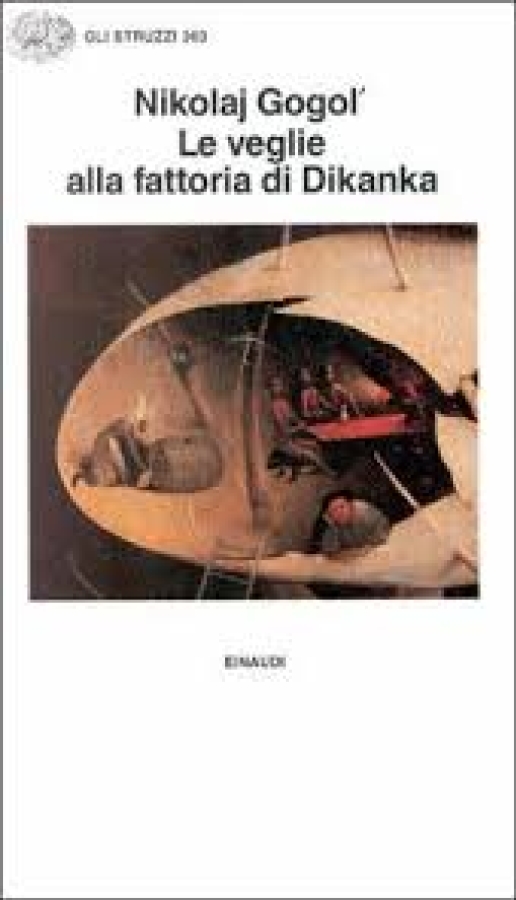
Evenings on a Farm Near Dikanka
> How intoxicating and magnificent is a summer day in Little Russia! (...) The towering oaks stand motionless with a lazy, carefree air, like individuals strolling aimlessly. (...) The variegated gardens are bejewelled with the emerald, topaz, and sapphire of airborne insects, and shaded by slender sunflowers. (...) Splendid is the Dnieper in fine weather: it flows free and majestic, swollen with waters, amid woods and hills, without a rustle or a murmur In this radiant setting, so beloved by Gogol, lies a small village, Dikanka, contented in the eternal cycle of the seasons, living a poor and serene peasant life. During the long, cold winters, it is the tales of the elders, the dances and festivities with pretty girls, and the Cossack revelries that make time pass merrily—"a casual cheerfulness, without mincing or affectation," as Pushkin wrote (see the quotation in Vittorio Strada's preface). Yet, these landscapes so rich in feeling, the brio, and the magic of these little tales are permeated by a subdued sorrow over the disappearance of Cossack society. We are in the second half of the eighteenth century, in the era of Catherine the Great (Empress of Russia from 1762 to 1796), when the independence of the proud Cossacks was subjugated to Moscow’s authority. There is none of the desperate cry of grief of *Taras Bulba*, faced with defeat and the betrayal of his son (see the review on this site); here, the looming destruction is embodied by "demons and witches," traditional figures of peasant lore used by Gogol to lend a shadowy cast to destiny. In the short story *A Terrible Vengeance*, a sorcerer employs all his diabolic power to bring death and bloodshed among the Cossack folk, slaying the noble ataman and his own daughter Catherine; and, echoing the Revelation of John > an unheard-of wonder had occurred near Kiev (...): the horizon had suddenly expanded so immensely that the outermost boundaries of the world could be seen. (...) The clouds lifted from the highest mountain, and upon its summit appeared an individual on horseback in full knightly array, (...) fearful and immense, (...) he hurled the sorcerer into the abyss , and all the dead > threw themselves upon him and seized him, sinking their teeth into him. What cheerfulness there could be in this harrowing prophecy would be good to ask Pushkin, if only one could. Not all the tales bear this apocalyptic stamp, so difficult to interpret. Throughout the stories, however, the petty tales of the people of Dikanka interweave two planes of existence: that of human beings, fashioned from weaknesses, subterfuges, intrigues, and greed, and that of the devils, who operate to disrupt and direct human life. Masquerading as a beekeeper-narrator, the writer seeks to gather the chatter exchanged around hearths on long winter nights, when one grows weary of music, songs, and revelry, as though he were a mere transcriber of oral accounts; and perhaps, therefore, it is I who have concocted who knows what morbidly prophetic fantasies in my head! In the 1842 novel *Dead Souls* (see the review on this site), Gogol writes that he wishes to narrate > the irritating sediment of petty things that clog our lives ; if there the setting is provincial society, here it is instead the humble folk, as in Émile Zola's *The Earth* and Giovanni Verga's *I Malavoglia* (see the reviews on this site). Particularly accomplished is the collection's central story, owing to the complexity of its characters and plot: *The Night Before Christmas*. Take, for instance, the scene in which the village notables are hidden in sacks so as not to be caught with their mistress: one feels as though witnessing a performance of the *commedia dell'arte* or a play by Molière. Or, in this very same tale, the meeting between the Cossack chieftains and Empress Catherine, in the presence of her renowned prince-lover, the founder of Little Russia and the port of Odessa (could he be the sorcerer?). With subtle irony, and without exposing himself politically, Gogol depicts the subjugation of the Cossack leaders; an aspect made all the more striking by the cunning of the humble village blacksmith, who manages to secure as a gift from the Tsarina a pair of little slippers he had promised to the girl he loved. For this tale alone, the book is worth reading. Why read it? It is sweet to lose oneself in a magical, ancestral world.
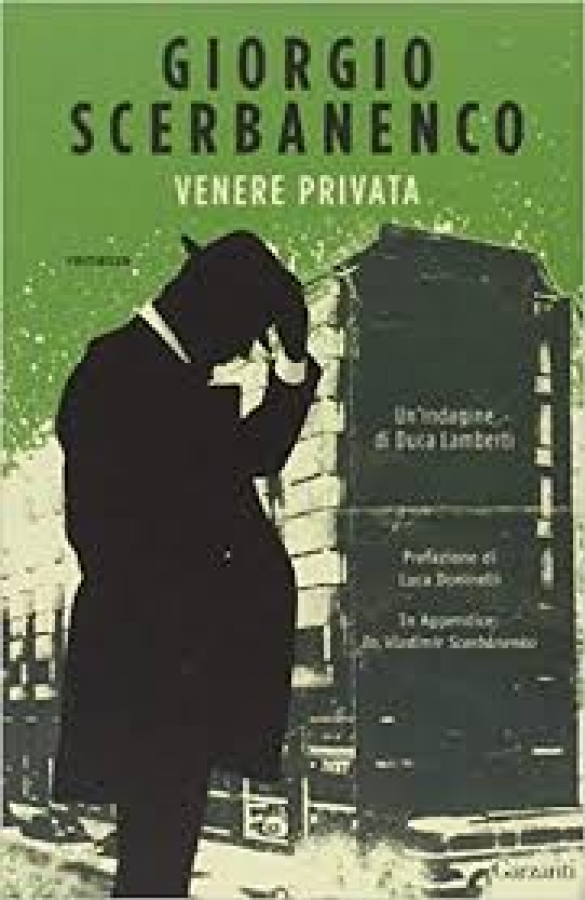
A Private Venus
Duca Lamberti is a physician struck off the medical register for having ended the life of a terminally ill patient; he has been released from prison and is offered a singular job: to rid the young scion of a prominent industrialist, Davide Auseri, of his alcoholism. > It was a sweet face, like a page’s, yet virile, untouched as yet by alcohol.(...) What expression did that face have? He searched for it, and then remembered what expression it was: that of a boy taking an important exam, unable to answer a question—an expression of anguish and timidity, and a few pathetic attempts to appear natural . Though perplexed, Lamberti accepts the assignment because > he is the prince of social redemption ventures, the duke, ah, what humour: freeing humanity (...) from the scourge of alcoholism; freeing humanity from the fear of death . There is also a second motive, lurking deep within the soul, in that interior world from which we always seek to escape: > the onslaught of thoughts, of memories, but when the tide rolled in, it submerged him and battered him far more than he had ever feared. All right, move on, he had gotten everything wrong . The first part of the novel seems redundant compared to a "noir > , which tells of the Milan of prostitution, immoral blackmail, and the ruthless violence inflicted upon naive, fragile girls. The premise frames the figure of Duca Lamberti, a former physician turned makeshift investigator, who finds in the police inquiry the solution to the causes of young Davide's alcoholism and, simultaneously, discovers a purpose for his own life. Thus emerges a character plunging into the abyss of an upwardly mobile, wealthy, and seemingly happy Milan. Everything was going filthily wrong in ways the placid, efficient Milanese (...) could not imagine, even if every day in the *Corriere* they read major stories of that kind; yet to them they belonged to a fourth dimension of an Einstein of crime, even more incomprehensible than the Einstein of physics." At this point the "noir > , whose plot we will certainly not recount, let alone its conclusion, can begin. Scerbanenco brings Raymond Chandler to mind (see the review of *The Long Goodbye*). As with the great American writer, the noir is a "non-noir" > . The order that characterizes the detective novel is absent; we are not in the presence of a solid plot that resolves into a triumph of good over evil. Everything remains opaque. Consider the novel's heroine: Livia Ussaro. Duca is drawn to her ( distinguishing marks: the way she looked at him was not in the least fair > ), yet he exposes her to the point where the girl will be scarred by the criminals, and Lamberti waits, failing to intervene to save her. "Enough now," he too thought of Livia, or was it a prayer, more than a thought. (...) "Do we really have to stay right here and wait > . (...) Shut up, shut up, why did he always have to get involved in dead-end situations, in eternal principles. (...) When someone had a sick head like his, he knew no bounds . As Luca Doninelli writes in the preface, in Duca Lamberti there is a melancholy > that stems from a gaze more disenchanted (I would even dare say: more cynical) than that of the criminals. (...) He is not good, thank God: he merely sees further, and is not afraid to look. He sees as far as there is to see. The charm of the novel lies in the writing: reading just a few pages is enough to be captivated by the elegance of the language and the melancholic sweetness of Scerbanenco’s Italian. I highly recommend the account of the poor girl’s entrapment, a victim of criminal machinations. As the poet says, speaking of the sad fate of a spider lured by a swallow, > the festively adorned stars,/call to him softly,/and let fall traces/visible to weeping,/while they veil the snowy/enchantment of their faces . (Enrico Cavacchioli, *Il ragno*). With the same poetic register, Scerbanenco conjures a muted atmosphere, a sadness that overwhelms and fascinates us. (The review of *L'isola degli idealisti* can be read on this site). Why read it? Let us be enthralled by the writing.
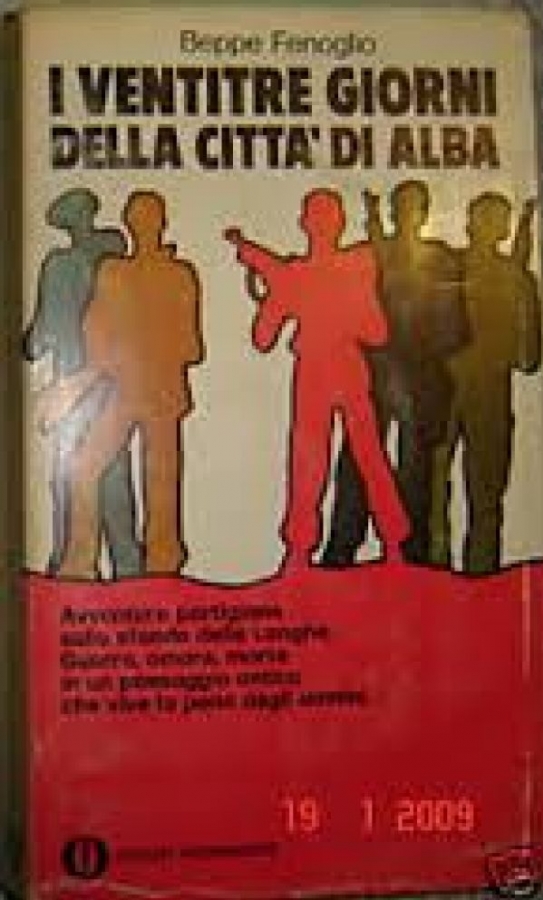
The Twenty-Three Days of the City of Alba
> It was the wildest parade in modern history: in uniforms alone, there was enough for a hundred carnivals. (...) Alongside the men marched the female partisans, dressed in men’s clothes, and here someone in the crowd began to murmur—Ah, poor Italy!—because these girls had faces and a gait that set all the townspeople winking . The partisans’ conquest of Alba lasted less than a month, and Fenoglio traces a realistic chronicle of it, devoid of rhetoric; at its center lies the contradictory nature of man. > But they weren't all whoring, of course; in fact, most were out commandeering cars, tires, and petrol. Not without quarreling among themselves with their safeties off, they tracked down and seized a great number of automobiles, with which they began a thrilling driving school along the ring road . Yet why does one become a partisan? To understand Fenoglio’s answer to this question, one must reverse the order of the stories, starting from the final ones, which seem ostensibly removed from the events of the liberation war. In *Pioggia e la Sposa*, a young boy is dragged by his aunt to a wedding, despite the torrential rain, which forces him (a «city-dressed boy») to cover himself with his priest-cousin’s hat. We understand that the boy has lost his mother; he is alone, and his aunt, stern and surly, is his only source of affection: > I saw that her eyes, together with her hand, grazed my soaked hair, and this time her hand was relaxed and tender, just as my mother’s hand had always been, and even her eyes seemed extraordinarily kind toward me, and less dark . Solitude turns into an anticipation of death in *L’odore della morte*: the protagonist, now a grown man, happens upon a girl and begins following her, merely to pass the time. He is attacked by her fiancé, but during the struggle he felt > that smell (...) already everywhere inside, having passed through his nostrils, his mouth, and his pores, unstoppable as the very power that distilled it; it must have already enfolded his brain, for he felt mad . In the other stories that do not deal with the partisan struggle, solitude, the prosaic nature, and the futility of life are recurring themes; flight, the resignation to an unhappy fate, and in some cases even suicide seem to be the only possible outcomes of the human condition. Thus, the choice to become a partisan is not the fruit of ideals; it is, rather, a revolt against an existence devoid of prospects. In the story *Un altro muro*, Max has been captured by the Fascists; he dreams of «the face of his corpse» and shouts to his cellmate: > do you feel up to dying for the idea? I don't. And what idea, anyway? If you search inside yourself, do you find the idea? I don't. And neither do you . At that moment > he hated his friends and comrades; he saw them that night roaming the high hills, free and masters of their own lives, armed, untroubled, and proud; he saw the hills illuminated as if by day by the moonlight on the frozen snow; he felt the wind coming in from the sea, sweeping through the great pass between the Apennines and the Alps . It is not the ideals of Justice and Freedom that move the partisans, but the desire for a primordial freedom: an indecipherable mixture of pent-up energy, of a longing for change, of standing alongside others on the right side. Yet partisan life does not resolve existential predicaments: either because death arrives too soon, or because war brings further violence and destruction in its wake. And in the end, once the liberation has been achieved, returning to a normal life is no longer possible and, as in *Ettore va al lavoro*, one knows only how to embrace the gun once more and go rob former Fascists. All the stories are remarkable, but one is especially so: *Gli inizi del partigiano Raoul*. > He intended to take Raoul as his nom de guerre. Along a completely deserted road he walked with a light heart; despite having left his widowed mother alone back in the village, he felt like nobody’s son—and that is the ideal condition for doing the two truly grave and hard things for an individual: going to war and emigrating . His headlong courage soon turns into revulsion at the life that awaits him: > what good is my education to me? Here, to hold out, you have to become a brute! And I don’t have it in me, I am good! Oh mama, mama! He thought back to dawn that very same day—could it really have been only eight hours ago? At night he regains his confidence while standing sentry, but when his watch ends and he finds himself back in a squalid, cavernous room, the sense of wretchedness returns, followed by fear. > How could the others sleep with such abandon? Were they certain they would live to see the morning? (...) The barn door flew open with a resounding bang, and the doorway filled with men clad entirely in black, as if masked from head to foot. (...) The beams of light terminated in white circles like so many tiny moons, zeroing in one by one on the faces of all the partisans. Whether due to that artificial light or something else, they were already all faces of corpses, with motionless eyelids and wide-open eyes. (...) Delio asked him—Slept well for your first time? There was a hint of malice in his voice.... È lʼincubo di un semplice ragazzo, non di un eroe. Fenoglio’s writing is consummate, now mature and confident. It loses certain idiosyncratic traits, such as the richness of idiom and the quest for neologisms. At times, it feels as though one were reading Cesare Pavese. Why read it? Magnificent stories: a mirror of the human condition.
Broad wind
Varì lives in Aùrno, a “dying sandstone village” on the Ligurian coast, near the French border. The olive trees, now old, no longer provide a living, and Varì works as a *passeur*, guiding clandestine migrants into France along mountain trails. In villages steeped in sun and sea salt, amid the wind and the heady fragrance of mimosa, many characters have sought a hiding place, from others and from themselves: an aging Dutch professor, his daughter who takes up with a smuggler, a butterfly collector, a gold prospector. The old peasants, the last inhabitants of these parts, and the newcomers live as if suspended, awaiting love, a different life, death. An old *passeur* is murdered and a young woman loved by Varì, Sabèl, disappears: she has gone to hide on an island near a convent in search of peace and a renewed balance. Was it she who killed the old *passeur* upon discovering she was his daughter? Varì waits for her in vain in his now-deserted village, until he realizes that his destiny is to live and die in hiding: “what life is there on those trails? None.” The subject of the book is presumably the existential angst of modern man, which manifests in solitude and the consciousness of having no future. In truth, however, what captivates about the book is its depiction of a nature that is magical, unreal, unchanged across centuries, and now unraveling. > Aùrno, six houses, had grand flights of terraces, among the rocks... a fountain gurgled all year long.... Aùrno was windy; but the winds, which lashed it, passed over the sea, which tempered them....Aùrno was dead. Luminous on account of the heights, the rocks, and the sun; yet now held in the grip of the lords of darkness . The fundamental merit of the book lies in the landscape, rendered in a style both spare and chromatic, almost like that of a painter contemplating the colors and sensations of nature. The existential anguish of the characters is eclipsed by the pursuit of pictorial effect, and their story remains mysterious, inscrutable, almost metaphysical. Why avoid reading it? To read it with full satisfaction, one would need to be in Liguria, up on those mountains: removed from that context, the story is too slight to be genuinely compelling.
Truth and Lie
Questo libro uscì postumo, ad un anno dalla morte dell'autore. Nel sito sono presenti le recensioni di *Lettere di una novizia* del 1941 (senza dubbio il migliore dei romanzi di Piovene) e di *Le stelle fredde* del 1971. Se in quest'ultimo racconto il confine tra la vita e la morte è dato da un vecchio ciliegio, la natura (il Carso, i colori, le antiche case) nella loro infinitezza e immobilità non offrono alcuna barriera. Come scrive Mario Luzi in *Diana, risveglio*, > nascono lieti immagini,/ filtra nel sangue, cieco nel ritorno, /lo spirito del sole, aure ci traggono/con sé: a esistere, a estinguerci in un giorno . Sergio lavora alla soprintendenza di Milano e scrive di politica, anche se ormai da tempo non ci crede più. Una telefonata del padre da Gorizia lo invita con urgenza ad una riunione familiare per decidere della sorte di Nico, un fratello con gravi problemi psichici. In realtà l'obiettivo è un altro: comunicare al figlio che intende suicidarsi. Tanti sono stati i presagi di questa cupa e drammatica decisione. Quando rivede il padre dopo molti anni Sergio si trova dinanzi ad una faccia, nella quale > c'era qualcosa di spaurito, la recessione verso il bambino magro che riappare per mescolarsi con il vecchio pesante, senile, uno sconcerto di crisalide in attesa di metamorfosi che non possono più avvenire . Così il padre ha cambiato casa, è andato a vivere in una grande dimora in campagna, con un salotto ammobiliato da un arredatore, una biblioteca dove i libri sono predisposti a caso (lui vecchio professore universitario), stanze disabitate, un ampio giardino trascurato, un automobile di lusso (lui così frugale). > Ecco quello che capita ai vecchi quando vogliono cambiar vita anziché sbrigarsi a lasciarla. (...) Non possediamo nulla fuorché il nostro passato. Cosa siamo, se non c'è più, o si rivolta contro rendendosi repellente, orribile? A questo punto il suicidio è avvenuto . Solo con la morte > il passato non fa più male. Non c'è più. Non esiste più niente di passato alle nostre spalle, nulla ci manda nulla, siamo appesi in un vuoto . Se il ragionamento del padre è razionale, il ritorno alla città della sua infanzia, ad un genitore distante ma ammirato, ad una natura, quella del Carso, ricca di «esistenze innumerevoli» (luce, colori, alberi protesi verso il cielo con le loro sagome contorte, voci diverse «non ancora confuse, d'amore, invocazione, lamento, sfida, desiderio di fuga», tutte queste immagini spingono Sergio al delirio. E' come «una di quelle zattere della memoria che affondano in un eccesso d'anima»; o come dice Luzi in *Anno* > tempo passato e prossimo si libra.../ Io, come sia, son qui venuto, avanzo/da tempi inconoscibili, ardo, attendo;/ senza fine divengo quel che sono,/trovo riposo in questa luce vuota . Sergio non ha la determinazione e la forza intellettuale del padre, si lascia trascinare nella depressione, con allucinazioni, deliranti affollamenti di incubi, che lo sovrastano e lo conducono, sempre e inesorabilmente, al cane della moglie, amico-nemico, vivo-morto micidiale, apparentemente senza un corpo: come un fantasma, > tornava, solo dal fondo buio, grande come una tigre, col pelo molto lungo agitato da un vento, gli occhi più strabici che mai e la corona d'oro in testa. Vicino alla morte, estenuato dalla «delusione, rinuncia, tristezza della verità, gusto di vivere esaurito»,Piovene cerca di imbastire una storia, qualcosa che, forse, avrebbe voluto essere un ritorno ai luoghi dell'infanzia e un tentativo di recuperare il rapporto con il padre e con la famiglia d'origine; decisamente non ci riesce perché i sogni, le divagazioni, i vaneggiamenti hanno la meglio sulla narrazione. Non c'è né una verità né una menzogna: la vita non brancola tra questi due capisaldi alternativi, si scivola invece nel vuoto verso la morte. Resta la scrittura a sorreggere il racconto, ma non è sufficiente. Perché non leggerlo? E' un delirio.
The Truth About the Harry Quebert Affair
Marcus is a successful young writer, but he has lost his inspiration. In a state of panic, he decides to turn to his mentor: Harry Quebert, a renowned author who, in the 1970s, sold over fifteen million copies of his second book, *The Origin of Evil*. Harry’s advice is reassuring, albeit unsettling in light of the novel’s conclusion: > blank pages are nonsense, exactly like sexual debacles caused by performance anxiety and he advises Marcus to come stay with him, in the quiet town of Aurora. The young man accepts, only to find himself at the center of a police investigation that directly implicates Harry. The remains of a fifteen-year-old girl, who vanished in 1975, are unearthed, and numerous clues point to Harry as the killer: the body was found buried in the garden of his home alongside the manuscript of the famous novel; Harry had carried on a love affair with the girl and likely murdered her to prevent a scandal from erupting. Marcus refuses to accept the police’s conclusions and sets to work to refute the accusations and unmask the real killer. Slowly—far too slowly—the events that led to the teenager’s tragic end unravel. The reconstruction of the truth unfolds across two narrative tiers, nested within one another. The first tier chronicles Marcus’s investigation and thus the gradual discovery of what actually transpired all those years ago. The accounts of Harry and the other characters also allow for the development of the second tier: the present-tense narration of the events back then. While the first tier exhibits more of the hallmarks of a classic small-town “noir”, the flashbacks seem aimed above all at probing the individual backstories of the characters, particularly Harry and the girl. Why did his friend choose to become embroiled in a romance with a fifteen-year-old: out of superficiality, genuine love, or because he was hunting for material for a novel? Just as Marcus exploits his friend’s and the other characters’ long-guarded secrets, so Harry had “stolen” another man’s book to achieve literary stardom. > I was terrified, Marcus! That summer, writing was an enormous struggle. I thought I would never make it... and in my hands I held the original manuscript of what I considered a masterpiece. So I decided to make it my own. There it is: that is how I built my career and my life on a lie . As the saying goes, “too much of a good thing spoils everything.” The author has weighed down the novel with an excessive number of ambitions: constructing a detective story; reconstructing, through an exasperating use of the “back-and-forth” technique, provincial life with its hidden mysteries beneath a bleak everyday serenity; addressing the unchecked ambitions of writers, willing to do anything to succeed in the greedy, ruthless world of publishing. The outcome is an overlong tale, devoid of suspense as well as the requisite psychological and atmospheric depth: in short, a noir too tedious to captivate, and an inward and social exploration far too superficial to sustain interest. The novel’s two-tiered, matryoshka-like structure is a sophisticated literary device; however, it renders the narrative repetitive and muddled when it fails to bring thematic and character-driven innovations to the story and lacks a recognizable formal cadence—two rules ignored in this book, often giving the reader the impression of pointlessly rereading the very same events. The overwhelming predominance of dialogue over exposition does nothing to foster moments of suspense, as the “noir” genre demands, nor to better define the situations and characters, as the novel’s non-detective ambitions require. Why not read it? It is dull, laborious, and inconclusive. One is left wondering why it ever enjoyed such immense success.
Camellia Street
Cecilia was abandoned as an infant on the doorstep of a couple, Señor Jaime and Señora Magdalena, who raised her as a daughter. Her appearance and her name, found on a note left inside the cradle, are a mystery: why Cecilia? Perhaps her father was a musician, or else «he must have been a very wicked man and that I had the ears of a criminal». Cecilia feels like an outsider, attuned to the world (flowers, the fragrance of gardens, stars, dresses, and sets of jewelry), but not to mankind. > Era come se la casa e i signori che mi avevano raccolto, con le tazze di tiglio e la torretta e la poltrona gialla e la storia della spilla da balia e del biglietto fossero una di quelle storie che si raccontano ai bambini per fargli paura nelle sere dʼinverno o per farli ridere, secondo come viene . An existential loneliness hangs over Cecilia, leading her to love only herself: observing her teenage reflection in a mirror, the girl realizes she is different from others, because «I was the one who made people fall in love, and inside the mirror I was the one in love». This emotional self-sufficiency leads Cecilia to drift, first accepting loveless romantic relationships, then turning to prostitution, and ultimately becoming the opportunistic mistress of wealthy, powerful men. Cecilia endures a joyless existence, a «living until death». And it is precisely the weary awareness of the futility of her existence that prompts the woman to retrace her steps in life to investigate how she had been abandoned, to unravel the mystery of her birth—the root of all her suffering. And she discovers that many loved her, that her adoptive parents were shattered by grief over losing her, and that her appearance and her name had a thoroughly mundane origin. A night watchman «had found a baby girl, like a kitten, who would be named Cecilia». In the novels of Mercè Rodoreda, there is always an initial, almost primordial wound that shapes the protagonist's entire life. In this case, the existential angst is the very meaning of birth: feeling that we do not know where we come from breeds a sense of estrangement toward humanity, an inability to forge authentic relationships—something Cecilia manages instead to achieve with objects and animals. Yet why not accept that we are all born like kittens, and that our true parents are those who took us in with affection? It is a demanding novel, with a slow narrative pace and rich in symbolism, rendering it frequently cryptic and elusive. There is never a shift in tone, never an acceleration, almost as if the plot simply rolls on like life itself, which, as the author puts it, consists of «many days». Why not read it? It is so surreal and cryptic as to be tedious.
Via delle Oche
We are in Bologna in the days immediately preceding the 1948 elections, amid a climate of fierce conflict between the Christian Democrats and the Popular Front. Deputy Commissioner De Luca has just been transferred to Bologna to take charge of the Vice Squad—he who had been Italy's youngest commissioner and was renowned for having solved numerous murders. He has been demoted, somehow spared from the purges if not from the firing squad, guilty of having served in the investigative division of the notorious Muti Brigade. He does not know well the «political geography» of the questura, where a Christian Democratic deputy questore and a Communist chief of staff coexist; yet De Luca remains stubbornly wedded to his mission as a policeman, regardless of the context. To Marshal Pugliese, his only friend in Bologna, who urges caution, he emphatically declares that he does not care if they are using him, > I am a policeman, Pugliese, I do police work, and I stand with whoever allows me to do my job! A death in Via delle Oche, the brothel district, allows him to bring his investigative abilities into play. The body belongs to the bouncer of a brothel, and De Luca immediately realizes it is murder. He does not stop even after the crime is downgraded to «intentional suicide» and the deputy chief of staff advises him not to stray outside his remit. > Jurisdictional overreach is not welcomed here. (...) Assistant Deputy Commissioner, keep your mind on the whores—they matter too . He pursues the investigation and stumbles across other murders and the disappearance of a young prostitute, who is likewise found murdered. The key witness is a brothel keeper, «Claudia Tagliaferri, known professionally as Tripolitina, miss and not missus»; De Luca could lose himself in the seasoned prostitute's arms, find moments of peace in the woman's «skin, warm and slightly damp with sweat», but the policeman never forgets his mission. What link connects the various crimes? Why is the deputy questore so intent on a cover-up and the chief of staff so keen on urging De Luca forward? Rebuffed, «with a hard smile that brought back the wrinkles to the corners of her mouth», Tripolitina cries, > you're not so strong, commissario, neither of us is. You're just a cop and I'm just a whore . De Luca knows he is a defeated man, yet, like a «discreet hero», he stubbornly persists in his investigation until he uncovers the connection between the various crimes and the > political geography behind them. The new Italy is just like the old one, made of murky and unmentionable secrets, and like De Luca we would want to run into the bathroom, lock ourselves inside, turn on all the taps, and sob loudly without anyone being able to hear us weep. The past is the present that lives on memory > , as Saint Augustine used to say. In the figure of Deputy Commissioner De Luca, within a political world already cynical, an authority already subservient to the dictates of power, we rediscover the Italy of today: that of covered-up massacres, of subjugation to unmentionable designs, of moral and civic decline. De Luca is vulnerable to blackmail; he would be better off accepting the alluring courtesan's advances, and dreaming himself, like the young Dino Campana, through the inviting streets of Bologna; and yet he sighed and got out of bed«: he slipped into solitude and defeat simply to remain a »discreet hero«. The present is so overbearing that it relegates Bologna, Campana's »turreted city", to the background; yet despite everything, the shadows and the light, the background noise, and the variegated human fauna constantly surface in a fresco of a Bologna now vanished. The plot, which aims to be that of a noir, the often redundant dialogic structure, and the somewhat stereotyped characters—with the exception of De Luca and Tripolitina—do not compromise an evocative, precise narrative style capable of conjuring the novel's underlying atmosphere: perhaps it deserved a broader, more intricate story. Why read it? A fine portrayal of De Luca, an evocative depiction of 1940s Bologna
The Road to Kabul
The year is 1939. Annemarie, having emerged from drug rehabilitation, undertakes a journey to Kabul with her friend Ella Maillart. The journey, which was meant to be an opportunity for rebirth for Annemarie and to strengthen the bond with her friend, fails in every respect. It would, however, be a mistake to expect references to drugs or to the romantic relationship between Annemarie and Ella (the latter’s name appears only a handful of times in the narrative), just as it would be illusory to seek an analysis of the places and diverse societies the two friends encounter. The real subjects of the book are the car, a Ford, and the journey as an escape. The various sketches that make up the narrative describe a social environment and a natural world—ever harsh and at times captivating—that nevertheless remain in the background, often proving repetitive and characterized by a dominant aestheticism. > I am amazed by the notes taken during the journey. I have forgotten most of the names. I do not even want to recount the legends I collected . The only real anchor is the car, struggling up impossible ascents, swallowed by sand, its engine boiling in the extreme heat and failing to start in the cold, constantly having to be repaired by local mechanics, who are always kind and accommodating. Everything else is illusion! Yet even the journey as an escape is an illusion. In a beautiful passage, Annemarie thus sums up her journey toward Kabul: > to tell the truth, I was simply tired of traveling and wanted to go home. I feared I had pushed myself too far and had unwittingly crossed the boundary of the space allotted to human beings... That is why one day I wanted to break free, from what fate I do not know exactly... Yet when once again the magic of twilight descends, when the shadowless day fades, and the roe deer stand on the grassy slope already shrouded in mist; when once again such an innocent hour is granted to me, I am ready to lower my eyes and repent and indulge temptation no longer, to admit that we are rooted in a narrow space and can traverse only a very short span, while beyond, in an incalculable distance, the ships were putting in at the shores of death . From a reading of this passage, the narrative’s limitations become evident: it is made of small elegies (almost prose poems) that have little to do with the events of the journey, with the setting and nature. The narrative is, in fact, introspective; yet, because the protagonist’s personal drama (drugs and despair) never emerges except between the lines, it ultimately proves too bloodless to make for an engaging read. Why not read it? It is repetitive, tedious, and insubstantial.
Traveling in Giallo
The publisher Sellerio has launched a series of crime anthologies centered on specific themes: it began with *Calcio in giallo* and now tackles the subject of travel. It is an excellent idea, but Gimenez-Bartlett, Malvaldi, Manzini, Recami, Rebecchi, and Savatteri ought to have applied themselves, rather than simply “dashing it off,” striving instead to cultivate the link between the assigned theme and the noir genre. This was not the case; the results are dull, banal, and pointless stories. Let us dwell on the only one worth discussing. In Gaetano Savatteri’s short story, *La segreta alchimia*, Saverio is an unemployed Sicilian; he has written a moderately successful novel and has a girlfriend who works in Milan. He finds himself in a supermarket with his friend Pippo, pretending to shop for a television just to pass the time. Unable to resist the temptation of a promotional deal, he buys some Duracell batteries, turns out to be the millionth customer, and wins a prize trip to Prague. Thus, entirely by accident, he finds himself on a flight to the “magic” city, accompanied by his friend Pippo and bound for his girlfriend, who awaits him in the Czech city. The algorithm that randomly assigns seats (an “electronic god,” a modern Jupiter) places a stunning girl next to Saverio; > as the engineer Gadda used to say, unexpected catastrophes are never the consequence or the effect, if you will, of a single cause, but are like a vortex , Larisa (“a high-class escort or one of Putin’s spies...?”) sweeps the young Sicilian off his feet; with > the movement of her red-painted lips, (...) the pressure of her arm, (...) her crossed legs , she leads him to reflect > on the destiny of peoples, the dictatorship of the proletariat, the gulags, Stalin... , which is to say, on all those historical events that made it possible to > sit serenely beside the splendid Bolshevik comrade Larisa . Yet the “god of low-cost travel” can be exceedingly spiteful: Larisa is an international spy carrying a flash drive loaded with crucial industrial secrets—a drive she slips into Saverio’s jacket to keep it from falling into the hands of other shady traffickers. The vacation turns into a thriller, complete with all its typical ingredients: stakeouts, trashed hotel rooms, nocturnal escapades that are risky but not excessively so, the indifference of the Czech police, and the investigations of the Italian authorities, culminating in a denouement surprising in its sheer prosaicness. There is little real suspense—Savatteri is no le Carré—but above all, the plot is not what interests him: he wants to recount how a young Italian, who fancies himself quite the hotshot, can be duped by the first female fellow traveler who comes along, provided she is slender, blonde, and buxom. Why write crime stories about travel if one has nothing to say? The rules of engagement were clear and simple: situate a noir story within the context of a journey, whether for business or leisure, in a neighboring or distant country, in a great metropolis or an exotic setting—in short, wherever the author pleased. Well, the authors produced an utter fiasco: perhaps they have never traveled, or perhaps, more simply, they just couldn’t be bothered. I suspect it was an act of rebellion: one cannot assign a schoolmasterly task to a writer, penning them within predefined boundaries; the “prompt,” evoking memories of the classroom, withers the imagination and creativity. Why not read it? It is dull and banal: the worst possible failing for a mystery and a travel story alike.
The Viceroys
*I Viceré* is a nineteenth-century version of the television series *Brothers & Sisters*. The Uzedas are an ancient noble family from Catania, counting even a saint among their ancestors. > The old Spanish stock, mingled over the centuries with island elements—half Greek, half Saracen—had gradually lost its purity and bodily nobility: who, for instance, could have distinguished Don Blasco from a coarse friar spawned by serfs, or Donna Ferdinanda from an old weaver woman? As in the famous television series, the members of this vast family bicker, trade insults, and scheme, yet they always live together, ever returning to the grand princely house. The year is 1850, in the wake of the Sicilian revolution of 1848–1849, which ended in bloodshed. The princess mother, a greedy and wicked woman, dies leaving two heirs: the eldest son, who assumes the title of prince, and the favored son, the young count Raimondo. The prince immediately sets to work seizing the entire inheritance through intrigue and subterfuge. Meanwhile, history marches on, and the “new Italy” allows the family—thoroughly Bourbon and reactionary though it is—to profit from public offices, now elective, and from the confiscation of ecclesiastical property. A conflict inevitably arises between the prince and his son Consalvo, whose transgression is hurting the prince in the “strongest feeling of all,” “his purse.” Yet Consalvo is an Uzeda, too. If > the prince had fought all his life to amass as much money into his own hands as possible, wresting it from his mother, his brothers, his sisters, his wife , Consalvo thought only > of his own individual interest; to satisfy his vanity he was willing to turn anything to his advantage . Ultimately, both were representatives > of those greedy Spaniards solely bent on enriching themselves, incapable of understanding any power, value, or virtue greater than that of money . And this is perhaps the true conclusion of the novel. When Consalvo becomes a member of parliament by posing as a democrat and visits Aunt Ferdinanda, who exclaims in anger: “Disgraceful times... Degenerate race!”, the new prince, and member of the Parliament of the Kingdom, replies with a truth that is profoundly pessimistic, yet often true: > history is a monotonous repetition; men have been, are, and will always be the same. No, our race has not degenerated: it is always the same . *I Viceré* is a choral novel. The individual protagonists are stereotypes of a social role to which they are condemned. The reader fails to become invested in the characters or the events, which are themselves repetitive and often predictable. The novel, like all great nineteenth-century books, flows slowly, devoid of leaps or rapids, like a mighty river. It is easy to read, yet also monotonous. Why read it? Because it is a good read under a beach umbrella.
The Paths of the Imagination
Maja and Klaas met in the editorial office of a provincial daily newspaper; their falling in love was accompanied by endless conversations and much reading, > their world was made of printed paper, of taking stances, analyses, written and oral reflections . The birth of three children forced Maja to dedicate herself to the family, abandoning her work. A prosaic life lies ahead, from which to derive a decorous pleasure, a love slowly turning into an affectionate friendship. Until three events change the couple's lives. Klaas discovers an unknown poet, Bernard Mork. He comes into possession of his poems and is captivated by them, particularly by the progression of the themes addressed: in *Morning Songs for Eve* there emerges an outburst of sensual ecstasy, such that to Klaas "his very existence suddenly seemed dry and barren"; in *Principles of Order* one witnesses a gradual return to self-control; and the *Letters to Baucis* are filled with an austere serenity. It is the story of a love affair between a man and a woman, a kind of *Canzoniere*, in which, along the long journey through existence, Petrarch moves from erotic fantasies about the beloved woman to a muted nostalgia for the sweetness of Laura's eyes, and finally to a fearful inwardness before impending death. But who is Bernard Mork? While Klaas is absorbed in this investigation, Maja undergoes another experience, equally comprehensive and mysterious. During a journey relocating to the Côte d'Azur, they have a car accident: Klaas must stay behind to wait for the car to be repaired, while Maja and the children continue on aboard a truck. > In the dim light of the dashboard, the truck driver beside her was a mountain of shadow (...), a giant, a superhuman force, who had taken them under his protection . In a state of near-unconsciousness, an "insignificant cog in that colossus on wheels," Maja listens to the truck driver’s stories. In all of them, mysterious women appear—apparitions or human beings, malevolent witches or lost creatures: in any case, swept away by the desire for death. If Klaas's quest still bears the semblance of reality, even as poetry fuels fantasy, the truck driver's tales belong to the realm of the imagination, perhaps to Maja's own nightmares. What is unquestionably real, yet indecipherable, is what occurs in the splendid villa on the Côte d'Azur. Owned by a wealthy Russian aristocrat, absent because constantly traveling, it is looked after by the caretaker, a suspicious and irascible man, repeatedly caught selling off the villa's valuable items. In particular, the children are forbidden from playing near a small shed: merely a tool shed, or the hiding place for something far more unsettling, such as the corpse of the wealthy Russian lady? The three narrative strands develop in parallel, culminating in the discovery of the poet’s true identity: Bernard Mork is a woman! But how does a woman write about eroticism, how does she recount her love affair? For Maja, the answer is simple: > in her poetry she was both man and woman. (...) But in order not to wrong her daughter, Eva, she was forced to change. It was a conscious choice. That is the reasoning of a mother, not of a poet > , replies Klaas, who then sinks into a literary dissertation. It would not be enough to listen to truck drivers' stories > to understand that the real theme is the strength of the woman who wants to become the protagonist, at least in poetry. The novel remains suspended, closing almost out of weariness. If we strive to offer a unified interpretation of a narrative fragmented into its three storylines, we might make this observation: three spheres coexist within all of us—the real world, the ideal, and the internal. In the real world there may be crimes, even if unsolved; there are characters and places, and therefore realist descriptions and the order of events; in the ideal world there are literature, philosophy, and so forth; in the internal world there are feelings, nightmares, and dreams. Wherever we attempt to position ourselves (for instance, Klaas in literature, Maja in dreams), it is difficult to defend against the imagination, for its paths are manifold. By chance while you sleep/by an involuntary movement of the fingers/I tickle you and you laugh/you laugh without waking/so pleased with your body you laugh/you approve of life even in sleep/like that day you told me:/let me sleep, I have to finish a dream" (Luciano Porta, from the collection *Invasioni*). A major Dutch writer, Haasse develops the story with prose that is simple, elegant, and effective. It makes for pleasant reading, as one gets lost in details that are meticulous and evocative; yet, on their own, they are unable to sustain a plot that is slender, jagged, and rambling. The relationship between Maja and Klaas remains in the background, left unexplored by the syntax and the words: it stands there motionless, each spouse enclosed within their own incommunicable self, despite the imagination. What the story fails to deliver might have been offered by narrative style; such is not the case. Why read it? Pleasant
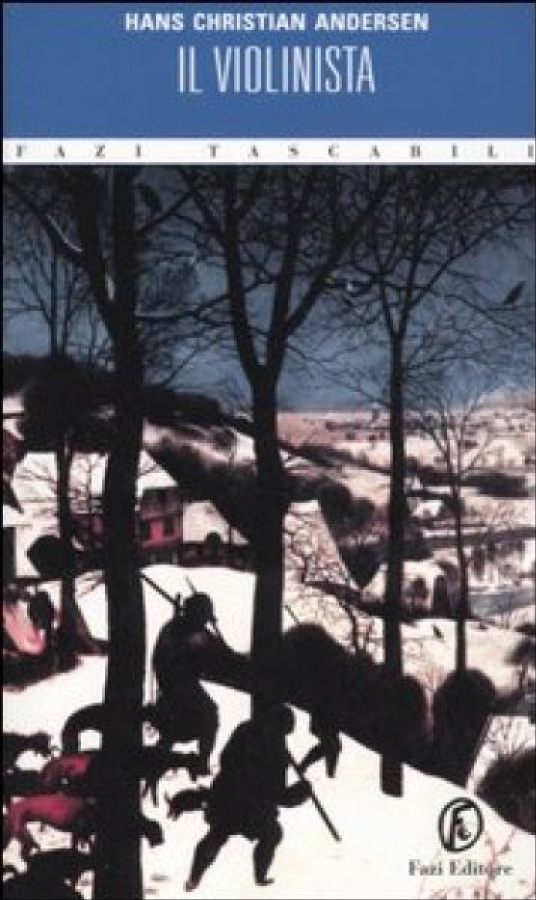
The Violinist
Christian and Noemi are two youths from markedly different social backgrounds (Christian deeply impoverished, Noemi from a wealthy Jewish family), yet both are driven by a fierce ambition and the pursuit of an “extraordinary life.” A dramatic episode from their childhood—the fire and destruction of Noemi’s home—also shatters a tender friendship and irreparably sunders the lives of the two youths. The wondrous garden where they first met is no more: childhood happiness has dissolved. In the first part, the most evocative also for its depiction of Danish rural culture, we follow Christian’s journey: the awakening of his vocation as a violinist, his father’s flight, a new family and solitude, life at sea, and his upbringing within another household. A tragic undertone prevails, yet the boy confronts misfortune with an enduring hope for the future. Particularly striking is the portrayal of the human and natural milieu that develops around a spring whose waters are believed to cure ailments. The relationship with nature takes on magical, animistic, and fairy-tale dimensions, placing animals—birds in particular—on a plane of intimate communion with human beings. How distant Andersen’s society is from our own, and how clear the transition from a rural to an industrial world! Even in the first part, the motif of the South emerges as one of the book’s fundamental touchstones: the migrations of storks and other birds are precisely the bridge between Northern and Southern Europe—a South dreamt of and experienced as a land of sun, warmth, and culture. The final part of the book focuses on Noemi, now a beautiful young woman, first enamored of a jockey and later wed to a wealthy French aristocrat. Vienna, Rome, and Paris provide the settings for Noemi’s life, while Christian remains in Denmark to dream and live in penury. The lives of the two youths diverge markedly, yet their conclusion is dramatically alike. Christian dies weary and disillusioned; Noemi returns to Denmark, wealthy and elegant, yet equally conscious of having fulfilled none of the aspirations of her youth. Was it worth it? Would it not have been better for the two youths to accept a quiet, routine life from the outset; or was there an alternative rooted in feelings far deeper than the quest for something wondrous? Andersen’s moral remains obscure: perhaps the book’s underlying thread is the struggle for survival and self-advancement, in which only the strongest prevails. The stork that was Christian’s companion is killed by its fellow migrants because it is no longer capable of making the long journey South. The narrative pace is highly effective in the first part of the book, only to unravel and become cumbersome and tedious.
Life
> When a thing has passed, what distinguishes it, in the reality of the present, from an illusion or a fantasy? Even if it once had an existence of its own, thereafter it will have none, save in memory . The author reconstructs the American story of her grandfather, Diamante, and of his love for a girl, Vita. In the early years of the twentieth century, poverty and despair drove Italians to emigrate to the United States. Diamante, eleven years old, and Vita, still a child, journeyed to New York to join her father. The sea voyage and the grueling life in the New World forged an indissoluble bond between them—one that, as so often happens, never managed to crystallize into an enduring and stable relationship. The narrative unfolds in three parts. In the first part, entitled *“The Line of Fire,”* the author recounts the arrival of the two children in America and describes, in grim, harsh, and at times harrowing pages, the Italian immigrant milieu. Squalor and violence predominate. The Italians struggle to survive and send a few coins back to Italy. For Diamante and Vita, there is also the specific context in which they are forced to live: the sordidness and greed of the girl’s father; his mistress, the sole maternal figure for Vita, yet despised precisely for driving a wedge between her and her real mother, who remained in Italy; and their fellow countrymen who, brutalized by hard labor, frequent the boarding house run by Vita’s father. It could easily be a Dickensian narrative or a Zolaesque realist novel: it is neither. The episodes unfold as if in a succession of nightmares, accursed reveries, outward projections of the author’s own existential anxieties. Over everything looms the damned city, whose depiction recalls—in the imagery deployed and its emphatic style—D’Annunzio’s *Città terribili*. This part of the novel concludes dramatically: Vita sets fire to her father’s mistress in an attempt to kill her. In the second part, *“The Road Home,”* Vita’s son, serving as an American soldier on the Italian front during the Second World War, retraces the search for Diamante and his family. We then find ourselves in the Italy of the 1950s, where Vita, now an affluent widow and an established woman, comes to Rome to meet Diamante and ask him to live together. She meets with a tacit refusal: it is too late. In the third part, *“The Trickle of Water,”* the scene shifts back to America with Diamante and Vita, still young, but by then estranged. Vita, for her part, has betrayed Diamante, prompting the youth to flee in an attempt to forget her. When he returns to New York to board a ship bound for Italy, he asks her whether she wishes to leave as well. Yet by now the two young people are too far apart, their worlds irrevocably detached: “I like America, I'm fine here,” Vita thinks. Yet is this story a reconstruction based on documents and accounts from the protagonists, or is it rather the fruit of the author’s imagination? Diamante undoubtedly existed, but he was a taciturn, reserved man who disclosed little about his life. Of the girl, Vita, the writer found no trace, not even after a meticulous search through the parish archives of her native village. Perhaps the love between Diamante and Vita is merely an ideal, a wistful yearning, a blurred photograph—much like the one the author imagines the two youths having taken of themselves. > Their faces were a hesitant, blurry halo, as if at the very last moment they had preferred not to be captured, not to surrender the unrepeatable instant they were living to a dead memory. Diamante was a flash of black. Vita a blot of white. Their features superimposed and indistinguishable, as though they belonged to a single person . The core premise of the book is compelling. To narrate Italian emigration through the love of two characters: a childhood romance perpetually pursued and never realized, for no discernible reason. It is a pity that this idea is developed without a genuine narrative plot, ultimately proving discursive and fragmented. The style—dense with parenthetical clauses, overburdened with vocabulary and imagery—fails to impart vitality and allure to the narrative, which consequently remains stranded among disparate literary genres: family chronicle, social novel, and the imaginative quest for an existential and emotional trajectory of one's own. Why skip it? The reading experience is tedious and often ponderous. It does little to illuminate the phenomenon of Italian emigration. The love between Diamante and Vita lingers suspended and indistinct, never truly engaging the reader.
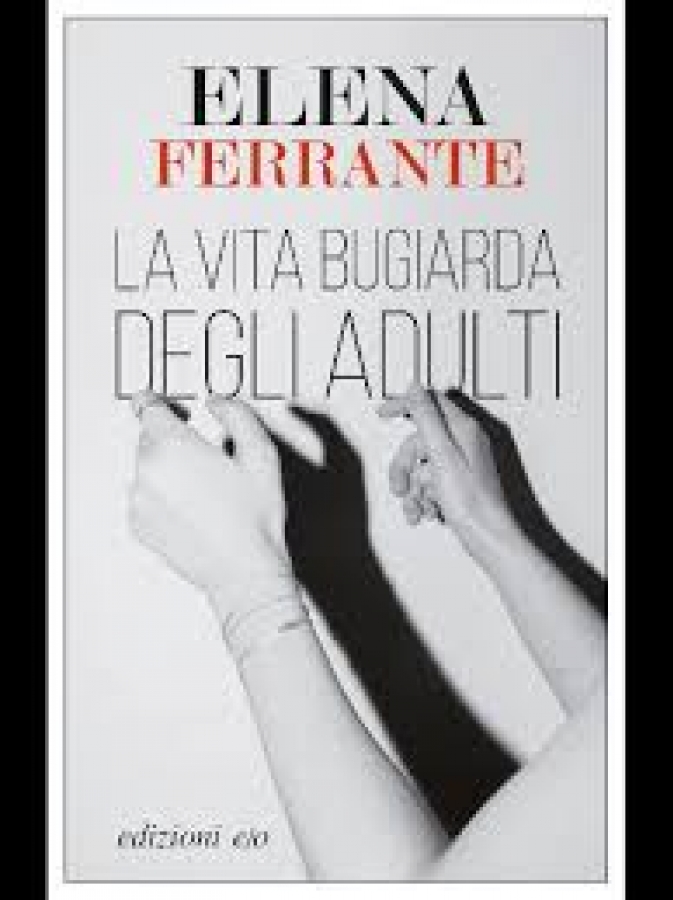
The Lying Life of Adults
Giovanna, the first-person narrator, is an adolescent living in an affluent neighborhood of Naples with educated, left-wing parents: her father a university professor, her mother a high school teacher and translator. The couple of friends they spend time with shares the very same traits: he, too, an academic, a habitual partner in heated debates with the father; she, a woman of high society, ever elegant and often sporting a splendid bracelet. Then there are their daughters, Giovanna's friends and confidantes. A fine bourgeois family, in short! The girl begins to falter at school and overhears a remark made by her father at the door. > adolescence has nothing to do with it: she's taking on the face of Vittoria. (...) That was how, at twelve, I learned from my father's voice, muffled by the effort to keep it low, that I was becoming like his sister, a woman in whom—I had heard him say for as long as I could remember—ugliness and malice were perfectly matched . An irrepressible desire arises in Giovanna to meet Aunt Vittoria, so hated by the father that her image had been excised from a family photograph. She wanted to know whether her father’s harsh words were merely the result of a momentary vexation, or whether he, so astute, had detected > the traits of a future defect of mine. (...) I wanted to understand whether my aunt was truly emerging through my body: the exceedingly thick eyebrows, the eyes too small and of a lusterless brown, (...) the short upper lip with a repulsive dark fuzz, (...) the sharp chin and the nose, ah the nose, the way it thrust gracelessly toward the mirror, (...) were these already features of Aunt Vittoria’s face, or mine and mine alone? (...) Was I myself, or the vanguard of my aunt, she in all her horror? Giovanna does not realize that the journey she is embarking on—getting to know her aunt and her world (the working-class neighborhoods of Naples)—will not merely confirm or disprove the roots of her presumed ugliness: it will be a descent toward the demolition of her parents, the loss of her mother, and the estrangement of her father. The parental figures, previously seen as an Olympus of perfection and models to be emulated, crumble to the point of dissolution. > What was happening, then, in the adult world, in the heads of perfectly reasonable people, in their bodies laden with knowledge? What reduced them to animals among the most untrustworthy, worse than reptiles? It is not the discovery of the sordid affair binding the parents to the couple of friends: the father having for years taken his colleague's wife as a mistress, while the colleague in turn carries on with Giovanna's mother; nor is it the murky history of the bracelet worn so ostentatiously by the father's mistress: having come by hazy means to Aunt Vittoria, who intended it as a gift for Giovanna, only for the father to present it to his lover. It is words that devastate the end of childhood: the time of adolescence ought to be slow, > made of great gray blocks and sudden swellings of green or red or purple. The blocks have no hours, days, months, years, and the seasons are uncertain, it is hot and cold, rainy and sunny. (...) The moment you search for words, that slowness turns into a vortex and the colors blur together like different fruits in a blender . And so we arrive at the heart of the matter: the theme of culture. Unlike Confucius, who regarded culture as the key to grasping "the sense of mutual humanity," Elena Ferrante appears to share my view: a good formal education, command of language, familiarity with books and culturally engaged circles, are a cage that imprisons feelings, submerging them beneath skillful semantic play, fostering pretense rather than sincerity. The trouble is that Giovanna, while recognizing in Aunt Vittoria the prodigious force of candor (hatred voiced without filters, intimacy, overflowing emotions, the authenticity of living), nevertheless falls in love with an intellectual, captivated by his words as much as by his appearance. Culture, a false chimera! One does not know humanity through thought; one grasps it through empathy. Fortunately, Aunt Vittoria bursts in to save her. > Did you hear that, Giannì? Here they call you a child. But are you a child? Then why do you get between Giuliana and her boyfriend? Answer me, instead of busting my balls over the bracelet. Are you worse than my brother? Tell me, I’m listening: are you more arrogant than your father? The book is a coming-of-age novel. It is intriguing at the beginning, stoking the reader’s anticipation of Aunt Vittoria: the expectation of a temperamental, visceral, and full-blooded character. Instead, this figure remains sidelined, occasionally summoned into the plot but never a protagonist. The narrative unfolds—or rather, tumbles—along a banal storyline and a fragile cast of characters. Failing to lean on plot and characterization, on the complexity of their bonds as in *My Brilliant Friend*, the writing reveals all its limitations: fluent, yet feeble, devoid of grit, as superficial as the story itself. Why read it? Those who fell in love with *My Brilliant Friend* cannot miss it.
The Mortal and Immortal Life of the Girl from Milan
It is difficult to find a common thread in this short novel, with its slender plot, its characters merely sketched because yearned for, and its misleading title. Yet there is an anchor: the figure of the grandmother, around whom unfolds the coming-of-age journey of the protagonist, the first-person narrator of this story. > Far too short in stature, plump and hunchbacked, rather homely with her red face and tiny purplish veins on her cheeks.... treated like a servant in her daughter's house, only the grandmother loved the young protagonist with an affection that expected nothing in return: > as a newborn I had been a little thing of living alabaster, a tiny sip of cherry julep, a *franfellik* made of sugar, vanilla, and cinnamon who, even if he pissed, pissed holy water. (...) And now look what I had turned into, wouldn'tstaystillforasecond, let me comb your hair. To her, the grandson possessed qualities "that no one, except her, could notice." What influence could such a grandmother have on a dreaming boy, brimming with impressions fueled by reading far too much? His head is crammed with disorderly fantasies, with too many roles to play: > the cowboy, the orphan, the cabin boy, the castaway, the hunter, the explorer, the knight-errant, Hector, Ulysses, the tribune of the plebs and finally Orpheus, who had gone to reclaim his bride Eurydice from the underworld. To make his fantasies real, the boy had to find his Eurydice and the entrance to the realm of the dead. The former is a little girl from Milan who lives in the apartment building opposite and whom he watches every day as she dances recklessly on the balcony. *Careful not to fall!* the boy would like to shout to her, *you might end up like Eurydice, killed by a snakebite, leaving Orpheus heartbroken.* The entrance to the realm of the dead, where he must rescue the little Milanese girl, is a manhole in a courtyard near his house—a manhole beneath which strange noises can be heard, perhaps the cries and laments of the dead. It is a happy childhood, protected by the grandmother, steeped in a world of fantasy: our protagonist is Aeneas in search of Anchises (even if the journey into the underworld is merely the discovery of a photograph of his grandparents looking happy and handsome on their wedding day); he has his Laura (the little Milanese girl) and is even Lancelot dueling enemies before his fair lady; and what does it matter if the enemy is a childhood friend and the weapons are a bicycle and an umbrella rigged up as a sword? As his studies progress, our protagonist discovers that his grandmother's tongue—so enchanting and affectionate—leads him to make numerous spelling and syntactic errors, preventing him from freeing himself from Neapolitan to speak and write correct Italian. The magic dissolves. > As if, from the age of twelve or thirteen, I had miraculously grown older than her, she had also developed a kind of deference toward me. (...) At nineteen, I still had no desire to recall childhood. (...) Deep down, I would have preferred coming into the world at around seventeen, sparing myself the foolishness of the first sixteen. The final step toward detachment occurs when our protagonist uses his grandmother's strange, despised tongue to pass his university linguistics exam with flying colors. I had to, the protagonist reflects, "demonstrate that I knew how to approach, in the prescribed manner, the uneducated who spoke" dialect. > I was taking advantage of her gullibility as if she were a child. (...) Cornering her, keeping her there in a corner for a couple of mornings, (...) and prodding her into telling me (...) whatever came to her mind from her world of a grandmother-servant who knew more Neapolitan words than anyone else. With the grandmother's disappearance, the now-adult protagonist writes with resigned melancholy, > I unequivocally lost the drive to achieve great things (...) knowing by then that what little is truly alive in what we do while living remains outside of writing; signs are constitutionally insufficient, vacillating between commentary and dismay—and thank goodness for that. I allowed myself only one small mitigating circumstance, and even today I still grant it to myself: the pleasure of the word that in the moment seems right, and then does not . We return to Pasolini, for whom only the *ragazzi di vita* grasp the essence of reality, unmediated, because they use "the language of speakers." And so all this writing, century after century, is nothing more than a form of narcissism, a pursuit of pleasure, the eternal mirroring ego. And the word is nothing but a useless filter between ourselves and the essence of life and death. The novel's chief merit lies in its writing. One is left admiring and captivated by the stylistic balance between simplicity and complexity in the sentences, by the fluidity of the narration, and by the masterful use of words, particularly adjectives. It may well be that the pleasure of writing is fragile, as Starnone says, but such fragility is more than welcome. In the end, the relish for language takes precedence over the story: delving into phonetics is intriguing and instructive, yet it proves an excessive digression that deprives the narrative of its compactness. Why read it? It is stylistically flawless, and the figure of the grandmother is magnificent.
Life is not in alphabetical order
> On the first day of school, the teacher placed a wooden box on his desk. Then he lifted the lid, peered inside, and one after the other began to pull out the letters of the alphabet... with twenty-one letters... you can build and destroy the world . Letters can be arranged according to the alphabet. To each letter corresponds a word capable of describing and qualifying, yet, unlike the alphabet, there is no logical or causal sequence among words. For example, Bandiera and Buio are words that both begin with the letter b, but what connection is there between them? And such is life: episodes, emotions, relationships crowd in and follow one another without reason, without rule. The book is a collection of very short stories, just a few lines long, which, taking their cue from a single word, capture the essence of a state of mind, of a social and familial context, of an existential condition. Entrata is a mundane word. Proceeding from it, from its very self-evidence, the author describes the profound bond between mother and son: > she hears you, inside your trousers, and laughs, and in the room where every evening you return to the world, together with her you smile . How many times has one gone to a pastry shop, to sip a coffee with a fine pastry? And yet, the word Pasticceria holds the sense of a forbidden indulgence, yet tasted ever anew: > so you drink a coffee at the counter, never taking your eyes off the chosen pastry, held captive with downcast eyes behind the glass. And you think....when you will be able to enter the pastry shop, part the crowd, set it free. And then offer it in sacrifice to your desires . What links the adverb Senza to nostalgia? When the child leaves school and > finds not only his mother but also fathers waiting for his classmates.... the child understands that inside his box there was one piece less, even though his mother was remarkable at keeping the world standing all the same. It is thus that, all at once, the child comes to know nostalgia for things that never were... above all he feels the melancholy of when one realizes they have stopped looking for something, of when one notices that among the many things learned, one has learned to live without . If one reads the novel a second time, with greater detachment than the first—when one had let oneself be enchanted by the delicate, muted imagery of the short stories—one perceives how the juxtaposition between life's disorder and the alphabet's order, the latter emblematic of the rules that loom over us, is merely a literary device. The short stories, which compose the book without any apparent logic, are traversed by a single underlying vision: sadness. There may be profound affection, such as a mother's, just as families may dissolve after quarrels and silences, but melancholy, a sweet ache of living, the sense of ineluctable and unhappy destinies always prevail. Yet then life does answer to a rule of its own; it simply has an order different from that of the alphabet. It is difficult to encapsulate states of mind and life situations in just a few lines. One runs the risk of lapsing into evocative yet fleeting imagery, necessarily superficial. The narrative remains suspended. The reader always expects something more at the conclusion of each very short story. It is a literary exercise that flatters the author, and fellow writers, more than it does the readers. The latter would expect a thorough, articulated development, worthy of the complexity of the existential condition. Why not read it? It is superficial.