Finished reading on: June 07, 2015
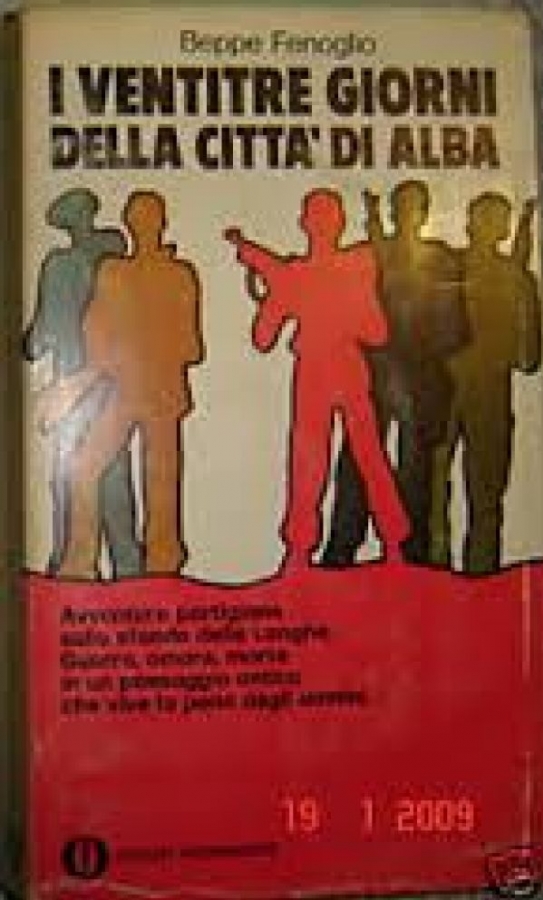
The Twenty-Three Days of the City of Alba
Title of the original version reviewed: «I ventitre giorni della città di Alba»
AI Translation Notice: This review was translated from the original Italian using artificial intelligence. Book quotes and excerpts are translated interpretations and will not match the author's original English phrasing or official published translations.
It was the wildest parade in modern history: in uniforms alone, there was enough for a hundred carnivals.
(...) Alongside the men marched the female partisans, dressed in men’s clothes, and here someone in the crowd began to murmur—Ah, poor Italy!—because these girls had faces and a gait that set all the townspeople winking
.
The partisans’ conquest of Alba lasted less than a month, and Fenoglio traces a realistic chronicle of it, devoid of rhetoric; at its center lies the contradictory nature of man.
But they weren't all whoring, of course; in fact, most were out commandeering cars, tires, and petrol.
Not without quarreling among themselves with their safeties off, they tracked down and seized a great number of automobiles, with which they began a thrilling driving school along the ring road
.
Yet why does one become a partisan? To understand Fenoglio’s answer to this question, one must reverse the order of the stories, starting from the final ones, which seem ostensibly removed from the events of the liberation war.
In Pioggia e la Sposa, a young boy is dragged by his aunt to a wedding, despite the torrential rain, which forces him (a «city-dressed boy») to cover himself with his priest-cousin’s hat.
We understand that the boy has lost his mother; he is alone, and his aunt, stern and surly, is his only source of affection:
I saw that her eyes, together with her hand, grazed my soaked hair, and this time her hand was relaxed and tender, just as my mother’s hand had always been, and even her eyes seemed extraordinarily kind toward me, and less dark
.
Solitude turns into an anticipation of death in L’odore della morte: the protagonist, now a grown man, happens upon a girl and begins following her, merely to pass the time.
He is attacked by her fiancé, but during the struggle he felt
that smell (...) already everywhere inside, having passed through his nostrils, his mouth, and his pores, unstoppable as the very power that distilled it; it must have already enfolded his brain, for he felt mad
.
In the other stories that do not deal with the partisan struggle, solitude, the prosaic nature, and the futility of life are recurring themes; flight, the resignation to an unhappy fate, and in some cases even suicide seem to be the only possible outcomes of the human condition.
Thus, the choice to become a partisan is not the fruit of ideals; it is, rather, a revolt against an existence devoid of prospects.
In the story Un altro muro, Max has been captured by the Fascists; he dreams of «the face of his corpse» and shouts to his cellmate:
do you feel up to dying for the idea? I don't.
And what idea, anyway? If you search inside yourself, do you find the idea? I don't.
And neither do you
.
At that moment
he hated his friends and comrades; he saw them that night roaming the high hills, free and masters of their own lives, armed, untroubled, and proud; he saw the hills illuminated as if by day by the moonlight on the frozen snow; he felt the wind coming in from the sea, sweeping through the great pass between the Apennines and the Alps
.
It is not the ideals of Justice and Freedom that move the partisans, but the desire for a primordial freedom: an indecipherable mixture of pent-up energy, of a longing for change, of standing alongside others on the right side.
Yet partisan life does not resolve existential predicaments: either because death arrives too soon, or because war brings further violence and destruction in its wake.
And in the end, once the liberation has been achieved, returning to a normal life is no longer possible and, as in Ettore va al lavoro, one knows only how to embrace the gun once more and go rob former Fascists.
All the stories are remarkable, but one is especially so: Gli inizi del partigiano Raoul.
He intended to take Raoul as his nom de guerre.
Along a completely deserted road he walked with a light heart; despite having left his widowed mother alone back in the village, he felt like nobody’s son—and that is the ideal condition for doing the two truly grave and hard things for an individual: going to war and emigrating
.
His headlong courage soon turns into revulsion at the life that awaits him:
what good is my education to me? Here, to hold out, you have to become a brute! And I don’t have it in me, I am good! Oh mama, mama! He thought back to dawn that very same day—could it really have been only eight hours ago?
At night he regains his confidence while standing sentry, but when his watch ends and he finds himself back in a squalid, cavernous room, the sense of wretchedness returns, followed by fear.
How could the others sleep with such abandon? Were they certain they would live to see the morning? (...) The barn door flew open with a resounding bang, and the doorway filled with men clad entirely in black, as if masked from head to foot.
(...) The beams of light terminated in white circles like so many tiny moons, zeroing in one by one on the faces of all the partisans.
Whether due to that artificial light or something else, they were already all faces of corpses, with motionless eyelids and wide-open eyes.
(...) Delio asked him—Slept well for your first time?
There was a hint of malice in his voice....
È lʼincubo di un semplice ragazzo, non di un eroe.
Fenoglio’s writing is consummate, now mature and confident.
It loses certain idiosyncratic traits, such as the richness of idiom and the quest for neologisms.
At times, it feels as though one were reading Cesare Pavese.
Why read it? Magnificent stories: a mirror of the human condition.