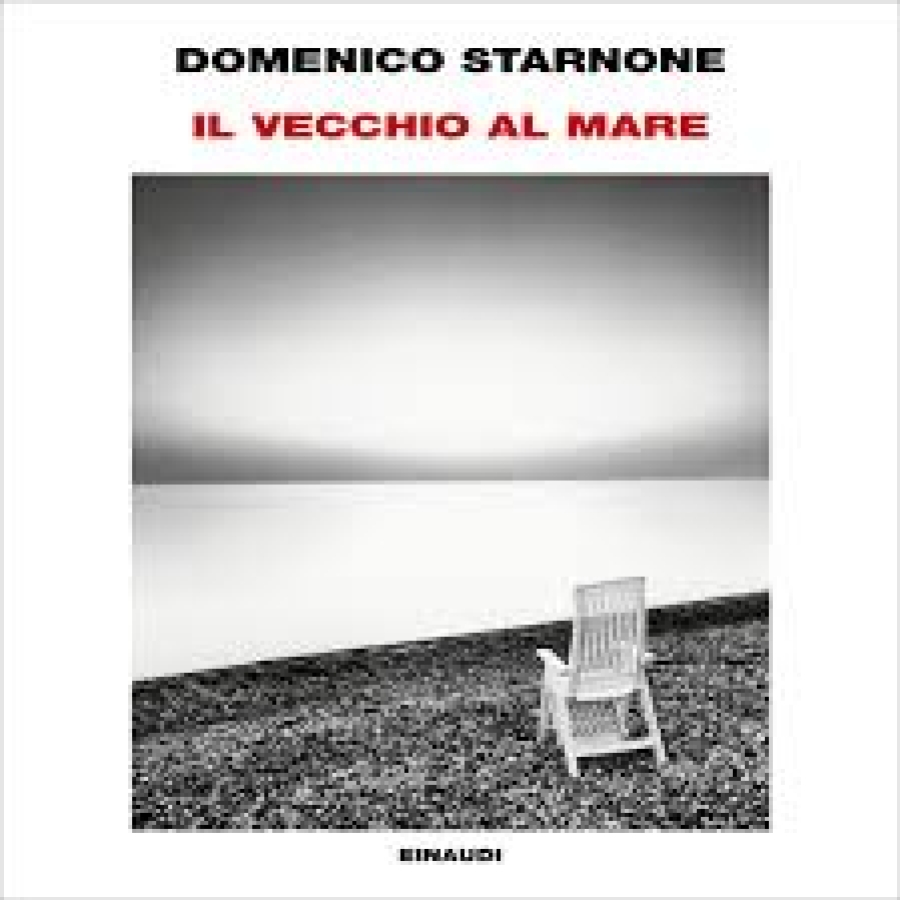
Finished reading on: August 22, 2024
The Old Man at the Sea
Title of the original version reviewed: «Il vecchio al mare»
AI Translation Notice: This review was translated from the original Italian using artificial intelligence. Book quotes and excerpts are translated interpretations and will not match the author's original English phrasing or official published translations.
I was heading to the beach, (...) minding my own business, when suddenly everything came to a halt: the wind, the sea, the shrubs, the beating of heart and flutter of eyelashes, (...) and in that moment of disoriented stillness the only thing moving was a small figure outlined in gold: not a body, not a pirouette of dust, not a flicker of light, but a presence that dashed along the wood of the step and slipped into the sand just ahead. For the first-person narrator, the eighty-two-year-old on vacation by the sea, this small figure
emerged from deep within my body
, like the "chimera" celebrated by Mario Luzi? ("she sets out between the walls, is prey to the light... / perhaps it was you, now it is an apparition"). Or is she instead one of Giorgio Caproni's girls? (
girls barely visible / yet acutely sensitive / in the black air that shines / gleaming like a pupil
). Starnone's answer is not unequivocal; he leaves us in suspense.
Of what I know and do not know (...) that I should attempt to write. But it is difficult; it would take energy and confidence, not this present, doubting exhaustion that drifts into a sudden nod of sleep. The old writer nevertheless endeavors to construct a story, slender and elegant as a poem. The small figure is Lu, athletic, full of energy and youthful authority. Then there are other women, from Evelina, the owner of a clothing boutique, to her client-friends: all of them lovers of Evelina's husband, Silvestro the deceiver. Are they real characters or resurfacing remembrances? In Lu, as in the other women, the writer projects no senile erotic desire; instead, he seeks to extract from the girl's body
a mother alive, vividly alive, (...) a mother free of disease, under thirty, of benevolent radiance, capable of arousing envy and then taming it, transforming it into sympathy and affection. (...) Even now, in old age, that is the risk. I start with Rosa (that is the mother's name) and I want more Rosa, ever more Rosa, too much Rosa, so that I lose what little truth there is—a laugh as she fixes her hair with both hands—and slip into falsehood. And as often happens when one lets oneself become enveloped by memory, the mind returns to a recurring fragment of the remembered person's life; so it is for the writer in the most captivating scene of the entire novella, wonderfully poised between reality and fantasy. Rosa was a seamstress and received clients at home in front of her young son. Invited into Evelina's shop, all the sensations of those sessions resurface as he witnesses the client-friends choosing dresses.
I didn't miss a single flutter of an eyelash. (...) I violently caught the vital scent of that dressing and redressing, shaping and reshaping, and I recognized it. It was the very same as that of my mother's clients. The old writer asks to try some dresses on Lu, who until that moment was present only as a sales assistant. It is a crescendo of sensuality and remembrance.
The girl no longer had the eyes of a fatigued servant, but gleaming pupils. (...) Bodies evaporate, there's little to be done, ambitions scatter, possibilities thin out. But at least for now, that is not what is happening to Lu. She has closed herself off once and for all from my dying mother, and dress after dress, pleased gesture after pleased gesture, she has regained a healthy color; she is strong again, radiating the light of someone determined at all costs to take a breathtaking leap right up to the top of the world.
The image of a sick old man facing the sea evokes Thomas Mann's Death in Venice; and perhaps it is this work that inspired Starnone rather than Ernest Hemingway's The Old Man and the Sea, echoed by the novel's title. It lacks the vigor of the American writer's masterpiece, while breathing that sensually decadent atmosphere of Mann's novella. The main theme is certainly the thought of death: nostalgias, remembrances, childhood images crowd the mind, brought to the surface by the regulars on the beach where the eighty-two-year-old spends his days, overlooking the sea. Running beneath the surface is a theme dear to Starnone: the craft of the writer. Nearing the end of life, one realizes that
manipulating the reality of facts, using it to draw out inventions with flashes of truth, was deceptively easy when I was young; in old age, it is a feeble attempt always one step away from dismay. What meaning is left in imagination, in believing oneself alive by making up stories?
Starnone is one of Italy's most refined writers. Every single sentence deserves to be taught for its masterly handling of syntax and lexical elegance, all while remaining within a contemporary and universally accessible idiom. Yet this pursuit of detail comes at the expense of the overarching plot, which is slender and inconclusive. The focus on the first-person narrator flattens characters who are potentially interesting, causing the narrative to slip into a kind of narcissistic self-indulgence.
Why read it? A masterclass in splendid Italian.