Finished reading on: March 26, 2014
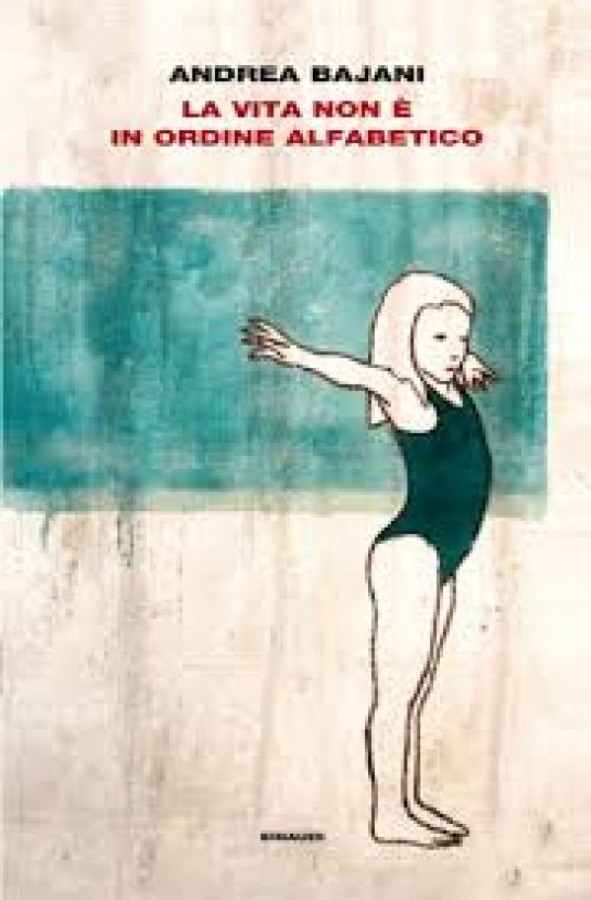
Life is not in alphabetical order
Title of the original version reviewed: «La vita non é in ordine alfabetico»
AI Translation Notice: This review was translated from the original Italian using artificial intelligence. Book quotes and excerpts are translated interpretations and will not match the author's original English phrasing or official published translations.
On the first day of school, the teacher placed a wooden box on his desk.
Then he lifted the lid, peered inside, and one after the other began to pull out the letters of the alphabet...
with twenty-one letters...
you can build and destroy the world
.
Letters can be arranged according to the alphabet.
To each letter corresponds a word capable of describing and qualifying, yet, unlike the alphabet, there is no logical or causal sequence among words.
For example, Bandiera and Buio are words that both begin with the letter b, but what connection is there between them? And such is life: episodes, emotions, relationships crowd in and follow one another without reason, without rule.
The book is a collection of very short stories, just a few lines long, which, taking their cue from a single word, capture the essence of a state of mind, of a social and familial context, of an existential condition.
Entrata is a mundane word.
Proceeding from it, from its very self-evidence, the author describes the profound bond between mother and son:
she hears you, inside your trousers, and laughs, and in the room where every evening you return to the world, together with her you smile
.
How many times has one gone to a pastry shop, to sip a coffee with a fine pastry? And yet, the word Pasticceria holds the sense of a forbidden indulgence, yet tasted ever anew:
so you drink a coffee at the counter, never taking your eyes off the chosen pastry, held captive with downcast eyes behind the glass.
And you think....when you will be able to enter the pastry shop, part the crowd, set it free.
And then offer it in sacrifice to your desires
.
What links the adverb Senza to nostalgia? When the child leaves school and
finds not only his mother but also fathers waiting for his classmates....
the child understands that inside his box there was one piece less, even though his mother was remarkable at keeping the world standing all the same.
It is thus that, all at once, the child comes to know nostalgia for things that never were...
above all he feels the melancholy of when one realizes they have stopped looking for something, of when one notices that among the many things learned, one has learned to live without
.
If one reads the novel a second time, with greater detachment than the first—when one had let oneself be enchanted by the delicate, muted imagery of the short stories—one perceives how the juxtaposition between life's disorder and the alphabet's order, the latter emblematic of the rules that loom over us, is merely a literary device.
The short stories, which compose the book without any apparent logic, are traversed by a single underlying vision: sadness.
There may be profound affection, such as a mother's, just as families may dissolve after quarrels and silences, but melancholy, a sweet ache of living, the sense of ineluctable and unhappy destinies always prevail.
Yet then life does answer to a rule of its own; it simply has an order different from that of the alphabet.
It is difficult to encapsulate states of mind and life situations in just a few lines.
One runs the risk of lapsing into evocative yet fleeting imagery, necessarily superficial.
The narrative remains suspended.
The reader always expects something more at the conclusion of each very short story.
It is a literary exercise that flatters the author, and fellow writers, more than it does the readers.
The latter would expect a thorough, articulated development, worthy of the complexity of the existential condition.
Why not read it? It is superficial.