Finished reading on: February 09, 2022
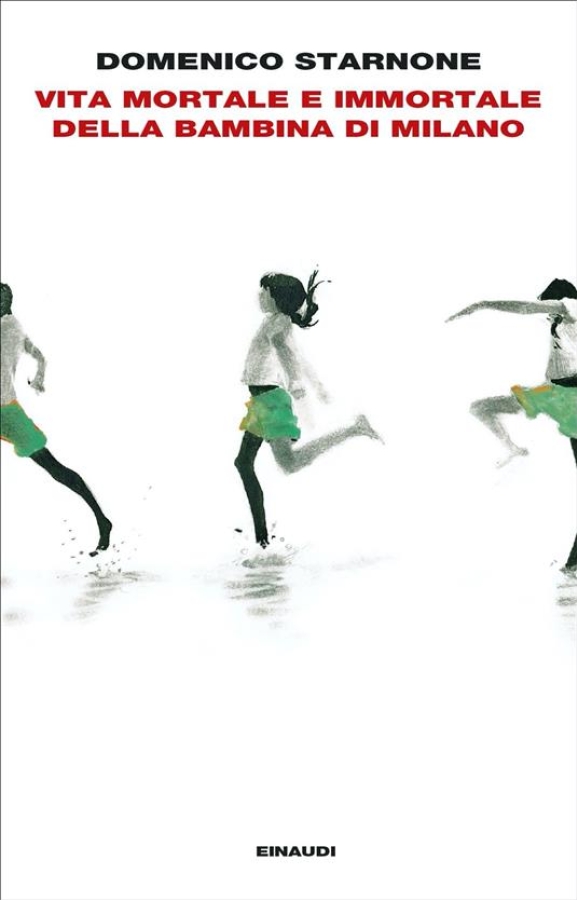
The Mortal and Immortal Life of the Girl from Milan
Title of the original version reviewed: «Vita mortale e immortale della bambina di Milano»
AI Translation Notice: This review was translated from the original Italian using artificial intelligence. Book quotes and excerpts are translated interpretations and will not match the author's original English phrasing or official published translations.
It is difficult to find a common thread in this short novel, with its slender plot, its characters merely sketched because yearned for, and its misleading title. Yet there is an anchor: the figure of the grandmother, around whom unfolds the coming-of-age journey of the protagonist, the first-person narrator of this story.
Far too short in stature, plump and hunchbacked, rather homely with her red face and tiny purplish veins on her cheeks....
treated like a servant in her daughter's house, only the grandmother loved the young protagonist with an affection that expected nothing in return:
as a newborn I had been a little thing of living alabaster, a tiny sip of cherry julep, a franfellik made of sugar, vanilla, and cinnamon who, even if he pissed, pissed holy water. (...) And now look what I had turned into, wouldn'tstaystillforasecond, let me comb your hair.
To her, the grandson possessed qualities "that no one, except her, could notice." What influence could such a grandmother have on a dreaming boy, brimming with impressions fueled by reading far too much? His head is crammed with disorderly fantasies, with too many roles to play:
the cowboy, the orphan, the cabin boy, the castaway, the hunter, the explorer, the knight-errant, Hector, Ulysses, the tribune of the plebs
and finally Orpheus, who had gone to reclaim his bride Eurydice from the underworld. To make his fantasies real, the boy had to find his Eurydice and the entrance to the realm of the dead. The former is a little girl from Milan who lives in the apartment building opposite and whom he watches every day as she dances recklessly on the balcony. Careful not to fall! the boy would like to shout to her, you might end up like Eurydice, killed by a snakebite, leaving Orpheus heartbroken. The entrance to the realm of the dead, where he must rescue the little Milanese girl, is a manhole in a courtyard near his house—a manhole beneath which strange noises can be heard, perhaps the cries and laments of the dead. It is a happy childhood, protected by the grandmother, steeped in a world of fantasy: our protagonist is Aeneas in search of Anchises (even if the journey into the underworld is merely the discovery of a photograph of his grandparents looking happy and handsome on their wedding day); he has his Laura (the little Milanese girl) and is even Lancelot dueling enemies before his fair lady; and what does it matter if the enemy is a childhood friend and the weapons are a bicycle and an umbrella rigged up as a sword? As his studies progress, our protagonist discovers that his grandmother's tongue—so enchanting and affectionate—leads him to make numerous spelling and syntactic errors, preventing him from freeing himself from Neapolitan to speak and write correct Italian. The magic dissolves.
As if, from the age of twelve or thirteen, I had miraculously grown older than her, she had also developed a kind of deference toward me. (...) At nineteen, I still had no desire to recall childhood. (...) Deep down, I would have preferred coming into the world at around seventeen, sparing myself the foolishness of the first sixteen.
The final step toward detachment occurs when our protagonist uses his grandmother's strange, despised tongue to pass his university linguistics exam with flying colors. I had to, the protagonist reflects, "demonstrate that I knew how to approach, in the prescribed manner, the uneducated who spoke" dialect.
I was taking advantage of her gullibility as if she were a child. (...) Cornering her, keeping her there in a corner for a couple of mornings, (...) and prodding her into telling me (...) whatever came to her mind from her world of a grandmother-servant who knew more Neapolitan words than anyone else.
With the grandmother's disappearance, the now-adult protagonist writes with resigned melancholy,
I unequivocally lost the drive to achieve great things (...) knowing by then that what little is truly alive in what we do while living remains outside of writing; signs are constitutionally insufficient, vacillating between commentary and dismay—and thank goodness for that. I allowed myself only one small mitigating circumstance, and even today I still grant it to myself: the pleasure of the word that in the moment seems right, and then does not
. We return to Pasolini, for whom only the ragazzi di vita grasp the essence of reality, unmediated, because they use "the language of speakers." And so all this writing, century after century, is nothing more than a form of narcissism, a pursuit of pleasure, the eternal mirroring ego. And the word is nothing but a useless filter between ourselves and the essence of life and death.
The novel's chief merit lies in its writing. One is left admiring and captivated by the stylistic balance between simplicity and complexity in the sentences, by the fluidity of the narration, and by the masterful use of words, particularly adjectives. It may well be that the pleasure of writing is fragile, as Starnone says, but such fragility is more than welcome. In the end, the relish for language takes precedence over the story: delving into phonetics is intriguing and instructive, yet it proves an excessive digression that deprives the narrative of its compactness.
Why read it? It is stylistically flawless, and the figure of the grandmother is magnificent.