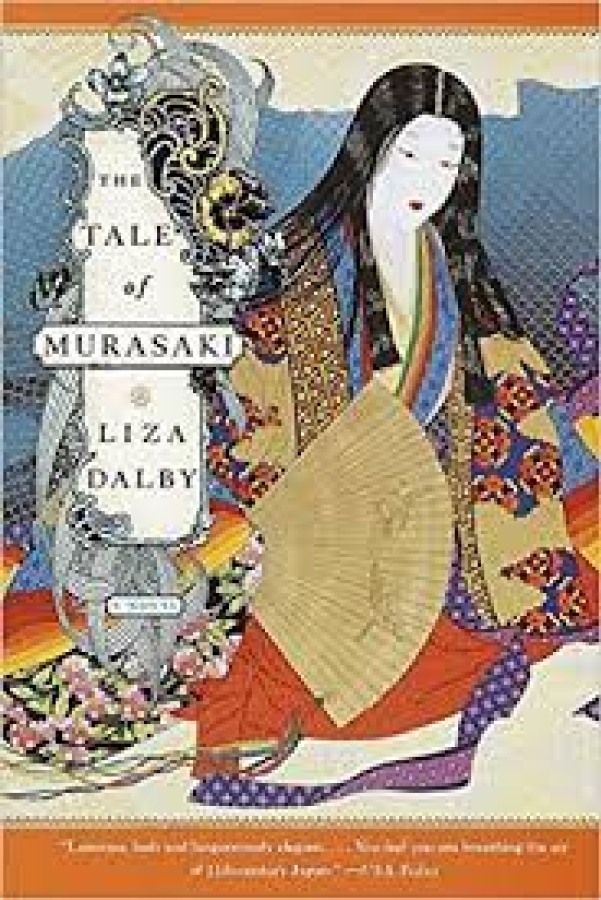
The Tale of Murasaki (the story of Murasaki)
As Wikipedia notes, Murasaki Shikibu (973–1014) was a Japanese poet renowned for the epic *The Tale of Genji*, likely written around the year 1000 when she served as a lady-in-waiting. Murasaki (Japanese for violet) is the name of the novel's female protagonist—a name also attributed to the poet herself, as her real name remains unknown. *The Tale of Genji* quickly achieved widespread circulation, turning Murasaki into an icon celebrated as the founder of the Japanese language, elevating it at last to the same rank as dominant Chinese literature: in short, Murasaki can be regarded as a kind of Japanese Dante. Attesting to Murasaki’s popular renown, legend has it that she began composing the work while in ecstasy before the full moon and, seized by frenzy, wrote on the backs of sutras (sacred texts of Japanese Buddhism)—a transgression that consigned her to hell. In her fictionalized biography, Liza Dalby retraces Murasaki's life: her youth and the study of Chinese despite women's exclusion from literary education (when her father praised his daughter to his friends, they pointed out it was time she married), her first sonnets with the invention of Genji, her stay in Echizen, where she finally came into contact with Chinese sailors, merchants, and diplomats, her marriage to an important imperial court official, her widowhood and role as lady-in-waiting to the empress, and ultimately her retirement to a Buddhist monastery. For those of us who know little of ancient Japan, the novel is of great historical interest: the economic and cultural relations with China; an approach to nature intent on capturing its "heart," transcending the naturalistic perspective of Chinese literature; the meticulous description of Japanese women’s varied, elaborate dress (the attention to colors and fabrics is astonishing); and the power struggles within the Imperial Court. Beyond these many impressions, the author addresses a central question through Murasaki: is "honest poetry" possible, as Umberto Saba phrased it? Is coherence between life and literature achievable? At the opening of the diary imagined by Dalby, Murasaki states that > life alone has never been quite enough. It becomes real to me only when I enrich it in stories. Yet somehow, despite everything I have written, the true nature of the things I sought to grasp in my novel still manages to slip between the words and lie, like little piles of dust, between the lines . It is an awareness the poet has held since her youth as a woman of letters, but one that finds dramatic confirmation as Murasaki accepts the painful destiny of women. Genji is a romantic figure, feminine and masculine all at once, to whom a woman can entrust herself completely, with trust and assurance. > Genji was meant to put an end to the draft of ill will that generally destroys relationships between men and women . It is a fantasy, devised to alleviate her own melancholy and that of her friends. Their choices immediately confront her with the contradiction between life and literature: the first friend marries an elderly official and her adolescent dreams dissolve into a drab solitude; the second kills herself rather than meet the same fate; the third, with whom Murasaki shares an intense intimate relationship, resolves to retreat into a monastery. The dream is shattered once and for all when Murasaki is raped. > I was vexed by how little literature prepares us for real life. (...) Uncertain whether it happened or not, sadly fading away, I scarcely noticed the laughing morning flowers . She could retire to a monastery like her friend, but ambitious and presumptuous, she remains convinced she can master her own destiny. Already acclaimed for her novel, she enters the imperial palace as a lady-in-waiting. > There was a dark side to that place. At times it reminded me of one of those monstrously large spiderwebs I had seen in Echizen . She becomes the mistress of the Regent, who uses her as a brilliant court chronicler and possesses none of Genji’s gentleness. She allows herself to become entangled in power struggles, in the rivalries and slander that permeate the women's quarters, and in the sexual harassment from men to which the court ladies must resign themselves. > I felt like the caterpillar that stays hidden in the shade, slowly digesting experiences in order to turn them into something else. (...) I could not deny that Michinaga (the Regent) had slowly influenced Genji's character, but it was not because of anything he had done directly. Genji had changed on his own. If he had become a bit coarse, well, that is what happens when one moves in the world. (...) I had come to the conclusion that my character Murasaki had outlived her usefulness. I had created a woman so perfect that there was nothing left for her to do but die. It took a long time to realize that I needed to sacrifice her to move forward. And it took me even longer before I realized that the problem did not lie with Murasaki, but with Genji. (...) The spider thrives, lost among the barren reeds glistening with frost, unable to foresee when it will weave its web anew . In the first part of the novel, before Murasaki enters the imperial palace, one has the impression that the author is writing about a Jane Austen heroine: resolute, independent, even within the confines of society. Then, slowly, that vitality withers, resignation sets in, and Murasaki bends, submitting to the power of men. The author's focus shifts to the context; the narrative becomes granular and repetitive, losing its rhythm, as if the writer were unable—or unwilling—to plumb the depths of Murasaki's soul. It is true that the poet often returns home to rest and concentrate on her work, but why does she agree to let herself be trapped once more: was it not possible that she was enticed by the allure of power, by the bewitching charm of the Regent? These are questions that would have been intriguing to answer. I have one: the pursuit of glory. The prose is elegant, refined, lexically rich within a linear syntax. The inclusion of short poems, in Japanese and English, evokes the romantic and sophisticated atmosphere of the Japanese literary world, of Murasaki, and of Dalby herself: the sonnets possess a distinctive beauty and resonance. It is regrettable that in the second part the narrative loses momentum and becomes verbose and tedious. Why read it? Historically interesting; Murasaki's figure is captivating.

Tarabas
We find ourselves in the eastern lands (Ukraine?) during the years of the First World War and the Russian Revolution. It is a period of violence and upheaval, yet the author also depicts these times with nostalgia, because vagabonds > can (still) live on the mercy of men. Although machines have begun, with punctual steel tread, their sinister march toward Eastern Europe, men still look kindly upon the misery of others . A communal spirit still prevails, but Tarabas, a brilliant and violent man, leads a life of his own, while the men of the eastern lands endure one in common. The novel unfolds in two parts, with a significant caesura marked by an anti-Jewish pogrom. In the first part, Tarabas, cast out by his family, lives in war, which is > his great, bloody homeland. He would arrive in peaceful regions, set villages ablaze, leave behind the ruins of towns large and small, weeping women, orphaned children, men beaten, hanged, and butchered . He cares nothing for history or the motives behind this endless war; what matters is continuing his soldierly existence. He is tasked with forming a regiment in the town of Koropta, home to a significant Jewish settlement. All fear him: the poor peasants, the Jews, and his own soldiers and officers, who > did not speak, they whispered. For in their midst, as on an island of silence, as though surrounded by a wall of mute and gleaming ice, sat the feared Colonel Tarabas alone at his table. He drank . And it is precisely during a massive drinking bout that, in a Jewish inn in the small town, the soldiers begin shooting at the courtyard wall, knocking down the plaster: the image of a Madonna emerges, which everyone believes to have been desecrated and hidden by the Jews. “They climbed down from the wagons, armed with whips and clubs,” and fell upon the Jews coming out of the synagogue, and precisely > in the dark solemnity of their long open caftans... the peasants believed they recognized the truly infernal origin of that people who fed on commerce, arson, robbery, and theft . A Jew hunt breaks out, which Tarabas’s men are unable to stop. It is the novel’s finest moment; the author renders in epic fashion, as if it were a phenomenon of nature, the murderous and senseless fury of the mob against the Jews. Perhaps the author shares Pascal’s view that the survival and the misery of the Jewish people “are equally necessary to prove the truth of Christ.” What occurred is ineluctable (“it was God’s will,” a Jewish man tells Tarabas), but it is also Tarabas’s fault, having drunk the night before and lingered too long in the barracks without keeping his soldiers in check. To this guilt he reacts in the only way a violent man knows: with further brutalities. One evening he comes across a poor Jew attempting to hide the sacred books of the Torah. In a fit of rage, Tarabas beats the man and rips out tufts of his red beard. It is an act of gratuitous brutality toward a wretched man. This marks rock bottom for Tarabas, who deep within his conscience has always sensed that he was a violent man, while simultaneously yearning for his childhood and harboring a desire to “flee from the present; backward into the past did the mighty Tarabas find refuge.” He resolves to abandon everything to atone, embarking on a kind of pilgrimage, a descent into destitution and solitude. His long wandering brings him back to Koropta to seek, somehow, forgiveness from the poor Jew. Only thus can he die in peace. Critics dwell on the figure of Tarabas as emblematic of a rootless man, “a guest on this earth,” as the novel’s subtitle puts it. I believe, rather, that the book pivots on a profoundly timely theme: how war can transform men, habituating them to cruelty and indifference—as though evil begat evil—in a descent into the underworld. What, after all, is the devastation of this small, harmless Jewish community if not an abandonment to evil, a release of the fury that ignorance and oppression suppress yet continually fuel? Tarabas’s atonement is ultimately a reaction against all this, a refusal to accept what appears ineluctable. The narrative style, essentially epic in character, transforms the tale into a legend; while highly effective in individual passages, it renders the overall narrative architecture fragile, leaving it, truth be told, frequently superficial and predictable. Why read it? It reads very smoothly, albeit with little emotional engagement.

Taras Bulba
For those of us who have dreamt of the battles and heroes of the *Iliad*, Gogol’s *Taras Bulba* recalls the great Homeric epic (see review on this site). There is a warrior people, the Cossacks, who arose from the “ancient, peaceful Slavic spirit” like a “burst of flame,” > an extraordinary manifestation of Russian strength, struck by the flint of misfortune from the breast of the nation. In place of the ancient principalities, of tiny towns filled with dog-breeders and hunters, in place of petty lords who feuded and traded with those towns, there arose formidable settlements, military units, entrenched camps, bound by the common tie of danger and hatred for infidel predators , the Ottoman no less than the Catholic Pole. Then there is a city that, like Troy, resists the Cossack siege, and there is Agamemnon with Achilles and Hector: namely, Taras and his sons, Ostap and Andriy. With superb brushstrokes, Gogol delineates their characters. > Taras was one of the genuine old colonels. (...) He loved the simple Cossack life. (...) Perpetually restless, he regarded himself as the legitimate defender of Orthodoxy. (...) Ostap was considered one of the finest comrades. (...) He was slow to yield to impulses other than those of struggle or a raucous, unbridled carouse. (...) Andriy too burned with the thirst to distinguish himself in feats of war, yet his soul was accessible to other feelings. (...) The image of woman began ever more frequently to rise in his ardent imagination , all the more so after he had met a young Polish noblewoman in Kyiv. In the background there are not merely military encampments, collective drinking bouts, looting, and combat; Gogol also sings of the Ukrainian plain, whose nature > had no beauty that could rival it; the entire surface of the earth appeared as a green-gold ocean, upon which millions of colorful flowers had burst forth. (...) Motionless, high in the sky, sparrowhawks hovered with wings outspread and eyes fixed upon the grass. The cry of a passing flock of wild geese echoed from who knows what distant lake. In an atmosphere at once epic and lyrical, the tragic events of Taras and his sons unfold, a sort of metaphor for the fate of the Cossacks, who would vanish from history under tsarist rule. Enamored of the beautiful Polish woman, Andriy betrays his comrades, but Taras is no Priam. > To betray like this? To betray the faith? To betray your comrades? cries Taras upon confronting Andriy, > stand there still and do not move! I gave you life, and I will kill you!. Overwhelmed by the Polish army, the Cossacks succumb; Ostap is sent to the scaffold. In the face of death the young man cries out, as if seeking one last aid from his father. > Father, where are you? Do you hear all this?, I hear it, was heard in the general silence, and in that same instant thousands of men shuddered. The voice of Taras is lost in nothingness, in death, while the great river flows between many inlets and sandbars, > the resonant cry of the swan echoes over it, and the proud wild duck darts swiftly across. Whoever has read the review up to this point may wonder what we are speaking of: who were these Cossacks? Whoever is interested in knowing may search the web; here it suffices to say that we are speaking of a history far removed in time and space, almost a legend. The events recounted by Gogol concern seventeenth-century Ukraine; yet *Taras Bulba* also speaks to our present day. Gogol is the bard of a people desperately yearning to be free, thus becoming the herald of all peoples fighting for their land and their destiny. Let us read his words, ringing with social grief, then as now, beneath manifold acts of violence and oppression. > There will be, there will be a bandura player with a gray beard spread across his chest; he may still be virilely human, aged only by his hoary head. (...) Thus their fame will spread high across the entire land, and all who are born thereafter into the light of the world shall speak of them, for the mighty voice of the singer reaches far, (...) calling all men without distinction to holy prayer. Gogol is renowned for an unfinished novel, *Dead Souls* (see review on this site), in which, with grotesque comedic tone and remarkable psychological subtlety, the author depicts provincial Russia—a sort of aimless reportage, devoid of moral designs, with no other interest than capturing the flow of life in all its immediacy. The contrast in style and motifs with *Taras Bulba* is striking: in the latter, the characters belong to a choral narrative, nearly prisoners of their tragic destiny, while a people and a land stand at the center of the writing—writing that seems to echo great epics, like Dante's own *Comedy*; for instance, in the similes Gogol employs, drawing on episodes of daily life to describe death on the battlefield. A Cossack is mortally pierced by a lance, > in streams gushed his young blood, like rich wine that careless servants brought up in a glass vessel from the cellar; (...) the master, rushing in at the noise, clutches his head in despair; he had saved that wine for a joyous hour of his life, (...) that he might recall (...) the past, another time when men took their pleasure differently and better. Why read it? A powerful book, a hymn to freedom.
The Tent (Microfiction)
The book is a collection of minimal tales: hence the title *Microfiction* of the Italian edition, which nevertheless fails to convey the overarching meaning of the stories. From the very outset, the writer declares that > she is working on the story of her life, (but whoever) wanted a storyline should have asked for it earlier. (...) Before I discovered the virtues of scissors, the virtues of piecing together . These minimal tales are fragments of life, the expression of a reality that can no longer be reassembled. In the story *Horatio's Version*, Atwood takes Hamlet's tragedy as her starting point to arrive at a reflection on herself as a narrator of human affairs. > So I went back to the stories of individual facts. (...) The French Revolution, the Terror, the slave trade, (...) Vietnam, the Middle East, Cambodia, you name it. I was there. Sometimes I was a merchant of goods, sometimes a courier, sometimes a spectator, sometimes a dispenser of aid. (...) I spoke to victims of famine, war orphans, survivors of massacres and rapes, those who committed them—all sorts of people, with clean hands and dirty. (...) I think I am ready to speak. To tell how things are, now, in this world. Finally, I am ready to begin . But what can I truly say? > So shall you hear of carnal, bloody, and unnatural acts; of accidental judgments, senseless slaughters; of deaths perpetrated by force and deceit; and, in essence, mistaken ends devised by their creators' minds. All this can I truly deliver . Yet everything terrible that happens in the world is nothing more than a "magic mirror" of the human mind. > Look into the magic mirror, gentle reader. Look deep into the eternal desire for good. Ask yourself. But Atwood, like all of humanity, is lost in an "impenetrable forest," in which refuge can only be found in a tent—a metaphor for writing. > Why do you imagine this writing of yours, this graphomania in a fragile cave, this scribbling back and forth, up and down the walls of what is beginning to look like a prison, incapable of protecting anyone? It is an illusion, the conviction that your scribbling is a sort of armour—almost seductive, for no one knows better than you how fragile your refuge is . These minimal tales are not isolated fragments, stylistic gems of a great writer, but rather represent a meditation on the destiny of humankind and the function of the intellectual, of the writer. Can we still represent our era through a grand narrative? Or, just as conflicts, destruction, and deaths follow one another and overlap without reason, incapable of even being explained, must the writer inevitably take refuge in a tent, there to voice flashes of grief and rationality? It is no longer even possible to narrate; one can only evoke. As often happens, the virtues are also the shortcomings. Atwood creates poetry with the syntax and style of prose. The boundary between the two literary genres is tenuous; evocative impressions prevail over discourse. Without a narrative structure to provide synthesis and rhythm, each tale slips into paradox and repeated phrasing, often without any discernible meaning. Except for a few flashes, such as the exquisite *Impenetrable Forest* and *The Tent*, the whole comes across as prolix and ponderous. Why avoid reading it? It is tedious and intellectualistic.
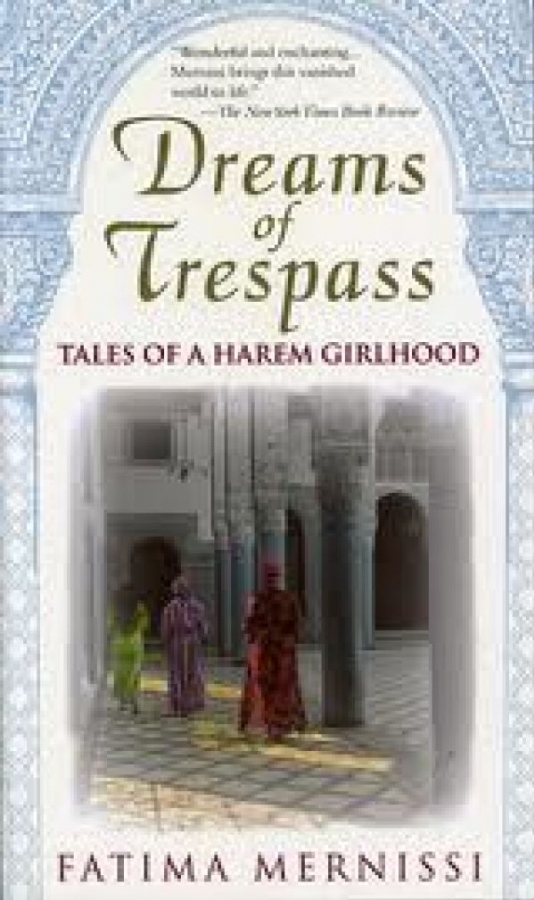
The Forbidden Terrace
As the author explains, there are two types of harems. Imperial harems are the ones best known to us Westerners: lascivious and indolent women, guarded by eunuchs, and ever-ready to satisfy their master’s desires. Domestic harems, on the other hand, are extended families in which women are confined within a physical boundary (generally the walls of a palace or townhouse when living in the city) or a virtual barrier in the countryside, where a woman could theoretically go outside but is prevented from doing so by social codes and customs. This novel concerns the domestic harem. We are in Fez, Morocco, during the 1940s, probably during the Second World War. The novel chronicles the author’s childhood within the extended family of her father and uncle. In several chapters, the narrative shifts to the countryside, to the sprawling house of her maternal grandfather—a polygamist, unlike the paternal household, which comprises solely monogamous couples. Three narrative threads can be identified in the book. The first, and most compelling, is the story of a young girl coming of age. The recited—never read—tales of the house’s many women, the discovery of the grand palace, the taste for the forbidden, and the play and solidarity among cousins fill Fatema’s life with joy and wonder. Fascinated by the adult women, their vitality, and their dreams, the young girl yearns for freedom, more out of affinity than a sense of deprivation. Indeed, she confesses > my childhood was happy because the boundaries were of a crystalline clarity . > Looking for frontiers became my life’s occupation.... everything seems easy looking at you (women of the harem)..... fragile, you, in the dead of night, on the distant terrace, yet so full of life, nurturers and guardians of wonders. I will become a magician. I will chisel words that give body to dreams, that will render borders vain . This wondrous childhood comes to an abrupt halt at the age of nine, when her cousin Samir, her peer and partner in games and mischief, confronts her with a choice: play with him or devote herself to making herself pretty. Still a child, Fatema chooses the latter path and breaks off her friendship with her cousin. The second narrative thread addresses the condition of women, deprived of freedom within the harem. Enclosed within the palace walls, even nature is replaced by > geometric and floral designs reproduced on the tiles... all the windows opened onto the courtyard . This physical deprivation becomes an existential sorrow, which only dreaming makes it possible to combat: > oh, yes, I would tell them of the impossible of a new Arab world, where men and women, locked in an embrace, dance away, with no more borders between them, nor fears... trust is the new game to learn..... they move forward, putting one foot in front of the other, their eyes fixed on the new, almost unimaginable horizon, unknown yet devoid of menace . For the intellectual Mernissi, the harem was a reality lived as a child, but it is also a metaphor for all the barriers erected against the potential of women—and of men. The third strand is sociological rather than narrative. The author describes harem life and, along with it, the customs of traditional Moroccan society. It is a particularly interesting aspect for Western readers. Indeed, what emerges is a North African and Muslim society previously unknown to us: culturally rich, tolerant, and open to changing customs and values. These are three narrative threads, yet the most spontaneous—Fatema’s childhood—is stifled by the other two, in which the adult woman takes over. Is it plausible that such a young girl could perceive the unease and yearning for freedom of the harem women with such philosophical clarity? Or is it Mernissi rereading the characters and events of the harem through the lens of her consciousness as an adult, intellectual, and politically engaged woman? Furthermore, the narrative thread tied to the condition of women is itself weighed down by the book’s obvious intention to document the harem and the Moroccan world: an undertaking in which the sociologist overshadows the creative writer. The layering of themes, the digressions on female emancipation, and the primacy given to social inquiry render the narrative verbose and redundant, stripping away the freshness and naivety that occasionally shimmer through the experiences of the young Fatema. The author fails to let political and social themes organically emerge from the novel—and thus from imaginative storytelling—relying all too often on the prose style and framing typical of an essay. Why read it? It is deeply interesting as an insight into the Muslim world. In certain passages, a strong poetic resonance makes itself felt.
The Lands of Sacramento
The novel is set in Molise between 1921 and 1922. It is our South: peasant-bound, archaic, and motionless for centuries. The lands of Sacramento are a fiefdom, left fallow because of a divine curse upheld by the Church, from which the estate had been expropriated by a wealthy family, the Cannavales. Paradoxically, the abandonment of this land places it at the disposal of the peasants. Some, the wealthiest and most unscrupulous, have shifted boundaries, effectively seizing the most fertile tracts; the majority, instead, turn to the fields to gather firewood, graze their few beasts, and forage for fruit and roots. On the other hand, the owner, the lawyer Enrico—sole heir of the Cannavales—is the quintessential apathetic Southern proprietor, squandering his vast inheritance on gambling, women, and travel, surrounded by a brood of petty parasites and exploiters. Luca, a twenty-year-old youth, tall, sturdy, and intelligent, is the son of impoverished peasants. He was destined to become a priest; then, restless and wavering, he abandoned the seminary to his mother’s deep sorrow, only to find himself a law student, penniless and without prospects. It would seem the classic destiny of so many Southern youths whose families made enormous sacrifices to have an educated son, however poor. What upends Luca’s life, and the future of the Sacramento lands, is the sudden intrusion of Laura. Raised in Naples and accustomed to the brilliant high society of the Parthenopean city, Laura was forced to relocate to Molise upon the death of her brother. Ambitious, she refuses to resign herself to the dullness of provincial life. She marries Lawyer Cannavale and resolves to develop the lands of Sacramento. She needs an intermediary between her designs and the peasantry. She finds him in Luca: who better than he—educated, driven, and respected by his people—can convince the farmhands to clear and till the Sacramento lands with the promise of holding them under emphyteusis? And Luca, naive and captivated by the woman, labors with vigor and success, placing his utmost trust in Laura. For many pages, the reader too indulges the illusion that Laura genuinely wishes to bring progress to these desolate Molise wastes. At last, a Southern proprietor who aspires to be an entrepreneur! Who loves her land! In reality, the peasants, and Luca with them, have been duped: the land has become the property of a Neapolitan corporation in which Laura is a shareholder. The peasants must resign themselves to remaining mere impoverished day laborers, doomed to destitution. They were used to break the ground, to dispel the curse, to inflate the sale value of the estate. And as has always happened in our South, the peasants’ protest ends in violent, tragic repression, with Luca himself paying the ultimate price, cut down and killed. The book is, first and foremost, a social novel, steeped in an intense realism. The author depicts, with grim fatalism, an affair that could have repeated itself across the centuries, ever identical to itself: the yearning for the land, the figure of a young man turned intellectual who naively fails to grasp the machinations of power, and an indifferent, selfish, and rapacious ruling class. After all, why trouble oneself over the lives of people who grow up, age, and die through the unfolding of physical existence, yet in a state of total mental inertia? This reading of the novel holds true for most of the events and characters, the latter serving as stereotypes of a social function rather than beings endowed with a rich inner life. Yet this becomes less tenable when confronted with the figure of Laura. Who is this woman? Cold, ambitious, amenable to a marriage of convenience, yet often affectionate, gentle, attentive to human relationships. Is she truly a manipulator, or is she herself a victim? > Laura stretched out her free hand toward Luca, smiling at him affectionately.... (then) Laura’s smile faded . Why not read it? It is slow and monotonous, failing to engage the reader.

Earth and Germinal
These are two naturalist novels of a pronounced sociological stamp: almost social inquiries. In *La Terre*, Zola depicts, ruthlessly and without the slightest concession to idealism or optimism, the economic and social reality of French agriculture at the close of the nineteenth century. Nothing is spared; in particular, the family and human relationships are shattered by the greed for property and an ingrained habituation to violence. In *Germinal*, which portrays the plight of the miners and one of the earliest workers' strikes, the style remains strictly realistic, yet idealistic notes emerge, tied to the conviction that one is witnessing the first steps of a great movement—the labor movement—destined to achieve social and political gains. Although the novel’s conclusion is tragic, the reader comes away with a certain optimism. Contemporaries favored *Germinal* over *La Terre*, but today it is undoubtedly the latter that stands out with greater validity, particularly for its narrative pacing (that of *Germinal* is somewhat tedious) and its depiction of the French countryside. These are two great social novels that place Zola among the greatest writers of this genre.
Nobel's Will
Annika is a journalist, married to a dull, unpleasant civil servant. Their marriage is in crisis. By chance, Annika is the only person who caught a glimpse of the murderer—or rather, the murderess—of the chairwoman of the Nobel Prize selection committee. From this event branch numerous narrative threads, perhaps far too many: the rivalries and secrets of the Swedish scientific community, a series of heinous crimes committed to eliminate potential Nobel contenders, the abuses perpetrated by European governments to appease the CIA in the war on terror, the attempt to curb civil liberties by legalizing wiretapping, the crisis of journalism and the press, and the strain of a domestic life borne entirely by the woman. Woven into this tangle of events is also an allusion to a sixteenth-century tale (a young woman had brutally killed the father who was sexually abusing her): a story that had fascinated Alfred Nobel in his day, and which has inspired the killer, an ambitious and sadistic scientist. The diverse narrative threads overlap without ever reaching a true resolution—save for the unmasking of the culprit, as in any self-respecting noir. Yet the author manages neither to pace the events nor to create an atmosphere of suspense. The pages drag by, tedious and at times repetitive; the novel's finest moments are reduced to the opening scene—the murder of the committee chair—and the finale, in which the protagonist miraculously escapes an arson attack. Why not read it? It is long and seems written more to induce sleep than to captivate the reader.
The Thicket (the forest)
In the face of evil, violence, countless innocent victims, genocides, and mass exterminations, we often wonder whether God exists or, if He does, whether He is an indifferent Being unmoved by the human condition. And often we are inclined to reply with the words of Shorty, one of the novel’s characters: > God is an idea, and the devil is us. (...) Life ain't black and white, here and there. There's some mud in it, and we are part of the mud . This novel tackles the question of good and evil, doing so through a tale that is adventurous, terrifying, and cynical. A smallpox epidemic has orphaned two adolescents, Jack and Lula. They are taken in by their grandfather: a paragon of virtue and steadfast values, at least in the eyes of the children. > He was a religious man and was always convinced that he would see everyone in heaven. It was a firm and solid thing in him, and it comforted him in every situation, and he had taught me that this was the way one had to deal with the world . They set out on a journey that was meant to bring the youngsters to live with an aunt; however, while crossing a river on a small ferry, the grandfather is murdered by a rogue, the boat capsizes, and Lula is abducted by bandits. Jack is terrified and immediately resolves to set out in search of his sister. Arriving in the nearest town, he runs into a dwarf, the aforementioned Shorty, and Eustace, a Black giant who is never without his hog. The two agree to help Jack, won over by the boy’s promise of an inherited property as a reward. They are ne'er-do-wells, or so it seems; but Jack’s misgivings lie elsewhere: > We might not have to kill anyone. Shorty and Eustace looked at me as if my pants had just fallen down and I’d dropped a big turd right there in the room. Might not have to kill anyone? Eustace said. You had a drink or two without me noticing? Jack loses his virginity to a young prostitute, from whom he learns that his grandfather had been one of her frequent patrons. He witnesses the torture of one of the outlaws at the hands of Eustace and Shorty; the latter recounts the chilling backstory of the sheriff, whose family was gruesomely slaughtered by Indians. Jack tries not to give in, turning to God, > but prayers felt meaningless to me, unlike when I was at home and my family was in the house with me and everything was in order. Prayers seemed real back then, but now they felt empty . They learn that the outlaws have holed up in a thicket—an impenetrable tract under bandit control. Thus begins “a noble rescue expedition”; pity that the party consists of such improbable figures: an inept tracker (Eustace), a pig that acts almost like a dog, a dwarf far too wise to be real, a prostitute partly infatuated and partly on the run, a desperate sheriff, and a wretched janitor who tags along out of fear or sheer lack of alternatives. Is this a metaphor for the wretched of the earth? Be that as it may, Jack plunges into the thicket alongside this bizarre entourage: he encounters gruesomely disfigured corpses and survivors still traumatized by the ruthless cutthroats; he hears harrowing tales of atrocious crimes and finds himself entangled in shootouts and killings, in which his companions display the very same disregard for human life as the bandits. It is like a descent into the underworld; human wickedness knows no bounds. Until, in a high-tension climax, the heroes—whom we would wish to be righteous—slaughter their enemies and rescue Lula. During the clash, Jack harbors no qualms; he has become a determined killer, stripped of moral restraint, no longer seeking Justice, expecting nothing from the law, devoid of any reverence for human life: > I felt further from Jesus and closer to Satan than I had ever been before . It is best not to disclose the novel’s ending: it lapses into a disappointing sentimentality of the “happily ever after” sort—a narrative stumble following a tale that leaves nothing to the imagination, so detailed and repetitively tedious are its gruesome acts of cruelty. One is left wondering about the author's purpose: an ode to violence, a portrait of modern society disguised as the American West, or, worse still, an attempt to convince us that coming of age requires accepting evil as the defining element of human existence across all eras. If this is the case, we counter with the words of a great Confucian philosopher (Wang Yang-ming, who lived between 1472 and 1529): the Mind, also known as Heart/Spirit (the unifying principle of the universe), > shares the very essence of human nature, and since human nature is fundamentally good, an equal perfection must be attributed to the Mind . It is pointless to ask whether God is good, evil, or indifferent, for He is nothing more than a projection of human nature: it is up to us to cultivate ourselves through knowledge, conduct, compassion, and sincerity, so as to act righteously and banish evil from our midst. The primary virtue of the novel lies in its narrative style. It is not an easy English, steeped as it is in slang and an apparently convoluted syntactic structure; yet it is precisely the writing that lends originality to the tale, intriguing and mesmerizing the reader. It is a pity that such skill was placed at the service of so misguided a message. Why read it? At times tedious, redundant in its cruelty, marred by too many digressions: what captivates is the prose.
Things Fall Apart (things fall apart)
The novel forms part of a trilogy alongside two other works, *No Longer at Ease* (1960) and *Arrow of God* (1964): an expansive fresco depicting the impact of colonialism on African society. In this narrative, the setting is established across the nine villages of Umuofia, in Nigeria; the historical period is that which immediately precedes the arrival of the colonizers. *Things Fall Apart* recounts, precisely, the demise of an agrarian civilization, shaped by the cycle of the seasons and governed by immutable, perennial codes. It is a realm forged of certainties yet inherently magical, teeming with elusive and mythical figures; its people are immersed in a living natural world, accustomed to accepting its benevolence alongside its wrath. A person's existence > unfolded from birth to death through a continuum of transitional rites, drawing them ever closer to the realm of their ancestors . Achebe depicts this society through exquisite and stately elegiac forms; he does so without self-indulgence or nostalgia, for those certainties also stemmed from the collective acceptance of an unyielding hierarchy and an inertia that entrapped human beings. The arrival of the white conqueror and his religion does not shatter an idyllic world; it also dismantles laws and customs that were often brutal and inscrutable, leaving > Umuofia bewildered like a startled animal, ears pricked, scenting the silent, ominous air without knowing which path to take . It would be reductive, however, to read the novel solely through its social and political dimensions; it chronicles the story of a man, meditating on power and its eventual fall. Okonkwo is a formidable warrior whose renown reaches beyond Umuofia, to the extent that the elders regard him as > among the bravest champions since the clan's founder wrestled a wilderness spirit for seven days and seven nights . His extensive properties and grand compound, his numerous wives and many children enable Okonkwo to aspire to the highest ranks of society. For him, this represents redemption from the legacy of his father, who had squandered everything and brought dishonor upon the household. It is an honor of high standing when the village elders resolve to place in Okonkwo’s charge a boy from another tribe, surrendered as compensation for the killing of an Umuofia maiden. Ikemefuna is resilient and robust, swiftly earning Okonkwo’s esteem and affection. Ah, if only he were his eldest son, instead of Nwoye, who is so frail as to recall Okonkwo’s own father! A deep bond also forms between Ikemefuna and Nwoye, the former assuming the role of an elder brother, at once protective and vigorous. The Oracle of the Hills and the Caves hands down Ikemefuna’s death sentence; he must be slain in accordance with an unbending, immutable law governing those given in retribution for a crime. > This boy looks to you as a father. Take no part in his death , an elder cautions, conveying the village’s decree to Okonkwo. Okonkwo would be excused from taking part in the gruesome execution; yet he cannot bring himself to withdraw, bound by a social standing he feels driven to maintain. And so Okonkwo follows Ikemefuna on his unsuspecting path toward death. The unfortunate boy recalls the tunes his mother used to sing to him: > he felt like a child all over again, comforted by the thought of returning home to his mother . He is struck down and cries out: > Father, they are killing me! Seized by terror, Okonkwo unsheathed his machete and dealt the finishing blow, terrified of being perceived as weak. (...) Nwoye had heard rumors that twins were cast into clay vessels and abandoned in the forest, yet he had never crossed paths with them until now. A sudden shudder had coursed through him and his mind seemed to grow dim, like a solitary wanderer encountering a sinister spirit upon the road at night. Something had broken within his spirit then. That very tremor fell upon him once more when his father walked through the door that evening after putting Ikemefuna to death. With this episode begins Okonkwo’s downfall; after all, what he has done is > the sort of transgression for which the deity obliterates an entire lineage . During a funeral gathering, Okonkwo accidentally slays a youth of Umuofia: custom dictates that he must go into exile for seven years, accompanied by his entire family. He resigns himself to this destiny; clearly his personal guardian spirit, his *chi*, was not forged for greatness. He knows, too, that once he returns to his village he will no longer be able to aspire to the summit of society, no matter how immense his valor and wealth might be. Yet while Okonkwo bows to ancestral mandates, he can in no way reconcile himself to the colonizer's rules, particularly when they strike at his own flesh and blood: his eldest son Nwoye converts to Christianity, renouncing family, tradition, and the ancient gods. Then, upon realizing that Umuofia is capitulating without resistance, he commits an individual act of rebellion: he strikes down the white man’s messenger, a traitor to his own people. Nothing remains for him but to end his own life, hanging himself: his world has collapsed. Much like in Aeschylean tragedy, Okonkwo seems driven solely by the divine, by his *chi* > , by ancestral decrees, by ageless rituals: at bottom, he carries no guilt for participating in Ikemefuna's execution. Achebe is too accomplished a writer to lapse into stereotypes: a pivotal strength of the novel lies precisely in the psychology of its characters; they maneuver within their human contradictions, caught between social strictures, affections, and ambitions. Ezinma, Okonkwo’s favorite daughter (ah, if only she were a boy!), is carried off by an ecstatic priestess to the shrine of the cave deity. Her mother trails behind in despair, yet lacks the courage to cross into the cavern, such is the awe commanded by the ancient faith. Okonkwo arrives with his machete, the consummate warrior, prepared to defend and, if necessary, tear his beloved daughter away, even against the divine will. Yet we must ask: why was he not willing to make that very same choice for Ikemefuna, or for Nwoye? Out of ambition, or simply because he did not love them enough? Furthermore, why do the gods strike him down, even when he complied with the cruel ancestral laws? And why does he resort to suicide, fully aware that one who takes his own life may only be buried by strangers, bringing ruin upon his entire house? As observed in the introduction, Achebe's characters do not seek our consent to be human; they offer no apologies for their complexity (or for being African, or human, or so extraordinarily alive). The setting, narrative, and characters captivate because they are rendered in prose that approaches perfection: unadorned, fluid, capable of interweaving English with vernacular idioms, conveying both the ambiguous allure of a civilization and the profoundly authentic, layered feelings of its protagonists. It is true that the subject is Africa, yet the refined craft and narrative pacing—with its deliberate suspensions and its oscillation between quietude and catastrophe—lead us into a universal dimension: the underlying subject is the enduring fate of the human condition, transcending both time and space. Why read it? Mesmerizing, a masterpiece.
This side of Brightness
In seeking meaning in this intense, tangled novel, *Gerusalemme Liberata* came to mind, a metaphor for a collective and individual purification that ought to lead to resurrection. For McCann too, the tunnel—the true protagonist of the narrative—evokes a journey at the end of which there should be light. Yet just as Torquato Tasso’s knights cannot attain sanctity because of themselves (“I shall live amid my torments, [...] raving, wandering: I shall fear myself”), so for the author every shadow of ourselves leads to another shadow, every tunnel to another tunnel. As Amelia Rosselli writes, > stationary before a destiny ever self-propelling or unrecognizable, among the tall stunted pines, among the many other things we do not write of so long as we manage to live them, among the tents of the campsite were indeed the usual traitors: myself disguised as a poor emperor, (...) I have undone all the tunnels of the sultry afternoon lull (from *Documenti*): there is no way out of depression, there is no hope. The trouble is that McCann attempts to tackle this existential theme within a traditional narrative structure. And indeed, the story sets out from the construction of the great underwater tunnel required to build the New York City subway. We are at the turn of the twentieth century: the undertaking is titanic, technical means rudimentary, working conditions punishing and arduous, the risks staggering. Working in the tunnel is Nathan Walker: a powerfully built black man, > the great arms, the thick chest, the knot of muscle, (...) happy and unhappy enough, sufficiently solitary, predominantly alone, Walker is capable, like a man who spends much time with himself, of laughing out loud for no apparent reason . The man takes care of the newborn daughter of a friend killed in a severe workplace accident. Over the years, affection for the girl turns into love; an aging man marries a very young woman, a black man joins with a white woman. This theme is then abandoned by the author (why introduce it, then?), or perhaps it hints at the mingling of different ages and races as a sin that lies at the root of a cascade of misfortunes: the wife is struck and killed by a car, the son takes revenge by murdering the driver and is subsequently shot dead by the police, the daughter-in-law turns to drugs and dies of an overdose, the grandson, Clarence Walker, lapses into depression after witnessing the death or suicide of his grandfather. It is truly too much! Alongside this honestly implausible storyline, the true theme of the novel slowly surfaces: Clarence Walker (referred to for many pages as “Treefrog,” a frog that lives in trees) has hidden himself in a tunnel among the homeless, carving out a lair in an inaccessible spot, reached only by a perilous catwalk. > Everything is in the purest darkness so that he can hardly see even the palm of his hand in front of his face. And then there is a slow coming of an array of tunnels and flashes of light and he can see through the shadows. He listens to the movements and fear drops down into his belly and settles in his liver : memories, evanescent portraits, a past no longer real, merely dreamed with nostalgia, in a ruthless indifference. And what is love like in the tunnel, this metaphor for our lives? > Angela’s nails scraped along his back, leaving marks in the skin, and the rhythm of their breath quick quick quick quick, a wild thrusting from them both, until everything unraveled into long gasps of breath, slow slow slow slow, and then the two of them could lie there waiting for something more . Like any good American novel there must be a happy ending: yet it feels too tacked-on to offer relief, after the strain of doggedly reaching the story’s conclusion. The writing is the book's redeeming virtue and what holds it aloft. Amid a messy plot, with superficially drawn characters and never a deep dive into the narrative’s countless turns, the reader must surrender to the grip of the prose, the syntax, the capacity to summon feelings, images, human conditions. One cannot help admiring certain subtle references, such as the phrase “funhouse darkness,” echoing the song by American singer-songwriter P!nk: “dancing through this empty house it tears us down throws you out screaming in the halls spinning all around and now we fall..... Why read it? It is strenuous, but the writing is fascinating.

Please let me hate you
Welcome back, superficiality! The novel is a modern love fable, complete with all its ingredients: the little Cinderella, in the guise of an angry, progressive young woman; Prince Charming, albeit independent and career-driven; the clash between bourgeois values and the aristocratic sphere, all set in the modern London of investment banking. The protagonist, who also serves as the narrator of the tale, is Jenny. Born into a vegan, animal-rights, pacifist, and anti-capitalist family, Jenny pursued a career as a tax attorney—not entirely betraying her native values (she is merely a vegetarian!), but choosing to forge her own life, one that does not simply mirror the family tradition. She has fashioned a self-image as a strong, “all brains” woman, drifting through failed romances with cultured, “left-wing” men adored by her family, but not by her. At the investment bank where she works and is held in high esteem, she has been waging a years-long “war” with Jan, the scion of a highborn lineage—brilliant, yet vain, arrogant, and obnoxious. Jenny must concede that he is a charming man, yet Jan’s background, his demeanor, and the competitive streak driving the young woman fuel a genuine hostility toward the handsome aristocrat. In an altercation that has since become notorious, Jenny, impetuous by nature, went so far as to break Jan’s noble nose. Working together is therefore out of the question. Yet a high-profile client insists on being represented by both, forcing them, much to their dismay, to “be a team.” Predictably, the “magical attraction” Goethe speaks of in *Elective Affinities* triumphs over differences in temperament, ideology, and social standing, as well as over their mutual competitiveness. Jenny and Jan find themselves in situations of escalating physical proximity: an accidental touch that nonetheless sends strange vibrations, a staged kiss (to spite Jan’s admirers), a kiss that is no longer staged, culminating in physical intimacy. > It is like eating something you know will upset your stomach, but which you simply cannot resist . The “armor” the girl has forged for herself dissolves like a wave in Jan’s arms. But if she did not want to be won over by her Prince Charming, why, when going out with Jan, does she let her friends convince her to dress provocatively and sensually? The ending is a foregone conclusion: the two marry in a lavish ceremony (500 guests). The young woman asserts her “proletarian” spirit by foregoing the veil, yet agrees to wear her husband’s splendid family jewels. A fitting compromise between socialist ideals and aristocratic ones! The novel’s primary virtue lies in its style: delicate, ironic, understated. The narrative relies fundamentally on dialogue, punctuated by Jenny’s sensations rather than reflections. And it is precisely the lightness and elegance with which the author depicts the young woman’s gradual surrender to the allure of the senses that constitutes the novel’s pleasantly engaging element. A pity there is no suspense: everything is entirely predictable, devoid of twists or genuine moments of rupture in a narrative plot far too weak to captivate. Another missed opportunity is the setting. The world of investment banking, with its ruthless rules of career advancement and competition, remains relegated to the background; indeed, at times, it verges on the implausible—one need only consider the boss, far too understanding to be real. Why read it? If one is in need of lightness, it makes for a pleasurable read.
I'll take you and carry you away
It is a book that complements the previous one. Set in the provinces, it recounts a squalid context inhabited by characters marked by a profound sadness over the bleakness of their dead-end lives: the group of violent youths predestined for crime or for an opaque existence like that of their parents; the family of Pietro, the protagonist, defined by the mother’s depression, the father’s violent alcoholism, and the brother’s mediocrity; Graziano Biglia, a squalid provincial *vitellone* who does not even realize he is in love with Flora; and Flora herself, who leads a hard but orderly life caring for her sick mother, until she meets Graziano, becomes pregnant with his child, and is subsequently abandoned, sinking into a state of depression and neglect: “didn’t you know, perhaps, that promises are made to be broken?”. So Flora says on the terrible evening when Pietro kills her. In this provincial setting, a friendship develops between Pietro and Gloria, who, despite coming from very different social backgrounds, forge a bond that cannot help but blossom into a love story. Yet Pietro cannot endure it, and the murder of Flora constitutes, essentially, a way of escaping such a desolate environment. > I understood why he had done it. To fight an evil thing inside us that grows and turns us into beasts. He cut his life in two to be rid of it... I didn’t want to end up like Mimmo... I didn’t want to become like them . Only murder, a violent and irreversible act, shatters a situation that feels destined only to worsen. The desolation lies not only in the present, but above all in the impossibility of a better future and a world devoid of prospects. The style is highly effective, shaped by an ensemble of episodes and characters moving within the realm of chance and unpredictability. The narrative pace is intensely sustained, making it a thoroughly compelling book to read.
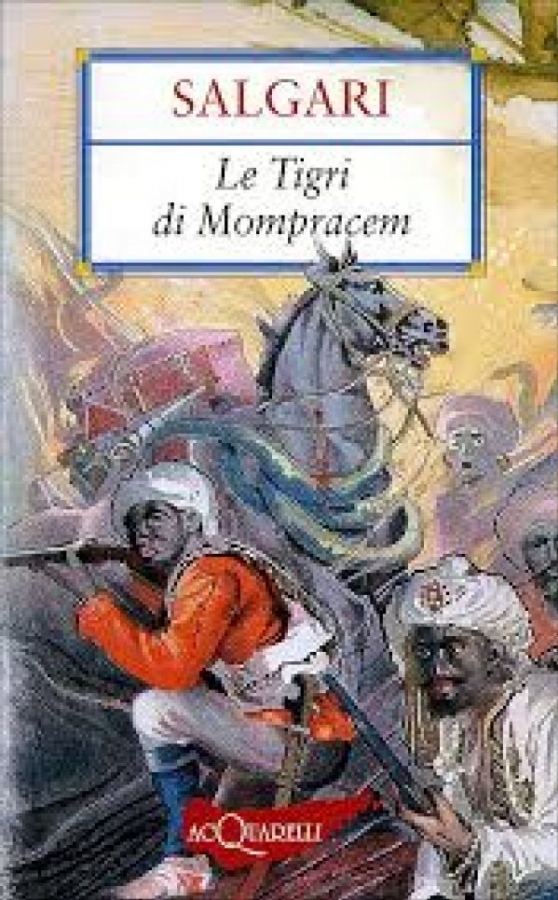
The Tigers of Mompracem
Sandokan > has a broad forehead, shaded by magnificent, boldly arched eyebrows, a small mouth that reveals teeth as sharp as those of wild beasts and gleaming like pearls; two pitch-black eyes, possessing a brilliance that fascinates, that burns, that forces any other gaze to drop . He is the "Tiger of Malaysia", "leader of the fierce pirates of Mompracem", sworn enemy of the British, avenger of oppressed peoples, but also an assassin, cruel, ferocious, terrifying. And so he would have remained, had word not reached him of a woman of great beauty, known as the Pearl of Labuan. An "irresistible force" drives him toward this maiden. He sets out with a few ships and encounters a British cruiser; his fleet is destroyed, his men are killed or drown, and he himself, gravely wounded, barely manages to survive. > I will recover (...) and he uttered that word with such energy as to make one believe he was the absolute arbiter of his own existence , then fear ( > the darkness (...) I do not want to die!...) and finally madness. Completely beside himself, he rushed forward frantically. (...) He believed he saw enemies everywhere. (...) Human beings rose from the ground groaning, screaming, some with bleeding heads, others with severed limbs and torn flanks. All were laughing, sneering, as if mocking the powerlessness of the terrible Tiger of Malaysia > . Sandokan’s delirium is the product of fever and physical exhaustion; the nightmares also arise from the resurfacing in his conscience of all the evil he has done, his ruthlessness, the many dead of his existence. What prevents him from descending into the depths of the earth > is love. After losing consciousness, he comes to in Lord James’s house, where he is cared for by Marianna, the Pearl of Labuan, with whom he falls madly in love: a passion immediately reciprocated. The novel, which seemed to be sliding down the slope of interior soul-searching, regains the typical rhythm of Salgari’s great books: discovered, Sandokan flees, only to return later to free Marianna and take her away; he succeeds thanks to his friend Yanez, who tricks Lord James into undertaking a journey, thereby exposing him to the pirates’ assault. Together at last, Sandokan and Marianna take refuge on Mompracem; to win back the young woman, the powerful Lord James gathers a formidable fleet, which attacks and captures the pirate stronghold after a great battle. It is true that for that heavenly creature, for her I shall have to lose everything, everything, even this sea that I called mine and considered as the blood in my veins. (...) Everything is dead or about to die here > . Marianna asks Sandokan whether he regrets his past power and whether she herself should wield the scimitar", the pirate answers her plainly: "You! You!, he exclaimed, No, I do not want you to become such a woman. It would be a monstrosity". A choice must be made, also because "two happinesses (Marianna and Mompracem) would be too much and I do not want them, (...) and that man, who had never wept in his life, burst into sobs, murmuring: The Tiger is dead, and forever!" The book went through five versions, from the first edition in 1883 to the last in 1891, testifying to a troubled writing process: the author could not find the right register for an audience largely composed of young readers. In particular, it lacks those narrative devices that give pace and surprise to Salgari’s tales. There are some amusing episodes (for instance, when Sandokan and Yanez hide inside a large stove and by pure luck go undiscovered), others seem somewhat contrived and far-fetched, such as the clash between an ape and a panther, while still others recall Salgari’s intense naval battles without the tension and plot twists that typically distinguish them. The author fails to engage the reader because the narrative focuses too heavily on the figure of Sandokan—fascinating, to be sure, but rigid and roughly hewn; nor is he leavened by other characters, as would happen later, when Yanez takes on an expanded, almost protagonist role. Salgari’s craft is not yet fully mastered, and to achieve this the author would have to conceal his own existential anxieties more thoroughly, moving only within a more superficial yet more captivating realm: that of adventure. Why read it? Despite its limitations, the hero Sandokan possesses a powerful appeal.
Stick out your tongue
> The sky was so blue and transparent that it seemed there was no air. (...) In the distance, at the foot of a mountain, I could see the village (...). A hundred or so mud houses lined the slopes, and on every roof a prayer flag. Higher up, halfway to the summit, stood a small Buddhist temple with walls painted in red and white stripes and a band of blue beneath the eaves. (...) Everything that moved—clouds, sheep, dogs, prayer flags, women with children in their arms, and I, a drifting Chinese newly arrived from the east—did so in slow motion . The protagonist and narrator has undertaken the journey to Tibet in the hope of regaining the will to live, a renewed spiritual energy. But > in this sacred land, Buddha seemed unable to save even himself; how could I expect him to save me? Tibet reveals itself to be a nightmare, where > the people endure hardships that lie beyond the modern world’s capacity for comprehension. I write this story in the hope that I may begin to forget it . The book is a collection of stories, of such savage brutality as to leave the reader with “a foul, acrid regurgitation rising to the mouth.” Take the final story in the collection: our Chinese traveler recounts the tale of a young girl chosen to be the new living Buddha. Here we are confronted with the pinnacle of Tibetan religious spirituality. The girl grows into adolescence in the monastery, where she studies and prepares for her exalted station. Like any young girl, she feels the first stirrings of love—a youthful, romantic, modest love woven of glances, thoughts, and sensations. Yet the moment of initiation arrives, the Ceremony of Full Powers: what does it entail? First, she is raped by a monk before the entire community; then, according to ritual, she must meditate in the ice for three days before her Buddha-nature can manifest. The girl dies on the second night in the frozen river and becomes > a body of ice resting upon the ice. (...) Everyone looked at the organs floating inside the transparent body. (...) Now the skull rests on my desk. (...) I will accept any offer, so long as it is sufficient to cover the expenses of my travels to the northeast . Censorship is always to be condemned: one cannot ban the publication of a book, whatever its content and artistic merit. I share, however, the verdict of the Chinese authorities: the book is “vulgar and obscene.” While it is true that idealizing Tibetans “amounts to denying their humanity,” the author’s depiction of Tibetan customs excessively reflects the perspective of one who considers himself superior and makes no attempt to investigate the distinctiveness of a people, dwelling solely on the most brutal and incomprehensible aspects. Why not read it? It is useless for understanding Tibet and implicitly justifies the suppression of this civilization by the Chinese. It is a neo-colonialist book.

Tokyo Soundtrack
The book recounts the environmental and social unraveling of Tokyo from the perspective of two adolescents. Were this story told by a Western writer, it would be steeped in violent realism or intense subjectivism. Consider the *Berlin* saga (see the review on this site), in which a city abandoned to an epidemic becomes the stage for struggles and romance within a dystopian setting, yet rendered in distinctly naturalistic tones. Hideo, however, is a Japanese writer, and he does not escape that magical realism that makes us love the literature of the Land of the Rising Sun so dearly (see the numerous reviews of Japanese novels on this site). Surprisingly, the sprawling narrative sets out from an island where two children have been shipwrecked: little Hitsujiko and the slightly older Touta. The pair must survive in a savage environment, overrun by feral goats. > Their world was there, on the island; there was no other place to go and, after all, what trust could they possibly place in human beings: Hitsujiko having survived by chance a mother who drowned herself, dragging the girl along to end her daughter's life as well; Touta dragged along by his father in a madly speeding motorboat to display the courage and strength of a true Japanese. It is with hatred that they receive the expedition dispatched to cull the goats, which discovers the two children in utter astonishment. > Yes, they were ready to challenge everyone, down to the very last one. From the top of the promontory, they hurled their scornful defiance at the Tokyo official, at the men with rifles, and at all the rest. And something gleamed in the right hand of one of them. A blade. There is in these two children a destructive fury that transcends a rebellious spirit: they are deeply convinced that "good and orderly Japanese society" is hostile, and that only an apocalyptic upheaval can save them, preventing them from slipping back into abandonment. This feeling will bind them forever, even when the two are separated. Hitsujiko is adopted by a couple who take her to Tokyo, to one of the city's most elegant neighborhoods, Nishi-Ogikubo; she is enrolled in an exclusive school and is able to study dance, an art in which she excels. Touta, on the other hand, now of age, goes to live in the Kagurazaka district, teeming with red-light establishments, prostitution, and an underworld interwoven with growing illegal immigration. One does not need to know Tokyo to appreciate the novel: the complex topography, with its meticulously detailed clustering of neighborhoods, the maze of highways, viaducts, subways, elevated and subterranean, aims to give us a tentacular image of the great metropolis—imaginative, mesmerizing, and terrifying. Tokyo is all the more dreadful because its tropicalization is underway: the magnificent cherry trees are vanishing, giving way to exotic plants that harbor unknown and lethal bacteria and viruses; the carp have died in the poisoned canals, wild animals roam the streets—in some cases, dogs abandoned by their owners. The stifling heat, air conditioners blasted to the maximum, torrential rains, and finally an epidemic overwhelm the tenuous coexistence of the different Tokyos: that of the "true > Japanese, like the inhabitants of Nishi-Ogikubo, who defend themselves against immigrants with private militias; the non-Japanese > who came from outside, having settled primarily in Okubo and Kagurazaka; and the subterranean city, populated by the Korpokkur, the first inhabitants of northern Japan before the arrival of the Ainu, the modern-day Japanese. The government relocates the purely > Japanese population to the mountains, where the water is still pure and untainted by the effects of tropicalization: did Hideo prophetically foresee the ideology of the tech oligarchs close to Trump? Specialized troops will disperse DDT and mutant insects underground, while the poor, the infected, and the immigrants are abandoned to their lethal fate. In this scenario, the author's concern is not to delve into the personal dramas of the two protagonists: they are embedded within an apocalyptic upheaval, in which ancient nightmares and new fears resurface. The two adolescents serve merely as the detonator of this upheaval: Hitsujiko with her captivating, mysterious dance, which leads the well-behaved schoolgirls into revolt; Touta with his warrior strength, cunning, and destructive will. Numerous other characters crowd the novel—a crow and a boy-girl lead us into the underground tunnels; countless episodes unfold without the reader always being able to trace the thread; unthinkable weapons are deployed, such as dance and cinema. Within this chaotic kaleidoscope, the reader catches a glimmer of hope that does not require fleeing to another, still-unspoiled planet: it is possible to rebel, to generate a chaos from which a new world might be born; yet this undertaking is entrusted to the humble and to the animals. As the author states in the afterword to the Italian edition: "I will never stop believing that singing all together is the best way to bless this century of ours and rejoice." And in this new harmony, perhaps Hitsujiko and Touta will find each other again on the island of their childhood. The novel develops in a traditional manner in its first part, up until the two youths are separated: the shipwreck, life on the wild island, the understandably difficult integration into the small school and community of one of the Ogasawara Islands. One seems to glimpse a coming-of-age story, albeit with distinctly Japanese idiosyncrasies. The relocation to greater Tokyo could have been the continuation of a tale of growth, and even of love. Instead, the plot veers in another direction: the political and environmental backdrop takes over, and the dark monsters of Japan, veiled beneath a shroud of cultural respectability, emerge with devastating force. The mind turns to the great novels of Kenzaburo Oe, such as *The Silent Heart* and *The Water Forest* (see the reviews on this site). Everything spirals into confusion, almost delirious, and the reader is better off simply getting lost, rather than wondering why a crow understands human speech, why diminutive beings dwell underground, or why dance and silent cinema can serve as lethal weapons, instruments of a revolution. It is fascinating, yet the lengthy digressions, the multitude of characters, and the surreal environments certainly contribute to our disorientation, making for a demanding read. Perhaps a touch of the solid nineteenth-century European novel would have brought order to a narrative that is all too often disjointed. What remains etched in memory is the prophecy of modern times—a prophecy startling in its prescience, considering the novel was written in 2003. Why read it? It is another face of Japan.
Three Crosses
We are in Siena in the early twentieth century: a city "wholly gathered within itself and unapproachable," where one lives gladly because it is possible to "know what one desires of others." Three brothers, Giulio, Niccolò, and Enrico, are sliding into poverty and attempt to save themselves by forging a friend's signature to discount promissory notes at the bank. It is a short-lived expedient, of which they are well aware, yet to which they cling in order to go on living in abundance. What interests the author is not so much the underlying social issue as the psychology of the three brothers, so distinct yet complicit in their fraud. Giulio > was the most melancholy of the three brothers... the most intelligent, and the only one who felt like working . It was he who had proposed the idea of forging the notes, yet he needed a justification capable of clearing his conscience: > no one can expect of me that I not be as God brought me into this world. I have never willingly done harm to anyone. I forged the signatures only because my real signature would have counted for nothing . Niccolò > was always disposed to good cheer, but so mercurially that he would insult anyone who said one word more to him than he cared to hear. Outside, he walked with his head held high, right down the middle of the street, playing the grand gentleman; he barely replied if greeted, striding past as though he despised everyone . Enrico > had been one of those cheeky, brazen boys of whom it is said that nothing good will ever come . Niccolò and Enrico would like to boss around and impose themselves upon Giulio, but then—one out of laziness, the other because he is less intelligent—they leave it to their brother to get them out of trouble. Yet there are endless quarrels and disputes, joined also by friends, which unfailingly end in bouts of heavy eating and drinking. The novel unfolds through a series of domestic sketches, largely set in the old, dusty bookstore—the three brothers' failing business. And life might have carried on amid chatter, squabbles, and feasts, when the bank, presented with yet another promissory note for discount, grows suspicious and alerts the unwitting friend. It is bankruptcy, disgrace, and destitution. And it is Giulio who grasps the full extent of their ruin, both financial and moral. To Niccolò, who insists he will certainly not lose his appetite over having swindled a friend ( > if we had half a dozen roasted woodcocks tonight, I’d clean the bones dry ), Giulio replies that > my will consists precisely in realizing my collapse. It is a sort of inverted pride; but pride all the same . Suicide is Giulio's inevitable fate. With a lapse in style, giving way to a lachrymose pietism, the novel closes with the deaths of Niccolò and Enrico as well. The novel is dedicated to Luigi Pirandello, and never was a reference more fitting. Indeed, of the realism so often invoked by critics, the narrative retains only the backdrop—the pretext for a psychological exploration into the impact of fraud and its inevitable exposure upon the behavior and conscience of its perpetrators. Furthermore, that this investigation centers on three brothers, bound to one another by affection as well as family dynamics, makes the narrative all the more compelling. Certainly, there are distinctively Tuscan idiosyncrasies, but they form merely the setting for a drama universal in both time and space. The account of Giulio’s suicide is a passage of startling modernity, in which objects themselves master the character's will: > on the chest, all those faux-antique objects told him: you are just like us. It is pointless for you to try to avoid us! He answered aloud: Wait, I’ll sign. And he saw his forged signature hopping along the floor. he bent down to catch it; he thrust his head beneath the shelves.... Then he turned out the light. And, in the dark, without realizing he was killing himself, he put his head inside the noose . With this passage, Tozzi surpasses Pirandello himself, establishing himself as one of the most original writers in Italian literature: social issues, regional milieu, psychological mechanics, and postmodern symbolism all merge in this novel. Why read it? If we read without prejudice and beyond clichés, we can discover wondrous, and overlooked, masterpieces within our literature.

Three Meters Above the Sky
The book recounts a love story set among the youth of the Roman upper-middle class. Babi falls in love with a wayward boy, clashing with her parents over him and allowing herself to be drawn into a series of episodes—some even violent—that are entirely foreign to her disposition as a sensible, poised young woman. In the end, however, her social milieu prevails, and Babi leaves the boy for someone closer to her own upbringing and traditions. It is a romantic story whose primary merit lies in its depiction of the world of upper-middle-class youth, their violent values, the indifference of school and parents, and the pursuit of intense, unconventional thrills. In truth, it all concludes in the most predictable fashion, with the characters returning to a “quiet bourgeois life” that, in reality, they never genuinely left. The book is very well written, in an ironic and detached style that is simultaneously capable of eliciting feelings of both sympathy and antipathy, yet always framed within a context of lightness and pleasantness. Aspirations, heartaches, happiness, and loves are rendered in a lean, highly effective tone. Yet an upbeat tone consistently prevails, which at times renders the whole work somewhat contrived and artificial, particularly in the novel’s concluding section.
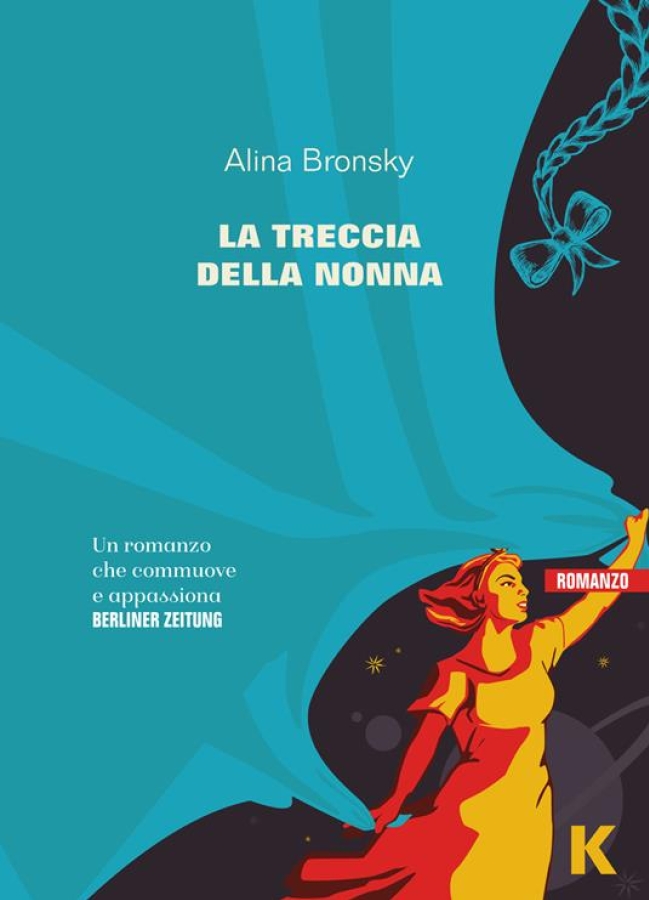
The Grandmother's Braid
The theme of this novel is closely akin to that of Domenico Starnone’s *Vita mortale e immortale della bambina di Milano*, recently reviewed on this site. Just as the Neapolitan writer’s narrative turns on the figure of the “servant grandmother” and her love—subsequently betrayed—for her grandson, here too a grandmother stands at the center of the story: a grandmother ready to place herself at the service of the young orphan—frail, sickly, somewhat dim-witted, and on that account a dead weight. > When we arrived in Germany, the first thing my grandmother did was take me to the pediatrician. In fact, she explained on the way, that was the real reason we had emigrated: so that a proper doctor could finally treat me, someone who might give us hope (...) that one day I would reach adulthood . The grandson nests comfortably beneath his grandmother’s maternal wing, establishing an affectionate relationship steeped in an unmentionable eroticism. And for this reason, it is the boy, still a child, who is the first to notice that the grandfather, the “handsome Asian,” has fallen in love with another woman. The novel opens with this discovery. > To me he was already an old codger (...) and his new, tender secret swept over me in a wave of admiration mixed with gloating , thus writes the boy, who serves as narrator and protagonist alongside the grandmother. If the story had explored the complex, perhaps incestuous relationship between an overbearing mother figure (authoritarian, intrusive, and overpowering) and a personality that could mature only through emancipation, the novel would undoubtedly have been intriguing and well worth reading. Instead, the author focuses on the figure of the grandmother to the point of turning her into a caricature. Confined to her matriarchal role, once she realizes her husband's infidelity, the woman does not fly into a rage, does not throw him out, nor does she even seem to suffer: everything is permitted to the “handsome Asian”—it is simply his nature. She goes further still. She takes charge of the child born of the man’s affair with a young woman; she takes in the young woman herself when she sinks into severe depression; she opens a dance studio and takes over the management of her husband’s company upon his death. It is all too much to remain plausible. Confronted with such excess, the grandson’s emancipation takes the form of betrayal. The boy cuts off his grandmother’s magnificent braid. > Wrap it in newspaper. Keep it as a keepsake. You’ll be leaving soon. I can smell traitors a kilometer away upwind. (...) She brought her face so close to mine that I could make out my reflection in her pupils. I can see it, she repeated vehemently, and pushed me away . Despite being well-written, fluid, and effortless, charming and witty (one need only think of the grandson’s embarrassment over his grandmother’s presence at school), the novel is insignificant. The author, for instance, fails to delve into the question of language: the grandmother who continues speaking Russian despite living in Germany, and the grandson whose emancipation is achieved partly through the acquisition of German—a fascinating theme of identity addressed by Starnone in the aforementioned novel, as well as by other authors: Jhumpa Lahiri’s *The Namesake* and NoViolet Bulawayo’s splendid *We Need New Names* come to mind (two books reviewed on this site). Here, by contrast, the social, political, and anthropological implications of language are developed in a superficial and trite manner. Why not read it? Insignificant.
The Children's Train
Between 1945 and 1952, approximately 70,000 children, mostly from the South, were taken in by peasant families in the Centre-North; this was made possible by the Communist Party, local Liberation Committees, the National Association of Italian Partisans, municipal administrations, and the local populations. It was a remarkable demonstration of national solidarity, which came to be known as the "Trains of Happiness." As Maddalena—a fighter in the Four Days of Naples—says in the novel to convince mothers to let their children go, > when we had to drive out the Germans, we women did our part. Mothers, daughters, wives, young and old: we took to the streets and we fought. You were there, and I was there too. This is like another battle, but against the most dangerous enemies: hunger and poverty. And if you fight, your children will win! The social and political theme of this glorious, often forgotten experience remains in the background, allowing the author to develop a different subject. Toward the end of the narrative, the protagonist and narrator articulates the overall meaning of his story: "I let time slip away, and now it is too late." To understand this sentence, we must retrace the journey of Amerigo Speranza, son of Antonietta Speranza and an unknown father, officially gone to America to seek his fortune. > My mother in front and me behind. Through the alleyways of the Spanish Quarters my mother walks fast: for every step of hers, two of mine. I look at people's shoes. Intact shoe: one point; shoe with a hole: I lose a point. No shoes: zero points. New shoes: bonus star. I've never had shoes of my own; I wear other people's, and they always hurt my feet . Amerigo accepts the squalor of the *bassi* and Antonietta's apparent coldness—she is too consumed by making ends meet to show affection to her son—as a natural state of affairs. Then, unbidden, the "Train of Happiness" bursts in. Along with so many other children, Amerigo leaves Naples for the North. > My mother Antonietta remains in a corner of the station that grows ever more distant, her arms crossed over my coat. As if she were holding me tight through the bombardments. (...) I look out the window, I think of my spot in Mama's bed. (...) I think of the streets where I used to wander all day collecting rags, rain or shine. I think of Pachiochia, who by now has gone to bed in her *basso* with the picture of the mustachioed king on the nightstand. I think of Zabagliona, and I seem to catch the smell of her onion frittata. I think of the alleyways where I lived, narrower and shorter than this train . These images are too distant from the lovely fairy tale awaiting Amerigo in the North: a room of his own, new clothes, plenty of food, the affection of Derna—the woman who took him in—and above all, the discovery of the violin and of music. "By now we are split in two." For Amerigo, piecing the two halves back together proves impossible, as Antonietta does everything in her power to obliterate anything pertaining to life in the North, even going so far as to sell the violin. > she does something she has never done before: she steps even closer and holds me with both arms. (...) You have to wake up from that dream, Amerì; your life is here. (...) I did it for your own good. (...) I tear myself from her embrace, I get out of bed . Amerigo would like to say so much, but can only voice his bitterness over the loss of his violin. "You're a liar," and he flees, catching the train back North. Many years later, Amerigo returns to Naples for his mother's funeral: he bears a different surname, he is a renowned musician, a stranger to his mother and to his city. Or at least he wishes he were, because > the cries from the markets, the endless gossiping of the women on the doorsteps of the *bassi*, the children chasing one another through the streets, and then a voice preserved in the deepest core of memory. Amerigo, Amerì! Come down, hurry, go ask Pachiochia for two lire... He would like to reclaim his life, but it is too late. > Gone. Destroyed by ruthless fevers,/consumed by an unknown affliction, far away, I cannot tell./Nor do I know if they will return, or when, or how,/the friends, the days, the brightest season,/if the life lost through inattention/will ever return. (Luciano Erba, "Lo svagato" from *Il nastro di Moebius*). Reading the novel leaves a singular, almost incomprehensible impression. The book tackles a great theme, the plot unfolds linearly, and the prose is fluid, if at times pedestrian. And yet, one cannot help but remain uninvolved, as though its many threads (the Trains of Happiness, the maternal bond, the *napoletanità*, the bittersweet and somewhat petty-bourgeois ending) blended so superficially as to leave the reader detached, cold, and even baffled. The truth is that the characters lack psychological depth, just as the settings—particularly the northern peasant world—feel purely literary, contrived at a desk rather than lived. Why read it? It is well written.

Sad, lonely and final
The novel chronicles Marlowe and Soriano’s investigation into the vicissitudes of Stan Laurel and Oliver Hardy. The style aspires to evoke that of Chandler, and the narrative is punctuated by frequent clashes in which the two protagonists invariably come off worst. The vision of society that emerges is one wherein interpersonal relations are consistently resolved through violence, most often at the hands of the police themselves. The result is a bleak pessimism regarding the prospects of civil coexistence.
All Our Secrets
According to verse 41 of Surah XXIX of the Quran, the house of those who do not follow Allah is as fragile as a spider’s web ( > those who have taken protectors other than Allah are like the spider that takes a house. But the frailest of all houses is the house of the spider. If only they knew! ). Huseyin and Emine have always strictly observed moral codes and fulfilled their duties, yet this did not prevent their family from disintegrating. After years of relentless labor in Germany, Huseyin bought an apartment in Istanbul, and just as he is ready to welcome his family, he dies of a heart attack. > Just one week, to stroll with them along the seafront, to offer your children a glass of çay, to take your daughter’s hand and tell her how much you love her, to tell your sons that you are proud of them, to call Sevda and ask her for forgiveness. If Huseyin is able to die still believing he was loved and respected (in his own eyes, he was a righteous and good father and husband!), his wife Emine will have to face her own faults mercilessly, after the author recounts the stories of their four children. > The phone call came in the middle of the night. A scream. At first, Umit could not tell whether that scream had come out of one of his dreams, which lately had been waking him continuously with a lump in his throat. Umit, still an adolescent, has just realized that he is in love with a boy his age, and his psychoanalysis sessions have unveiled the dark undercurrents of an outwardly serene family. > And then suddenly, almost out of nowhere, you start talking about when you used to wet the bed, (...) and then about those ugly, hushed quarrels between your parents, (...) the endless murmuring of your mother trying to calm herself by reciting surahs from the Quran, which terrifies you. Sevda, who arrived in Germany only at thirteen and never attended school, was forced into marriage while still an adolescent; when she returns to her parents wishing to separate, her father’s words are categorical: > “You’d better go back to Ihsan, Sevda.” “But I don’t want to.” (...) “He is coming to pick you up tomorrow.” These were the last words Sevda ever exchanged with her father. Peri is the daughter who went to university, the pride of her parents even though they do not understand her. And after all, how could they understand a daughter who studies Nietzsche and has met a peculiar Kurdish boy, Ciwan, to whom she manages to confess that within her family > a crack has formed somewhere and now it is shrouded in silence , as if there were secrets they refuse to reveal, that her parents keep bottled up inside, beginning with their language, Kurdish, which only they are permitted to speak. And the eldest son, Hakan: why does he decide to drive to Istanbul? Perhaps he does not wish to attend the funeral of the father he still resents for forbidding him from attending a film audition? > Hakan never had an opportunity, and now he gets by as best he can. The stories bring us to the novel’s final chapter, in which, during a dramatic confrontation between Sevda and her mother, the secrets of this family—seemingly so flawless under the guidance of Allah—are laid bare: it is a kind of catharsis where the voice within us, our conscience, demystifies all the rules that loom over us, the representations we construct of ourselves, to finally make us understand who we are. > You ask who I am? It doesn’t matter, Emine. The real question is who you are. Because I am only a part of you. Emine. I am the chasm between your faith and your deeds. I am the contrast between the image you have of yourself and the face you show to others. I am the gap between what you deem right and wrong, the fine crack in your morality, the rift between who you are and who you ought to be. And in the apartment where you thought you would live out your remaining years, rediscovering your love for Huseyin—an apartment now reduced to rubble by the earthquake—you imagine, Emine, opening the door. > your heart exults. You say: Ciwan. Even the greatest mystery of your life, your gravest fault, is unveiled, > and you will be able to forgive yourself. It would be reductive to read the novel solely through its social and anthropological lens: a Kurdish-Turkish family that emigrated to Germany, the outcome of an intertwining of stories, cultures, languages, and rifts hard to heal. Across all the characters, even the most educated and integrated like Peri, lingers the sense of being outsiders, people who could be cast out at any moment; all the more so because their Kurdish origins, carefully concealed by the parents, render them potential foreigners or even enemies within Turkey itself. All of this is certainly present; yet to appreciate the novel one must aim higher, looking to the unsaid within every family, to the difficulty of communication between parents and children, to the elders’ presumption to chart their offspring’s destiny, to the fact that home is as fragile as a spider’s web and cannot be saved by relying on God, moral strictures, money, and consumerism. The family must be > the place where you will always forgive one another. Because only forgiveness can alleviate our loneliness. Because only if you forgive will you be forgiven in return , thus speaks conscience to Emine. The novel is structured into chapters that correspond to the story of each protagonist. At first, the reader is disoriented, mistaking them for simple character sketches linked only by the fact that the figures belong to the same family. Only at the end does one realize there is a common thread, revolving around a tragedy of abandonment and rejection. The plot does not always sustain the same narrative momentum, particularly in the chapter devoted to Hakan, which feels somewhat trite and out of tune. The prose is forged from taut dialogue and psychological insight, at times remarkably effective, particularly in the narration of Sevda, undeniably a central figure. Notable is the shift from the third-person narrator to the second-person “you,” skillfully employed whenever the author addresses Emine and Huseyin—a literary device that evokes a blend of accusation and understanding, yet always maintains emotional proximity to these two tragic figures. Why read it? A truly fine work, bordering on a masterpiece.