V. Nikolaj Gogol
Books by this author (1)
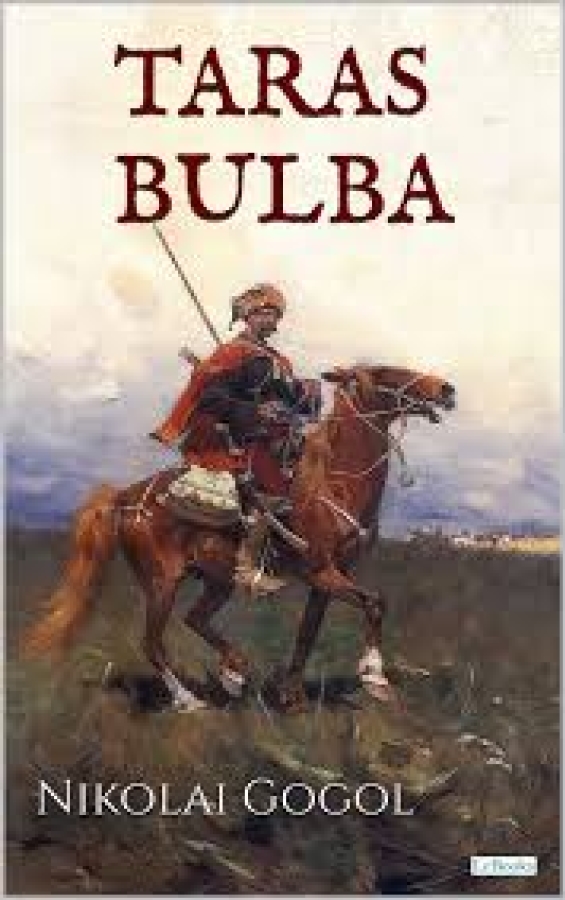
Taras Bulba
For those of us who have dreamt of the battles and heroes of the *Iliad*, Gogol’s *Taras Bulba* recalls the great Homeric epic (see review on this site). There is a warrior people, the Cossacks, who arose from the “ancient, peaceful Slavic spirit” like a “burst of flame,” > an extraordinary manifestation of Russian strength, struck by the flint of misfortune from the breast of the nation. In place of the ancient principalities, of tiny towns filled with dog-breeders and hunters, in place of petty lords who feuded and traded with those towns, there arose formidable settlements, military units, entrenched camps, bound by the common tie of danger and hatred for infidel predators , the Ottoman no less than the Catholic Pole. Then there is a city that, like Troy, resists the Cossack siege, and there is Agamemnon with Achilles and Hector: namely, Taras and his sons, Ostap and Andriy. With superb brushstrokes, Gogol delineates their characters. > Taras was one of the genuine old colonels. (...) He loved the simple Cossack life. (...) Perpetually restless, he regarded himself as the legitimate defender of Orthodoxy. (...) Ostap was considered one of the finest comrades. (...) He was slow to yield to impulses other than those of struggle or a raucous, unbridled carouse. (...) Andriy too burned with the thirst to distinguish himself in feats of war, yet his soul was accessible to other feelings. (...) The image of woman began ever more frequently to rise in his ardent imagination , all the more so after he had met a young Polish noblewoman in Kyiv. In the background there are not merely military encampments, collective drinking bouts, looting, and combat; Gogol also sings of the Ukrainian plain, whose nature > had no beauty that could rival it; the entire surface of the earth appeared as a green-gold ocean, upon which millions of colorful flowers had burst forth. (...) Motionless, high in the sky, sparrowhawks hovered with wings outspread and eyes fixed upon the grass. The cry of a passing flock of wild geese echoed from who knows what distant lake. In an atmosphere at once epic and lyrical, the tragic events of Taras and his sons unfold, a sort of metaphor for the fate of the Cossacks, who would vanish from history under tsarist rule. Enamored of the beautiful Polish woman, Andriy betrays his comrades, but Taras is no Priam. > To betray like this? To betray the faith? To betray your comrades? cries Taras upon confronting Andriy, > stand there still and do not move! I gave you life, and I will kill you!. Overwhelmed by the Polish army, the Cossacks succumb; Ostap is sent to the scaffold. In the face of death the young man cries out, as if seeking one last aid from his father. > Father, where are you? Do you hear all this?, I hear it, was heard in the general silence, and in that same instant thousands of men shuddered. The voice of Taras is lost in nothingness, in death, while the great river flows between many inlets and sandbars, > the resonant cry of the swan echoes over it, and the proud wild duck darts swiftly across. Whoever has read the review up to this point may wonder what we are speaking of: who were these Cossacks? Whoever is interested in knowing may search the web; here it suffices to say that we are speaking of a history far removed in time and space, almost a legend. The events recounted by Gogol concern seventeenth-century Ukraine; yet *Taras Bulba* also speaks to our present day. Gogol is the bard of a people desperately yearning to be free, thus becoming the herald of all peoples fighting for their land and their destiny. Let us read his words, ringing with social grief, then as now, beneath manifold acts of violence and oppression. > There will be, there will be a bandura player with a gray beard spread across his chest; he may still be virilely human, aged only by his hoary head. (...) Thus their fame will spread high across the entire land, and all who are born thereafter into the light of the world shall speak of them, for the mighty voice of the singer reaches far, (...) calling all men without distinction to holy prayer. Gogol is renowned for an unfinished novel, *Dead Souls* (see review on this site), in which, with grotesque comedic tone and remarkable psychological subtlety, the author depicts provincial Russia—a sort of aimless reportage, devoid of moral designs, with no other interest than capturing the flow of life in all its immediacy. The contrast in style and motifs with *Taras Bulba* is striking: in the latter, the characters belong to a choral narrative, nearly prisoners of their tragic destiny, while a people and a land stand at the center of the writing—writing that seems to echo great epics, like Dante's own *Comedy*; for instance, in the similes Gogol employs, drawing on episodes of daily life to describe death on the battlefield. A Cossack is mortally pierced by a lance, > in streams gushed his young blood, like rich wine that careless servants brought up in a glass vessel from the cellar; (...) the master, rushing in at the noise, clutches his head in despair; he had saved that wine for a joyous hour of his life, (...) that he might recall (...) the past, another time when men took their pleasure differently and better. Why read it? A powerful book, a hymn to freedom.