Finished reading on: November 21, 2021
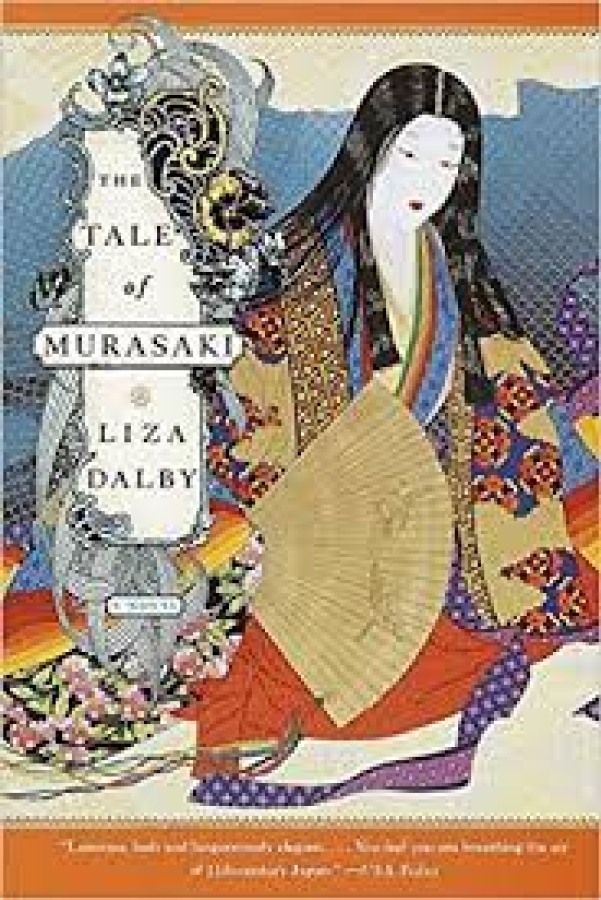
The Tale of Murasaki (the story of Murasaki)
Title of the original version reviewed: «The Tale of Murasaki (la storia di Murasaki)»
AI Translation Notice: This review was translated from the original Italian using artificial intelligence. Book quotes and excerpts are translated interpretations and will not match the author's original English phrasing or official published translations.
As Wikipedia notes, Murasaki Shikibu (973–1014) was a Japanese poet renowned for the epic The Tale of Genji, likely written around the year 1000 when she served as a lady-in-waiting. Murasaki (Japanese for violet) is the name of the novel's female protagonist—a name also attributed to the poet herself, as her real name remains unknown. The Tale of Genji quickly achieved widespread circulation, turning Murasaki into an icon celebrated as the founder of the Japanese language, elevating it at last to the same rank as dominant Chinese literature: in short, Murasaki can be regarded as a kind of Japanese Dante. Attesting to Murasaki’s popular renown, legend has it that she began composing the work while in ecstasy before the full moon and, seized by frenzy, wrote on the backs of sutras (sacred texts of Japanese Buddhism)—a transgression that consigned her to hell. In her fictionalized biography, Liza Dalby retraces Murasaki's life: her youth and the study of Chinese despite women's exclusion from literary education (when her father praised his daughter to his friends, they pointed out it was time she married), her first sonnets with the invention of Genji, her stay in Echizen, where she finally came into contact with Chinese sailors, merchants, and diplomats, her marriage to an important imperial court official, her widowhood and role as lady-in-waiting to the empress, and ultimately her retirement to a Buddhist monastery. For those of us who know little of ancient Japan, the novel is of great historical interest: the economic and cultural relations with China; an approach to nature intent on capturing its "heart," transcending the naturalistic perspective of Chinese literature; the meticulous description of Japanese women’s varied, elaborate dress (the attention to colors and fabrics is astonishing); and the power struggles within the Imperial Court. Beyond these many impressions, the author addresses a central question through Murasaki: is "honest poetry" possible, as Umberto Saba phrased it? Is coherence between life and literature achievable? At the opening of the diary imagined by Dalby, Murasaki states that
life alone has never been quite enough. It becomes real to me only when I enrich it in stories. Yet somehow, despite everything I have written, the true nature of the things I sought to grasp in my novel still manages to slip between the words and lie, like little piles of dust, between the lines
. It is an awareness the poet has held since her youth as a woman of letters, but one that finds dramatic confirmation as Murasaki accepts the painful destiny of women. Genji is a romantic figure, feminine and masculine all at once, to whom a woman can entrust herself completely, with trust and assurance.
Genji was meant to put an end to the draft of ill will that generally destroys relationships between men and women
. It is a fantasy, devised to alleviate her own melancholy and that of her friends. Their choices immediately confront her with the contradiction between life and literature: the first friend marries an elderly official and her adolescent dreams dissolve into a drab solitude; the second kills herself rather than meet the same fate; the third, with whom Murasaki shares an intense intimate relationship, resolves to retreat into a monastery. The dream is shattered once and for all when Murasaki is raped.
I was vexed by how little literature prepares us for real life. (...) Uncertain whether it happened or not, sadly fading away, I scarcely noticed the laughing morning flowers
. She could retire to a monastery like her friend, but ambitious and presumptuous, she remains convinced she can master her own destiny. Already acclaimed for her novel, she enters the imperial palace as a lady-in-waiting.
There was a dark side to that place. At times it reminded me of one of those monstrously large spiderwebs I had seen in Echizen
. She becomes the mistress of the Regent, who uses her as a brilliant court chronicler and possesses none of Genji’s gentleness. She allows herself to become entangled in power struggles, in the rivalries and slander that permeate the women's quarters, and in the sexual harassment from men to which the court ladies must resign themselves.
I felt like the caterpillar that stays hidden in the shade, slowly digesting experiences in order to turn them into something else. (...) I could not deny that Michinaga (the Regent) had slowly influenced Genji's character, but it was not because of anything he had done directly. Genji had changed on his own. If he had become a bit coarse, well, that is what happens when one moves in the world. (...) I had come to the conclusion that my character Murasaki had outlived her usefulness. I had created a woman so perfect that there was nothing left for her to do but die. It took a long time to realize that I needed to sacrifice her to move forward. And it took me even longer before I realized that the problem did not lie with Murasaki, but with Genji. (...) The spider thrives, lost among the barren reeds glistening with frost, unable to foresee when it will weave its web anew
.
In the first part of the novel, before Murasaki enters the imperial palace, one has the impression that the author is writing about a Jane Austen heroine: resolute, independent, even within the confines of society. Then, slowly, that vitality withers, resignation sets in, and Murasaki bends, submitting to the power of men. The author's focus shifts to the context; the narrative becomes granular and repetitive, losing its rhythm, as if the writer were unable—or unwilling—to plumb the depths of Murasaki's soul. It is true that the poet often returns home to rest and concentrate on her work, but why does she agree to let herself be trapped once more: was it not possible that she was enticed by the allure of power, by the bewitching charm of the Regent? These are questions that would have been intriguing to answer. I have one: the pursuit of glory.
The prose is elegant, refined, lexically rich within a linear syntax. The inclusion of short poems, in Japanese and English, evokes the romantic and sophisticated atmosphere of the Japanese literary world, of Murasaki, and of Dalby herself: the sonnets possess a distinctive beauty and resonance. It is regrettable that in the second part the narrative loses momentum and becomes verbose and tedious.
Why read it? Historically interesting; Murasaki's figure is captivating.