Finished reading on: June 23, 2019
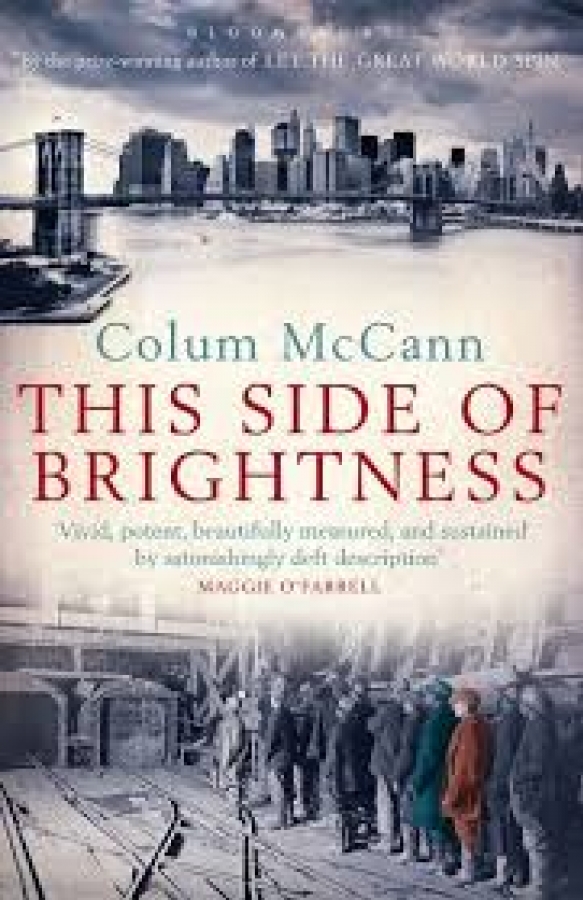
This side of Brightness
AI Translation Notice: This review was translated from the original Italian using artificial intelligence. Book quotes and excerpts are translated interpretations and will not match the author's original English phrasing or official published translations.
In seeking meaning in this intense, tangled novel, Gerusalemme Liberata came to mind, a metaphor for a collective and individual purification that ought to lead to resurrection. For McCann too, the tunnel—the true protagonist of the narrative—evokes a journey at the end of which there should be light. Yet just as Torquato Tasso’s knights cannot attain sanctity because of themselves (“I shall live amid my torments, [...] raving, wandering: I shall fear myself”), so for the author every shadow of ourselves leads to another shadow, every tunnel to another tunnel. As Amelia Rosselli writes,
stationary before a destiny ever self-propelling or unrecognizable, among the tall stunted pines, among the many other things we do not write of so long as we manage to live them, among the tents of the campsite were indeed the usual traitors: myself disguised as a poor emperor, (...) I have undone all the tunnels of the sultry afternoon lull
(from Documenti): there is no way out of depression, there is no hope. The trouble is that McCann attempts to tackle this existential theme within a traditional narrative structure. And indeed, the story sets out from the construction of the great underwater tunnel required to build the New York City subway. We are at the turn of the twentieth century: the undertaking is titanic, technical means rudimentary, working conditions punishing and arduous, the risks staggering. Working in the tunnel is Nathan Walker: a powerfully built black man,
the great arms, the thick chest, the knot of muscle, (...) happy and unhappy enough, sufficiently solitary, predominantly alone, Walker is capable, like a man who spends much time with himself, of laughing out loud for no apparent reason
. The man takes care of the newborn daughter of a friend killed in a severe workplace accident. Over the years, affection for the girl turns into love; an aging man marries a very young woman, a black man joins with a white woman. This theme is then abandoned by the author (why introduce it, then?), or perhaps it hints at the mingling of different ages and races as a sin that lies at the root of a cascade of misfortunes: the wife is struck and killed by a car, the son takes revenge by murdering the driver and is subsequently shot dead by the police, the daughter-in-law turns to drugs and dies of an overdose, the grandson, Clarence Walker, lapses into depression after witnessing the death or suicide of his grandfather. It is truly too much! Alongside this honestly implausible storyline, the true theme of the novel slowly surfaces: Clarence Walker (referred to for many pages as “Treefrog,” a frog that lives in trees) has hidden himself in a tunnel among the homeless, carving out a lair in an inaccessible spot, reached only by a perilous catwalk.
Everything is in the purest darkness so that he can hardly see even the palm of his hand in front of his face. And then there is a slow coming of an array of tunnels and flashes of light and he can see through the shadows. He listens to the movements and fear drops down into his belly and settles in his liver
: memories, evanescent portraits, a past no longer real, merely dreamed with nostalgia, in a ruthless indifference. And what is love like in the tunnel, this metaphor for our lives?
Angela’s nails scraped along his back, leaving marks in the skin, and the rhythm of their breath quick quick quick quick, a wild thrusting from them both, until everything unraveled into long gasps of breath, slow slow slow slow, and then the two of them could lie there waiting for something more
. Like any good American novel there must be a happy ending: yet it feels too tacked-on to offer relief, after the strain of doggedly reaching the story’s conclusion.
The writing is the book's redeeming virtue and what holds it aloft. Amid a messy plot, with superficially drawn characters and never a deep dive into the narrative’s countless turns, the reader must surrender to the grip of the prose, the syntax, the capacity to summon feelings, images, human conditions. One cannot help admiring certain subtle references, such as the phrase “funhouse darkness,” echoing the song by American singer-songwriter P!nk: “dancing through this empty house it tears us down throws you out screaming in the halls spinning all around and now we fall.....
Why read it? It is strenuous, but the writing is fascinating.