Federigo Tozzi
Books by this author (1)
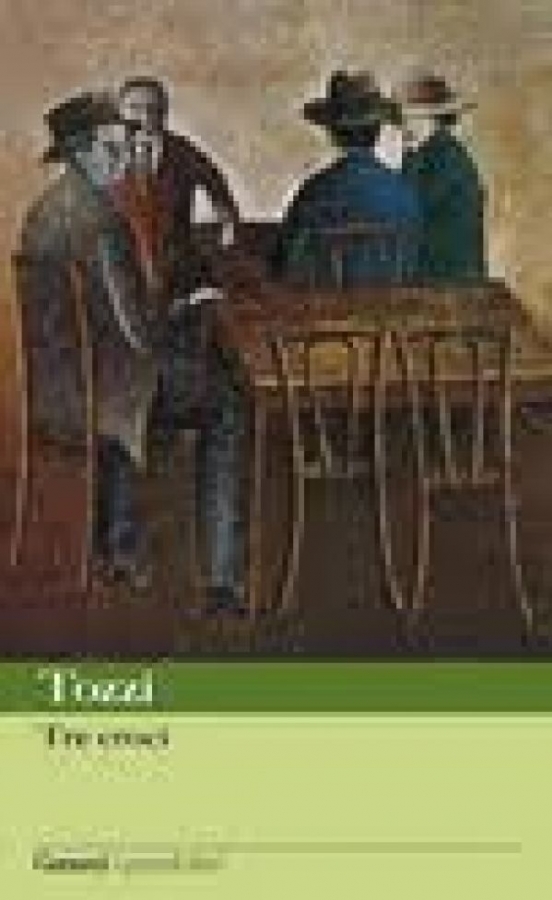
Three Crosses
We are in Siena in the early twentieth century: a city "wholly gathered within itself and unapproachable," where one lives gladly because it is possible to "know what one desires of others." Three brothers, Giulio, Niccolò, and Enrico, are sliding into poverty and attempt to save themselves by forging a friend's signature to discount promissory notes at the bank. It is a short-lived expedient, of which they are well aware, yet to which they cling in order to go on living in abundance. What interests the author is not so much the underlying social issue as the psychology of the three brothers, so distinct yet complicit in their fraud. Giulio > was the most melancholy of the three brothers... the most intelligent, and the only one who felt like working . It was he who had proposed the idea of forging the notes, yet he needed a justification capable of clearing his conscience: > no one can expect of me that I not be as God brought me into this world. I have never willingly done harm to anyone. I forged the signatures only because my real signature would have counted for nothing . Niccolò > was always disposed to good cheer, but so mercurially that he would insult anyone who said one word more to him than he cared to hear. Outside, he walked with his head held high, right down the middle of the street, playing the grand gentleman; he barely replied if greeted, striding past as though he despised everyone . Enrico > had been one of those cheeky, brazen boys of whom it is said that nothing good will ever come . Niccolò and Enrico would like to boss around and impose themselves upon Giulio, but then—one out of laziness, the other because he is less intelligent—they leave it to their brother to get them out of trouble. Yet there are endless quarrels and disputes, joined also by friends, which unfailingly end in bouts of heavy eating and drinking. The novel unfolds through a series of domestic sketches, largely set in the old, dusty bookstore—the three brothers' failing business. And life might have carried on amid chatter, squabbles, and feasts, when the bank, presented with yet another promissory note for discount, grows suspicious and alerts the unwitting friend. It is bankruptcy, disgrace, and destitution. And it is Giulio who grasps the full extent of their ruin, both financial and moral. To Niccolò, who insists he will certainly not lose his appetite over having swindled a friend ( > if we had half a dozen roasted woodcocks tonight, I’d clean the bones dry ), Giulio replies that > my will consists precisely in realizing my collapse. It is a sort of inverted pride; but pride all the same . Suicide is Giulio's inevitable fate. With a lapse in style, giving way to a lachrymose pietism, the novel closes with the deaths of Niccolò and Enrico as well. The novel is dedicated to Luigi Pirandello, and never was a reference more fitting. Indeed, of the realism so often invoked by critics, the narrative retains only the backdrop—the pretext for a psychological exploration into the impact of fraud and its inevitable exposure upon the behavior and conscience of its perpetrators. Furthermore, that this investigation centers on three brothers, bound to one another by affection as well as family dynamics, makes the narrative all the more compelling. Certainly, there are distinctively Tuscan idiosyncrasies, but they form merely the setting for a drama universal in both time and space. The account of Giulio’s suicide is a passage of startling modernity, in which objects themselves master the character's will: > on the chest, all those faux-antique objects told him: you are just like us. It is pointless for you to try to avoid us! He answered aloud: Wait, I’ll sign. And he saw his forged signature hopping along the floor. he bent down to catch it; he thrust his head beneath the shelves.... Then he turned out the light. And, in the dark, without realizing he was killing himself, he put his head inside the noose . With this passage, Tozzi surpasses Pirandello himself, establishing himself as one of the most original writers in Italian literature: social issues, regional milieu, psychological mechanics, and postmodern symbolism all merge in this novel. Why read it? If we read without prejudice and beyond clichés, we can discover wondrous, and overlooked, masterpieces within our literature.