Fatma Aydemir
Books by this author (1)
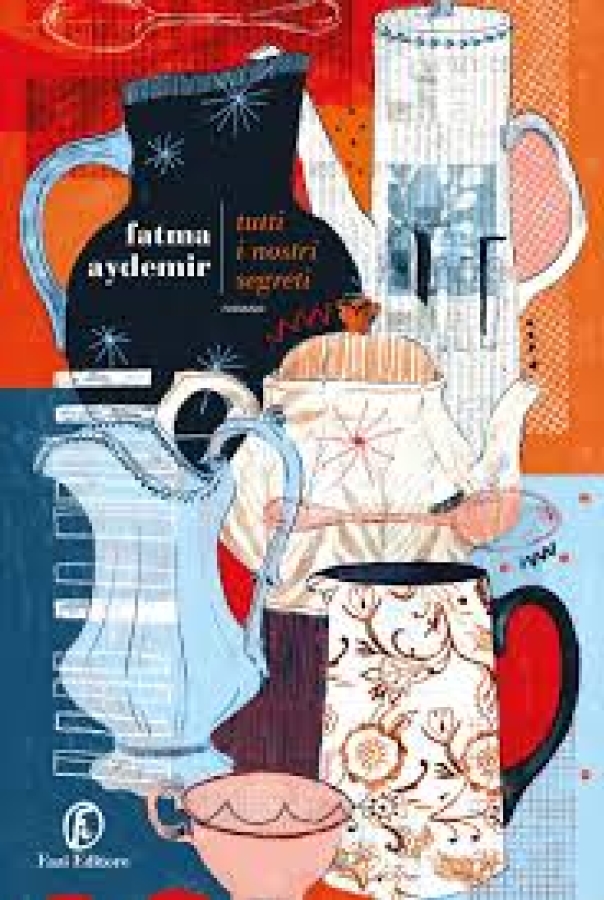
All Our Secrets
According to verse 41 of Surah XXIX of the Quran, the house of those who do not follow Allah is as fragile as a spider’s web ( > those who have taken protectors other than Allah are like the spider that takes a house. But the frailest of all houses is the house of the spider. If only they knew! ). Huseyin and Emine have always strictly observed moral codes and fulfilled their duties, yet this did not prevent their family from disintegrating. After years of relentless labor in Germany, Huseyin bought an apartment in Istanbul, and just as he is ready to welcome his family, he dies of a heart attack. > Just one week, to stroll with them along the seafront, to offer your children a glass of çay, to take your daughter’s hand and tell her how much you love her, to tell your sons that you are proud of them, to call Sevda and ask her for forgiveness. If Huseyin is able to die still believing he was loved and respected (in his own eyes, he was a righteous and good father and husband!), his wife Emine will have to face her own faults mercilessly, after the author recounts the stories of their four children. > The phone call came in the middle of the night. A scream. At first, Umit could not tell whether that scream had come out of one of his dreams, which lately had been waking him continuously with a lump in his throat. Umit, still an adolescent, has just realized that he is in love with a boy his age, and his psychoanalysis sessions have unveiled the dark undercurrents of an outwardly serene family. > And then suddenly, almost out of nowhere, you start talking about when you used to wet the bed, (...) and then about those ugly, hushed quarrels between your parents, (...) the endless murmuring of your mother trying to calm herself by reciting surahs from the Quran, which terrifies you. Sevda, who arrived in Germany only at thirteen and never attended school, was forced into marriage while still an adolescent; when she returns to her parents wishing to separate, her father’s words are categorical: > “You’d better go back to Ihsan, Sevda.” “But I don’t want to.” (...) “He is coming to pick you up tomorrow.” These were the last words Sevda ever exchanged with her father. Peri is the daughter who went to university, the pride of her parents even though they do not understand her. And after all, how could they understand a daughter who studies Nietzsche and has met a peculiar Kurdish boy, Ciwan, to whom she manages to confess that within her family > a crack has formed somewhere and now it is shrouded in silence , as if there were secrets they refuse to reveal, that her parents keep bottled up inside, beginning with their language, Kurdish, which only they are permitted to speak. And the eldest son, Hakan: why does he decide to drive to Istanbul? Perhaps he does not wish to attend the funeral of the father he still resents for forbidding him from attending a film audition? > Hakan never had an opportunity, and now he gets by as best he can. The stories bring us to the novel’s final chapter, in which, during a dramatic confrontation between Sevda and her mother, the secrets of this family—seemingly so flawless under the guidance of Allah—are laid bare: it is a kind of catharsis where the voice within us, our conscience, demystifies all the rules that loom over us, the representations we construct of ourselves, to finally make us understand who we are. > You ask who I am? It doesn’t matter, Emine. The real question is who you are. Because I am only a part of you. Emine. I am the chasm between your faith and your deeds. I am the contrast between the image you have of yourself and the face you show to others. I am the gap between what you deem right and wrong, the fine crack in your morality, the rift between who you are and who you ought to be. And in the apartment where you thought you would live out your remaining years, rediscovering your love for Huseyin—an apartment now reduced to rubble by the earthquake—you imagine, Emine, opening the door. > your heart exults. You say: Ciwan. Even the greatest mystery of your life, your gravest fault, is unveiled, > and you will be able to forgive yourself. It would be reductive to read the novel solely through its social and anthropological lens: a Kurdish-Turkish family that emigrated to Germany, the outcome of an intertwining of stories, cultures, languages, and rifts hard to heal. Across all the characters, even the most educated and integrated like Peri, lingers the sense of being outsiders, people who could be cast out at any moment; all the more so because their Kurdish origins, carefully concealed by the parents, render them potential foreigners or even enemies within Turkey itself. All of this is certainly present; yet to appreciate the novel one must aim higher, looking to the unsaid within every family, to the difficulty of communication between parents and children, to the elders’ presumption to chart their offspring’s destiny, to the fact that home is as fragile as a spider’s web and cannot be saved by relying on God, moral strictures, money, and consumerism. The family must be > the place where you will always forgive one another. Because only forgiveness can alleviate our loneliness. Because only if you forgive will you be forgiven in return , thus speaks conscience to Emine. The novel is structured into chapters that correspond to the story of each protagonist. At first, the reader is disoriented, mistaking them for simple character sketches linked only by the fact that the figures belong to the same family. Only at the end does one realize there is a common thread, revolving around a tragedy of abandonment and rejection. The plot does not always sustain the same narrative momentum, particularly in the chapter devoted to Hakan, which feels somewhat trite and out of tune. The prose is forged from taut dialogue and psychological insight, at times remarkably effective, particularly in the narration of Sevda, undeniably a central figure. Notable is the shift from the third-person narrator to the second-person “you,” skillfully employed whenever the author addresses Emine and Huseyin—a literary device that evokes a blend of accusation and understanding, yet always maintains emotional proximity to these two tragic figures. Why read it? A truly fine work, bordering on a masterpiece.