Finished reading on: February 27, 2015
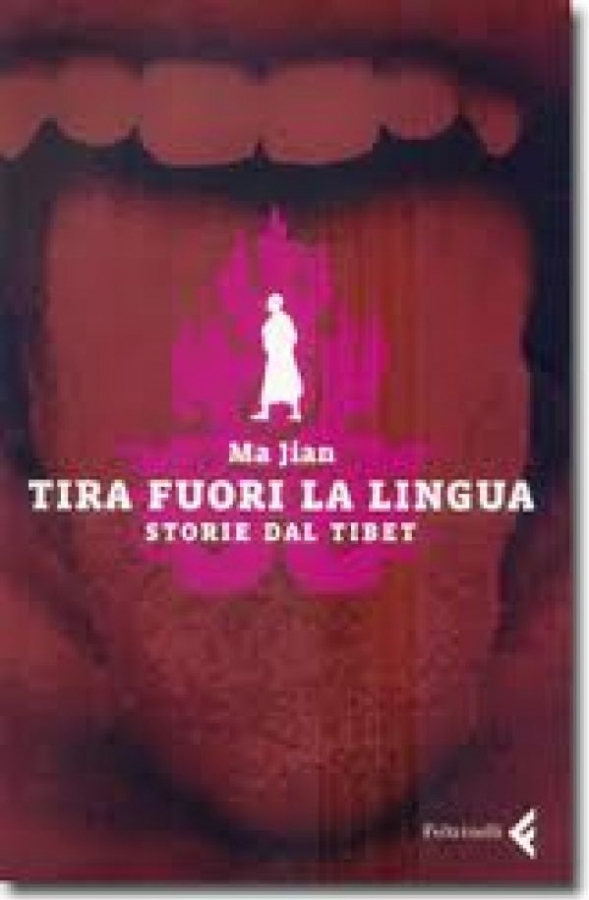
Stick out your tongue
Title of the original version reviewed: «Tira fuori la lingua»
AI Translation Notice: This review was translated from the original Italian using artificial intelligence. Book quotes and excerpts are translated interpretations and will not match the author's original English phrasing or official published translations.
The sky was so blue and transparent that it seemed there was no air.
(...) In the distance, at the foot of a mountain, I could see the village (...).
A hundred or so mud houses lined the slopes, and on every roof a prayer flag.
Higher up, halfway to the summit, stood a small Buddhist temple with walls painted in red and white stripes and a band of blue beneath the eaves.
(...) Everything that moved—clouds, sheep, dogs, prayer flags, women with children in their arms, and I, a drifting Chinese newly arrived from the east—did so in slow motion
.
The protagonist and narrator has undertaken the journey to Tibet in the hope of regaining the will to live, a renewed spiritual energy.
But
in this sacred land, Buddha seemed unable to save even himself; how could I expect him to save me?
Tibet reveals itself to be a nightmare, where
the people endure hardships that lie beyond the modern world’s capacity for comprehension.
I write this story in the hope that I may begin to forget it
.
The book is a collection of stories, of such savage brutality as to leave the reader with “a foul, acrid regurgitation rising to the mouth.”
Take the final story in the collection: our Chinese traveler recounts the tale of a young girl chosen to be the new living Buddha.
Here we are confronted with the pinnacle of Tibetan religious spirituality.
The girl grows into adolescence in the monastery, where she studies and prepares for her exalted station.
Like any young girl, she feels the first stirrings of love—a youthful, romantic, modest love woven of glances, thoughts, and sensations.
Yet the moment of initiation arrives, the Ceremony of Full Powers: what does it entail? First, she is raped by a monk before the entire community; then, according to ritual, she must meditate in the ice for three days before her Buddha-nature can manifest.
The girl dies on the second night in the frozen river and becomes
a body of ice resting upon the ice.
(...) Everyone looked at the organs floating inside the transparent body.
(...) Now the skull rests on my desk.
(...) I will accept any offer, so long as it is sufficient to cover the expenses of my travels to the northeast
.
Censorship is always to be condemned: one cannot ban the publication of a book, whatever its content and artistic merit.
I share, however, the verdict of the Chinese authorities: the book is “vulgar and obscene.”
While it is true that idealizing Tibetans “amounts to denying their humanity,” the author’s depiction of Tibetan customs excessively reflects the perspective of one who considers himself superior and makes no attempt to investigate the distinctiveness of a people, dwelling solely on the most brutal and incomprehensible aspects.
Why not read it? It is useless for understanding Tibet and implicitly justifies the suppression of this civilization by the Chinese.
It is a neo-colonialist book.