Finished reading on: June 04, 2017
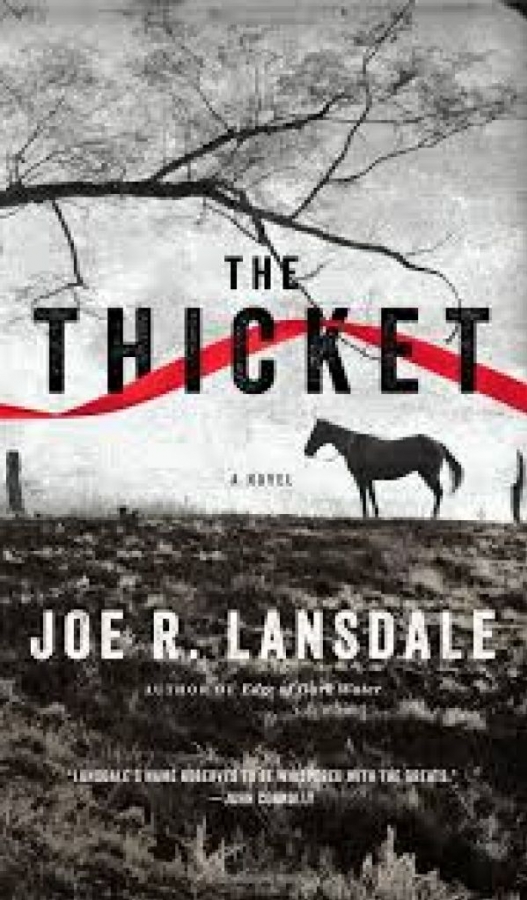
The Thicket (the forest)
Title of the original version reviewed: «The Thicket (la foresta)»
AI Translation Notice: This review was translated from the original Italian using artificial intelligence. Book quotes and excerpts are translated interpretations and will not match the author's original English phrasing or official published translations.
In the face of evil, violence, countless innocent victims, genocides, and mass exterminations, we often wonder whether God exists or, if He does, whether He is an indifferent Being unmoved by the human condition.
And often we are inclined to reply with the words of Shorty, one of the novel’s characters:
God is an idea, and the devil is us.
(...) Life ain't black and white, here and there.
There's some mud in it, and we are part of the mud
.
This novel tackles the question of good and evil, doing so through a tale that is adventurous, terrifying, and cynical.
A smallpox epidemic has orphaned two adolescents, Jack and Lula.
They are taken in by their grandfather: a paragon of virtue and steadfast values, at least in the eyes of the children.
He was a religious man and was always convinced that he would see everyone in heaven.
It was a firm and solid thing in him, and it comforted him in every situation, and he had taught me that this was the way one had to deal with the world
.
They set out on a journey that was meant to bring the youngsters to live with an aunt; however, while crossing a river on a small ferry, the grandfather is murdered by a rogue, the boat capsizes, and Lula is abducted by bandits. Jack is terrified and immediately resolves to set out in search of his sister.
Arriving in the nearest town, he runs into a dwarf, the aforementioned Shorty, and Eustace, a Black giant who is never without his hog.
The two agree to help Jack, won over by the boy’s promise of an inherited property as a reward.
They are ne'er-do-wells, or so it seems; but Jack’s misgivings lie elsewhere:
We might not have to kill anyone.
Shorty and Eustace looked at me as if my pants had just fallen down and I’d dropped a big turd right there in the room.
Might not have to kill anyone? Eustace said. You had a drink or two without me noticing?
Jack loses his virginity to a young prostitute, from whom he learns that his grandfather had been one of her frequent patrons.
He witnesses the torture of one of the outlaws at the hands of Eustace and Shorty; the latter recounts the chilling backstory of the sheriff, whose family was gruesomely slaughtered by Indians.
Jack tries not to give in, turning to God,
but prayers felt meaningless to me, unlike when I was at home and my family was in the house with me and everything was in order.
Prayers seemed real back then, but now they felt empty
.
They learn that the outlaws have holed up in a thicket—an impenetrable tract under bandit control.
Thus begins “a noble rescue expedition”; pity that the party consists of such improbable figures: an inept tracker (Eustace), a pig that acts almost like a dog, a dwarf far too wise to be real, a prostitute partly infatuated and partly on the run, a desperate sheriff, and a wretched janitor who tags along out of fear or sheer lack of alternatives.
Is this a metaphor for the wretched of the earth? Be that as it may, Jack plunges into the thicket alongside this bizarre entourage: he encounters gruesomely disfigured corpses and survivors still traumatized by the ruthless cutthroats; he hears harrowing tales of atrocious crimes and finds himself entangled in shootouts and killings, in which his companions display the very same disregard for human life as the bandits.
It is like a descent into the underworld; human wickedness knows no bounds.
Until, in a high-tension climax, the heroes—whom we would wish to be righteous—slaughter their enemies and rescue Lula.
During the clash, Jack harbors no qualms; he has become a determined killer, stripped of moral restraint, no longer seeking Justice, expecting nothing from the law, devoid of any reverence for human life:
I felt further from Jesus and closer to Satan than I had ever been before
.
It is best not to disclose the novel’s ending: it lapses into a disappointing sentimentality of the “happily ever after” sort—a narrative stumble following a tale that leaves nothing to the imagination, so detailed and repetitively tedious are its gruesome acts of cruelty.
One is left wondering about the author's purpose: an ode to violence, a portrait of modern society disguised as the American West, or, worse still, an attempt to convince us that coming of age requires accepting evil as the defining element of human existence across all eras.
If this is the case, we counter with the words of a great Confucian philosopher (Wang Yang-ming, who lived between 1472 and 1529): the Mind, also known as Heart/Spirit (the unifying principle of the universe),
shares the very essence of human nature, and since human nature is fundamentally good, an equal perfection must be attributed to the Mind
.
It is pointless to ask whether God is good, evil, or indifferent, for He is nothing more than a projection of human nature: it is up to us to cultivate ourselves through knowledge, conduct, compassion, and sincerity, so as to act righteously and banish evil from our midst.
The primary virtue of the novel lies in its narrative style.
It is not an easy English, steeped as it is in slang and an apparently convoluted syntactic structure; yet it is precisely the writing that lends originality to the tale, intriguing and mesmerizing the reader.
It is a pity that such skill was placed at the service of so misguided a message.
Why read it? At times tedious, redundant in its cruelty, marred by too many digressions: what captivates is the prose.