Joseph Roth
Books by this author (1)
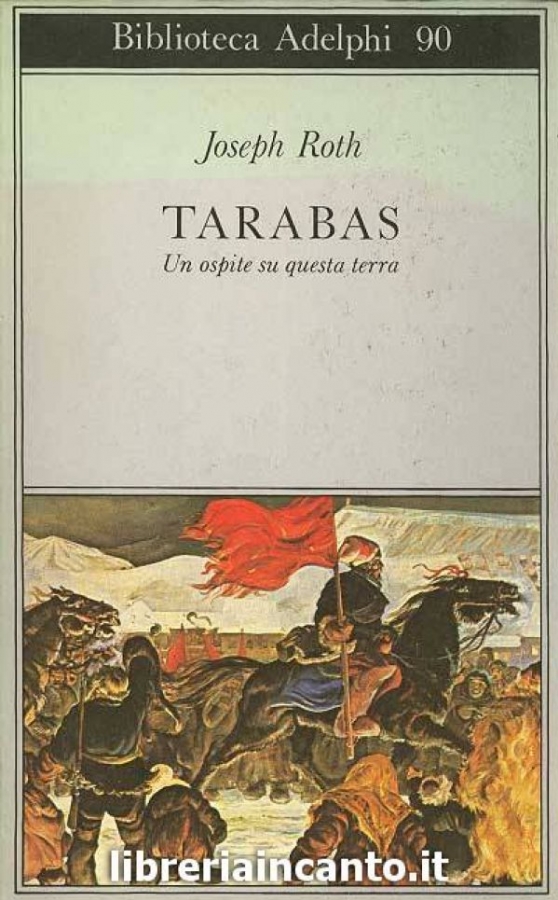
Tarabas
We find ourselves in the eastern lands (Ukraine?) during the years of the First World War and the Russian Revolution. It is a period of violence and upheaval, yet the author also depicts these times with nostalgia, because vagabonds > can (still) live on the mercy of men. Although machines have begun, with punctual steel tread, their sinister march toward Eastern Europe, men still look kindly upon the misery of others . A communal spirit still prevails, but Tarabas, a brilliant and violent man, leads a life of his own, while the men of the eastern lands endure one in common. The novel unfolds in two parts, with a significant caesura marked by an anti-Jewish pogrom. In the first part, Tarabas, cast out by his family, lives in war, which is > his great, bloody homeland. He would arrive in peaceful regions, set villages ablaze, leave behind the ruins of towns large and small, weeping women, orphaned children, men beaten, hanged, and butchered . He cares nothing for history or the motives behind this endless war; what matters is continuing his soldierly existence. He is tasked with forming a regiment in the town of Koropta, home to a significant Jewish settlement. All fear him: the poor peasants, the Jews, and his own soldiers and officers, who > did not speak, they whispered. For in their midst, as on an island of silence, as though surrounded by a wall of mute and gleaming ice, sat the feared Colonel Tarabas alone at his table. He drank . And it is precisely during a massive drinking bout that, in a Jewish inn in the small town, the soldiers begin shooting at the courtyard wall, knocking down the plaster: the image of a Madonna emerges, which everyone believes to have been desecrated and hidden by the Jews. “They climbed down from the wagons, armed with whips and clubs,” and fell upon the Jews coming out of the synagogue, and precisely > in the dark solemnity of their long open caftans... the peasants believed they recognized the truly infernal origin of that people who fed on commerce, arson, robbery, and theft . A Jew hunt breaks out, which Tarabas’s men are unable to stop. It is the novel’s finest moment; the author renders in epic fashion, as if it were a phenomenon of nature, the murderous and senseless fury of the mob against the Jews. Perhaps the author shares Pascal’s view that the survival and the misery of the Jewish people “are equally necessary to prove the truth of Christ.” What occurred is ineluctable (“it was God’s will,” a Jewish man tells Tarabas), but it is also Tarabas’s fault, having drunk the night before and lingered too long in the barracks without keeping his soldiers in check. To this guilt he reacts in the only way a violent man knows: with further brutalities. One evening he comes across a poor Jew attempting to hide the sacred books of the Torah. In a fit of rage, Tarabas beats the man and rips out tufts of his red beard. It is an act of gratuitous brutality toward a wretched man. This marks rock bottom for Tarabas, who deep within his conscience has always sensed that he was a violent man, while simultaneously yearning for his childhood and harboring a desire to “flee from the present; backward into the past did the mighty Tarabas find refuge.” He resolves to abandon everything to atone, embarking on a kind of pilgrimage, a descent into destitution and solitude. His long wandering brings him back to Koropta to seek, somehow, forgiveness from the poor Jew. Only thus can he die in peace. Critics dwell on the figure of Tarabas as emblematic of a rootless man, “a guest on this earth,” as the novel’s subtitle puts it. I believe, rather, that the book pivots on a profoundly timely theme: how war can transform men, habituating them to cruelty and indifference—as though evil begat evil—in a descent into the underworld. What, after all, is the devastation of this small, harmless Jewish community if not an abandonment to evil, a release of the fury that ignorance and oppression suppress yet continually fuel? Tarabas’s atonement is ultimately a reaction against all this, a refusal to accept what appears ineluctable. The narrative style, essentially epic in character, transforms the tale into a legend; while highly effective in individual passages, it renders the overall narrative architecture fragile, leaving it, truth be told, frequently superficial and predictable. Why read it? It reads very smoothly, albeit with little emotional engagement.