Finished reading on: April 11, 2022
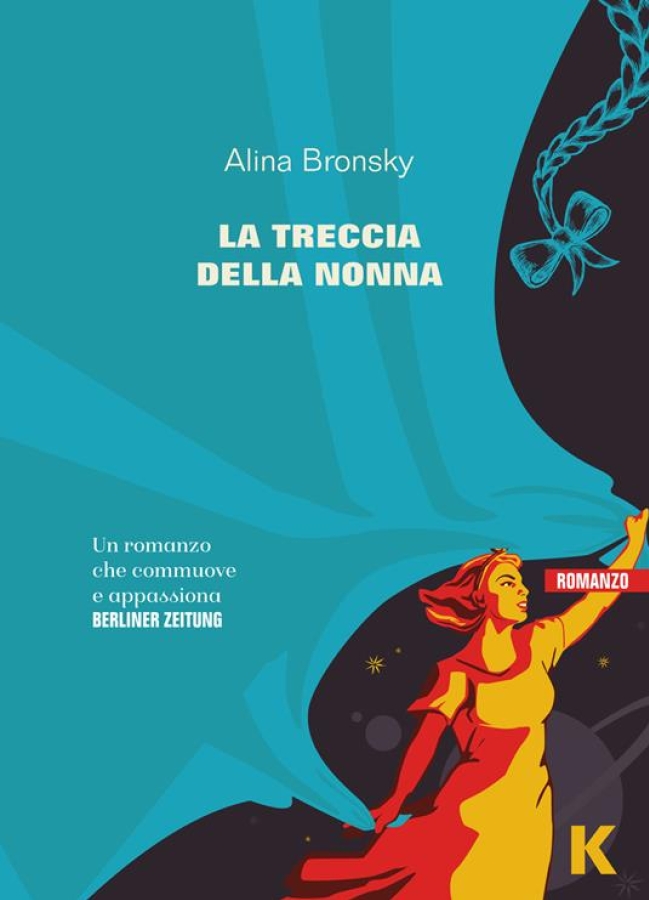
The Grandmother's Braid
Title of the original version reviewed: «La treccia della nonna»
AI Translation Notice: This review was translated from the original Italian using artificial intelligence. Book quotes and excerpts are translated interpretations and will not match the author's original English phrasing or official published translations.
The theme of this novel is closely akin to that of Domenico Starnone’s Vita mortale e immortale della bambina di Milano, recently reviewed on this site. Just as the Neapolitan writer’s narrative turns on the figure of the “servant grandmother” and her love—subsequently betrayed—for her grandson, here too a grandmother stands at the center of the story: a grandmother ready to place herself at the service of the young orphan—frail, sickly, somewhat dim-witted, and on that account a dead weight.
When we arrived in Germany, the first thing my grandmother did was take me to the pediatrician. In fact, she explained on the way, that was the real reason we had emigrated: so that a proper doctor could finally treat me, someone who might give us hope (...) that one day I would reach adulthood
. The grandson nests comfortably beneath his grandmother’s maternal wing, establishing an affectionate relationship steeped in an unmentionable eroticism. And for this reason, it is the boy, still a child, who is the first to notice that the grandfather, the “handsome Asian,” has fallen in love with another woman. The novel opens with this discovery.
To me he was already an old codger (...) and his new, tender secret swept over me in a wave of admiration mixed with gloating
, thus writes the boy, who serves as narrator and protagonist alongside the grandmother. If the story had explored the complex, perhaps incestuous relationship between an overbearing mother figure (authoritarian, intrusive, and overpowering) and a personality that could mature only through emancipation, the novel would undoubtedly have been intriguing and well worth reading. Instead, the author focuses on the figure of the grandmother to the point of turning her into a caricature. Confined to her matriarchal role, once she realizes her husband's infidelity, the woman does not fly into a rage, does not throw him out, nor does she even seem to suffer: everything is permitted to the “handsome Asian”—it is simply his nature. She goes further still. She takes charge of the child born of the man’s affair with a young woman; she takes in the young woman herself when she sinks into severe depression; she opens a dance studio and takes over the management of her husband’s company upon his death. It is all too much to remain plausible. Confronted with such excess, the grandson’s emancipation takes the form of betrayal. The boy cuts off his grandmother’s magnificent braid.
Wrap it in newspaper. Keep it as a keepsake. You’ll be leaving soon. I can smell traitors a kilometer away upwind. (...) She brought her face so close to mine that I could make out my reflection in her pupils. I can see it, she repeated vehemently, and pushed me away
.
Despite being well-written, fluid, and effortless, charming and witty (one need only think of the grandson’s embarrassment over his grandmother’s presence at school), the novel is insignificant. The author, for instance, fails to delve into the question of language: the grandmother who continues speaking Russian despite living in Germany, and the grandson whose emancipation is achieved partly through the acquisition of German—a fascinating theme of identity addressed by Starnone in the aforementioned novel, as well as by other authors: Jhumpa Lahiri’s The Namesake and NoViolet Bulawayo’s splendid We Need New Names come to mind (two books reviewed on this site). Here, by contrast, the social, political, and anthropological implications of language are developed in a superficial and trite manner.
Why not read it? Insignificant.