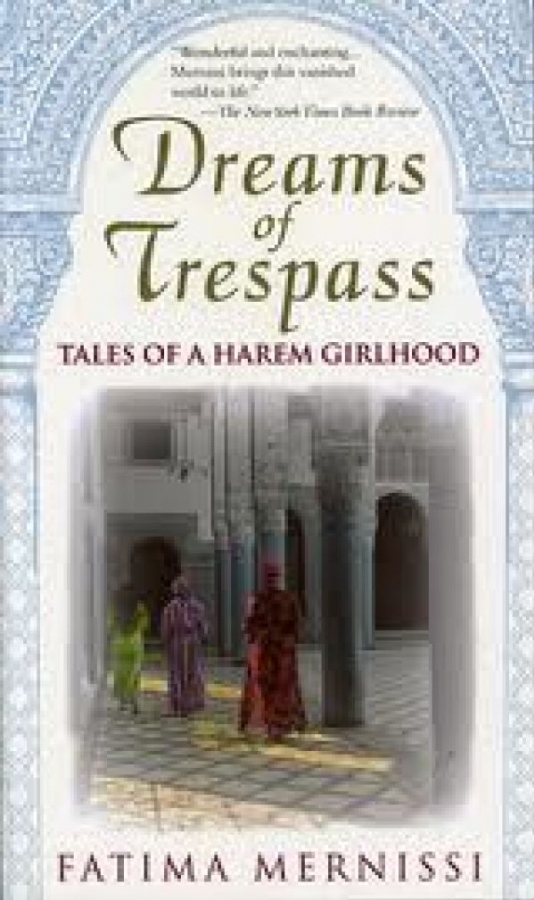
Finished reading on: November 09, 2012
The Forbidden Terrace
Title of the original version reviewed: «La terrazza proibita»
AI Translation Notice: This review was translated from the original Italian using artificial intelligence. Book quotes and excerpts are translated interpretations and will not match the author's original English phrasing or official published translations.
As the author explains, there are two types of harems.
Imperial harems are the ones best known to us Westerners: lascivious and indolent women, guarded by eunuchs, and ever-ready to satisfy their master’s desires.
Domestic harems, on the other hand, are extended families in which women are confined within a physical boundary (generally the walls of a palace or townhouse when living in the city) or a virtual barrier in the countryside, where a woman could theoretically go outside but is prevented from doing so by social codes and customs.
This novel concerns the domestic harem.
We are in Fez, Morocco, during the 1940s, probably during the Second World War.
The novel chronicles the author’s childhood within the extended family of her father and uncle. In several chapters, the narrative shifts to the countryside, to the sprawling house of her maternal grandfather—a polygamist, unlike the paternal household, which comprises solely monogamous couples.
Three narrative threads can be identified in the book.
The first, and most compelling, is the story of a young girl coming of age.
The recited—never read—tales of the house’s many women, the discovery of the grand palace, the taste for the forbidden, and the play and solidarity among cousins fill Fatema’s life with joy and wonder.
Fascinated by the adult women, their vitality, and their dreams, the young girl yearns for freedom, more out of affinity than a sense of deprivation.
Indeed, she confesses
my childhood was happy because the boundaries were of a crystalline clarity
.
Looking for frontiers became my life’s occupation....
everything seems easy looking at you (women of the harem).....
fragile, you, in the dead of night, on the distant terrace, yet so full of life, nurturers and guardians of wonders.
I will become a magician.
I will chisel words that give body to dreams, that will render borders vain
.
This wondrous childhood comes to an abrupt halt at the age of nine, when her cousin Samir, her peer and partner in games and mischief, confronts her with a choice: play with him or devote herself to making herself pretty.
Still a child, Fatema chooses the latter path and breaks off her friendship with her cousin.
The second narrative thread addresses the condition of women, deprived of freedom within the harem.
Enclosed within the palace walls, even nature is replaced by
geometric and floral designs reproduced on the tiles...
all the windows opened onto the courtyard
.
This physical deprivation becomes an existential sorrow, which only dreaming makes it possible to combat:
oh, yes, I would tell them of the impossible of a new Arab world, where men and women, locked in an embrace, dance away, with no more borders between them, nor fears...
trust is the new game to learn.....
they move forward, putting one foot in front of the other, their eyes fixed on the new, almost unimaginable horizon, unknown yet devoid of menace
.
For the intellectual Mernissi, the harem was a reality lived as a child, but it is also a metaphor for all the barriers erected against the potential of women—and of men.
The third strand is sociological rather than narrative.
The author describes harem life and, along with it, the customs of traditional Moroccan society.
It is a particularly interesting aspect for Western readers.
Indeed, what emerges is a North African and Muslim society previously unknown to us: culturally rich, tolerant, and open to changing customs and values.
These are three narrative threads, yet the most spontaneous—Fatema’s childhood—is stifled by the other two, in which the adult woman takes over.
Is it plausible that such a young girl could perceive the unease and yearning for freedom of the harem women with such philosophical clarity? Or is it Mernissi rereading the characters and events of the harem through the lens of her consciousness as an adult, intellectual, and politically engaged woman? Furthermore, the narrative thread tied to the condition of women is itself weighed down by the book’s obvious intention to document the harem and the Moroccan world: an undertaking in which the sociologist overshadows the creative writer.
The layering of themes, the digressions on female emancipation, and the primacy given to social inquiry render the narrative verbose and redundant, stripping away the freshness and naivety that occasionally shimmer through the experiences of the young Fatema.
The author fails to let political and social themes organically emerge from the novel—and thus from imaginative storytelling—relying all too often on the prose style and framing typical of an essay.
Why read it? It is deeply interesting as an insight into the Muslim world.
In certain passages, a strong poetic resonance makes itself felt.